
"Prediction is very difficult, especially if it's about the future." -Niels Bohr
What's going to happen next? It's perhaps the most important thing to know if we want to be prepared for practically anything in our lives. And without even thinking about it, most of us are actually very good at this in a huge number of aspects of our lives. For example...

Image credit: Crazy Adventures in Parenting.
I was hungry at work today, and I was prepared for it. Somehow, I knew that I was going to need food throughout the course of the day, and so I was prepared for it by bringing food from home. This is an incredibly mundane prediction, but think about it for a moment: how did I know I was going to be hungry?
In my case, it's because I've been in this situation before: thousands upon thousands of times before, in fact. Every day when I wake up, I get hungry after a certain amount of time. Perhaps today would have been different; perhaps it would have been the first time in many years where I simply wasn't hungry during the day. But I was so certain I would get hungry that I didn't even stop to consider the possibility that I wouldn't; I know from my own past experience that I'd get hungry, and therefore I planned accordingly.

Image credit: Johnny Nichols, 2008.
This is a fabulous example of a pre-scientific prediction! I've taken information from very, very similar situations that I've experienced before, I know -- looking back -- how those previous situations turned out, and so I can infer how this current situation is likely to turn out. This is something we do all the time in our lives, and something we've done frequently throughout history. The phrase Red Sky at Night, Sailor's Delight didn't come about because we understood the science behind the next day's weather and the properties of the atmosphere the night before, it came about because when we observed phenomenon A (the red sky at night), it was very often followed by phenomenon B (good sailing weather the next day).
We use this all the time in our lives: it's why we have confidence that the next untested apple we eat will be delicious and not poisonous (even though the occasional apple is poisonous), that our house hasn't burned down when we go to the store (although sometimes houses do burn down when you're at the store), and that the store you're going to will have apples to sell you when you go (even though they're sometimes out of apples).

Image credit: screenshot from weather.com (L) and the Old Farmers' Almanac (R).
Sometimes, this type of pre-scientific prediction is the best we can do. If we can make this into a truly scientific prediction, we stand to do much better, but it's a much more difficult task. A truly scientific prediction requires the following three things:
- that the scientific theory that governs your phenomenon is completely understood,
- the conditions that will affect the possible outcome(s) are known and understood in their entirety, and
- that you have enough computing power to figure out what the outcome is going to be.
In addition, because measurements are imperfect (and sometimes physical laws aren't 100% predictive), you are also going to have a quantifiable uncertainty associated with your scientific prediction.
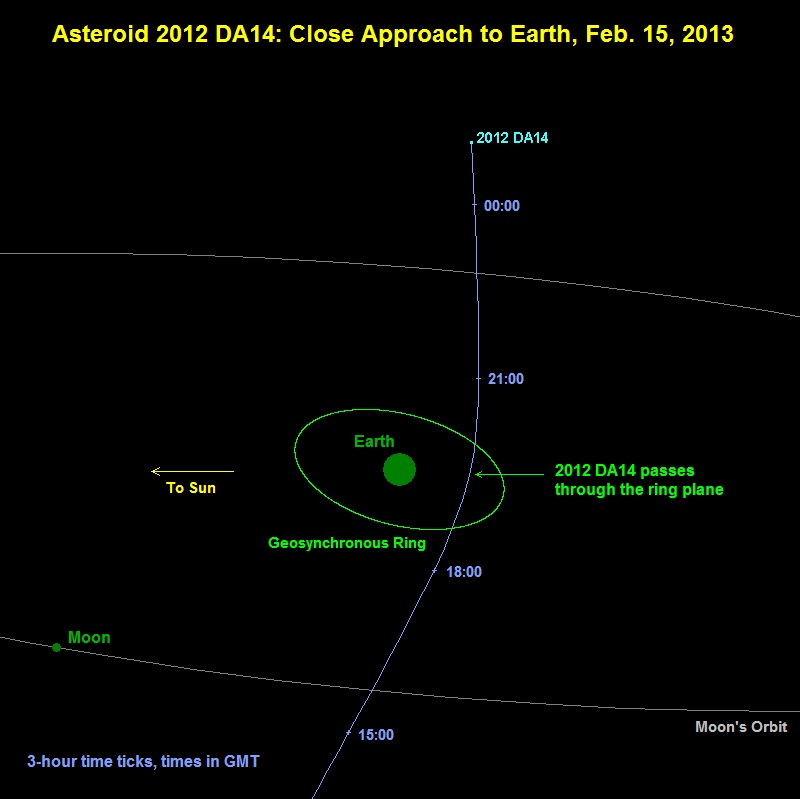
Image credit: NASA / Paul Chodas, Jon Giorgini & Don Yeomans / JPL NEO Program Office.
For some physical systems, the uncertainties can be so small that a prediction will be incredibly powerful; we know that on February 15th, 2013, a 45-meter wide asteroid will miss the Earth by only about 20,000 kilometers. Yet, the law of gravity is so well-known and the asteroid's properties and trajectory is so well known that we can state with great confidence that there is absolutely a 0% chance that this asteroid will hit the Earth.
In other cases -- like meteorology -- the uncertainties are very large. It's why we can't predict with very much certainty whether Hurricane Sandy will wind up striking New York with strong winds, weak winds, or not at all.

Image credit: NOAA's information about wind speed probabilities as of 10/26/2012.
We can speak intelligently about what the outcome will be in terms of probabilities and uncertainties, but this also requires a few things that are far from given:
- Scientists who can communicate these results clearly and effectively,
- A media / government that can understand that information, make reasonable and effective policies based on that information, and communicate these results to the populace, and
- A populace that's scientifically literate enough to understand what's communicated to them and act in accordance with those recommendations.
This ought to be one of the main goals of science, as it's one of the most important services that science can perform for a society. Sometimes statistically unlikely things happen, sometimes we're unprepared for a disaster when it does happen, sometimes what seemed like a reasonable policy turns out to be ineffective, and sometimes people simply don't listen. Unfortunately, when the wrong combinations of those things happen, people wind up dead.

Image credit: collapsed houses in the Village of Onna, Italy, photo by REUTERS/Max Rossi.
In 2009, the L'Aquila earthquake was an unfortunate example of just such a breakdown: scientists correctly assessed the situation, which they then communicated to a civil protection official who issued the following statement:
The scientific community tells us there is no danger, because there is an ongoing discharge of energy. The situation looks favourable.
Which, of course, is not what the scientists said at all. The scientists reached the conclusion that the observed tremors could not help predict whether there would be a major quake, information that they never communicated to the general public.
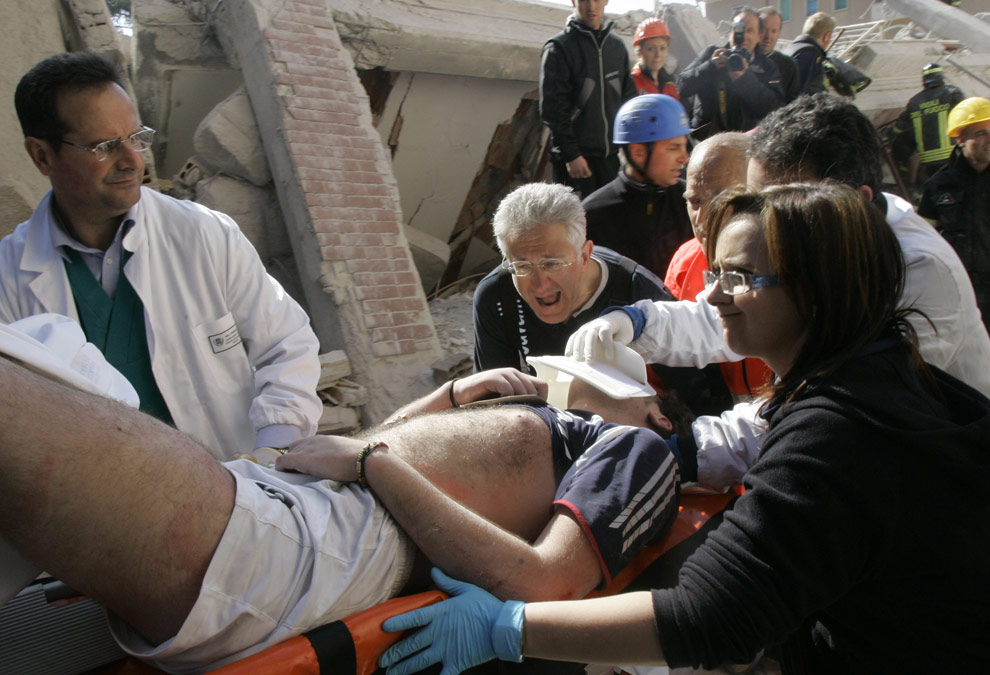
Image credit: AP Photo / Pier Paolo Cito.
Because of the quake, 309 people were killed. It truly was a scene of horror, with tragic results. Unfortunately, this is what often happens when there's a natural disaster.
Was it a poor job of science communication? Yes, on the part of the scientists, and in particular on the part of the civil protection official, Bernardo De Bernardinis, who added that citizens should go have a glass of wine. But realistically, recommending evacuation based on what was observed would have been absurd; some natural phenomena are simply presently beyond the reach of science.
In other words, neither the occurrence nor the severity of this disaster could have been predicted. Which is why the following is all the more absurd.
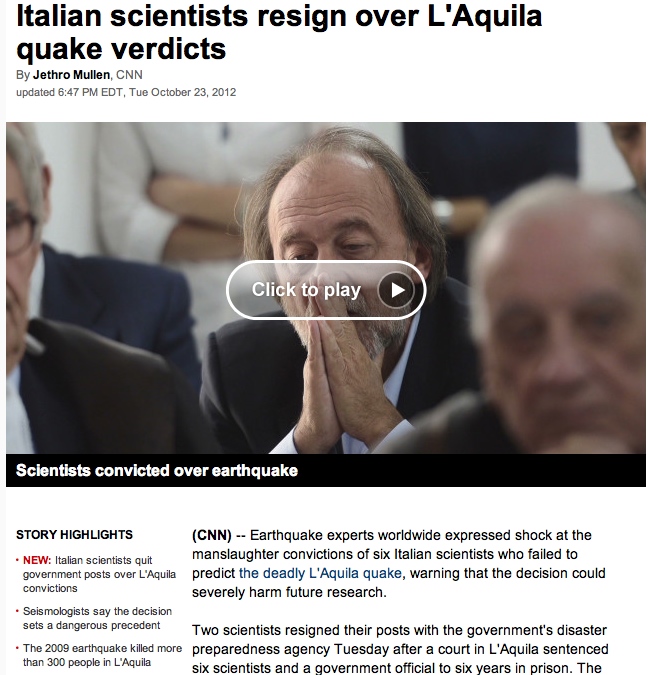
Image credit: CNN.com.
The government official (De Bernardinis) as well as six Italian Seismologists were sentenced for manslaughter in connection with the L'Aquila earthquake. Now, Italian justice may be as phantasmal as an American kangaroo, but this is just absurd. It's science's job to use we know to predict -- to the best of science's abilities -- what's going to happen next, along with probabilities and uncertainties. These scientists did their job, and they did their job adequately well, if not spectacularly.
You do the world a disservice when you scapegoat scientists for a disaster they could not predict and an incompetent government official they could not control. We now live in a world where we jail scientists for failing to clean up the government's miscommunication about a disaster they could not predict, while we simultaneously accuse them of fear-mongering for the impending disasters that good science does predict.
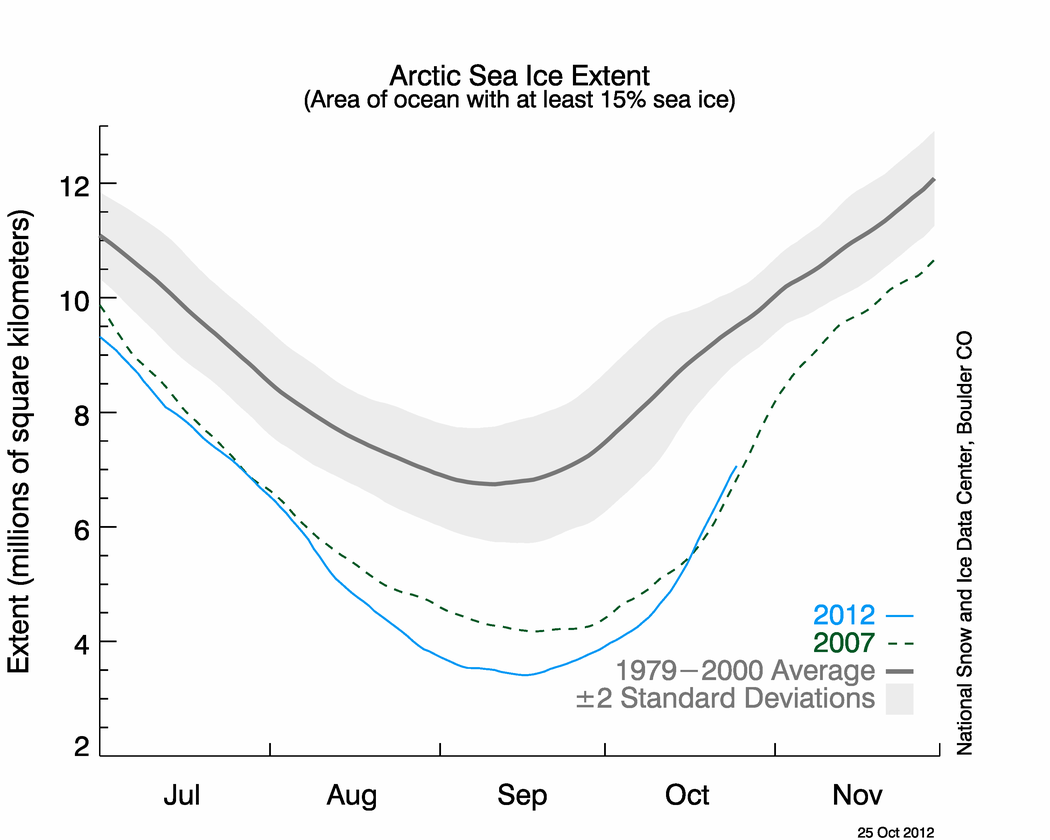
Image credit: National Snow and Ice Data Center.
If you want to know what's going to happen in the future with any sort of accuracy, you need science. It's the only thing that's ever worked, and the more we do it, the better we get at it. This means we need to make the world safe for scientists to do science, we need to treat the science being done with the respect it deserves, and we need to improve and encourage communication between scientists and the public.
Remember, somewhere, right now, a scientist is hard at work trying to understand how some part of this Universe works for the sole purpose of trying to protect you from what are otherwise completely unpredictable natural disasters.

Image credit: http://murninghanpost.com/; a collage of disasters.
I'll be following very closely the aftermath of the L'Aquila Earthquake and the associated trial, and hoping that the world chooses to value the one defense it has against the wrath of a complex Universe: science.
Science gets into trouble the minute they actually go beyond the 'science' per sey and delve into the public arena. i'm around these guy and gals everyday, believe me, for the most part, the smartest of the bunch are no where near capable of communicating effectively, present blogger excepted---ethan is one of the best i've seen online or anywhere, I commend you sir. but getting back to what i was trying to say, i think scientists, for the most part, should stick to making observations and determining this or that based on the data they see (to put it simply), they should not be walked out to brief a sometimes scared public about the what they have interpreted. brief your public officials, thats what they are supposed to do, if they can't do it then vote them out of office and demand accountability or communication skills from the new guy/gal. its when scientists turn into some sort of advocacy for a certain subject that gets me riled up. again, make your observations, make determinations based on your observations, and generally shut the **** up after that. just my 2 cents.
You might want to read to Wiki-page on this disaster, and than you get to know some interesting facts about history, predicting, and realizing that those convicted scientists were no good, perhaps nice people, yes, but not good scientists.
http://en.wikipedia.org/wiki/2009_L'Aquila_earthquake
If they had any common sense, they would have warned the people but no, nobody wants to 'scare' the public.
... same goes for the LHC, a 100 000 times hotter than the heart of the Sun, and a frequency & density that is 10^9 higher than cosmic ray collisions in Nature, ... but no it's all safe.
The most sad fact of this case and for Science, was that a little guy had to withdraw his conclusions due to peer pressure. Just like for the LHC, I don't see anyone getting a paper published on it due to the same peer pressure. Can you imagine one person saying that this large experiment isn't safe jeopardizing this whole project, because of a wild guess. I don't see him or her getting a chance to make a career in particle physics ever.
This disaster is a very clear case of how scientists turn their heads away because of peer pressure, and very sad they for science in general.
Hi Ethan,
thank you for the post, I was hoping for you to write about this episode. Orac of Respectful Insolence also wrote a good post (http://scienceblogs.com/insolence/2012/10/24/criminalizing-scientific-m…), go read it if you haven't.
I want just to add some context to the inaccurate statements by De Bernardinis: he did sound too reassuring, but you must understand what happened in the weeks before the quake. When De Bernardinis talked about "no danger ", he added "I said it to the mayor of Sulmona"; he was reassuring the people of Sulmona, a city 25 miles from L'Aquila. Why Sulmona? Because in those weeks a crackpot of the I-can-predict-earthquakes variety was writing on the web and going around Sulmona with loudspeakers, announcing that a strong earthquake was going to happen in Sulmona the next day (the earthquake in L'Aquila occurred a week later); this played a part in motivating the Commission to try and calm down the panicked population.
In that interview, De Bernardinis encouraged to stay attentive but not ansious, and the wine quip was prompted by a journalist remark, "Meanwhile we drink a glass of wine", to which the answer "Absolutely, a Montepulciano".
P.S.: "to use we know to predict" should be "to use what we know to predict".
Who would want to be a seismologist in Italy now? Anti-science has sure done its job this time. The idea of sentencing scientists with manslaughter for an earthquake is just the sort of thing that'll throw us back into the dark ages. Nice article!
Atom,
"Because in those weeks a crackpot of the I-can-predict-earthquakes variety was writing on the web …"
He was not just some kind of crackpot:
Giampaolo Giuliani
From 1971 to 1984 he was technical research in astrophysics at the Observatory of Campo Imperatore, employee IAS (Institute of Astrophysics Frascati), from 1984 to 1990 to ' Astronomical Observatory of Campo Imperatore ( AQ ).
He worked at the National Laboratories of Gran Sasso of 'National Institute of Nuclear Physics (INFN) as a non-graduate technical assistant of the Institute of Physics of Interplanetary Space of Turin , one of the twenty structures of ' National Institute for Astrophysics (INAF ) . He participated in the first experiment EAS-TOP and then experiment Large Volume Detector (LVD) for the detection of neutrinos produced by stellar gravitational collapse . He is now retired.
http://it.wikipedia.org/wiki/Giampaolo_Giuliani
… and the real reason why he had to shut up:
http://thelede.blogs.nytimes.com/2009/04/06/earthquake-warning-was-remo…
According to the expert, incorrect prediction “can be even more damaging that a real earthquake” because of the panic this can create and the effect it can have on the economy and property values in the area.
Those people didn't care about real safety, they only cared for their own property values and their job. It's good that they are in jail now.
"i think scientists, for the most part, should stick to making observations and determining this or that based on the data they see"
They do.
You're suffering from observation bias. You don't hear about the scientists who don't speak a lot in public, do you.
Ergo, all the ones you know are either personal aquiaintances or ones on the telly.
"its when scientists turn into some sort of advocacy for a certain subject that gets me riled up."
So scientists aren't allowed to be a human and to advocate for subjects like you can? Why?
No, the problem is that some scientists advocate things you don't like to hear. This is just a way of saying "Don't tell me things I don't want to hear".
"Italian laboratory technician Giampaolo Giuliani predicted a major earthquake on Italian television a month before"
And there are thousands of people proclaiming the end of the world is nigh. One day they'll be right.
But it won't be because they knew something others ignored.
The evidence was not evidence that an earthquake was imminent. pre-shocks and radon release happen and then no earthquake happens.
This "prediction" did not give a date or even a range of dates. It was little more than "This earthquake prone area is going to have an earthquake soon".
Then again, when a scientist predicted the tsunami that hit Thailand, he was prosecuted for harming the tourist industry and the economic welfare of the country.
And look at AGW.
Even conservative and restrained talk of the danger gets the scientists labelled "alarmist".
"“Because in those weeks a crackpot of the I-can-predict-earthquakes variety was writing on the web …”
He was not just some kind of crackpot:"
Ooooh, bad move. Quote all of his statement, chelle, dear:
"Because in those weeks a crackpot of the I-can-predict-earthquakes variety was writing on the web and going around Sulmona with loudspeakers, announcing that a strong earthquake was going to happen in Sulmona the next day"
Prediction:
Location: Sulmona. wrong.
Date: next day. wrong.
Unless your crackpot and his crackpot were different people.
Wow,
Well he wasn't the guy who drove around with the loudspeakers, he gave a phone call to the mayor of Sulmona, who organised it, and according to Giuliani he warned him for a regular quake at that time.
So some people are now trying to blame this honest guy who was cautious and made the measurements to cover up their own ignorance, that's sick.
"and according to Giuliani he warned him for a regular quake at that time."
Not according to the Mayor in question.
And still he had the location AND time incorrect.
Not much of a prediction.
Ha ha, you are going to trust a politician on his word, lol
Are you going to trust a scientist on his? Lol!
Wow,
"Are you going to trust a scientist on his? Lol!"
Haha, so true :mrgreen:
Yes I have at times found myself standing in RAIN where and when there was suppose to be SUNSHINE.
Whether YOU blame it on the WEATHER, the WEATHER CHANNEL, the WEATHER MAN, the SCIENTISTS, some UNAUTHORIZED CLIMATE EXPERIMENT, the POLITICIANS, , the SINS OF PEOPLE, YOURSELF or... tells a lot about YOU.
I personally blame the earthquake in Italy on the increasing number of tourists in Italy; all those people have shifted the tectonic plates ever so slightly and well they just all snore at the same time in the middle of the night (1:05 a.m. local time) and disaster is the result. It could happen anywhere. Look at the statistics.
"Haha, so true"
So you admit that your defense of Guiliani is incorrect! Well done for recognising your error :-)
Wow,
The sad thing is that many people trusted those scientist and died, that's why they have to go to jail. Guiliani is not to blame, he was on close on target.
No, those people trusted the builders of the homes.
The scientists didn't cause the problem.
Guilliani was wrong in his prediction.
So were the other scientists.
But they go to jail because people are arrogant assholes and want retribution.
chelle, here's an idea for you, dear.
Reat the bloody article before posting on it.
If nothing else, the unaccustomed exercise of your brain will be a pleasant change for you :-)
Balderdash! Michael Mann's computer models quite confidently predict the Earth's temperature fifty years from now, and under a variety of assumptions about our carbon dioxide emissions no less. Right? Of course I'm right. Environmental extremists routinely predict the future catastrophes if their agenda is not enacted, and the EPA would not be framing its regulatory agenda around these predictions if there was any uncertainty in their reliability. Right again? Of course I'm right again. The central point of this article is so much balderdash.
Wow,
Nope, the day of the disaster Giuliani predicted it correctly.
And damn right people want retribution, if those scientist had acted properly, than people would have gotten out of their houses; but no, instead they laughed all dangers away. And the way the Science community is now acting towards Giuliani is pure arrogance, people like 'Atom' want to picture him as the 'crackpot' that was the cause of it all, while he was correct. Scientists all over the world should be ashamed for how these scientists in Italy acted; instead of speaking of an anti-science plot, and picturing those Italians that lost family and friends as idiots, this is just sad.
The same goes for the LHC where you have temperatures that are 100.000 times hotter than the heart of the Sun, and a frequency & density level that is 1.000.000.000 higher than Cosmic ray collisions in nature, … everybody with some sense knows that this is a tricky experiment, but all safety arguments are laughed away. Well good luck!
"the day of the disaster Giuliani predicted it correctly"
Nope, he predicted a week early.
" if those scientist had acted properly"
They had.
"people like ‘Atom’ want to picture him as the ‘crackpot’ that was the cause of it all,"
Jeez, what a retard you are. No, atom pictures him as a crackpot NOT the cause of it all.
Then again, you're a crackpot yourself, so your love for him is expected :-)
"quite confidently predict the Earth’s temperature fifty years from now, and under a variety of assumptions about our carbon dioxide emissions no less. Right?"
Right. Though you neglect to say that there is also an error bar on it.
"Right again? Of course I’m right again."
Yup, right again, though to neglect to mention that Hansen's model results published in 1988 were within a whisker of the right value for sensitvity to CO2: he got 3.4 when a value of 3.2 C per doubling of CO2 would have been spot on.
And, dear, please don't post yet more crap about the "danger" of LHC. That shite belongs on the quackery thread for quackers tinpot theories like yours.
Pissing about on other threads until you can "slip in" a load of codswallop is still forbidden.
Unless you don't like to do what the owner of the blog wants... despite all your proclamations that you're a good little girl :-P
I think at least part of the problem was the government took the opportunity to use the 6 scientist and the govt spokesman as scapegoats for their lack of planning and investment. The town is in a known active earthquake area with a long history of serious earthquakes, yet there seems to have been no effort to reinforce at-risk buildings or enforce earthquake-proof building codes.
Wow = Idiot
chelle, you're a crackpot in love with crackpots.
They're the only ones that will put up with your tantrums :-P
Wow,
You didn't read the article but yet you keep on trashing the guy. What's the use.
You certainly love that kook!
So now you're saying he could have given a couple hours warning.
After being doubly wrong before, what do you think would have been done in those few hours?
Nothing.
a) they wouldn't have believed him because of his numerous failures before
b) they would need far more than a few hours to do anything about it
But you still gun for those other scientists.
Because you hate them :-^
Wow,
As usual you are twisting everything around when you are wrong.
… and here is an other of you nonsensical comments, because you don't read what others post, yet you keep on insulting others. You're no better than those criminal Italian scientist who waved everything away with a stupid joke.
This was in the article he linked to:
No, as usual, I'm ensuring that you don't give only the information you want purveyed, chelle, dear (though it seems your hubby has taken over duty at the moment :-D)
I guess you don't like scientists unless "scientism" has dumped on them in your opinion, then there is rectal illumination for all! lol!
"This was in the article he linked to:
“To me, this is a perfect storm. There was a crank stirring up panic, and the best scientific information available suggested that the risk of a major quake was low …”"
Yup! I can read. Can you ;-)
Doesn't say anything about the quake being the crank's fault. Nor the arrest of the other scientists being his fault. In fact, it only appears to claim about the crank's fault for being a crank.
Which is rather tautological :-D
Wow,
"though it seems your hubby has taken over duty at the moment"
Nope. It seems that paranoia is taking over again in that beautiful mind of yours. Take care.
“Prediction is very difficult, especially if it’s about the future.” -Niels Bohr
I've heard something very like that attributed to Yogi Berra?
Paranoia? YOU talk of paranoia? My goodness. Well, thanks for the belly laugh before bed! ROFLMAO!
Wow,
I know for a fact that you are paranoid, because I am not a couple, nor have I ever used a sockpuppet name here, both are delusions of yours. You have developed some kind of obsession about people being anti-science.
Sure I do question the fact if making the most intense fire in our Milky Way couldn't combust surrounding matter, but I don't do this because I believe people want to do this on purpose to cause harm, but due to genuine ignorance that pops up on a regular basis (perfect storm). Just like the ignorance of those Italian scientists that was the cause of people losing their loved ones. They laughed all troubles away just like how you laugh the issues about your mental health away. Anyway, you are just an idiot; but they had a serious responsibility and they failed badly.
Chelle, stop with LHC and combustion already, or take it to the post, you know which. Do we have to play this game every time Ethan post's something. Go sit in the van with speakers and drive around your home town, or whatever. Just stop writting about it here once and for all!
SL,
"Go sit in the van with speakers and drive around your home town"
You just didn't get it, now did you? Giuliani didn't drove around with speakers, he made a phone call to the mayor of that other town who organized this. He is not the crank that people want to make of him. Show some respect for this guy, who was actually making measurements, stop being so ignorant.
You just won't shut the fuck up aboult LHC and when called on it, segue ito something COMPLETELY DIFFERENT in the hope that it would be forgotten.
You're just a tired sadsack troll whining on about "the establishmen" wot have got it in for ya.
Fuck right off.
Chelle
Some time ago on another post you made a comment claiming a frog thrown into a pan of hot water would jump out, but one in a pan of slowly heated hot water would not notice it was cooking until it was too late. I told you this was apocryphal and straight from the plot of Dante's Peak, which you said you had never seen. You really should watch it. In fact, swap volcano for earthquake, and apart from the dastardly scientist getting his comeuppance at the hands of the natural disaster he denied was going to happen instead of at the hands of the legal system, you could have written the plot.
But congratulations are due you for staying completely on post for once, and illustrating Ethan's point perfectly. You approach everything thinking in a way that has been totally appropriate through most of human evolution. In an environment where everybody is almost 100% ignorant of how the world really works, all you have to go on is trust in the individuals deemed to be the wisest. Even if they claimed sacrificing your youngest child to the gods of the ground was the only way to stop the earth shaking again and yet it still shook, they could then claim it would have shook even more were it not for your sacrifice. Because without science you have no idea of what would have happened without that sacrifice, so you can only ever look at one side of the equation.
There is always a cost (in the broadest sense) and benefit to any course of action, and humanity as a whole is more and more in a position to measure those. There will always be room to argue how much chalk is equivalent to a pound of cheese, but this must be done on the basis of evidence. Scientists and especially those they advise have to use their judgement. If people live in an area prone to earthquakes, how much does the probability of an earthquake have to increase before they are evacuated? Because whether you like it or not, there is a cost to that evacuation. And it’s not just financial. If you evacuate a town every time a crank predicts its destruction, then once a there is real evidence of an earthquake, the people may well say, "oh no not again”, and will stay where they are die. Whose fault would that be? Would you expect the cranks to be prosecuted after the event in such a case? If so can I suggest you put Dr Andrew Wakefield at the top of your hit list. He has been responsible for the killing and maiming more children over the last decade than all but the worst of oppressive regimes.
David L,
Stop bringing up this nonsense.
The one thing these scientist had to do was give a good assessment of the situation, and they did a very poor job doing so; and because they downplayed the risk people got killed.
Look at the storm that is nearing the East coast of the US, scientists aren't saying to sit back relax and drink a glass of wine; no, people are serious about this and saying to be on guard
Those Italian scientist should have took their job more seriously that is all. Also read the first comment on this blog by 'copernicus34' that says it all:
"The one thing these scientist had to do was give a good assessment of the situation"
And they did.
Still not reading the flaming article, I see, chelle, dear.
PS I note your hubby has stopped posting again, little c. :-D
Wow,
Paranoid freak. I post from multiple devices, and pay no attention to what the cache settings are on each one. Just as a test I've now filled out my name with capitals, sigh.
"Stop bringing up this nonsense."
No Chelle it is not nonsense. What you seem to be incapable of recognising is it is perfectly possible for the scientists to say the risk of an earthquake is not significant enought to advise evacuation, and still be correct even if the earthquake subsequently occurs.
Yes, chelle, you ARE a freak and frequently paranoid.
This is pointed out to you in the hope that recognising your problem will help you find psychiatric help.
I only want the best for you, you know that :-)
Wow,
I have no mental issues. In contrast one has to only scroll up a little and check what type of Jekyll & Hyde personality you have:
Why all the hate for someone who just wants you to get better, chelle?
Feeling oppressed are we? :-)
Well, it's a shame that these scientists are being jailed for a natural disaster. Even if the scientists had given the facts for the likelihood of an earthquake of the magnitude that had followed, the majority would have remained within L'Aquila due to the low probability of it actually taking place. Science is not perfection and the combination of some politician's remarks and hindsight does not always help uncover the facts. It's understandable for these people to want retribution, but the Italian courts using these scientists as scapegoats does not bring about justice.
Unfortunately some like Chelle will always blame them, and will refute any amount evidence that may say otherwise, so there is no point in engaging people like that in this type of conversation.
Interestingly, with Sandy about to hit NYC right now, the local news is filled with coverage. They were just interviewing a lady who is disobeying mandatory evacuation orders, because she evacuated for Irene last year, and it wasn't that bad.
THAT is the problem with giving evacuation orders for 2% events. The Italian court is clearly wrong.
Rawr,
Look this is what Ethan said himself:
And these people were responsible for good communication, that was their job, and they failed. It was not about organising evacuations, it was about giving a clear assessment. If it wasn't for these scientist people would have been more cautious.
Science should learn an important lesson here, but clearly some don't want to realise that a deadly mistake was made. And some even want to blame someone who was warning people about the situation. Grow up and take responsibility for your own wrongdoings, it is not all kids play.
"THAT is the problem with giving evacuation orders for 2% events."
Too true.
Technically not all American kangaroos are phantoms. There is a resident population of feral Rock Wallabies on the island of Oahu in Hawaii...a product of an accidental escape in the 50's. Estimated to number 100 individuals, sightings are rare but consistent. Since Hawaii is part of the United States and wallabies are technically Kangaroos (or the other way around)...I'd say American Kangaroos aren't always phantoms.
Chelle you have a knack of quote mining the one phrase which supports (or rather the one which you chose to interpret as supporting) your stance, whilst ignoring everything else. You quote Ethan on “Was it a poor job of science communication?", but in his next sentence he says "But realistically, recommending evacuation based on what was observed would have been absurd;" So what exactly was the "deadly mistake"? The only lesson I can see is "don't be a scientist in Italy"
What would be your criteria for ordering an evacuation if you were the Chief Geologist for the San Fransisco Bay area? It seems to me your strategy would be "Look for a crank who agrees with me and ask his advice. Because if there is the slightest chance of a earthquake, one of the world's greatest centres of technological innovation has to grind to a halt"
chelle also HATES people quotemining her.
REALLY detests it.
Probably doesn't like the competition and since she has little intelligence to find another way of arguing her "point" feels put-upon when people do to her as she does to others.
Poor ickle babby... :-)
DavidL,
According to Wiki it was not about 'ordering an evacuation', but:
They were criticised in court for being "falsely reassuring"
http://en.wikipedia.org/wiki/2009_L'Aquila_earthquake#Prosecutions
Everybody in the Bay area, knows that one day a big shock can come, it is also the case in Japan. So I don't think that any scientists over there would say to sit back and relax when you just had two small earthquakes, but to be very cautious. And certainly no scientist will do so in the future after this verdict, that's why I find it a good thing. Perhaps the sentence is too much and should be reduced after one year, and they shouldn't pay for the damages ... but some people have lost family and friends forever, due their poor communication.
There is a lesson that every body could learn here, instead of accusing those judges, and claiming an attack on science. Here is an interesting article on the subject: http://world.time.com/2012/10/24/the-aquila-earthquake-verdict-where-th…
"According to Wiki it was not about ‘ordering an evacuation’, but:
They were criticised in court for being “falsely reassuring”"
Only in hindsight, which is 20:20 in every case.
Here we go again, chelle cheering on the nutbar crowd and cherry picking them quotes.
Ever heard of mens rea, chelle?
Judges should know of it.
When they ignore it, then they are open to criticism.
6 years of prison each!!! OMG!!! The worst criminals and gang members don't get that much sometimes. Absolutely appaling!
Chelle you are sidestepping the issue. "They may have been criticised by the court for being “falsely reassuring”", but the only people knowledgeable enough to make that judgement are the world's seismological experts, especially those with local knowledge, probably some of the six scientists involved.
In the real world there are no certainties. In this case, 40,000 people were made homeless. To keep it simple let's say that is 40% of those in the affected area, and the earthquake was expected in an area ten times larger, so 1 million people deemed at risk, of which about 300 died, so about a 3500:1 risk of dying. Lets add the chance of an earthquake being assessed at about 3% in the next 10 days and we are back to 1 in a million per person per day. Would that risk cause you to significantly change your behaviour if you had lived in the region? Is so, what risk would you ignore and advise others to do likewise? And how do you manage to live if you feel the need to always avoid a risk like that? (For comparison, it is about the same as the risk of dying on a seventy five minute commercial flight) It may even be safer to stay than risk driving out of the earthquake zone in the company of Italian drivers on Italian mountain roads!
DavidL,
I'm not sidestepping. Poor communication is what got people killed. You can argue as much as you want, it won't change the past and the mistake they made.
You can get a fine for not wearing your seatbelt. Well these guys said it was safe not to wear a seatbelt, they were stupid idiots.
Yes, you are sidestepping.
The scientists did what the evidence said was the best advice.
Jailing the scientists was revenge, not justice.
Wow,
"The scientists did what the evidence said was the best advice."
Are you insane, their advice was the worst, they could have given. Even Ethan said clearly:
"Was it a poor job of science communication? Yes
If you ever worked for a big company you know that they don't joke about safety, risk is never taken lighthearted, and this is what they did. These people who were responsible to communicate about the risks failed miserably. The evidence showed clearly to be on the look out, and not to sit back and relax.
Perhaps you simply don't understand what 'advice' means.
"their advice was the worst,"
Nope, it wasn't. It was a fair assessment of the EVIDENCE.
But we know you hate this evidence stuff.
"But the unreasonable person would shift the goalposts, bring up a new argument, point to some misinterpreted piece of evidence, etc., in some never-ending game of cat-and-mouse.
...
Because from here on out, you are no longer free to promote your own, personal, anti-scientific screed here. Not on this blog, not on any old posts, not on any new posts.
...
If you said your piece of mind and were properly informed, and you continue to plow ahead and promote your anti-scientific nonsense, you get one warning to take it to this page."
http://scienceblogs.com/startswithabang/2012/09/23/weekend-diversion-yo…
Chelle is confusing stupidity (bad judgment), mis-communimcation (bad advice), and slight negligence with criminal acts. You don't go to jail for those things. Do you get fired? Absolutely... but prison? It's borderline delusional to think that. If I leave a child in a hot car and that child dies is that negligence? Yes... is it criminal and should I go to jail for my stupidity? Absolutely not...
There's a great discussion over at Professor Matt Strassler's blog about all this. I think his take on it is right on.
http://profmattstrassler.com/2012/10/25/shock-foreshock-and-aftershock-…
Chelle, still you refuse to say exactly where they went wrong exactly what you would have done differently were you one of them. At what expected number of deaths per million people would you move the advice from "Carry on as normal" to "Sleep away from buildings", and at what level escalate to "Leave the area"? That is the judgement call the scientists had to make, and if you can't say where you would draw the lines, you are in no position to assess the judgement of others.
DavidL,
I would have said, to check your building, find a safe place to sleep cause there is a 2% chance that it a big quake might come. The same things that is being said in areas where there are hurricanes, every year.
--
Aquanerd,
The question is how high do you want to set standards. It makes me think of the Costa Concordia cruise ship disaster where 30 people died because the captain sailed too close to the cliffs. I had a discussion with my nephew who has been many years 1st on giant oil tankers, and who supported the captain because he's knows that from big ships sailing next to the coast you hardly get to see a thing; thus the captain probably sailed so close to please his passengers he explained to me, so they would get a nice view. He said that the captain only wanted to do good for is passengers, and he felt sorry for him, colleagues stick together. This drama is similar as the case with these scientists; they only wanted to do good for the people, and comfort them saying that nothing bad would happen. Well the great danger is wanting to please others, and if you don't set standards or penalties high enough people will always be attracted to lower safety standards, just to try to please others, that's the big problem; and it is probably why these scientists failed badly, and the cost of lives was so high. Wanting to do good sometimes does more bad than anything else.
Sure 6 years is far too high, but regarding their position and the lives that were lost, I believe that one year might be in order, just so everybody knows that the job of safety adviser should not be taken lightly, and you should stand above politics. And yes for the people that lose a kid out of their own stupidity, they are indeed already punished enough.
"I would have said, to check your building, find a safe place to sleep cause there is a 2% chance that it a big quake might come"
Which is why the buildings should have been better built. But that's Big Business.
And moreover, that would lead to no evacuation still. So even you would be facing charges of murder under your affirmed rationale.
"they only wanted to do good for the people, and comfort them saying that nothing bad would happen"
That, however, is YOUR quote.
Give us the SCIENTISTS declaration at the time.
Go on, get some data and evidence for your position.
Wow,
True, and that's why I also wrote "and it is probably why these scientists failed badly"
... but this is what also was said in a link I posted earlier on:
I interpreted it as 'do good for the people', for not wanting to cause possibly unnecessary panic.
“and it is probably why these scientists failed badly”
Nope, it begs the question: did the scientists fail badly?
That is only your contention. Backed up by a quote you said?
You haven't a clue what "evidence" is, do you.
Get off to the http://scienceblogs.com/startswithabang/2012/09/23/weekend-diversion-yo… thread, you're being a deliberate ignorant arsehole again.
“I would have said, to check your building, find a safe place to sleep cause there is a 2% chance that it a big quake might come”
So you still avoid answering. If a 2% risk per day merits a warning, do you then think a 20% chance per day would merit evacuation, and perhaps a 0.2% chance means just carry on?
But even if you can answer that question you are still left with the problem of deciding whether you are facing the 0.2% risk or the 20% risk. Only the expert consensus can determine that risk with any accuracy. And the earthquake actually happening will not make that risk assessment wrong, even if it was less that 0.2%. That is fundamental to the Science Of Predicting The Future
... and that's how a bullshitter tries to bullshit his way out of things. Too bad for those Italian scientists that those judges are used to hear bullshit stories, and lame excuses every single day.
Either get some evidence for once or piss off to http://scienceblogs.com/startswithabang/2012/09/23/weekend-diversion-yo… where the dunderheads can waffle without clogging up GENUINE discussion.
Chelle,
Do I seriously need to give you a special invitation every time you are called out specifically to take a line of discussion over to this thread?
http://scienceblogs.com/startswithabang/2012/09/23/weekend-diversion-yo…
That thread was specifically placed there -- along with the comment policy with which you are well-acquainted -- to prevent the derailing of topical discussions.
When I see you engage in behavior like this I seriously wonder if you are trying to goad me into banning you from this site. I don't want an answer; I want you to -- now and forever -- cease commenting on any thread once you are asked to move your future comments to the place designated for them. This policy applies to everyone, and so far you have been the only one to continually violate it.
Stop doing so.
Wow,
Come on this is no genuine argument:
Does he realise that 20% is 1 chance in 5? All the statistics are there, it has very little to do with consensus. The moment the frequency goes up, the higher the risk becomes. DavidL you should read this article I linked to earlier on:
Ethan,
Well if this is the end than so be it,
Have fun!
You don't get 20% of an earthquake. You get one.
But if the cost of evacuation is 1Bn and the cost of cleanup without evacuation is 4Bn, then do the maths.
Of course, the planners can't say this, can they. So they need a scapegoat.
Well the other option would be to, for example, show some evidence of what the scientists who have been chucked in jail said that was enough to make them guilty.
You instead preferred to post about what they could have done to be guilty, then, when refused this option, huff off.
It is not possible that we can predict all the future disasters for the safety of human beings?
@Heart:
Currently, we can't.
Well, we could wait until they happen...!
Ah yes, the ancient fortune-telling art of Chronomancy. :)
Ethan, of course Chelle is trying to goad you into banning them, because that would be "persecution" and improve their crackpot street cred. I appreciate you bending over backwards to accommodate alternative hypothesis. Such is good science.
I also appreciate you bending over backwards to say that there was poor science communication when a bureaucrat translated "insufficient data for a prediction" to "no danger". Even though it is ridiculous to assign legal liability to the scientists, it is nevertheless important to recognize when things could have been done better.
DavidL:
Maybe it works differently in Italy, but in the US that is exactly the sort of judgement call scientific advisors to the government don't make. A probability does not dictate a policy response. It may suggest one or support one, but ultimately its up to the people, as represented by their government, to decide how much risk to accept. Take Sandy as a more recent example: the role of meteorologists is to give the government their best informed estimate about path, wind speed, wave height, etc. That is the science part of hurrican response.That is where their expertise lies. But its up to government - not scientists - to decide whether 60mph winds mean evacuate or 80mph winds mean evacuate. That's a policy decision and relies on a lot more factors than just the storm physics. Its exactly the sort of decision that should be made by an elected official - and not a scientist - precisely because they are elected, and so (i) have been democratically chosen by the people to make such decisions, and (ii) can be held responsible for their policy decisions via future election.
I completely agree eric. I was a little imprecise in my language, trying to get Chelle to acknowledge the issues involved. The "system" makes that call. I would expect the recommended course of action to be a political decision anywhere in the world, based on the best scientific advice.
The scientists would only be negligent if they predicted a low risk based on data that a consensus of experts would have assessed as far higher risk. Chelle seemed think that scientists who predict only a 2% chance of an earthquake are automatically negligent if that earthquake actually occurs, and any attempt to justify their actions is after the event is just them bullshitting their way out of a hole. Classic projection of her evidence free world. The discredited Oracle must pay.
Before we build technologies that can alter nature, like that of controlling space-time, building global weather control system... we need a method of preventing corporations, both declared and undeclared [like the Bush/Cheney/Saudi/BinLadin Group/al-Qaeda (literally means the Corporation in Arabic)] to prevent disasterous results. The Corporation presently institutes suicide bombing to create political unrest so that the nations national resources are stolen by The Corporation like they are doing in Iraq (Iraq effectively gets nothing for the oil taken from them).
Search for "eliminate all corruption"
Not one major soft target of The Corporation has EVER been attacked by al-Qaeda (al Quida). Not one oil pipeline, top investor, related family, oil tanker, executive. Bin Laden would have been frozen and a forensic pathologist would have recovered a great deal of intelligence from his body. Bin Laden in part of The Corporation. His father and brother were both close associates of the Bush family. They were both killed in accidents near the Bush home; 10 years apart.
You might find my own book "Probing the Future: the art and science of prediction" (Booklocker.com) entertaining. IT discusses some of mankind's attempts to predict the future through the ages, including some famously bad predictions, and then examines the scientific basis for why it can be so difficult to make reliable predictions of the future state of complex dynamical systems.
hello.im iranian and i studying about future in english and this page are very good for me.thanks lot
A person can prophecy all he/she wants, but can't predict unless the Spirit of Truth is at work with that person, which can disclose, or enlighten that person with true, or factual information, therefore letting the person "know" what the future holds or will bring. It does that by bringing to the fro, or aligning the future event, to the NOW moment, where that "now" moment, (which is always with us, - now, now now - and which is the ONLY real Truth! ) also contains the past, so, likewise, that person, if asked, can also see, or can also be enlightened with past events to be able to describe exactly what transpired during that time.
A prophecies on the other hand, is different than a prediction in that, a prophecy can change, it is flexible, or adaptable, (go-with-the-flow) depending on the situations, or events leading up to it, so a prophesy can turn out be wrong, but of course, a prophecy can also turn out to be correct, but again, depending on the situations or events leading up to it.
A prediction, in the real sense of the word, is pre dictated, so it can't change.
But you don't have to wonder anymore whether the future can or cannot be predicted. For all you future needs and/or questions, just hire Futurist Paul Guercio and physicist Dr. George Hart, who run the MERLIN PROJECT, and ask them to ask MERLIN whatever it is that you wish to know (for a hefty fee of course) and Merlin will predict, and print out the answers for you.