

"Everyone carries a piece of the puzzle. Nobody comes into your life by mere coincidence. Trust your instincts. Do the unexpected. Find the others." -Timothy Leary
Here we are, on planet Earth, the product of generations of civilization-building, maybe four-billion years of evolution on our world, around 13.7 billion years into the existence of our observable Universe.
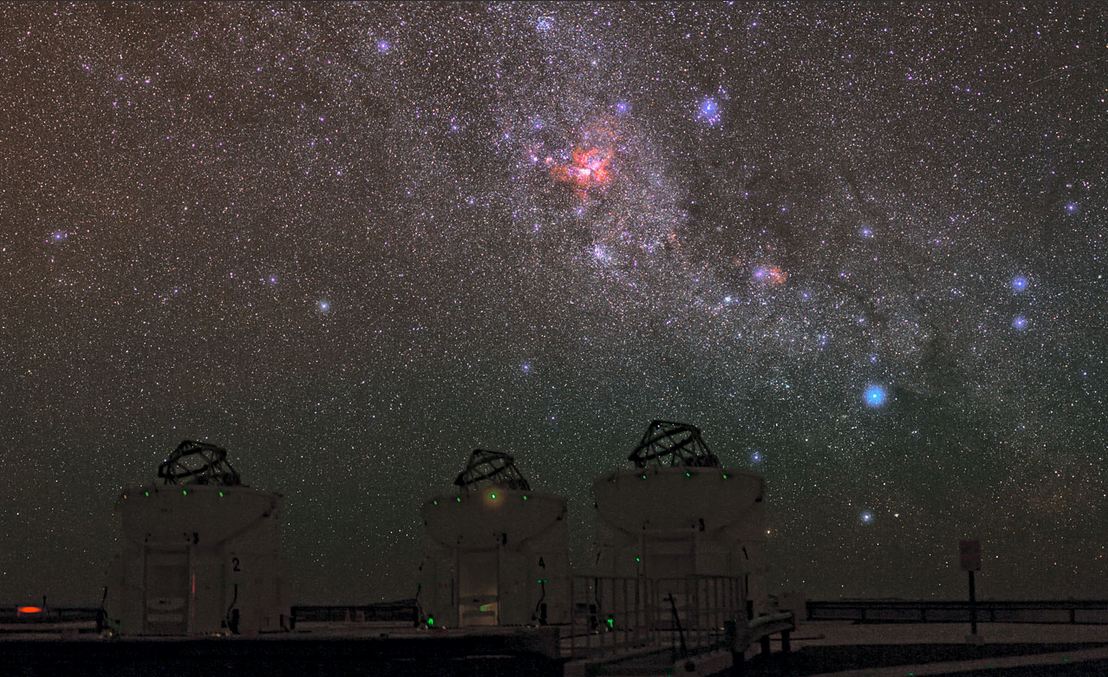
Image credit: Paranal Observatory, ESO / Babak Tafreshi.
The Universe, quite possibly, didn't have to be exactly the way it is. It didn't have to have the laws of physics be exactly what they are, with the masses and charges of particles having the specific values they're observed to have, with the forces having the exact coupling constants that they do.
And yet, you may wonder if there's some significance to these constants of nature having the values they do, and whether they have those values out of some necessity.
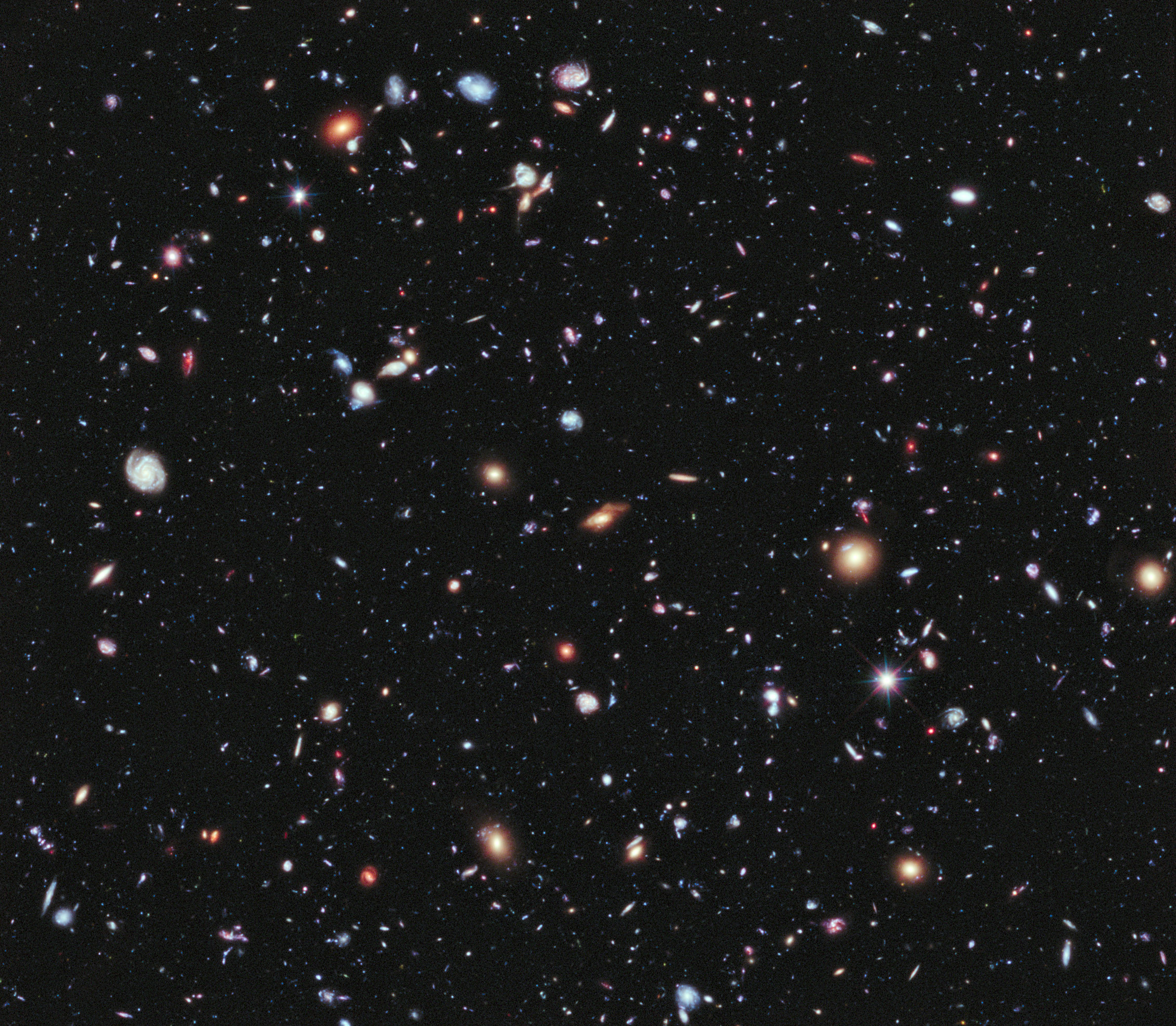
Image credit: NASA, ESA, G. Illingworth, D. Magee, and P. Oesch (University of California, Santa Cruz), R. Bouwens (Leiden University), and the HUDF09 Team.
When you think about the Universe, there are some plain, indisputable scientific truths that stare you right in the face. Stars and galaxies exist, held together by the force of gravity. Here on Earth, a huge variety of elements -- found to have the relative abundances they have -- are present. And humans, for all of our flaws and fallibilities, have, in fact, come to exist.
All of these things can be taken together, and a very simple logical conclusion can be drawn about the whole shebang: The Universe, with everything that exists in it, must be governed by physical laws that at least make it possible for things to turn out the way they have been observed to have happened.
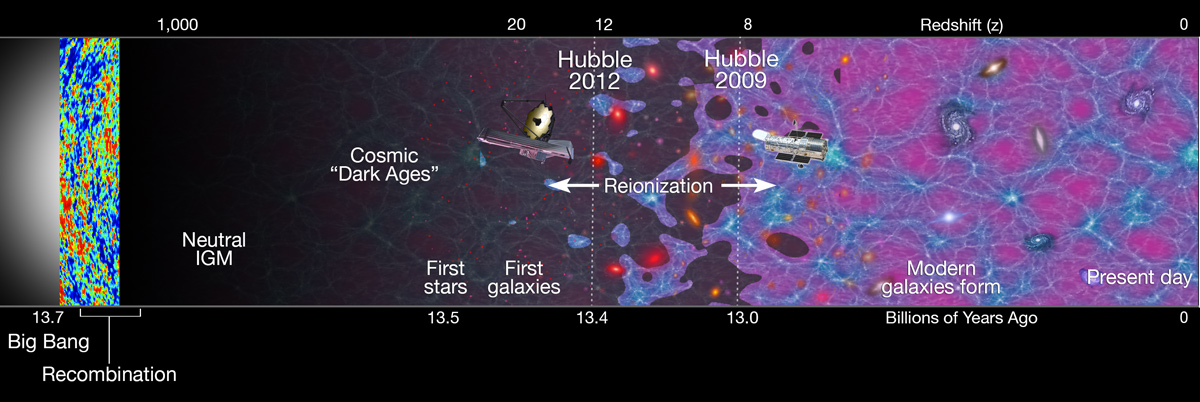
Image credit: NASA, ESA, R. Ellis (Caltech) and the UDF 2012 Team.
For example, we cannot live in a Universe where the existence of matter is forbidden; because it is observed to exist, the Universe must exist in such a way that the creation of matter was possible at some point in the Universe's past. Because the Universe is observed to be 13.7 billion years old, any model of the Universe where the lifetime of that Universe is smaller than 13.7 billion years is ruled out.
These examples may seem so simple and self-evident that they appear to be not even worth mentioning, and yet this method of reasoning can not only be incredibly powerful, this is sometimes the only method of reasoning available to us. In the absence of other physical information about the Universe, it must be true that the laws of nature allow the history of the Universe to unfold as it has already done so. This method of reasoning has a special name: The Anthropic Principle.*
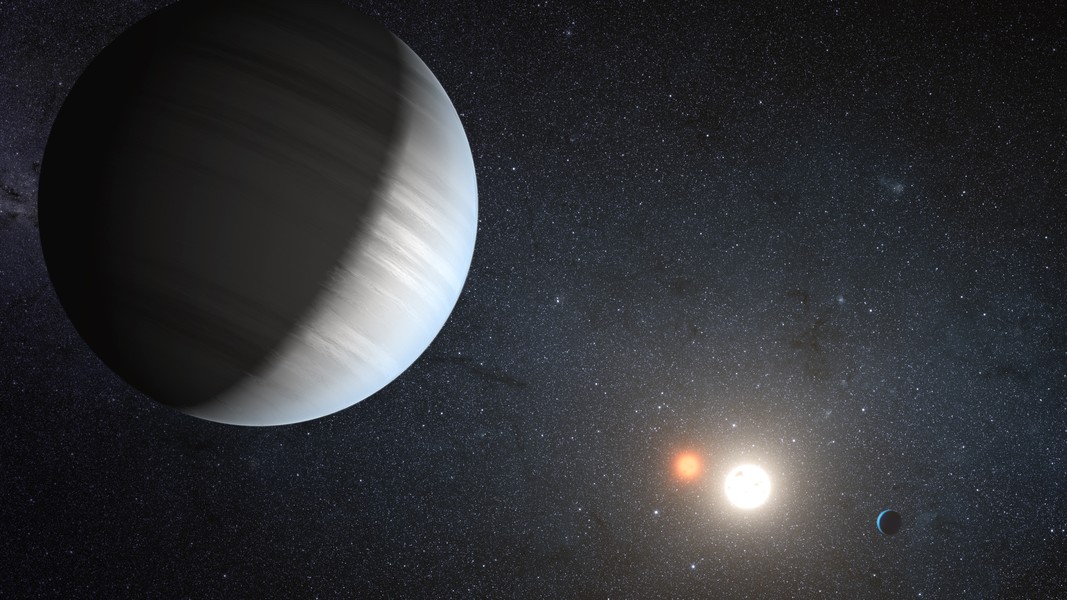
Image credit: NASA / JPL-Caltech / T. Pyle.
Historically, when it comes to cosmology, there are two (and, as far as I know, only two) instances where this has been applied correctly when there were no other avenues of evidence to consider to move our understanding of the Universe forward.
The first one came from the realization that stars are made up of mostly hydrogen, and nearly all of them are powered by nuclear fusion of hydrogen into helium, which occurs through a chain reaction known as the proton-proton chain.
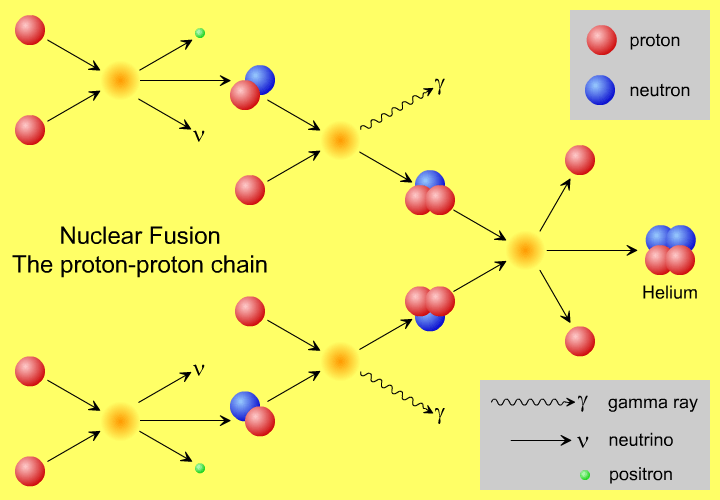
Image credit: Randy Russell.
This produces Helium-4 (a nucleus with two protons and two neutrons bound together) in great abundance; this is, for instance, how our Sun works. But where, then, would all the heavier elements -- the other 88 naturally occurring elements here on Earth -- come from? They must have been created somehow, but there's a problem: you can't add a proton to a Helium-4 nucleus (because there's no stable mass-5 nucleus), and you can't add another Helium-4 nucleus to it (because there's no stable mass-8 nucleus, either). You might want to add an intermediate element to Helium-4, but temperatures in the core of a star are so high that any mass-6 or mass-7 nucleus would be immediately destroyed as well. So how do you make heavier elements?
It's a good question, and the answer came from perhaps the greatest scientist never to be awarded a Nobel Prize: Fred Hoyle.

Image credit: BBC Universe, of Fred Hoyle in 1963.
Because carbon is abundant, Hoyle reasoned, there must be a way to combine three helium nuclei together at once to form Carbon-12 from that. Beryllium-8, what you'd get if you combined two Helium-4 atoms, is so unstable that it decays after some 10-17 seconds. But if you could get a third Helium-4 in there quickly enough, it's conceivable that you'd be able to form carbon. This process, in theory, is known as the triple-alpha process, since a Helium-4 nucleus is also known as an alpha particle.
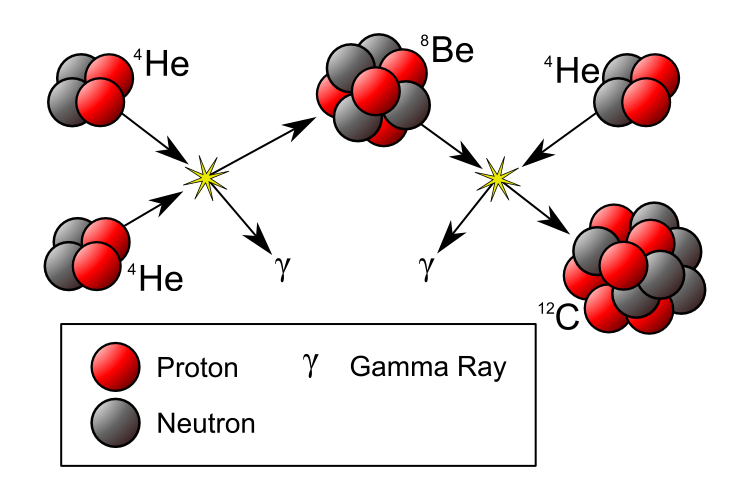
Image credit: original work by Wikimedia commons user Borb.
The only problem with this reasoning was that the mass of Carbon-12 didn't match the mass of three Helium-4 atoms; it was significantly lighter. In perhaps the greatest leap ever made using the Anthropic Principle, Hoyle went out on a limb to predict that an excited state of Carbon-12 -- with the right energy to allow its creation via the triple-alpha process -- must exist.
The discovery of this state with exactly Hoyle's predicted properties, now named the Hoyle State, is the greatest scientific achievement ever made by use of the Anthropic Principle. In perhaps second place, we can note that spacetime itself -- empty space -- could have any intrinsic amount of energy to it you can imagine; there are no constraints placed on it by the laws of physics.
Image source unknown; looks to be a Retro-3D rendering.
If we were to make an order-of-magnitude estimate of what this value should be, based on our fundamental constants (Planck's constant, the gravitational constant, and the speed of light), we get a number that's unreasonably large. As in, if it had that value, either positive or negative, the Universe would have either expanded into oblivion or recollapsed in some tiny fraction of the first femtosecond. Therefore, it was reasoned, if the value of this cosmological constant (or vacuum energy) was non-zero, it must be less than 10-120 times the "expected" value in magnitude.
This prediction, made in 1987 by Steven Weinberg, was verified in 1998 when the value was finally measured to be about 10-122 times that value, and to be positive after all.
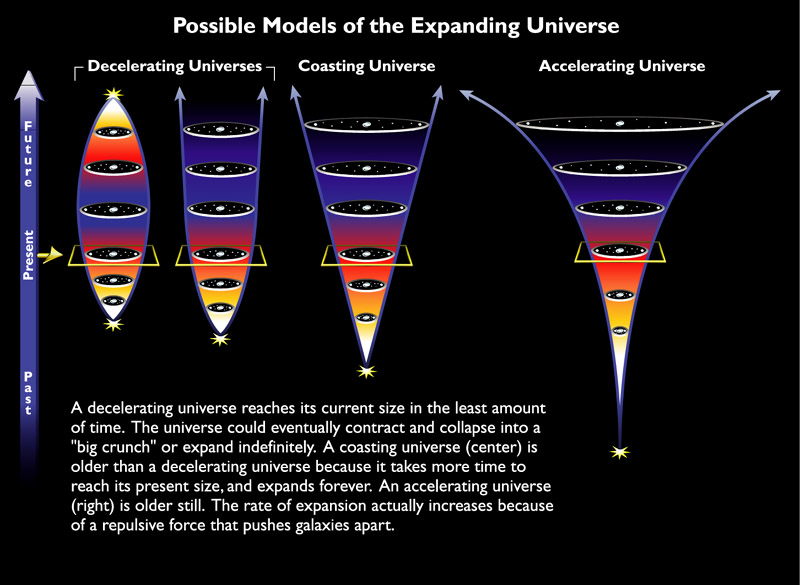
Image credit: Large Synoptic Survey Telescope, NSF, DOE, and AURA.
That's what the Anthropic Principle has been good for in the past: where the only data is that we are here in this Universe as-is, we can still say intelligible things about what the Universe must allow.
But it doesn't tell you why or how; the Anthropic Principle is what we use to guide us only when there is no better data or observation to point us in a better direction.
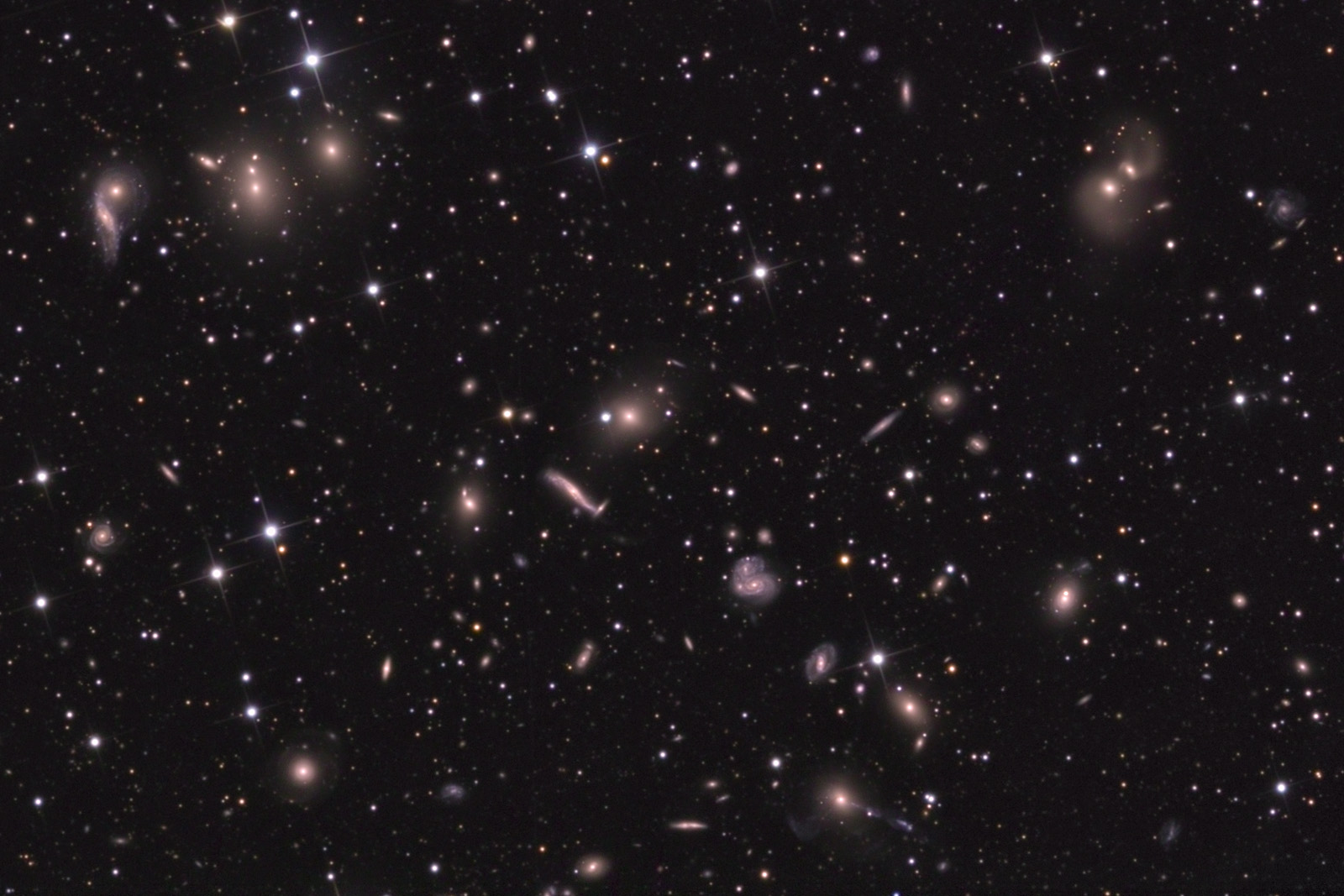
Image credit: The Hercules Galaxy Cluster, by Russ Croman / RC Optical Systems.
Using the Anthropic Principle as a justification for the Universe to be the way it is is no way forward scientifically. It is a bridge, to be used only to constrain what is possible, and to tell us where to look for a way through our problems. What one mustn't do is to use the Anthropic Principle as a replacement for dynamics, or the question of how/why the laws of physics brought forth some aspect of our Universe. [When you hear people use it as respects the string landscape, they succumb to exactly this pitfall. If string theory is correct, and the landscape is real, and if physics is ever to understand why our cosmological constant has the value it does, the Anthropic argument will shed no light on that problem. I see it as a craven excuse to avoid asking a tough -- and perhaps unanswerable -- question.]
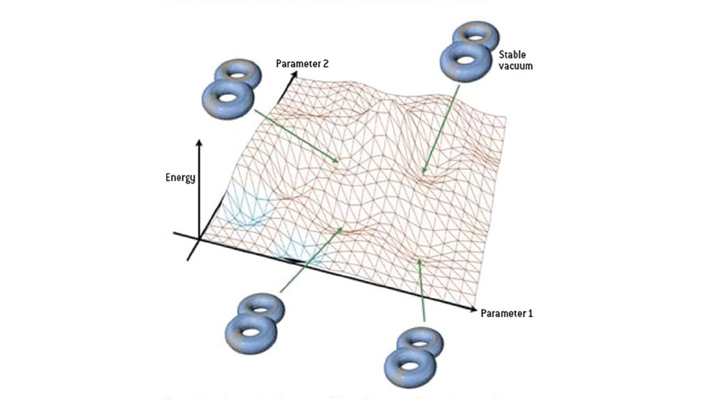
Image credit: The Stephen Hawking CTC at University of Cambridge.
As far as science goes, our existence in this Universe the way it is remains a self-evident scientific truth. We can learn some amazing things about it just by realizing that the Universe must exist in such a way that it has allowed our existence to be possible. (Not inevitable, as some mistakenly claim.) But the science we can extract from that fact is very limited, and still must hold up to the scrutiny of observations and experimentation. We must be careful not to fall prey to thinking that the possibility we think of first is the only way it could have actually happened; the Universe is full of phenomena that have surprised us before, and while the Anthropic Principle is often the beginning of an investigation, it's never the end!
* -- More technically, this is called the Weak Anthropic Principle. Some people adhere to a variant of this known as the Strong Anthropic Principle, which states that the Universe "must be such as to admit the creation of [intelligent] observers within it at some stage." This is (IMO) a clear logical fallacy and an uninteresting, unproductive line of thought, as just because the Universe did, in fact, result in our being here, it by no means had to result in the creation of us (or any other intelligent life). But you may disagree; your mileage may vary.
- Log in to post comments
Dear Mr. Siegel,
I actually hadn't run across the term "coasting universe" before. I'm rather taken with the idea. What would that universe be like, and how do we know that's not what we have? Observed expansion reportedly leads to a cold dark universe, as our fellow galaxies are hurtling away from us, soon to disappear beyond the event horizon of the deep past. Is there no circumstances in which new galaxies could arise from the now invisible dark matter and energy? (My weak anthropic reflex abhors this awful, inflationary vacuum of emptiness we seem to be in the center of.)
Thank you Ethan. Please someday do a piece on recombination after the BANG. I think I missed that day in school.
@Chris Thomson: A "coasting universe" is one in which the expansion rate (the scale factor a(t)) is a true constant, independent of (cosmic) time.
We have both observational evidence (from Type Ia supernovae, for example), and observational inference (from the large scale structure of the universe and calculations of gas dynamics) that it is impossible for the galaxies we observe today to have formed, with the clumpiness we see in galaxy clusters, in the 13.67 Gyr lifetime of the Universe.
We do know is that the Universe is "flat" -- that is, the total mass-energy content (technically, the average density thereof) of the Universe is exactly enough (within measurement uncertainties) so that the broadly sketched spacetime is Minkowskian, like you learn about in special relativity.
The type Ia SNe data tell us that up to about 5 Gya, the Universe's expansion was decelerating, and since then it has been accelerating.
When you put all of that together (as Ethan has much more clearly explained in several of his postings), the Universe *must* be constructed of (at present) about 5% baryonic matter (rocks, stars, gas, dust, us), about 20% non-baryonic matter (the so-called "dark matter" which provides the large-scale clumping), and about 75% cosmological constant (the so-called "dark energy" which drives the present accelerated expansion).
You can't make "new galaxies" just out of dark matter, because (by definition) a galaxy has stars, gas and dust made out of baryonic matter. The dark matter provided a scaffolding around which that gas and dust could collapse and heat up to form the small and intermediate scale structures we see today. But without the gas and dust, you can't make new observable galaxies.
Would love to hear you write up this.
http://www.preposterousuniverse.com/blog/2012/09/27/guest-post-joe-polc…
Clearly this is an article I will have to read a few times. The information is extremely interesting but trying to digest it all makes my head hurt. Very interesting take on the anthropic principle. Ethan, are you a Slayer fan by chance? You look like Kerry King - one of my favorite musicians.
Re: the point about the Strong / Weak versions of the Anthropic Principle.
Dr. Siegel,
I don't follow the logical fallacy claim for the strong principle. While it is possible to argue that an intelligent observer is not a necessary consequence of a particular arrangement of the universe, isn't that just another way of saying if things had been different, then they'd likely be different? Intelligent observers did result (I know - it's an optimistic claim) from this particular arrangement, it could just as well be that they would always result from this particular arrangement.
A wonderful book: "The Cosmological Anthropic Principle" by John Barrow and Frank Tipler. Changed my life. Not only are the Cosmological Constant and the Triple Alpha resonance "fine tuned" to allow us to exist. Many other quantities like particle masses, strength of gravity vs E-M, etc. etc.
If creationists had any sense at all they would focus on physics rather than biology!
... well, on further review, there's much more to this than meets the eye. Thanks for stimulating a look at the versions of this principle. I've some reading to do!
Anthropic used to be an adjective that meant relating to humans or the era of human life. Clearly you have trashed that meaning, and have created a definition which applies so generally to scientific reasoning that it loses any interesting specificity.
The athrotopic principle seems to allow some new ideological thinking that may not always follow the current paradiam. This can only be a good thing, as the following of religious or scientific dogma can lead you away from the real truth.
All the significant factors in the Universe's existence and the Earth's ability to carry intelligent life are so arbitrary that finding "The theory of everything" seems ridiculously vain. I would propose that a much more reasonable hypothesis is that there is (was?) a creator and we can only follow HIS/HER footprints- this is Occam's Razor in practice.
I would add Bousso et al successful anthropic predictions, but then again it depends on if you accept their measures I suppose. You can always claim that they are erroneously made.
I'm no theoretical physicist, but a layman with an astrobiological interest. Hence I can react on this.
You make it a forbidding claim, but there is no reason to. If a method works to answer a question, it should be allowed. To not allow it would be "a craven excuse", no?
One reason you can make this claim is that you equivocate between the AP, which is picking the constraint the historical pathway sets, and the WAP of anthropic theory, where the most likely value of habitable universes are picked for test. (Hoyle used the AP, Weinberg the WAP, precisely as you describe it.)
The other reason, which is more sympathetic, is that it is "a replacement for dynamics". But it is, picking pathways (most generically by likelihood), implicitly constrained by dynamics. When combined with dynamics such as eternal inflation, it is a constraint tool. So anthropic theory can't lack dynamics, it asks for it.
As an outsider it is difficult to understand why hackles gets raised by methods that some inside the group uses, tentatively or not. It is after all the science who will decide which methods that are useful, not hackle raising (one would hope).
An interesting note is that Hoyle has just been proven wrong:
"The reaction is known as the triple-alpha process and it is responsible for the large amount of carbon found throughout the universe. For years, the process by which stars combined light, simple nuclei into the most crucial element has been understood only as a two-step process. But recently, the problem was revisited to unveil the full scope of mechanisms behind the formation of life’s most crucial isotope, carbon-12.
Specifically, that problem was the rate of carbon-12 production at low temperatures. Previous calculations made by a group led by Kazuyuki Ogata, professor of nuclear physics from Kyushu University in Fukuoka, Japan, resulted in dramatic models where stars would burn up so fast that they could not reach the red giant phase."
"At low temperatures, when the energy is not enough to reach the resonances, carbon-12 can still be formed through the simultaneous fusion of three alpha particles. And while in the past, nuclear theory accurately modeled the rates of the two-step process, it was woefully inaccurate when it came to the single-step process. The Kyushu group made a serious improvement on those predictions.
“However their results prohibited the formation of red giants, which we know exist because we’ve observed them,” said Nunes. “So I had the idea for an alternative approach without the limitations of the one that was being used at the time.”
Together, Nunes and Nguyen solved this very challenging three-body scattering problem (PRL paper). When their new results were obtained, they agreed with the prior theory for high-temperature carbon-12 formation. At lower temperatures, however, they predicted an increase of the rate by about 10 trillion times from the estimates from the past.
While this seems like a lot, it still was much less than Ogata’s predictions.
“With our new results, red giants finally exist again!” said Nunes. “From here, we have to use the new rates in many more astrophysical scenarios. We hope it will resolve some issues lingering in novae and supernovae.”
http://www.nscl.msu.edu/general-public/news/2012/origin-life%E2%80%99s-…
The PRL paper linked there is from October.
By the way, I forgot this:
Weinberg's predicted value could be tested by observation, AFAIK.
One of the more odd claims by anthropic theory detractors is that 'it can't be tested', if that is what this alludes to. Clearly it can.
And who would do justification anyway? That is for theologians, and as you note not productive. (And again, the AP/WAP was productive.)
This is correct I think. But we should note that astrobiology abiogenesis is explicitly founded on an AP pathway - life exist, it didn't right after inflation, hence abiogenesis must have occurred.
Torbjorn:
Well, just look at Wild Bill's and William McDill's posts to see why. The SAP is often used as a teleological argument (i.e. Improbable coincidence = intelligent design by a loving, human-centered God). That's what they both did.
Now, whatever you think the AP's pros and cons might be as a hypothesis-generating tool, when it gets used in that way it shares/suffers all the problems of every other teleological argument.
To answer those two posts in brief: we don't actually know how fine tuned this universe is. We don't know how arbitrary our settings are. We don't know how many other options there could have been. We don't know the number of past, present, or future universes. And we have absolutely no justification to infer an intelligent cause from an improbable event, let alone a classic monotheistic, human-centered tri-omni intelligent cause.
You make it a forbidding claim, but there is no reason to. If a method works to answer a question, it should be allowed. To not allow it would be “a craven excuse”, no?
Ah, but the anthropic principle in the context of the string theory landscape doesn't work to answer a question. In fact, it is effectively a statement that the question "why these laws and not others?" is not even allowed to be asked. This is why so many physicists are skeptical of the landscape concept.
William McDill:
This is the argument from incredulity.
On the contrary, it's a contravention of the law of parsimony to postulate a Creator when none is needed to explain the observed phenomena.
" I would propose that a much more reasonable hypothesis is that there is (was?) a creator "
PROBLEM: that creator is much less likely than "All the significant factors in the Universe’s existence and the Earth’s ability to carry intelligent life are so arbitrary" giving us existence.
Your mention of Hoyle's State is quite timely, as a nice 2012 paper using lattice QCD techniques to directly compute the internal structure of that state has just been published in PRL. The preprint version is http://arxiv.org/abs/1208.1328 .
The authors report that the C-12 ground state is (as was well known) an equilateral triangle with an alpha cluster at each vertex, while the Hoyle State has one angle opened to a large obtuse angle (picture the shape of a water molecule).
The authors don't directly compute the opening angle, because they're working on a finite square lattice, rather than a triangulated continuum.
You've done well as far as you've gone...but that's when we can start bringing in the laws of probability/statistics. THEN we get a truly Anthropic-looking universe. I grade you a B on your work, professor. Come back with some statistics work, and then maybe you can earn an A.
Ethan
Very well said.
Yo Ethan - Nicely done.
I'm surprised that any version of the anthropic principle has been used to generate a supported hypothesis. To my mind it's basically a philosophical statement, and the version of it that is supportable is that "all other factors equal, we are more likely to exist in a universe that is conducive to intelligent life, rather than in one that is not."
There must be a flaw in my reasoning or in my rendition of that, if it doesn't have (or lead to having) the ability to produce testable hypotheses. Usually I'm pretty darn good at spotting the existence of paths from philosophical assertions to testable hypotheses. I'm thinking that it must require the specialized knowledge in the field (items about which us laypeople are ignorant/unaware), to be able to reason back from "we exist, therefore the universe must conform to physical laws that are favorable to our existence," to hypotheses about specific physical laws and properties of matter/energy/spacetime that are required for us to exist.
In a way, this does appear to be teleological: it starts from a "goal state" of "we exist," and then seeks out the preconditions for our existence. To my mind there's nothing wrong with humans doing teleology, or working their human teleologies into the fabric of nature as motivations toward a goal of understanding nature.
---
IMHO Occam is the wrong approach to the question of deities in a rationally apprehended universe. Does it contravene the law of parsimony to postulate the existence of squirrels, when no squirrels are needed to explain the existence of the universe? "Deity" is a singularly unique class of entity, having singularly unique characteristics. Therefore there is no basis upon which to make inferences from the existence or nonexistence of other classes of entities, to the existence or nonexistence of deities. There is no basis for comparison between "universe with omnipresent deity" and "universe without deity," because we can't be certain which type of universe we inhabit, and how the other type would be.
Thought experiment: ask yourself, "If what I believe about the existence or nonexistence of deities was incorrect, how would the universe differ from what I presently observe?"
Thanks for the info, Ethan! Even though I think I can understand why some people here comment on the strong anthropic principle as being legitimate, I'll take your side here. Just think of the first mammal - the common ancestor of all humans. Had it fallen prey to another animal or just simply died prior to having offspring due to some bad luck, we wouldn't be here. So much for the universe's necessity to create us.
"Using the Anthropic Principle as a justification for the Universe to be the way it is is no way forward scientifically."
What bugs me is why natural elements stop at Uranium (92) and do not go to Neptunium at 93. Why the anti-Neptunium bias? Also there needs to be an element between lithium and beryllium. A 3.5 thing. It would make nice crystals, sort of a beryllo-tourmaline.
There was no first mammal. The concept of "species" is an approximation of reality that we apply in order to create order and understanding for ourselves, just like the approximated idea that the Earth is orbiting a static Sun. (or the Moon the Earth).
"IMHO Occam is the wrong approach to the question of deities in a rationally apprehended universe. "
Would that be because it doesn't let you put a god in everywhere you think it'd look good and you want there to be one?
" Does it contravene the law of parsimony to postulate the existence of squirrels, "
If you observe them, definitely yes.
"Therefore there is no basis upon which to make inferences from the existence"
If you'd stopped there, you would have been right. But you fucked it all up by continuing and claiming "or nonexistence". Which part is COMPLETELY WRONG. There is no basis to make up an unobserved complex thing that does the godding.
It isn't Occam's Razor that means no deities. It's that there's nothing to need one for.
"Thought experiment: ask yourself, “If what I believe about the existence or nonexistence of deities was incorrect, how would the universe differ from what I presently observe?”"
Ever tried it? If the answer to your thought experiment is "there is no difference" then why did you put a god in there?
Moreover, that thought experiment is answered in the religious texts of, for example, the Abrahamic religions and the answer is "Very very very different".
For example:
1) Bats would be birds
2) The universe would have been created two different ways at the same time
3) One person could be born twice at different times in two different places
Most religions would have lightning being an immorality seeking missile. Which is a hell of a lot different from the causal generation and random targeting of the lightning we have on this planet.
Not to mention that thunder would have naff all to do with lightning if the religions who propose a god were correct.
The only god concept that doesn't give us a very different universe is the deist one for which there's no reason to believe exists, nobody really thinks that when they think "god" and who doesn't bear worshipping or contemplation because they are adamantly absentee landlords.
Another famous example:
René Descartes: "Je pense donc je suis" (="I think so I am")
I prefer Didactylos:
I think I think therefore maybe I am.
Anthropic reasoning isn't "the" anthropic principle, which can be any of the variant interpretations from selection effects to a strong cosmological principle that requires life for some good physical reason.
G,
I think the problem you, and many others, have with the logic of the anthropic principal, is that it really isn't an anthropic principal, per se. The term "anthropic" implies that there is something special about humans. That is, the existence of humans leads us to postulate other entities (such as Hoyle's state, for instance) that would be necessary for humans to exist.
The real problem with this is that the "porcine" principal or the "simian" principle would lead to the same entities. What is necessary for humans to exist is also necessary for pigs or apes or any other living organism to exist.
Further, you could expand this into a "gaian" principle as well. Any entity needed for the earth to exist must actually exist in the universe. It seems to me that the anthropic principle is nothing more than the argument as follows:
P1. Entity "X" exists
P2. For entity "X" to exist, entities "A", "B" and "C" must exist.
Therefore, entities "A", "B" and "C" exist.
(Obviously this argument could be modified to any number of postulated entites necessary for entity "X" to exist; nothing special about three entities).
Seen in this light, there doesn't seem to be anything too special about the anthropic principle.
G,
You also seem to have difficulties with Occam as well. Occam's razor is simply that we should not NEEDLESSLY multiply entities. Your example about squirrels is completely fallacious. Please explain why we observe small, furry mammals with large bushy tails that climb trees and eat acorns if squirrels do not in fact exist.
We only postulate those entities needed to explain what we observe. We do observe small, furry, bushy-tailed, acorn-eating, tree-climbing mammals. Therefore, we postulate that such creatures do, in fact, exist. Where is the physical evidence that a divine creator exists? Please don't point to anything at all in the Bible; that's a record of the folk wisdom of sheep-herders from 6000 years ago, not physical evidence of divine existence. What do you observe in the physical world TODAY that requires a divine creator for its explanation? If you can't find anything, then applying Occam's razor allows you to conclude that this divine creator does not exist. I can point you to physical evidence that squirrels exist; I cannot do the same for God.
"” Does it contravene the law of parsimony to postulate the existence of squirrels, ”
If you observe them, definitely yes."
I'd put that the wrong way round.
If you don't observe them, definitely yes.
Re. "Wow":
I didn't put a god in there: you did. Conflating agnosticism with theism is a dominance game played by dogmatic atheists, just as conflating agnosticism with atheism is a dominance game played by dogmatic theists. I'm not going to play along, and I'm calling you out on it. Go find someone else to gratuitously put down. Better yet, stop it, it does a disservice to atheists.
Re. Sean T:
I don't privilege humans in any way other than being observers in a local frame of reference. That is, the only frame of reference we have for observation is our own. Were we squirrels, we would have the Squirrelous Principle. The point of all this is that whoever "we" are, we would find ourselves in a universe that's more likely to be favorable to our existence. What I found remarkable was Ethan's point that this is not just an abstraction or a tautology, but that it leads to falsifiable hypotheses. What I fond equally remarkable was that I didn't see that possibility years ago. I'm more than willing to fess up to my own areas of ignorance and incomplete thinking, but what I won't do is "go along to get along."
The Gaia hypothesis suffers from an unfortunate name. The idea that ecosystems have negative feedbacks that arise from the interactions of organisms and are to some degree stabilizing, is now well accepted in ecology. No deities required, except by those who wish to insert them in order to shoot them down.
Back to Occam again: First of all, the Abrahamic deity is a straw man, easily dispensed with. Subtract the narrow tribal particularisms, starting with the male pronoun, and what's left is a kind of minimal deist assertion, or to be more conservative (unfavorable), a kind of pantheistic "universal mind." The entire point of my thought experiment is that there is no way to ascertain a difference between a universe _with_ that kind of entity, and a universe _without_ it, which is subtly but significantly different to asserting that there is no difference between the two universes.
For all we know there may be a difference, or there may not be. But all we have to observe is the actual universe as it exists. I agree that our most successful theories and models have no need of even a deist or minimalist pantheist element, but that is not the same thing as asserting the positive nonexistence of any such entity.
To be terribly blunt about it, I'm arguing for agnosticism, on the strictly empirical basis that a) there is no viable empirical test for deities, and b) logical inferences are insufficient either way. I'm also arguing for the proposition that beliefs about deities are the outcome of individual variations in neurophysiology. That and nothing more.
Lastly, I'll assert that the empirical evidence from neurophysiology will also support the hypothesis that the personality characteristics of fundamentalist atheists are closer to those of fundamentalist theists than either are wiling to admit, starting with a relative incapacity to deal with uncertainty. Dogmatism is an emotional trait. "Emotions are chemicals" (more accurately: emotions are the subjective sensations of the effects of specific chemicals on specific neurons). QED. It just remains to get the right operationalizations and make the measurements.
G,
I guess we are in agreement then. Occam's razor is really a methodological tool not an epistomological one. The needless multiplication of entities leads to overly complicated explanations and less useful hypotheses, but it's certainly theoretically possible that the truth is needlessly complicated. Occam's razor would lead us astray in such a situation.
As you admit, though, there's no necessity to invoke a deity in any scientific explanation of the universe. While it's theoretically possible that Occam's razor could lead us astray in this case, the entire history of science shows that the principle is useful. It is entirely reasonable, then, to proceed with scientific explanations that lack reference to a deity.
As for the metaphysics, I leave that to the philosophers to debate. The existence or non-existence of a deity (not, as you correctly point out, the Abrahamic one), is not really a matter for science to decide. There is no testable hypothesis, for instance, that would allow one to investigate the deist position. Since that position claims that God exists, but doesn't interfere with the universe at all, the result of any measurement one would care to make would be the same as if there were no God at all. Thus, science is incapable of dealing with the truth of Deism. Obviously, Occam tells us to proceed with the atheist assumption vs. the deist one, but that is methodological, not ontological.
In short, I would agree that scientific reasoning leads us more toward an agnostic position rather than an atheist one.
"but it’s certainly theoretically possible that the truth is needlessly complicated. Occam’s razor would lead us astray in such a situation. "
However, that would be found because the evidence would show that complication.
I.e. multiplying the number of dimensions to four so that you can get the perihelion of Mercury right.
So the razor ensures you don't fuck about in the pig pen whilst the scientific method indicates when the pig pen has something in it.
"In short, I would agree that scientific reasoning leads us more toward an agnostic position rather than an atheist one."
Since agnosticism and atheism are orthogonal, what the hell do they have to do with each other?
You're getting them confused too.
Agnostic is NOT "a weak atheist". THEY ARE DIFFERENT BREEDS ENTIRELY.
Science would lend you to agnosticism.
Whether that led you to theistic agnosticism or atheistic agnosticism is dependent SOLELY on what you think about the various god concepts and whether you believed all of them or merely *nearly* all of them.
"I didn’t put a god in there: you did."
WRONG WRONG WRONG WRONG WRONG.
THEIST and ATHEIST **PUTS** God in there.
BECAUSE they are talking about gods (the faith or lack of them).
For fucks sake, read a frigging dictionary.
"Conflating agnosticism with theism is a dominance game played by dogmatic atheists"
Conflating agnosticism with atheism is a dominance game played by theists and apologists for theists.
I DID NOT CONFLATE THEM.
Do you even know what "Orthogonal" means?
IT IS THE OPPOSITE OF CONFLATE.
Gnosticism and Theism concern TWO SEPARATE CONCEPTS.
Got that?
First is about knowing.
Second is about believing.
A-* puts "lack of" in front of them.
A lack of knowing = A Gnosticism
A lack of believing: A Theism
Knowing = Gnosticism
Believing = Theism
A-Gnostic Has FUCK ALL to do with A-Theism.
Wow,
Point taken. But, honestly, I'm not sure that science is totally able to distinguish between atheistic and theistic agnosticism, and I guess that's more precisely what I meant.
Obviously, science can refute the claims of the Abrahamic religions. However, consider the proposition that there exists an omnipotent deity and that this omnipotent deity chooses to NEVER interfere with the universe. Therefore, any observation you make is consistent with both the existence of this deity and the non-existence of any deity. Science would be unable to make the distinction between the two cases. (I'm not sure why anyone would go to the trouble to postulate such a deity, when such a deity would have no effect on anything, but that's not the point).
Wow,
Just a question. What label would you use to refer to someone who doesn't have a belief in God or a belief that there is no God? You surely could not call that person either a theist or an atheist, right? Obviouisly, that person would have to be an agnostic, since he/she would not be able to claim to know that God exists (or does not exist), but is there a label for someone who doesn't fall to either side on the atheist/theist "axis"?
Someone who has no belief in god bit no KNOWLEDGE that there is no god would be an Atheist Agnostic.
A belief that there is no god is neither atheism nor agnosticism but somewhere around nihilism.
"is there a label for someone who doesn’t fall to either side on the atheist/theist “axis”?"
Nothing.
It's the same as "an integer that is neither positive nor negative nor zero".
By definition a null set.
Gnosticism is orthogonal to theistm/atheism.
So you COULD claim Gnostic not on the theist/atheist axis.
" But, honestly, I’m not sure that science is totally able to distinguish between atheistic and theistic agnosticism"
It isn't and can't.
God concepts such as in the Bible can be distinguished, however, since they assert that they have done something physically to this earth, however, CAN be refuted or confirmed by science.
That, however, is not faith but proof.
Christians assert their proof of their faith is the "design" of the Tse fly. Or the flagellum. Or the stopping of the sun.
These claims ARE within science to prove or disprove.
And disproof of them disproves a god who did that.
A deist god, however, is definitionally not disprovable by science since such a god never acts on the universe so created.
But any concept of god that has been promulgated by any discernable faith HAS been disproven.
Such proof/disproof NOT being theism/atheism, but Gnosticism. And proving Gnosticism-as-nonexistence correct for the given claim.
"You surely could not call that person either a theist or an atheist, right?"
You could not call them gnostic or agnostic, however.
DEFINITIONALLY
If someone has no belief in a god, they are atheist. At the very least to that god.
A theist has no belief in gods they don't believe in and are for those gods, atheist.
A christian is a-theistic to Jove. Or Urumaklu. Or Shiva. To all these gods they are atheistic.
This is the current usage, but there was an earlier usage.
However, some theists actively deny the existence of other gods, rather than merely passively lacking a positive belief in them. Active denial is different from lack of positive belief.
When I was younger, and Soviet communism was actually a major element in the world, this was the sense of the term "atheist" - active denial.
The usage of those times was very much, despite the construction of the words, that an "agnostic" was someone who neither believed in nor positively denied the existence of gods. An atheist was someone who explicitly denied that gods, or at least any traditional interpretation of the Christian God (including liberal, ecumenical interpretations) could be valid.
There was a reason why such atheists existed at the time - that type of atheism, flat out denial that a god could even hypothetically exist, signaled commitment to a particular ideology.
In those time, at least under the common usage of the terms, one could not simultaneously be agnostic and atheist.
In the Internet Era, the meaning of the terms has changed. The end of the Soviet Union and its then-ideology as a major force in the world may have something to do with this.
"Atheist" now does tend to mean "lack of belief in gods". Internet atheists sometimes react with exploding-head rage when it is implied that an atheist "denies the existence of gods". Yet that was, in fact, an older usage of the term.
Circa 1980 I was an "agnostic" but not an "atheist". By today's internet standard, I'm both. I have witnessed an at least informal evolution in the usage of the terms during my lifetime.
"This is the current usage, but there was an earlier usage."
No the word atheist when INVENTED meant "lack of a belief". It's never been anything different.
"However, some theists actively deny the existence of other gods,"
Yup, so theists are atheist to other god concepts. As I said.
" Active denial is different from lack of positive belief."
And definitely not stamp collecting is definitely a hobby? Rubbish.
" this was the sense of the term “atheist” – active denial. "
That was never the meaning of the word, it was just another way of labeling Soviets "Evil". Today you have the same problem with the language from the same people who use "Liberal" as some sort of insult.
If you know there is no god, you're a Gnostic Atheist.
It STILL isn't a religion, and the "definite" bit is the Gnosticism, not the atheism.
"The usage of those times was very much ... an “agnostic” was someone who neither believed in nor positively denied the existence of gods"
That explains why you think it means that, but that doesn't stop it being ABSOLUTELY WRONG. An agnostic has no position on god, ONLY knowledge.
Being in a group who all get it wrong doesn't make you right.
"In those time, at least under the common usage of the terms, one could not simultaneously be agnostic and atheist."
Yes you can. Easily and in those times as you could before and since.
"I don't believe in God, I don't know that it's even possible to know if one exists".
A/Gnostic is talking about knowing the answer.
A/Theist is talking about your belief.
Orthogonal.
Circa1980 you were an agnostic atheist if you did not believe in a god.
Wow -
I'm sorry that you could not understand my comment.
I did not actually offer a challenge to your absurd claim to be able to tell everyone else what the "correct" meaning of common words "has always been" (I'm challenging that now but did not originally).
All I did was explain a prior usage.
I realize that you cannot quite get it.
Oops, forgot one thing - being an isolated raging troll on an internet comment board doesn't make you right, either.
(For full disclosure, on the rare occasions when I visit this site, I agree with the content of many of your comments.)
harold, not agreeing with your idiocy doesn't make one a troll.
for full disclosure you should agree or disagree with someone REGARDLESS of whether you've agreed or disagreed with them before. Assert agreement on whether you agree. not whether someone is nice.
harold, you got the history of the meaning of the word wrong, it wasn't "recently" the current meaning, IT ALWAYS WAS THAT MEANING.
And the most gnostic gnu atheist IS STILL NOT RELIGIOUS.
Just because you believe agnostic means "weak atheist, who doesn't make any theist try to think" doesn't mean that is now a religion (note the use of "believe"? despite its existence there isn't a "religion of thinking a word means something other than it does").
But theists made uncomfortable by someone showing them how their faith is silly is left with only one recourse (they won't want to change their religion, that's off the table): say to the atheist "Well, that's a religious faith too!".
It isn't.
Not even if you say "Nope, there is absolutely no god whatsoever"
Now if God turned up and proved themselves to everyone and they STILL don't believe in it, then this still isn't a religion, but it's as silly as any religious nutter insisting that there's a god and he's visited them and told them The Truth.
But whilst there's absolutely no proof of god and ALL concepts of god have proven themselves incompatible with themselves, "there absolutely is no god" is just reasonable.
First of all, apologies for my prior verbal hostility, which was pointless.
Now to address this.
1) I did not explain what "I thought" the words mean, or should mean, I explained a common, widespread past usage of the words. That usage existed. I was not advocating that particular usage, I was pointing out that it was once common. Period. It is worthwhile to know that it once existed.
2) I am in favor of encouraging theists, and everyone else, to try to think.
3) I don't have any religious beliefs, and can conclude safely that all religious beliefs that make claims directly contrary to science are wrong. Most religious beliefs that don't do that seem like magical thinking, wishful thinking, or projection of human traits onto inanimate objects to me, as well.
However, I don't "know" that there aren't any deities, I simply have no reason to think that there are any deities.
"First of all, apologies for my prior verbal hostility, which was pointless."
That's OK, it's not possible to get a proper conversation going on a blog by internet post. Condensing a thought makes it more abrupt.
"However, I don’t “know” that there aren’t any deities, I simply have no reason to think that there are any deities."
Then you're an atheist.