

“Hell must be isothermal; for otherwise the resident engineers and physical chemists (of which there must be some) could set up a heat engine to run a refrigerator to cool off a portion of their surroundings to any desired temperature.” -Henry Albert Ben
One of the most amazing ideas to come out of our observations of the Universe over the last century is that our vast, star-filled, mostly-empty Universe hasn't always been like this.
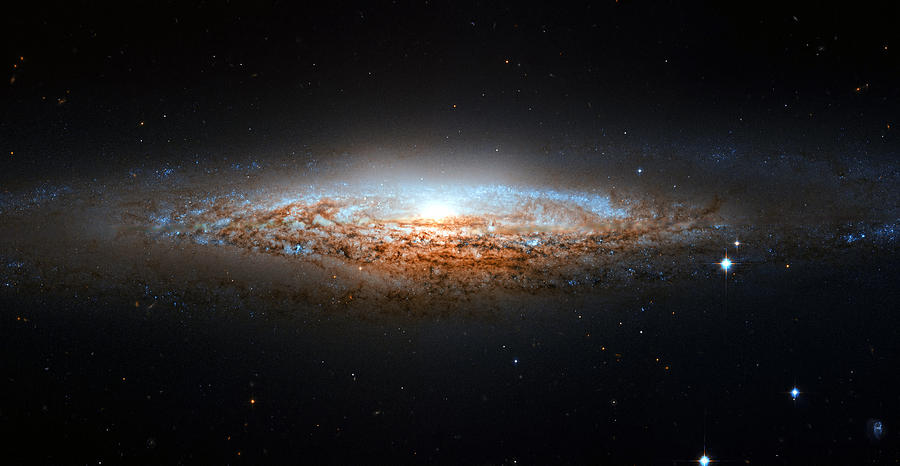
Image credit: Ricky Barnard / Fine Art America.
Today, the Universe is very cold, expanding, and the average distance between galaxies is increasing as time goes on. The farther away a galaxy is, the faster it appears to be moving away from us and the farther towards the red end of the spectrum its light appears to be shifted.
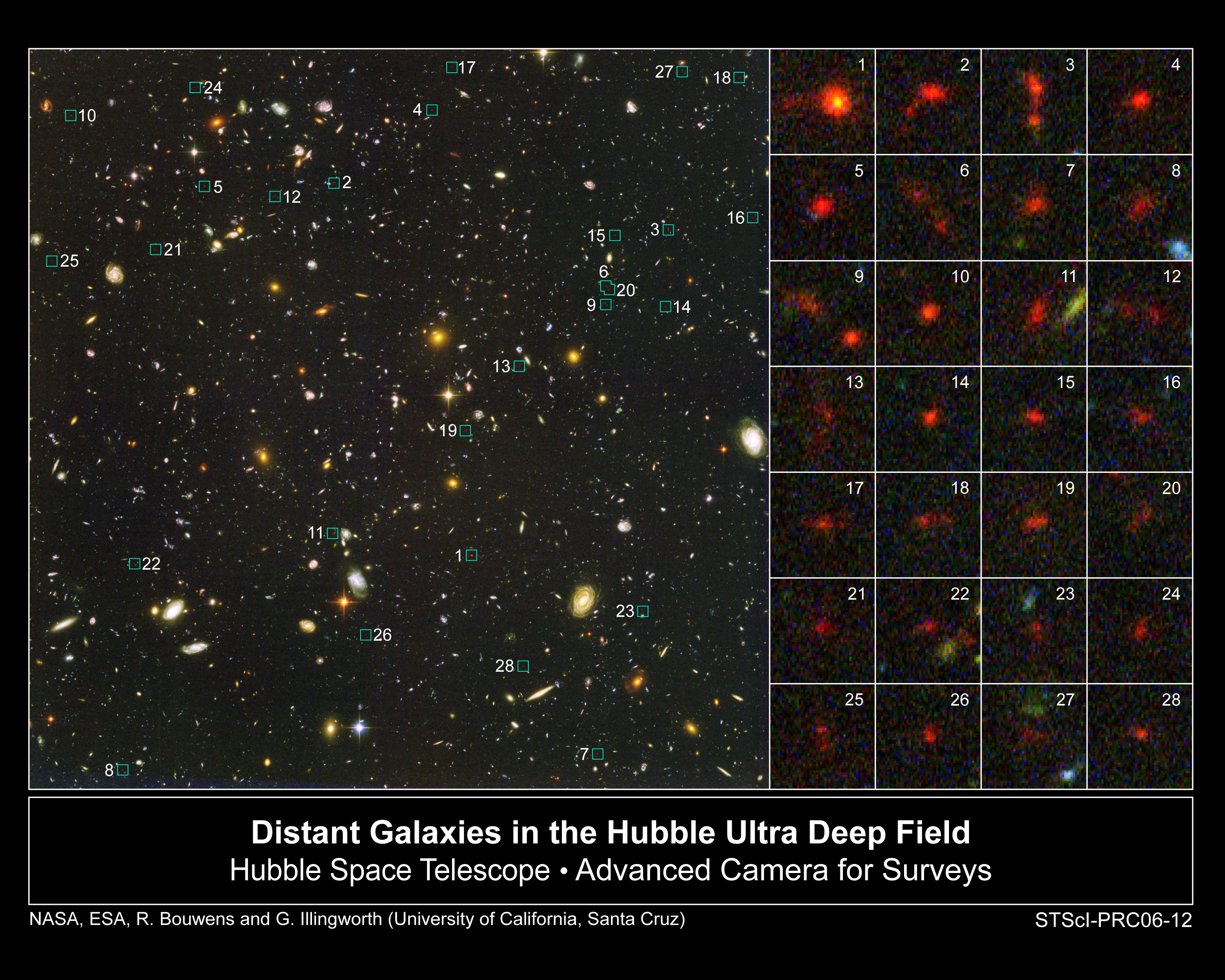
Image credit: NASA, ESA, R. Bouwens and G. Illingworth (UC Santa Cruz).
The Big Bang, of course, is the theoretical framework that makes sense of all these observations, and leads us to our present picture that the Universe was much hotter and denser in the past, and has been cooling, expanding and diluting ever since, something that continues at this very moment.
The clutch confirmation of this theory came in the mid-1960s, when the ultimate prediction of the Big Bang -- that a background of blackbody radiation just a few degrees above absolute zero should permeate the entire Universe -- was detected equally, omnidirectionally throughout the Universe by Arno Penzias and Bob Wilson.
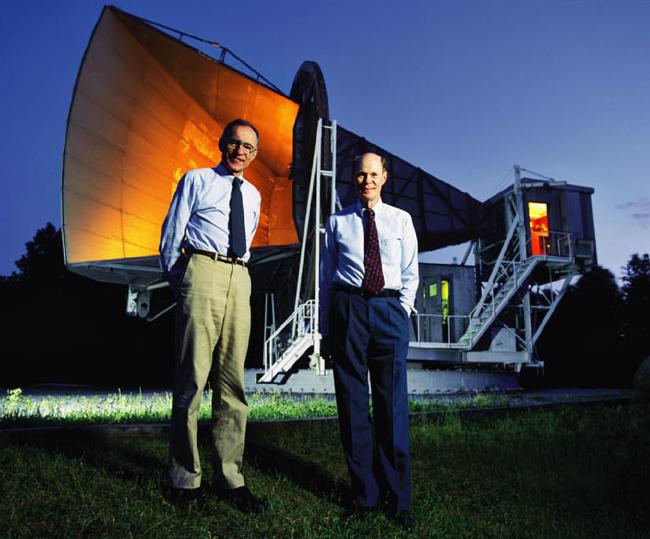
Image credit: uncredited; possibly by the US National Park Service.
This radiation is everywhere, in all directions, and is as close to uniform as you're likely to find in nature. Even though the photo you've most likely seen of it -- the Cosmic Microwave Background (CMB) radiation -- looks anything but uniform.
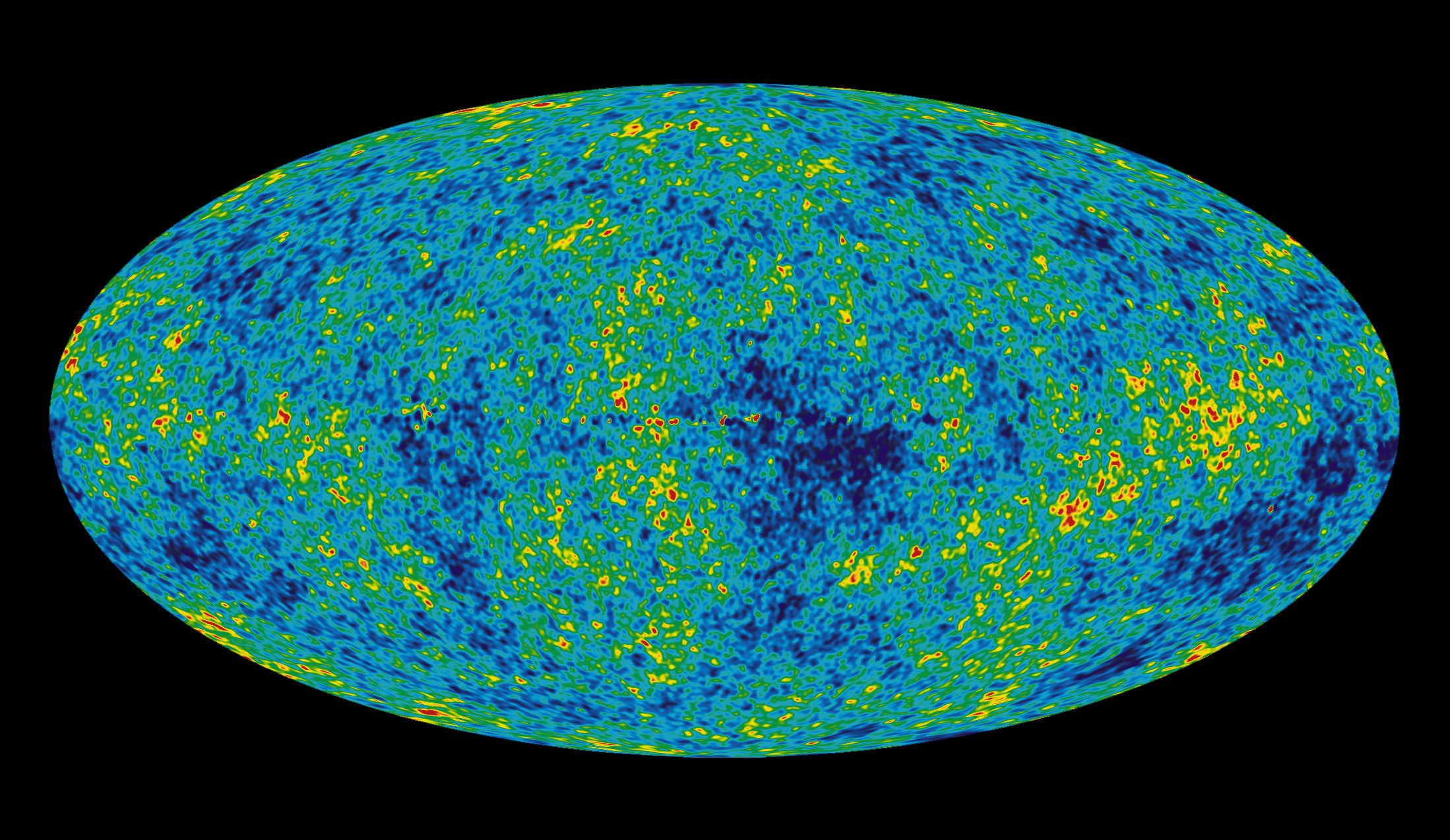
Image credit: NASA / WMAP science team.
That's because what you're looking at here are the fluctuations in the CMB, or the departures from perfect uniformity. The reality of the situation is that the average temperature of the CMB is 2.725 K, and the largest fluctuations you can see are maybe just 100 microKelvin, or on a scale of 0.0001 K!
For comparison, that would be like showing a map of the elevation of the Earth, if the highest mountain on Earth, instead of being Mount Everest, was the hill that comes as your default MS Windows background.

Images credit: Wikimedia Commons and 9Gag.
In other words, it's really uniform! And like I said, it isn't just the fact that it's a uniform temperature in all directions, it's that it follows a very particular distribution: the blackbody spectrum. This was confirmed more than 20 years ago by the COBE satellite, in one of the most strikingly accurate matches between theory and observations of all-time.

Image credit: NASA / GSFC, from the COBE satellite / FIRAS instrument.
What you might notice is that even though this radiation peaks at around millimeter-scale wavelengths (placing it firmly in the microwave region), it extends to both shorter wavelengths (into the infrared) and far out to longer and longer wavelengths, going far into the radio portion of the electromagnetic spectrum.
The wavelengths get so long (and the frequencies low enough) that if you can find an old television set with rabbit-ear-antennae and set it to channel 3, about 1% of the "static" that you see comes from the cosmic microwave background!
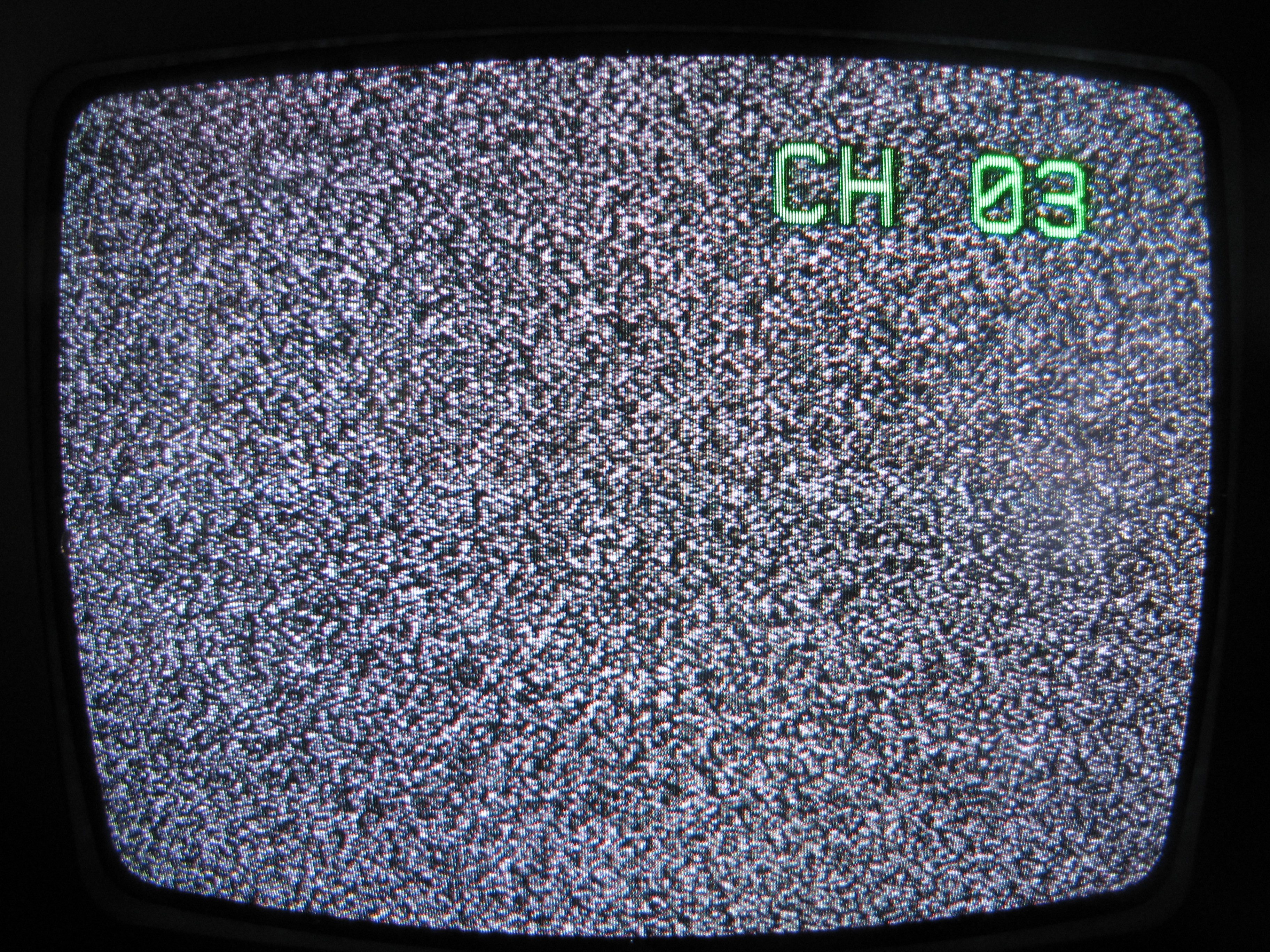
Image credit: Thomas Schrantz, of http://www.mathpirate.net/.
This static would be there even if you left Earth, left the Sun and Solar System behind, and even wiped out all the galaxies from the sky. That's the static that's left over from the Big Bang.
And as the Universe continues to age and expand, it also continues to cool. Which means, if we look back into the past, that leftover radiation should have been hotter back then. Big Bang cosmology even predicts exactly how much hotter it should have been: if you can measure the redshift (z) of a distant galaxy, the temperature of the CMB back then should have been exactly what it is now, multiplied by 1 + z. And the data seems to match, as far as we can tell!
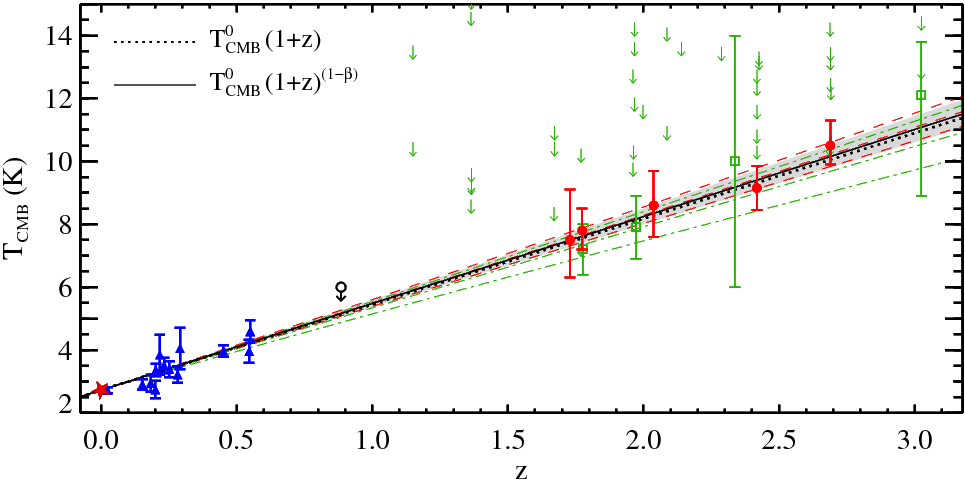
Image credit: Michael Richmond, w/ data from Noterdaeme et al., A&A 526, 7L (2011).
But even at their very best, the techniques used to date still have large error bars on them, particularly at high redshift. But researchers from CSIRO's Australia Telescope Compact Array have just made the best-ever determination of whether this relation holds true at high redshift or not.
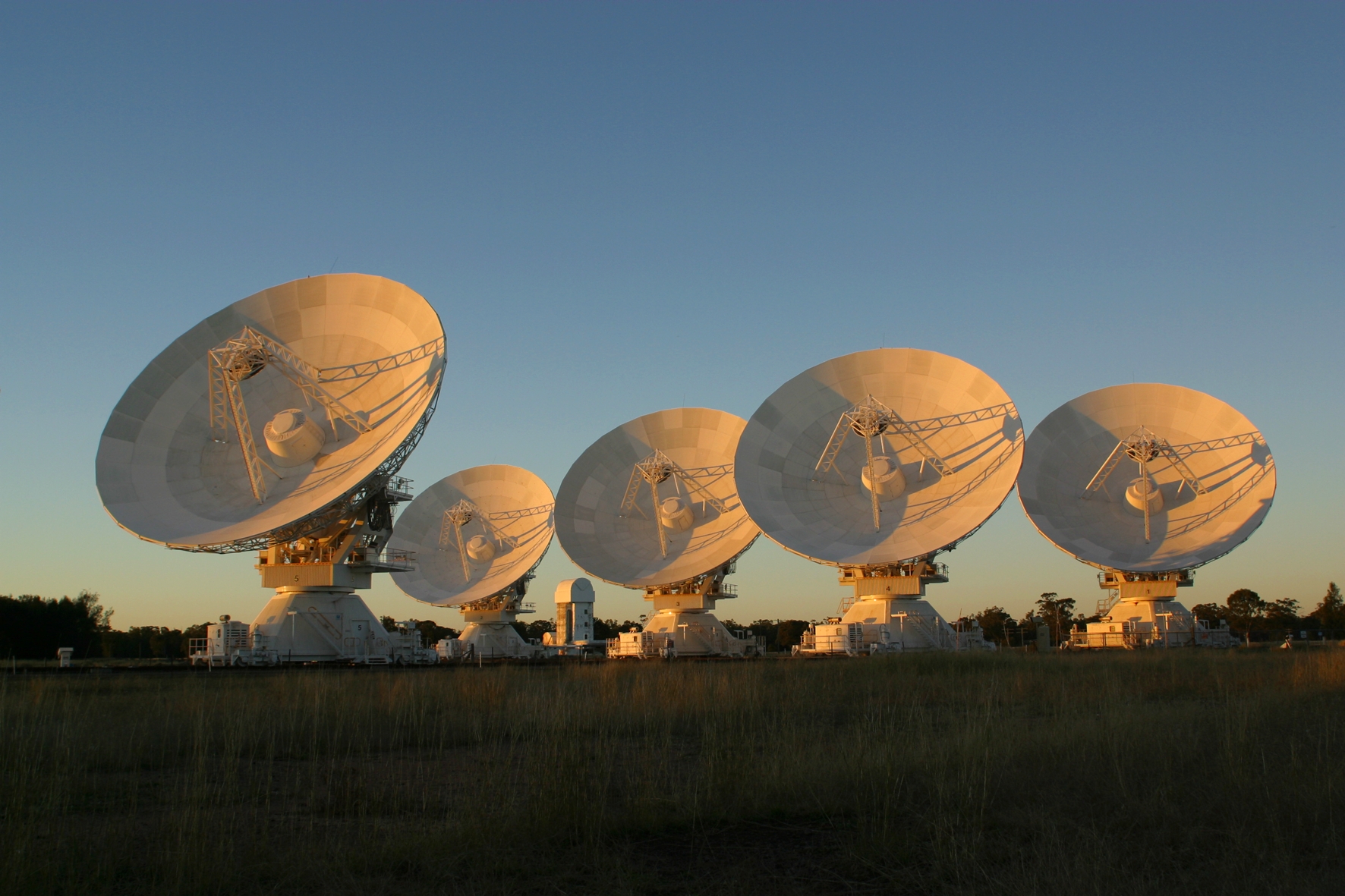
Image credit: David Smyth / CSIRO.
When you head out to the outskirts of a galaxy -- away from the stars or dusty areas within -- the only thing keeping the temperature of the gas there from dropping asymptotically toward absolute zero is the CMB itself. By looking at a particular distant galaxy located 7.2 billion light years away (at a redshift of z=0.89), scientists would expect to find gas at a temperature of 5.14 K, nearly double the 2.725 K we observe today.
Of course, that's far too low a temperature for us to detect it with an array of radio telescopes at this phenomenal distance. But if there were a strong energy source behind this galaxy, relative to our line-of-sight, we could infer the temperature based on the effects of the intervening gas from the galaxy itself.

Images credit: Telescope: N. Junkes; Radio insets: A. Biggs; Intervening galaxy: NASA, ESA, STScI & W. Keel; Quasar: NASA, ESA, STScI & E. Beckwith.
This one particular galaxy was a pristine candidate for these observations, and the researchers (S. Muller et al., here) were able to determine that the temperature of this gas -- in equilibrium with the CMB at that redshift -- is 5.08 ± 0.10 K, in outstanding agreement with the Big Bang's prediction of 5.14 K and the best-ever measurement of temperature at such a high redshift! (New point in red, below.)
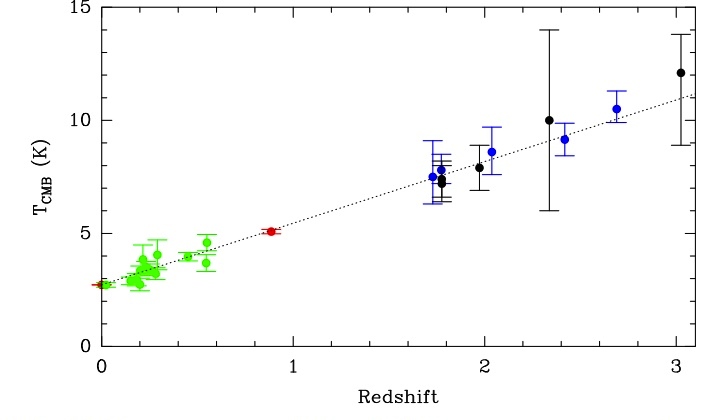
Image credit: S. Muller et al., via http://arxiv.org/pdf/1212.5456v1.pdf.
And there you have it. The Universe has been expanding and cooling for over 13 billion years. It's cooler right now than it's ever been before, and is the warmest it will ever be as we continue to move forward in time. This is a brand new way of testing the Big Bang to this level of accuracy, and once again, the observations show that the theory passes the test with flying colors.
Well done to the entire team that made this happen, and now you know just one more way that we can confirm the Big Bang: by looking back to a time when the Universe was twice as hot!
- Log in to post comments
It just keeps getting better.
I had to reread this post a few times to understand what point exactly Ethan was trying to make.
I guess I'm just dense.
I've you're feeling dense today too; then just ponder the 3rd to last paragraph and the last graph.
OK, I can't follow the research paper yet; so I don't yet understand how S. Muller et al did. And I certainly don't understand in detail what they did.
But after pondering, I do understand what an amazing excellent piece of scientific research. Very nice.
Now I've got to dig through their paper a bit more and see if I can understand just a bit more how they did it, and in the detail just a bit more what they did, and just a bit more of the theory of why they did.
I think I understand the why best; but it's always a good idea to review what I think I know but may not really know so well.
Thanks Ethan for bringing us such interesting research to think about. Nice.
Ethan
Thanks again for a thought promoting piece. Your blog is the best thing I have found in years.....
I have a request... sort of like at a concert.... The first picture on this post shows what I think is gravitational lensing. That caused me to remember some pieces I have read on this, and I can see some of the effect - curved spiral galaxies, etc - but it is clear I cannot make out all of the effect in the images. That leads me to think that there is some pretty cool software looking for the effect. What, exactly, is being looked for by this software? Just seeing a elliptical galaxy that still looks elliptical to me doesn't lead me to see the effect of the lensing. Are there some images with overlays that shows how the light was bent. Maybe with an image overlaying this that shows the effect of the lensing even in the parts of the image that it is quite subtle.
Thanks again.
"team" not "time"
Thanks, carlo!
Ethan, The Atheist Experience often have people calling in about "Where's your proof of the Big Bang, huh? See! All you atheists have your own religion!!!". And, not being scientists, they can't nail these claims definitively.
You may be able to help out their plight by passing on this info to them in a way they can both understand (thereby are able to answer questions about it from the genuinely surprised that there IS evidence for the Big Bang) and communicate to those unwilling to look at anything awkward if it doesn't promise to make them right.
Phil,
That might be a good idea for a blog post down the road; I'll see if I can come up with a good, visually interesting answer to that. Thanks for the question!
Wow,
I don't know the Atheist Experience folks personally, as the only time I've ever been to Austin was just for a week at the Jan. 2008 AAS meeting. But if you know the folks there, feel free to put them in touch with me; I'd be happy to help them out in whatever (reasonable) way possible.
I figured you being a fellow American, it'd be better coming from you, especially since you can then define what you are willing to do, rather than have me offer your effort.
I'll send them a link to this thread.
Holy empirical predictive success, Batman! I can't wait until they find more suitable test cases and start peppering that graph with more measurements of such astounding precision. Correct me if I'm wrong but the BB prediction depends on the relationship between redshift and age and therefore expansion-corrected distance, so the success of that prediction also affirms Dark Energy measurements?
Oh and on another note, I cannot stand the "Derpa-derp science is a religion too!" For one, as Wow would like to inform these nimrods, we do have "proof" in the empirical science sense of evidence. For two, "believing" that the Big Bang is probably a correct model of the physical universe is nothing like "believing" that Jesus died for your sins. Not counting that the former actually has empirical evidence because that was point one. It's just a completely different sense of the word. I "believe" my auto-mechanic when he says my problem is a blown head gasket because he knows cars better than me, but it's not really the same as religious faith in him, now is it? Especially since that belief is rather strongly conditional on my car not breaking down again as soon as I drive it off the lot. If a similar blow to the credibility of the Big Bang Theory were to happen, then belief in it would wane, too. Just... that's not likely. They're making a false equivalence between different kinds of belief -- making the whole argument a PUN!
And besides how wrong and stupid the argument is, there's how pathetic it is to make an argument that accepts your opponent's premise that your beliefs are stupid. "Well you're no better!" is the last-ditch argument of someone who has already lost and can only hope to drag the opponent down with them.
Anyway. Go science!
Great !!! One small typo...nice to know you are human!! "The wavelengths get so long (and the frequencies so high) " ?! Frequencies get low when wavelengths get long!
Fixed; thanks Lou!
Wow,
also send the Atheist Experience a link to Talk Origins Index to Creationist Claims.
http://www.talkorigins.org/indexcc/list.html
They frequently use TalkOrigins, though it's used in email and forum conversation.
It may be that they already have an explanation for non-specialists on this (it was on slashdot too, this paper).
It's not the superbowl between the "fundamentalist theists" and the "fundamentalist atheists"
It's a bit more subtle. Albert Einstein on science and religion.
http://www.sacred-texts.com/aor/einstein/einsci.htm
It's far more subtle than that. But one thing is not subtle: he completely and absolutely rejected religious God.
But faithiests keep insisting that his god is their god.
Because they never conceive of a world where they are wrong, therefore any mention of god must be THEIR god (unless that insinuation is deleterious to their cause).
Spinoza's god is nothing like that which is meant when "people talk of god".
But if it helps, the faithiests will insist they are the same.
Which religion's (i.e. mythology's) God?
"Hinduism is set in a diverse system of thought with beliefs spanning henotheism, monotheism, polytheism, panentheism, pantheism, monism, and atheism among others." wikipedia
Yes In Hindu there is a trimurti
- Brahmā the creator
- Vishnu the maintainer or preserver
- Śhiva the destroyer or transformer
At first glance this is appears similar to the Christian trinity
- the Father
- the Son (Jesus Christ)
- the Holy Spirit. The Holy Spirit is the Giver of Life and some say in death leads souls to the Father and Son
But then,
"An iconographic representation of Shiva called (Ardhanārīśvara) shows him with one half of the body as male and the other half as female. According to Ellen Goldberg, the traditional Sanskrit name for this form (Ardhanārīśvara) is best translated as "the lord who is half woman"... Ardhanarishvara is depicted as half male and half female, split down the middle." wikipedia
So even among theist, there is quite a variety of definitions of god.
Now in Egyptian mythology, we find
- "Ptah is the creator god par excellence: He is considered the demiurge who existed before all things, and by his willingness, thought the world. It was first conceived by Thought, and realized by the Word" wikipedia
Of course the word Ptah is related to the word Pater which is related to the Word father.
Just as the word "word" is related to the word "world."
And the word "universe" is "uni" "verse" or "one" "word"
But why have all the "fertility goddesses", the female goddesses, gone?
The mysteries of life in all ancient cultures was first correctly attributed to woman. A man could not compete with the belly of a woman growing bigger and bigger until a baby was born. There was no greater mystery than this. As well the woman's monthly cycle coincided with the cycles of the moon.
So for the priests of old to overcome the priestesses, they had to invent an even greater greater mystery. Thus Ptah created all the other gods. This claim was to top the other Egyptian top-god Alum. This theology of the top-god debate even back then was really about about power and politics.
Whose Alum?
"Atum was a self-created deity, the first being to emerge from the darkness and endless watery abyss that girdled the world before creation. A product of the energy and matter contained in this chaos, he created divine and human beings through loneliness: alone in the universe, he produced from his own sneeze, or in some accounts, semen, Shu, the god of air, and Tefnut, the goddess of moisture."
So is this a trinity with a female goddess. Sort of in that we got a female as the the number 3 power position. Not a male holy spirit, not a half female Shiva, but a full female Tefnut.
Ultimately, the fertility goddess were demoted right out of the trinity.
At any rate we'vew got Gods the Father and Brahma giving birth to the world.
What irony?
Another irony.
Consider the virgin birth of Jesus Christ.
Yes, Mary, the mother of Jesus Christ, was a virgin.
But what did the word "virgin" mean 2000 years ago.
- a virgin was an unmarried woman. And as we know Mary and Joseph were not married.
- a virgin was a "temple prostitute.
"Sacred prostitution, temple prostitution, or religious prostitution is a sexual ritual consisting of prostitution or other sexual intercourse performed in the context of religious worship, often as a form of fertility rite."
But the modern meaning of virgin is relatively recent.
"Virginity is the state of a person who has never engaged in sexual intercourse... The first known use of virgin in English is found in a Middle English manuscript held at Trinity College, Cambridge of about 1200... By about 1300, the word was expanded to apply also to Mary, the mother of Jesus, hence to sexual virginity explicitly." wikipedia
"God" the creator now looks just like Santa Claus.
But the orginal the creative goddess, the fertility goddess looked like a pregnant woman. And women were the high priestesses.
"In ancient Roman religion, Ceres was a goddess of agriculture, grain crops, fertility and motherly relationships. She was originally the central deity in Rome's so-called plebeian or Aventine Triad, then was paired with her daughter Proserpina in what Romans described as "the Greek rites of Ceres"." wikipedia
Look at that, a trinity with a goddess as the head.
Of course the gods can't be forgotten because we keep using their names. "Ceres, minor-planet designation 1 Ceres, is the only dwarf planet in the inner Solar System, and the largest asteroid." wikipedia
"in Rome and throughout Italy, as at her ancient sanctuaries of Henna and Catena, Ceres' ritus graecus and her joint cult with Proserpina were invariably led by female sacerdotes... , its earliest priestesses "generally were either from Naples or Velia", cities allied or federated to Rome. Elsewhere, he (Cicero) describes Ceres' Sicilian priestesses as "older women respected for their noble birth and character".[ Celibacy may have been a condition of their office"
Of course there is much debate among scholars as well believers.
But my point is this.
Do not follow the fundamentalist down their narrow path of a narrower and narrower points of view about what the word "god" means.
Bring in the full mythology meaning of words, as well as historical understanding to discussion of the words like "god" and "uni" "verse".
Words were the powerful magic by which the poets of the bible (all men) overthrew the female goddesses.
Do not accept the literal interpretation of sacred books; force the mythological andmetaphorical discussion?
At the end of the day is the idea of one God may be about as silly as the idea of "one" verse, i.e. a "uni" "verse".
We seem to be in an age of the "multi" "verse"
Just as the "word" is no longer just in one holy book.
So the "world" may no longer be just one world.
So give the discussion of "god" and "uni" "verse" full range and the appropriate subtlety.
Narrow minded nonsense requires a broad mined irony.
Then you have the Norse. Where the Gods usurped creation and aren't tri-omni's.
Aboriginal (Australian, African and Amerindian) where the gods are local gods. Which were likely the original idea that brought on the Abrahamic faiths because he figured there must be SOMEONE in charge of all these, setting the rules that these "lesser gods" had to abide by.
Because he'd grown up in a world where there was a DEFINITE hierarchy.
So the universe MUST be run that way!
What is a 'make'? And what is a 'Maker'?
What is a 'made'? And what is a 'Mader'?
What made you? And what is a 'Madeyouer'?
What made us? And who is the 'Madeyouser'?
Medusa.
But wasn't there another part involved in making us? I asked her, and she replied "OH, yes, that old thing, the 'Did-yous-part-er'.
Deus-Piter / Jupiter.
When you have Mars Rovers beaming back pictures of alien rocks, not to mention Hubble beaming back its amazing pictures, all this god stuff just gets more and more boring.
Como comentário, sugiro o blog; "Olhando o Universo".