

"To run away from trouble is a form of cowardice and, while it is true that the suicide braves death, he does it not for some noble object but to escape some ill." -Aristotle
"I think suicide is sort of like cancer was 50 years ago. People don't want to talk about it, they don't want to know about it. People are frightened of it, and they don't understand, when actually these issues are medically treatable." -Judy Collins
The fall of 2007 wasn't so long ago; maybe you can remember where you were clearly for yourself. For me, I had recently finished graduate school, had even more recently met my then-partner (and now-wife) Jamie, and in June of that year, we moved across the country to Tucson, Arizona, where I had just started working as a postdoctoral research associate. I also had a new favorite song for-the-moment about growing up,
by Storyhill. I was 29 years old. And one early morning, on my way to work, I got a phone call from my old office-mate in graduate school. I hadn't heard from him in a while, and he sounded more upset than I'd ever heard him before. My best friend from graduate school, the night before, had committed suicide.
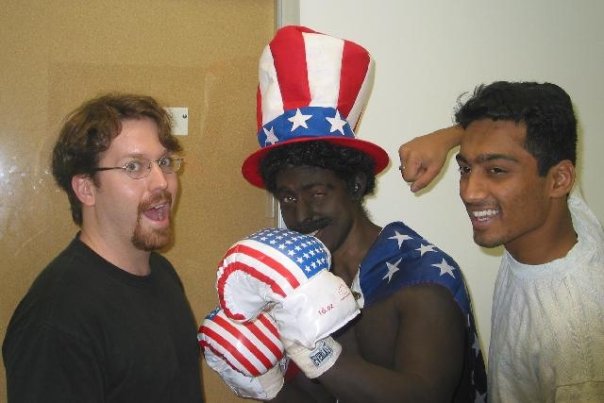 That's Wayne on the left, from Halloween in 2003. Sorry that this is the only photo I have of him; I'm in the middle.
I remember meeting him back in 2001, when I was starting out as a grad student in Florida. He was finishing up a masters in electrical engineering, and was taking a couple of the physics graduate courses to see how serious his love for it was. We had a lot of things in common: we were loud, we were brash, we were ambitious, and each had big personalities. We also had a lot of hard work ahead of us to achieve what we wanted and learn what we desired to know, and became good friends right away.
We'd spend hours and hours together late into the night, figuring out what thousands of students before and after us struggled to figure out: how to make accurate sense of the physical phenomena in our Universe. We'd teach each other how to solve the problems the other one didn't know, share math tricks, and generally made each other stronger.
We also became good friends outside of grad school. We ran and worked out together, I introduced him to ultimate frisbee, he taught me to play hockey. We introduced one another to better and better alcohol. We drank too much together. One time he got into a fight at a bar and I leapt to defend him. That was the definition of a good friend to him, and in a way it cemented our friendship. (We wrestled once to see who would win, and I lasted all of a shameful 90 seconds against him. I didn't know it at the time, but he had studied Brazilian jiu-jitsu, and was impressed I'd given him the challenge I did.) We spurred each other on to go on adventures: we learned to rock climb and snowboard together, we went mountain biking in the sketchiest, most flooded places despite not even knowing what we were doing.
And all the while, we helped each other succeed in the most difficult graduate courses offered in theoretical physics, even as we went down our own paths: me in astrophysics, him in mathematical physics. We went to some of the same physics conferences and supported each other, and shared our hopes and dreams for our individual careers and lives. What we wanted to study, what problems we wanted to solve, what professors we aspired to work with, and what we wanted as people.
Wayne was married the entire time I knew him, and was as supportive as a married friend could ever be to a single person. I met his little sister, whom he loved and worried about tremendously. I met his mom and stepdad, who he was proud had found happiness with each other. I met his wife and his in-laws, who were always kind and generous to me, and even hosted me for Christmas one year. He introduced me to his towering Great Dane of a dog, Mortimer, who successfully converted me from a cat person into a dog-and-cat person. And he was always supportive of my misadventures in dating, no matter where they brought me. He never judged me for it. He was a good friend, and knowing him was a great part of being alive.
By time the beginning of 2006 came around, I was getting close to graduating. I had three publications under my belt and was working on another one (and my dissertation); Wayne had maybe another year to go but was starting to get close, too. But his life had hit a snag; his relationship with his wife had hit the rocks, and he was having a hard time coping with it. In the midst of that, while playing ultimate frisbee, he ruptured his Achilles tendon, and had to walk in a boot.
You never know what kind of darkness someone wrestles with in their own internal world. By mid-2007, I knew that Wayne was having a hard time. His wife had split up with him, and he was having a hard time accepting it. He talked a lot about how he'd wanted kids, and how it was so important to him to have one, stable marriage his whole life through, like his parents never did. He was always so strong in so many ways, I never expected that suicide would even be an option in his mind. On the night of September 20th, 2007, he called me and left me a voicemail. It sounded very cryptic, like he was going away somewhere. It didn't quite sit right with me, so I called him back, and we talked for a while. I asked him what was going on, and he told me about a girl he had started seeing. He told me he was at the bottom of a bottle of whiskey, some vicodin and some other drugs.
Maybe I should have known. Maybe if I had, there was something I could've done, or something I could've told him. Maybe I would have told him about PostSecret or Hopeline. Maybe I would have yelled at him for thinking about throwing away 40 or 50 awesome years because he couldn't face one or two that promised to be very difficult. Maybe I would have reminded him of how strong he was, and told him all the things I knew that he was proud of in himself. Maybe I would have invited him out to Arizona, to take some time and get away from his stresses. Maybe I would have talked to his other friends and been aware of his prior suicide attempts, the ones he never told me about. Maybe I could have been a better listener, or been a better friend at the end.
But I was what I was, no less, no more. I was never one to judge, and I thought the girls, the whiskey, and the drugs were just his ways of dealing with his difficulties. I told him I loved him and I wanted him to be happy, and that's all anyone should ever want for him. I said goodbye, never knowing that I was saying goodbye forever. The next morning, he was found having hung himself.
Once he was gone, there was nothing to do except grieve. I flew back to Florida for the memorial service, and got very drunk with his family and friends, telling stories about Wayne and how we best remembered him. When I got back home, I took something of mine that reminded me of him and burned it, doused it in water, and buried it in my backyard. I built a rock cairn on top of it with a big "W" in front of it. For many weeks, I couldn't let go of my friend who was gone. Finally, one night I had a dream about him, and he told me that nothing could hurt him anymore. We all have our own ways of making sense of our grief, I suppose.
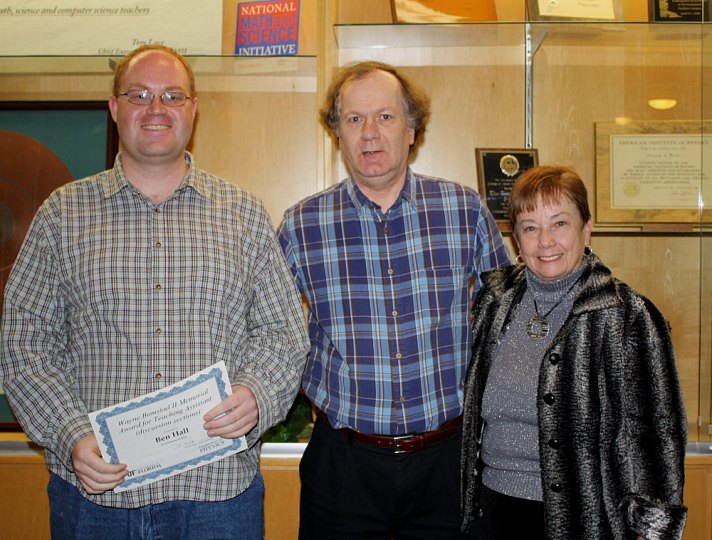 Image credit: the recipient of the 2010 Wayne R. Bomstad II award, with the department chair at center and Wayne's mom at right.
I still stay in touch with his mom (above, right), who's started a scholarship at Florida in Wayne's name, and with his sister, who I do my best to be as close to an adoptive brother as I can.
It's more than five years later, and sometimes I still can't believe that he's gone. There's so much to life that he'll never get to have, and whenever I think about him I think about how much he's missed, and how many things have happened that he would have loved to experience and share in. But most of all, I still just miss my friend.
I'll never know the depths of pain that he was feeling or why he thought that suicide was the only way to end it, but I know he wasn't the only one who's ever felt that way. If you or anyone you know has suicidal thoughts or other symptoms of depression, there is help. There are people to talk to, there's counseling, there's treatment, and there's hope. Please don't wait until it's too late, and know that the National Suicide Prevention Hotline -- 1-800-273-TALK (8255) -- is always open.
They say that suicide touches us all, and I have chosen to no longer remain silent about how it's touched me. Thank you for letting me share this very personal story with you. The Universe misses you, Wayne, but mine is all the more bright for having known you, even if you left it far too soon.
Thank you Ethan for this
I will raise a glass for Wayne right after posting this comment
I will think about how I must listening harder to others
Michael
that's "listen"
Thank you Ethan for sharing this with me. As
Wayne's mom, your words are beautiful and so complimentary to my son. I go through each day wishing I could have done more. I did not understand nor acknowledged how sick my son was with depression. His single spaced letter said it so plain. He felt like he was in a valley of darkness with no way out. In the counseling I have been involved in since, these words are so common with people with depression. I LOVE him so much. He was a true delightful son to raise with so much energy, ambition, interests, love of live, sports, math, friends and always ready to try something new. He would try to be his best at everything he did. I still do that. I tried to be the best mom and now have the most wonderful husband so I can be the best loving wife possible.
As a child, he excelled in so many things starting with jumping ditches with his bike at 5 with 2 sets of stitches within a month. He never had anything less than an A in every subject until he discovered some social friends and events in high school.
His friends are still very special to me including Ethan, who I always will be fond of and keep in touch.
He tried T-ball, soccer, swimming, football, baseball, and enjoyed hockey so much. He was fortunate to go to Russia to play with a Florida team.
Wayne was an avid reader who taught himself to read before he was 4. He liked science fiction including Star Wars, stories by Stephen King, and many other authors, movies and of course video games.
I miss him everyday and also have dreams about him all the time. One dream, he told me not to worry as he was okay.
Throughout college, he received many awards at USF including outstanding Engineer when he graduated. He had 1 patent, had 2 publishes, and received awards at UF with so many accomplishments.
Thank you University of Florida for being Wayne's support, home with every opportunity any Graduate student could desire.
Thank you for this opportunity to share my son's life with you.
Henrietta Shuminsky, Wayne's Proud Mom
,
Wayne was an awesome friend. I'll never forget his laugh.
Graduate school itself can be extremely stressful. The psychological challenges can be larger than the intellectual ones. This may not have been part of Wayne's story, but some grad student environments are truly inhumane. I just found out about the National Graduate Student Crisis Line (1-800-GRAD-HLP). ...20 years after I could have used it.... http://www.gradresources.org/menus/chronicleAug2012.shtml
Another resource to call, even if you are not having suicidal thoughts.
Unfortunately men's suicides are more successful that women's.
Knowing that, we men need to teach ourself and each other to ask for help explicitly. We need to explicitly tell a friend our suicidal thoughts. We need to explicitly ask our friend about their suicidal thoughts.
Very few people that I know, have never had the feeling of complete hopelessness, that complete despair that their life is over. I mean most adults deny it; but most young people admit it.
Denial is one way of coping. But remember "males die much more often by means of suicide than do females, although reported suicide attempts are 3 times more common among females than males.... The incidence of completed suicide is vastly higher among males than females among all age groups in most of the world. In the United States, the ratio varies between 3:1 to 10:1." wikipedia
So guys DO NOT DENY your suicidal feelings past or present. Talk, be open to your friends, to a shrink, to someone who can listen. It may save your life or a friends.
Not everyone can listen. It was too hard even for my mom to hear my pain. THAT'S OK. My mom told me she loved me and that was enough. But my shrink LISTENED and knows everything important.
If you think it is easy being a shrink; just try listening to some blathering idiot planning to jump off a bridge week after week after week. That'd be me.
Seeing my psychiatrist was a fortunate necessity.
Wayne should not have died.
It's not Ethan's, Tony's, Henrietta's or anyone's fault. Suicidal depression happens and can happen to almost anyone. It's like a heart attack; but most of us don't know CPR for depression or suspected depression.
CPR for depression is TALK, be OPEN, and LISTEN, LISTEN AND LISTEN. And get professional help for yourself or your friend. INSIST ON IT. (IT'S LIKE WRESTLING YOUR DRUNK FRIEND WHO'S TWICE AS STRONG AS YOU FOR HIS CAR KEYS. JUST DO IT.) Yeah yeah nobody likes psychiatric drugs and we don't want that shit in our medical record and etc. etc.. Denial can wait till later; urgency NOW.
The best thing my shrink ever said to me was, "If you kill yourself; I will kill you."
The second best thing my shrink said to me was, "You have to promise me that you will not kill yourself and that you will call me when you feel suicidal. And you may have these thoughts for a long time to come." And I promised.
You see, guys and gals, if you don't learn CPR for depression; someone is going to end up dead and everyone else is going to end up with a broken heart.. Someone (ourself or someone we love) who given a chance would have had a longer worthy life.
Always take suicide talk and threats seriously.
Learn CPR for depression; someone's HEART IS GOING TO BE BROKEN FOREVER.
And if we fail and our heart is broken. Yes because if our loved one failed; then we also failed. Then what can we do with our broken heart. Look up above at Wayne's mom, smiling, giving an award in her son'e name. That's the example; we live fully and we remember.
I don't understand the importance of the Aristotle quote. Is it to show changing attitudes over time? The meaning of suicide has changed a great deal over time, so it probably doesn't make sense to compare Judy Collins with Aristotle to show that there has been an advance in understanding. I don't agree with Collins that suicide is like cancer. Maybe we are talking about it more, and maybe it is something that in many cases could have been avoided; but it's something that comes from the inner life of the person, and the path someone takes toward it is different than the path anyone else takes, and it's bound up deeply with someone's attitudes and feelings about the most important things in his or her life. Like depression and body image disorders, there is an enormous stigma associated with suicide. The medical model of suicide, like a purely medical model of other mental illnesses, has severe limitations.
The title of Kay Redfield Jamison's book Night Falls Fast (http://www.mayoclinic.com/health/suicide/MH00058) suggests one of its main themes: in many cases, the decision to commit suicide often precedes an attempt by a very brief period of time, as short as ten minutes. Someone may have been depressed or having suicidal thoughts for much longer, but moving beyond thoughts or feelings is often fatal. The analogy of CPR makes sense, as suggested above (as opposed to a more general medical model for the whole process). Don't leave the person alone. Don't get off of the phone. Tell the person to promise to wait and sit still until you can come over; these kinds of promises can be very effective at preventing the person from acting. Call the person's primary care doctor and therapist if he or she has one. Get the person to an ER. Cancel everything else you have to do until you can hand the person off to a professional or another trusted individual.
In general, the Internet is a disaster for people contemplating suicide. It's easy to find sites comparing the most painless methods, the most effective, etc. Many religious people and groups see suicide as a time to proselytize, which I suspect is not going to be helpful for many people. Fortunately, there are a good deal of sites aimed at giving information about the nature of suicide, its prevention in both near and short term, and its aftermath. The Medline Plus page on suicide is a good place to start: http://www.nlm.nih.gov/medlineplus/suicide.html. And here is a Mayo Clinic article explaining warning signs and questions to ask someone to assess his or her risk at a given moment: http://www.mayoclinic.com/health/suicide/MH00058.
I am pretty sure that (as mentioned above in this thread) the reason men's suicides are more frequently completed is that men are more likely to use guns, and gun suicides are more effective. For example, if you swallow a whole bottle of aspirin, you'll destroy your liver, but can survive, especially if you can get your stomach pumped in time, whereas a firearm is much more lethal.
There are a little more than twice as many suicides as there are murders, looking at ages 1-85: http://www.nimh.nih.gov/statistics/3AGES185.shtml, and almost twice as many for ages 18--65: http://www.nimh.nih.gov/statistics/3AGES1865.shtml.
I have sworn off of reading blog comments and from contributing to them because they usually devolve into rants or worse, and I usually have something important I should be doing instead. But this is different.
CORRECTION to previous comment
The web address for Jamison's Night Falls Fast is http://www.amazon.com/Night-Falls-Fast-Understanding-Suicide/dp/0375701….
I accidentally copied the link to the Mayo Clinic suicide screening page, not a bad place to be misdirected to, I suppose, but still, not what was intended.
Speaking for myself only.
Aristotle's insight is valid today.
“To run away from trouble is a form of cowardice "and, while it is true that the suicide braves death, he does it not for some noble object but to escape some ill.” -Aristotle
My contemplated suicide was running away from trouble and it was cowardice and selfish; I wanted to live but I couldn't face life's struggles; and I didn't know what else to do or believe that anything would or could help or change anything. Jumping off a bridge still is my suicidal thought; it may appear brave; but it is not. It takes much more courage to struggle on miserably; if not for oneself, then for those who care about you.
When you look at the irises blooming and you realize that you can no longer feel beauty. When you can't bear to look at your own face in the mirror, let alone shave. When your mind and body are a fog, and you stumble just walking. When you don't want another day and just just want to lie down and never get up. But you show face and pretend confidence day after day; until you can't.
By then, you are neither strong enough to ask for or even accept help. My college daughter told me to see a shrink. I refused. Terrified, not knowing what else to do; she called a shrink. He made a house call to my bedroom; where I lay tormented under covers. There was no courage except that my method of suicide takes a lot of mental and physical effort to execute: climbing to the top of a suspension bridge and jumping.
He was a kind man. He listened long and then he asked, "Did I want to be admitted to a hospital; or did I want to come to his office the next day?" I chose his office and agreed to take the medications (which my daughter would pick up) and I agreed not to commit suicide.
Medications have their important place; but for me talk therapy was more important. For a long time, talk therapy was one long conflicted whine; I was unable to express rage. Eventually, I learned to be appropriately enraged, "How long do I have to struggle like this?"
"As long as it takes."
So that's my personal interpretation of that Aristotle quote.
So us Tough guys aren't afraid to blow our head off, or jump off a bridge or hang ourself; but we're afraid to cry, to tell a friend our pain, to feel and admit our shame and helplessness. And feeling helpless; do we have the courage to ask for help (I didn't) or accept help from a loved one (I didn't) or accept help from a shrink (reluctantly I did; but I didn't like it one bit.)
So enough about me. I'm OK enough. Talk to my shrink next week. Life is hard and good.
A buddy of mine had done and seen everything in the vietnam war.
At home he was a psychological suicidal mess.
He described his VA psychotherapy as follows.
He was sleep deprived and taunted for days. Push in the chest every hour, "Come on tough guy; tell me how you feel. You afraid of your feelings."
He was a tough guy with medals to prove it, a real soldier who could ignore his pain. Most of his buddies died; he had done and seen things that no man admits.
After several days even he admits his pain, the horror and nightmare by crying like a baby.
That's how his therapy began. It was a group kind of therapy which he continued in for 7 years.
It's a hearsay story from a friend. If you are a veteran, I defer to your explanation of VA therapy for post traumatic stress, suicide or whatever...
Ethan, thank you for the thoughtful post and making me think today.
Ethan, it was nice to see Wayne again even if it was only on your blog. Sometimes I also still can't believe he is gone. Brings back memories of all the all-nighters we pulled for QFT...
Ethan-
That meant so much to me what you wrote about my big brother that was my heart and soul,best friend,and rolemodel... I was the last person to talk to him on the phone that night he took his life and i will never understand why he choose me to hear him commit suicide while i was on the phone but i do forgive him.It made me cry when u said u would treat me like your adopted sister since i had lost the most important person in my life.I call you anytime i have troubles when i cant call my brother and tell him things or share joys that come into my life.Im so grateful to have you be there for me,i love ya Ethan! I know my brother doesnt have to go through pain anymore but the pain in my heart will never go away,i miss him everyday of my life. R.I.P my big brohter<3
Hi Ethan: My dad killed himself when I was 12, and I never understood the depths of his depression until I read William Styron's "Darkness Visible." It's a short, great read and I hope you'll read it and find peace. Cay
RIP Wayne
It's been over 20 years since I lost one of my best friends to suicide. I still miss him. Thank you for sharing.
I've struggled with depression for a long time, and often thought about suicide. There are a lot of things I considered saying in this post, but in the end none of them felt right. Except this: thank you for sharing Wayne's story and raising awareness. Suicide is tragic and when it happens it's no-one's fault, but sometimes just having someone to share with can be enough to make a difference. And on that note, maybe this short Valentine's Day rhyme will put a smile on someone's face:
Long waves are red,
Short waves are blue,
E is m (c to the power of 2).
Each wavelength of light
Has its own unique hue;
I'm made of physics
And so are you.
Thank you.
My brother committed suicide 18mos ago after struggling w/mental illness for years. he was a compassionate competent nurse, a wonderful musician and a loving husband and father. He tried so hard, we tried so hard. Brain stuff is so very tricky.
Moving thoughts Ethan... My brother killed himself.. It was the mid 80's and he had aids.. He felt it a death sentance after watching his partner drain unto a shell.
The Aristotle quote hit me hard. Thanks for posting this.
Thank you for posting this. One of my best friends just did it and you're words are more consoling than any website. You've described everything I feel now. Thank you. RIP Wayne.
RIP Alex.
Physical injury plus lack of sex/love = suicide.
That is the formula for suicide.
My dearest friend, Tess, gave up on life three werks ago. She was the most stable person i knew. She helped me clean up from a three gram per day cocaine habit, let me cry when i needed to. Helped me through the deaths of the matriarchs of my family, and introduced me to a healthy way of life. She helped so many people through hard times and left judgement behind. She died in a mental health facility after being released the night before. I need help to get through this
Remeber your first band ravish. Still think of you
Ps message was for shannon b
our friend has been gone since Aug 2013. he left this earth to give his wife everything. If we had known, we would have given her everything to keep him here. we miss him so much.
Who are you? Mjlover8sixtree?
It was a heart wrenching story..but I can feel how sometimes life hangs heavy;it's not only about problem, but can be lack of it too, which drives people mad. The immense boredom and ennui over powers us.. RIP Wayne. Thank u for posting it. Sincerely
A friend...