

This year's story so far: in May, I accepted some bets but was still trying to come to terms with Rob Dekker. In the comments there we came to agreement on the following:
If both NSIDC and IARC-JAXA September 2016 monthly average sea ice extent report are above 4.80 million km^2, RD pays WMC US$ 10,000. If both are below 3.10 million km^2, WMC pays RD US$ 10,000. In all other cases the bet is null and void
The numbers are a bit of a compromise, and of course the large "null gap" in the middle means a no-payment result is quite likely. Now is a sort-of good time to announce this, because this years ice has temporarily stopped falling off the cliff:
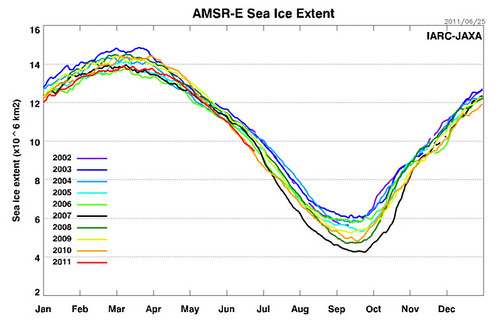
My previous post contains my reasoning, and also the other bets. At some point I'll transfer that and those to here for completeness, but just for now its getting late so I'm going to put this post up.
Rob's view
(this is Rob's side of the story in his words)
There is little doubt that Arctic sea ice is on the decline. This is where William and me agree. What we do not agree on is how fast it will decline in the future.
Let me start by saying that I actually did not want to bet with William at all. I really wanted to bet with the self-pronounced 'skeptics', who continue to call AGW a "hoax", want to dissolve the IPCC, are cherry-pick data that serves their beliefs and accuse this planet's top scientist of fraud and file Freedom of Information acts to sustain their myth-creation media machine.
However, none of them want to put their money where their (big) mouth is. I made several attempts to bet with these guys, to see if they really mean what they said, but bet challenges always go unanswered. So as an advice to people out who are still arguing with climate-change deniers, offer to bet with them, and see how they try to weasel their way out with ad hominums and more allegations of scientific wrongdoing. Either way, it is clear they do not believe their own words, and instead simply repeat spin generated from their political media.
Meanwhile, in the real world, there is a real scientific debate ongoing regarding Arctic sea ice. On the one hand, there are the IPCC's GCMs, which project an Arctic ice free summer by around 2070. GCMs project recovery of sea ice after excessive minima such as 2007, to a slow (30 year) down trend.
On the other hand, there are models of sea ice volume, which show much sharper decline than the decline in sea ice extent indicates. These models indicate that Arctic sea ice is getting thinner and thinner, to the point where (as Dr. Maslowski pronounced) it will "just melt away quite suddenly" in some summer, possibly as early as 2013.
Who to believe ?
As the amateur climate scientist, I don't believe anything unless it is sustained by evidence. For starters, I noticed that the actual sea ice extent has been more than one standard deviation below the mean of the IPCC GCM projections, since the late 1990's and almost two standard deviations below the mean since 2007. The question is, will it return to the GCM projected long-term term trend line, or not. Tsietsche et al 2010 and William's own paper, both based on GCMs, project recovery. However, it seems that GCMs underestimate the ice albedo effect. In Tsietsche et al, only 25 W/m^2 in July is attributed to albedo changes, while other papers observe albedo changes as high as 125 W/m^2 in July (when open water replaces ice cover). That factor of 5 difference is a strong indicator that Arctic sea ice may not recover so easily from record lows (like 2007), but instead accellerate its rate of decline. Besides, the Arctic is a dumping ground for the Northern Hemisphere's heat. Heat due to GHG increases will be pushed into the Arctic since that is the coldest place around. The Arctic is a heat sink since there in no colder plave around except for outer space. That's why Arctic winters are significantly warmer than just a few decades ago and the Arctic is warming up faster than any other region on Earth. Arctic summers however cannot warm much, since sea ice prevents it from going much above 0 C. Common sense tells me that added heat will just go to melting ice. That effect should be noticeable in reduction of Arctic sea ice volume, and it is. The PIOMAS record for example shows a decline of sea ice volume minima from around 17 million km^3 in the early 80's to as little as 4 million km^3 in September 2010. That decline is actually accellerating, and is on track to hit rock-bottom by around 2016, as this graph indicates :

Needless to say that zero volume means zero sea ice extent, which puts some merit behind Dr.Maslowski's statement that it will "melt away quite suddenly" in some summer in the near future, which would make my projection of 3.1 million km^2 look like an immense over estimate of sea ice in 2016. Various in situ ice thickness measurements seem to confirm the PIOMAS estimates, although the gap in satellite ice thickness data (between Icesat and Cryosat) currently seriously hampers confirmation or rejection of these Arctic ice volume developments.
So this bet is really a bet between scientific models of Arctic sea ice development.
William rightfully sustains the confidence in GCMs that are the basis of the IPCC Arctic sea ice projections, while I have more confidence in the scientific findings of albedo change and Arctic sea ice volume models.
Who is right ? September 2016 will tell, or maybe earlier...

And I sure hope that I am wrong. Because if I am right, Arctic sea ice is in much worse shape than the IPCC expects it to be, with potentially disastrous consequences for Arctic wildlife and climate patterns across the entire Northern Hemisphere.
Refs
* neven1.typepad.com
* Lab Lemming - third annual guess-the-sea-ice contest
* A Bad Bet on Arctic Sea Ice Revkin-Romm stuff
* Arctic Death Spiral: Sea Ice Passes De Facto Tipping Point Thanks to Deniers, Media Blow The Story, Again - etc etc - Romm - just here for my reference.
I would have to agree and will do this very soon.
I have unscientifically been observing that when it is warmer than normal where I live in the UK (Oxford) then the rate of decline in sea seems to slow down, and when it is normal or cooler than normal in the UK then rate of sea ice decline is higher than normal.
This is solely looking at the NSIDC data.
WMC comment that the sea ice decline has stopped falling off a cliff at the same time as the mini heatwave in the UK fits. Now I've made my completely unscientific theory public the next test will be later this week if the weather reports prove true and normal British summer returns. Sea ice decline should start falling off a cliff again.
Kevin
Is "temporarily stopped falling off the cliff" a technical term?
The bets are set, the stadium is open: http://www.arctic.io/satellite
No, honestly, why you don't agree to spend the money on something which may eliminate the root of the problem at least a bit. Is it that hopeless?
[Spending money, in a sense, *is* the root of the problem -W]
PIOMAS is a computer model of thickness, not an actual measurement.
[Well done, you've noticed what the rest of us already knew -W]
Real measurement of global sea ice extent shows little trend change:
http://oi53.tinypic.com/wmav6g.jpg
[That isn't a very good picture, but even it shows you're wrong. I find it hard to understand someone who would produce that pic, or (like you) copy it here. Do you really think that writing "there is no trend" is going to disguise the obvious fact that there is a trend? -W]
Actual physical measurement of sea ice volume only has a single year of data so far:
http://www.bbc.co.uk/news/science-environment-13829785
[Wrong; people have been measuring ice volume for some time now, as even that article notes: Scientists already have a number of insights on sea-ice thickness in the Arctic - from buoys, from submarine sonar data, from field expeditions, from aircraft sorties such those by the AWI, and from previous generations of satellite radar and laser altimeters. But Cryosat should be a big boost to that data haul, not least because it sees the entire Arctic basin, right up to two degrees from the pole. - do you not even read the stuff you link to? -W]
-snip-
Kevin, one might say that's NAO for you :-). I've never seen spring sea ice (except refrozen) of under 15 cm thick, so my unscientific guess is once the thickness hits the half a foot mark the remainder may vanish overnight. Now, I've not lived by the Baltic Sea and it's less salty than that high north Sea of Northern Lights, but i guess this doesn't matter, the brittleness of the spring first year ice makes those last 6 inch slabs of a fake floes isothermal and the final melt will take place so fast one could take a timelapse with a frame rate of only minutes to capture that event.
On another tone, Nevens arctic sea blog informs of couple of french explorers attemping to catamaran across the north pole this year, but their boat/ice sled isn't of the ordinary design.
How about a bet on the Antarctic?
http://arctic.atmos.uiuc.edu/cryosphere/IMAGES/seaice.anomaly.antarctic…
[Antarctic ice seems fairly constant, and that appears to be roughly what the models predict (though I could easily be misremembering that... hold on, I'll actually bother check... hmm, that wasn't as easy as I thought. http://www.ipcc.ch/publications_and_data/ar4/wg1/en/ch4s4-4-3-4.html doesn't really help. Does anyone disagree about the Antarctic? -W]
> a bet on the Antarctic?
Already in progress:
http://www.agu.org/pubs/crossref/2011/2011GL047304.shtml
[But that isn't sea ice... -W]
"Besides, the Arctic is a dumping ground for the Northern Hemisphere's heat. Heat due to GHG increases will be pushed into the Arctic since that is the coldest place around.3
So what happens to the NH climate when the ice has all disappeared?
[I wouldn't put it like that. There is a net heat transfer from the equator to the poles, of course. That will continue. If the pole warms up, relative to the equator, then perhaps that mechanism works less efficiently -W]
Anyone wishing to bet with far lower stakes (e.g. fun and games) is welcome to the Lounge of the Lab Lemming 3rd annual ice extent guessing contest:
http://lablemminglounge.blogspot.com/2011/06/2011-arctic-sea-ice-extent…
"So what happens to the NH climate when the ice has all disappeared?"
My guess would be sharper seasonal changes, like the one we here in Finland had a couple of years back when middle october had temperatures of 10-15 C and the beginning of november was -15C :-/, many trees still having green leaves, a somewhat surreal sight. Whether there'll be more snow/rain in winter would depend more on the location/weather, if my guess holds :-| No disagreement on Antarctic here.
Out of interest, what happens if the figures published in Sep 2016 are subsequently found to be in error and revised? Does that lead to a return of the cash? I'd make sure you draw all this up in a contract. ;-)
Apologies for a slight threadjacking.
A recent thread on the Bad Science blog described a Fenland councillor proposing to remove all restriction of property development, refering to archaeologists as 'bunny-huggers' (something more in Eli's line?) and made an incidental reference to 'polar bears will not be seen floating down the Nene in my lifetime' - which is an obvious denialist dig at AGW. Is the meme 'polar bears will not be seen' at some arbitrary location his own creation or is it an established denialist strawman?
Here are the projections.
http://www.ipcc.ch/publications_and_data/ar4/wg1/en/ch10s10-3-2-4.html#…
What is interesting is that the NH is behaving as expected with the observed warmer temperatures although the exact rate is in question. But sea ice in the SH is actually increasing which is counter intuitive and not in line with projections. Seems like a more interesting discussion.
[Is the Antarctic increase significant? My recollection is that it has come and gone, but mostly is not. also, I wouldn't really rely on the multi-model means like that, since quite a lot of GCMs have quite appalling sea ice -W]
considering where the Nene is, we're unlikely to see any polar bears there any time soon. short of a massive temperature drop, anyway. so at best he could be said to be attacking the inane "stop being alarmist, it's not warming. in fact we're about to have an ice-age!" bollocks. or maybe there are ice floes in northampton, and no-one else has noticed.
then again, considering his choice of words and the fact he seems to be a Tory councillor, i wouldn't be surprised if he was a denialist who just got a bit confused.
nice to see another BadSciencer about, by the way :-)
Well, my 3 guesses are:
5.0 with 0.46 standard error
4.8 with 0.22
4.4 with 0.5
The first and last are expected to be biased high and low, respectively.
Doesn't look to me like your $10k bet had much prospect for you to lose, keeping my status as the only person (?) to win a sea ice bet with you safe. Also, alas, not much room for you and me to take up another bet of some quatloos.
I'll be writing this up fully at my place July 1, when I come out of blog hiatus.
WMC,
Looked like it was increasing to me.
http://curry.eas.gatech.edu/currydoc/Liu_GRL31.pdf
(Of course it is by the evil Judith Curry, but I think from before she became evil.)
[L+C is junk: http://scienceblogs.com/stoat/2010/08/round_in_circles_with_accelera.php -W]
'Real measurement of global sea ice extent shows little trend change:'
http://oi53.tinypic.com/wmav6g.jpg
Isn't your position for the Arctic that there is no real change in the trend and that the recent very low values are noise and not a real acceleration? So you agree with tinypic? Because really what tinypic says is that there is a longterm downward trend in global sea ice, and this trend has not changed.
[Aiee, yes, you're right. I misread the caption. As for that, my betting position doesn't fit it; I'm no longer convinced there is no "trend change". I don't think you'd e albe to tell from that pic anyway -W]
Although I note tinypic states that 90% of the sea ice is the Antarctic and 10% in the Arctic which is rubbish.
And your bet for $10k, my impression is that if PIOMAS is accurate then your bet is very dangerous, under the assumption that as PIOMAS volume keeps trending rapidly towards zero the extent will have to speed up to meet zero at the same point. So you are either betting $10k on:
1) PIOMAS is not accurate, or
2) The volume trend will slow down to maintain a steady reduction in extent, or
3) Extent will only join the PIOMAS rush towards zero after 2016.
Or I've failed to understand something.
[A combination of 1 and 2 -W]
Dang, I didn't notice NikfromNYC or I wouldn't have posted on this thread. :-) I just think the Antarctic thing is interesting and brings into question current ice models. I'm not sure if that makes William's bet better or worse.
Continuing from Three views of sea ice. Well, tis now mid-June, so the futurology aspect of the prediction is closing rapidly. Or so you would have thought.It will freeze and in that cold conditions,cant even be away in a distance of 500miles.
Hi!
The second graph (the one with quadratic trend lines for each month) is based on an old PIOMAS version as far as I understand. The anomaly trend has since then been updated and is less negative. It would be really interesting for the discussion going on here to update that figure with the new values! It would probably look quite different.
Compare the current trend:
http://psc.apl.washington.edu/wordpress/wp-content/uploads/schweiger/ic…
with the former:
http://psc.apl.washington.edu/wordpress/wp-content/uploads/schweiger/ic…
[Hmm, that is interesting. I'm not familiar with the PIOMAS model at all, and I've never taken its results terribly seriously. But that they are revising it upwards is worth knowing -W]
Some relevant graphs I worked up a while ago.
It has always appeared a little hokey to me to sum the absolute winter extent with the absolute summer extent from the other pole. It has the effect of 'offsetting' the shrinking seasonal ice from one pole with the growing seasonal ice from the other.
So I worked up a sum of the summer extents for each pole instead (basically phase shifted one pole by 6 months): Global Summer Sea Ice Extents, 1979-2010.
Second, I worked up some long term trends charts. These charts shows the changes in the trends rather than the values themselves:
Trends in Arctic Summer (September) Sea Ice Extent (1979-2010)
Trends in Antarctic Summer (March) Sea Ice Extent (1979-2010)
From the trends charts, it appears to me that ice lose is accelerating - and by quite a lot.
And no - I won't bet this year. Losing $100 once was quite enough. :)
>"[I'm not familiar with the PIOMAS model at all, and I've never taken its results terribly seriously. But that they are revising it upwards is worth knowing -W]"
The reason you think it is "worth knowing" seem unclear.
More details of the change are at http://psc.apl.washington.edu/wordpress/research/projects/arctic-sea-ic…
Seems like they have stopped doing a downward bias correction, which is quite possibly systematic errors in sonar measurements than a real bias in the model results. I don't see much prospect of that sort of adjustment being repeated. If anything, there seems more possibility of them deciding they need to put the adjustment back in than a further adjustment in the same direction for similar reason.
Could be all sort of other reasons for other adjustments but are future adjustments more likely to be upward than downward because the last adjustment was upwards when the reasons are likely to be different?
If this is the reason for you thinking it is "worth knowing" the direction of the adjustment, then it seems to me the details matter.
Or is the reason it is "worth knowing" direction of change more about understanding whether potential bettors are likely to be feeling more or less confident?
The GCM are wrong with respect to Arctic Sea Ice. They miss the importance of the thin, low salinity surface water that the Arctic Sea Ice floats in, and they miss the heat content of mid-water currents advecting heat from the North Atlantic. Also, the GCM miss the fact that small breaks in the ice convert the Arctic from a dry environment to a moist environment.
[I don't believe that. What evidence do you have? -W]
Moisture in the Arctic atmosphere is a huge feedback that that was not properly calculated.
The Arctic Sea Ice is not long for this world. We are just one big summer storm from a large loss of sea ice. The period of 2012 to 2016 is a very good bet for substantial seasonal loss of sea ice. 2016 is also a good bet for extinction of polar bears, Arctic seals, and walrus.
Increased humidity in the Arctic is changing global circulation patterns much faster than the GCM expected.
Sorry guys, but the GCM underestimated -- everything!
A possible explanation for faster melting:
http://www.theglobeandmail.com/news/technology/science/canadian-scienti…
[Hmm. There are things wrong with that article - most obviously relying on a 2007 paper - and I was always rather dubious of the Catlin thing - it looked mostly likely people doing an "explore" with a veneer of science (oh, I remember: http://scienceblogs.com/stoat/2009/04/wandering_across_the_arctic.php). But if they have a paper in preparation, then good - we'll find out what they found out. They aren't in a great hurry though - the walk was 2009, no? -W]
It looks like they have done a survey each year starting in 2009 (with different objectives each time?):
http://www.catlinarcticsurvey.com/2011/06/28/initial-analysis-on-arctic…
http://www.bbc.co.uk/news/uk-england-cornwall-13940234
It's nice that eskimo traditions of taking emergency sweet water from thick multiyear slabs of ice (as first described by Nansen in the 19th hundreths?) finally gets recognized in western press science reporting.
http://www.theglobeandmail.com/news/technology/science/canadian-scienti…
nuff said.
@Daniel #21,
Indeed PIOMAS removed their adjustments for bias in the (sonar) submarine ice thickness validation measurements.
I'm not sure if that is realistic, since the submarine measurements as tested against actual in-situ measurements do reveal a bias :
http://psc.apl.washington.edu/wordpress/research/projects/arctic-sea-ic…
As crandles points out, this is "quite possibly systematic errors in sonar measurements than a real bias in the model results" and these adjustments won't be repeated and possibly would have to reversed if actual measurements keep confirming the sonar bias.
Here is the (62 page) report that explains everything and more you ever wanted to know about PIOMAS and it's validation techniques :
http://psc.apl.washington.edu/wordpress/wp-content/uploads/schweiger/pu…
And here is a graph of the 'new' PIOMAS volume numbers over time (this graph gets updated twice monthly, or whenever PIOMAS updates their results) :
http://img607.imageshack.us/img607/4533/piomastrnd4.png
So, is (adjusted for sonar bias or not) PIOMAS right ? Heck, we really don't know. But at least their numbers seem to match past ICEsat measurements and on-going in-situ measurements of ice thickness quite nicely, and better than anything out there right now.
Rob Dekker #28
Thanks for the info. I also managed to find an update of that second graph of this blog post over at neven1´s blog. This is apparently what it looks like with the new PIOMAS values:
http://img42.imageshack.us/img42/2294/piomastrnd2.png
Looks very much the same to me.
There's a small plug for your brave bet at about 0:17:20 in the new edition of The Climate Show.
"I have unscientifically been observing that when it is warmer than normal where I live in the UK (Oxford) then the rate of decline in sea seems to slow down, and when it is normal or cooler than normal in the UK then rate of sea ice decline is higher than normal."
Ha! I imaged the same thing!
>> http://www.agu.org/pubs/crossref/2011/2011GL047304.shtml
> [But that isn't sea ice... -W]
Just wondered if the same process affects sea ice from underneath, or contrariwise if more melted glacial fresh water makes any contribution to sea ice thickness or extent.
[Ah. There is a whole pile of complicated sub-ice-shelf melting/refreezing stuff, people in BAS used to do loads of it, Pine Island Glacier and all -W]
Today's view
of this summer's
"ice free" Arctic
is here
my dear
tinyurl.com/icefreearctic
[I guess one of us is missing the point, but I think it is you. Who was claiming that the Arctic would be ice free, now? -W]
Want to increase our four bets to £100 each from £67 each?
To bring them together:
we are betting £x that either 2011, 2012 or 2013 will beat the minimum extent record of 2007, based on daily IJIS SIE numbers (which makes it more fun), but the record has to be confirmed by the monthly NSIDC extent number.
Crandles offers 3 separate bets on the average of [2012, 2013 and 2014] (to be above/below 4.294, I take the high side), of [2013, 2014 and 2015] (4.119, ditto) and of [2014, 2015 and 2016] (3.94, ditto). In the event of anything that clearly throws things out like a VEI6 volcanic eruption bets are voidable.
[Its looking a bit dodgy, isn't it? There is a little downwards wobble. Never mind, lets up the ante, it will be more fun. yes, I accept -W]
So far it still looks like it is back to "temporarily falling off a cliff." As of this morning IJIS and NSIDC show the sea ice extent trend is at a crossroads: will it track with 2007 or 2010? I'm betting 2007, meaning a minimum of 4 million km2 by the end of ice melt the 3rd week of September. I'd bet anybody that it will be less than last year (but certainly not 3.1 million km2). Any takers?
Nik From NYC.
I'm on record as maintaining that the Arctic won't be summer sea ice free this decade.
But by looking at those images at 250m/pixcel you get a totally different view of the ice than the one you seem to have.
http://lance-modis.eosdis.nasa.gov/imagery/subsets/?subset=Arctic_r05c0…
Warning- large image.
A few remarks regarding the new version of the PIOMAS model:
Daniel: "Looks very much the same to me."
A couple of us at Neven's have been tracking PIOMAS trends since the time they only published the graph or their results - myself (I'm the original author of the graph in Rob's view) and another poster. I stress this is only a curve-fitting exercise (and the one shown was only a beta version anyway), and makes no claims to predictive capacity. I redid the graph when the revised model output was released, and found the zero intercept for September was pushed forward only 2 years from 2016 to 2018. The other poster uses what is probably a better curve-fitting algorithm, and still finds the zero intercept for September at 2016. So it seems the change only extends the estimated life of September ice by a year or two.
http://neven1.typepad.com/blog/2011/07/piomas-june-2011.html#more
Because the output for recent years has been below the linear trend, the slope has been increasing steadily. A year ago the linear trend reported for version one was -3.2 x 10^3 km^3/decade. Before version one got switched off it peaked at -3.6, while version two started at -2.8. However, this month the trend is listed as -2.9, and given the sharp drop this month, will continue to rise in the short term. It seems likely that the reported trend for version two will lag 18 to 24 months behind the trend produced by version one output, reiterating the point that any respite indicated by the new model is minimal.
The revision did not uniformly ramp up their model outputs, but (AFAICT) tightened error margins on their successive runs (ie seperate model runs produce less variable results than version one). The new results converge on the higher end of their old output, but still fall within the range of values from version one.
Echoing crandles "bias" point, the PSC website refers to the downward slope of the trendline as a conservative estimate - that is, the actual conditions (assuming the model is accurate) are declining more swiftly than the published trend. Is it accurate? I lack the expertise to say. It is validated against real thickness measurements where available, and appears to show good results. But, like the famous line about Camelot, "it's only a model..."
Thanks Frank, for your perspective on the PIOMAS version differences. And forgive me for not properly crediting your graph in the text here.
Incidentally, it seems that the new version 2 graphs that Daniel and me linked to (I think they were posted by Wipneus) have been taken off imageshack.
Do you know what happened there ?
Either way, the PIOMAS (version 2) numbers can be downloaded for free from the Polar Science Center :
http://psc.apl.washington.edu/wordpress/research/projects/arctic-sea-ic…
Quick follow-up : The mystery of PIOMAS version 2 graph is solved : Wipneus posted new graphs and deleted the old ones :
http://neven1.typepad.com/blog/2011/07/piomas-june-2011.html#tp
>And forgive me for not properly crediting your graph in the text here.
LOL - it's cool Rob. I wasn't asserting intellectual ownership (I suspect that might be like trying to assert IP on a Wikipedia edit, but thats rather off topic.
I only mentioned it as background to going on to say that the new version didn't change a huge amount with regard to September minimum bets.
Addendum: The new version's output has more of an impact on winter-spring ice volume, and the same curve fitting exercise has version two April pushing out nine years compared to version one April. That's not relevant to your bet though, and when we do reach the point of contemplating ice free winters, the dynamics will have changed so much that trying to do a simple extrapolation from past data will be even less informative than now.
Next Search sea ice outlook report is out and the movement is geneally downward.
http://www.arcus.org/search/seaiceoutlook/2011/july
[Hmm, I see some familiar names in there. And am I right that the spread is less than previous years? -W]
There is only 3 predicting less than 4.3 whereas there were 4 previously but there are now 10 in the 4.3 to 4.7 range compared to 7 previously.
So for 13 out of 16 contributors a new record low wouldn't be teribbly surprising. Are you regretting giving even odds for no record in any of 3 years yet?
[No, not yet. I can't say I'm exactly comfortable and I'm not encouraging more bets but I'll hold my position -W]
The July 2010 report range of 1.0m to 5.7m is a rather wider range than this year's 4.0m to 5.5m. Even ignoring the 2010 1.0m outlier the range is narrower this year than 2010.
However, July 2009 report range was the narrowest at 4m to 5.2m. July 2008 report range was 3.15m to 5.25m. So the community seems to be swinging wildly from wide ranges to narrow ranges and back again.
You may have noticiced I think +/- 1m might underestimate a 95% credible interval; and that is regardless of the claims of some contributors to have an error estimate of +/-0.2m but saying that will probably mean the outcome this year falls half way between 4.2m +/- 0.2m and 4.7m +/- 0.2m and both of those (as well as most others) will look reasonably close to their range if not within their range.
Based on today's value and the 2002-2010 observed magnitude of the decline from this date to the minimum, the 2011 expected IJIS daily minimum would be 4.33 with a confidence interval of (3.45, 5.17) ...
... assuming that the statistics are stationary. It's a somewhat reasonable assumption since there doesn't seem to be any sign of correlation between the amount of ice in mid-July and the magnitude of the decline below that amount.
Daily min in 2007 was 4.25, and monthly was 4.38, right? So odds of beating 2007 this year are getting close to even.
http://www.alaskadispatch.com/article/new-reason-rapidly-melting-arctic…
---excerpt---
a group of U.K-based explorers walked more than 500 kilometres of sea ice in the High Arctic, taking temperature readings of the ocean below them.
They found a layer of cold, salty water about 200 metres down that they suspect has come from the melting of first-year ice.
That meltwater has forced the relatively warmer water to the surface, where it's speeding up the decay of more ice.
'Complicated processes'
"We're trying to understand why the ice is melting so fast," said Simon Boxall of the Catlin Arctic Survey. "It's not just down to simple warming. There are more complicated processes."
The speed at which sea ice is disappearing in the Arctic has far exceeded almost all predictions and alarmed climate scientists.
A 2007 paper from the National Snow and Ice Data Center in Boulder, Colo., found that the projections of the UN-sponsored Intergovernmental Panel on Climate Change were already obsolete three years after they were published.
----end excerpt---
Are you following the discussion of your bet over at Lucia's? First she declared that RD was doomed. Then she discovered she'd been analyzing December ice volume rather than September ice extent (oops). Now she seems to have concluded that the most likely outcome is nobody wins, but that RD is substantially more likely to win than you are.
[Nope, don't read Lucia. However, if she thinks the most likely outcome is no-one wins, she has successfully read me -W]
Here's the thread:
Connelly-Dekker Bet: Actuallyâ¦. Robâs got a very good chance of not losing
Oh, and don't blame me for the spelling of your name in the thread title....
[Nope, don't read Lucia. However, if she thinks the most likely outcome is no-one wins, she has successfully read me -W]
For her weighted combination of five empirical models, she gets a 55% chance of "No one wins", a 36% chance that Rob Dekker wins, and a 9% chance that you win.
That's a pretty high chance of losing $10K. Of course, her models might not be a good match for reality.
[When you provided the link, I had a quick look, and got as far as "I picked a couple of random models" before giving up. What is the point? -W]
William, J,
Lucia's analysis is a (past) trend analysis which does not include physical effects. I can't deny that it feels good to see that trends favor me winning, but I noted there that increased variability (which is also projected in the IPCC models and Kay et al 2011 etc etc) during steep decline means that the chances of you winning are higher than she projects. Either way, we don't know what will happen. We are all using models, and for the Arctic specifically the constraints on parameters are in the range of 10W/m^2, which leaves a lot of ice/year to melt or grow. And we don't know what that means for extent yet.
I'm just already very happy that we decided on our difference of opinion and came to our bet agreement in a civil and rational manner. Seems that Joe Romm and Andy Revkin have a harder time figuring out what they disagree upon, with rather 'dirty' concequences :
http://dotearth.blogs.nytimes.com/2011/08/11/a-bad-bet-on-arctic-sea-ice
I hope they can realize that they are just clashing egos right now, and identify/quantify what exactly they disagree upon...
[Thanks for that bet link; I'll add it to the refs. Yes I'm glad we managed to agree, though I'm feeling a little nervous right now -W]
Something to feel nervous about.
(source)
J, that link shows the same thing as the graphic Rob provided up in the main post. But note that the PIOMAS model projections show no such thing (just the boring old ice-free period by mid-century). That would seem to imply a rather sharp turn in the trend, and considering the state of the central pack as of last week (~.9 meter pancake ice per Polarstern obs) I'm really wondering how that's going to happen.
Rob, I'm surprised the bone of contention between Revkin and Romm isn't clear. Revkin has decided that we have several decades of slack, more than enough time to implement that RP Jr./Lomborg/BTI techno-pony/adaptation approach without having to do much of that inconvenient mitigation. The science was saying something not inconsistent with that ~10 years ago, and Revkin seems to want to discount subsequent developments. But where he pisses Romm off in particular is by grasping at straws like the speculative Arctic refugium business, or by placing far too much weight on Kay et al. (which note failed to cite the pioneering work of Connolley & Bracegirdle!).
Consider this Revkin comment that Romm highlighted:
OK, so Andy dislikes worrying. Perhaps he could do us the favor of not worrying quietly while avoiding putting garbage remarks like that on his blog.
I wanted to note also what poor journalistic practice it is for him to use ~5 year old quotes from scientists in a post on current ice conditions.
Steve, thanks for your POV.
I agree that Andy's statement is upsetting, not just because it seems to contradict the reality of rapid changes in the Arctic, but also because it reveals a level of indifference with these changes which is surprising for a blogger at Andy's level. It's like Andy does not care what happens in the Arctic.
I would like to make a few sidenotes though on the disagreement :
(1) First of all, I think both Joe and Andy need to turn down the volume of their own rethoric. Anyone starting a blog with "In his predictable assault on my piece..." cannot possibly be open to a discussion or dispute resolution. With so much noise between them, neither one can listen.
(2) I think Romm made a couple of mistakes in his bet proposal :
First, he was not clear about what he wanted to bet on. Only after inquiry, it turned out he wanted to bet on ice volume. You can't bet on ice volume, since there is no observation of ice volume. He should shoot straight and propose a bet on ice extent or ice area. Not volume.
Second, he did not propose a "neutral" zone for variability. Without that, it's a win-or-loose deal which could be decided by variability alone, which is a bad bet (as Andy pointed out).
So Joe was shooting from the hip, and Andy responded in defense, and neither on had the clarity of mind to recognise the flaws in the proposal and correct them.
(3) Andy's statement (the one you mention above) is not scientific and actually very political. What exactly is an "irreversibly slushy state" of the Arctic ? And to which extent does the Arctic need to decline until Andy feels that it becomes "relevant to todayâs policy debates" ?
So, with each of them putting huge rethoric shields around there own opinions, and being vague about what they really mean or believe what is important, their statements leave very much open for the dis-infomation industry to mis-interpret. And so it did.
Let me finally note that Andy's statements are consistent with the IPCC projections, while Joe's statements are more consistent with much steeper dcline. In that regard, the difference of opinion is very similar to what William and me were facing.
So that's why I suggested that they get together and quantify what they disagree upon, so that they can then decide on either a "good bet" or a consolidation and clarification of their mutual opinions.
Steve said : I wanted to note also what poor journalistic practice it is for him to use ~5 year old quotes from scientists in a post on current ice conditions.
I have to agree with you there. Especially since the same scientists he uses in his defence he also puts down when he discards the "Death Spiral". That's really bad journalism practice. And may I add that I'm appalled by Andy referencing Motl on the "sensitivity of the Arctic". If you follow the link to Motl's site, and to the comments, you will find a rant from Motl which defies reason (against me actually, when I confronted him with some of his questionable assertions). He calls reports on Arctic ice decline "breathtakingly idiotic propagandistic proclamations ", calling me names and claiming that I hold a "obsessive religion - which is as hostile and dangerous as the radical Islamism". And other assertions similar to the Oslo killer's proclamations.
Looking at these rants I seriously wonder if we won't find Motl in the news one day in a completely different context. This guy has issues.
[There is no hope for Motl in that context, and for Revkin to ref him is inexplicable. Like so many others, Motl is saner once you talk to him - well, I have a bit, by email, and he does manage to tone down eventually -W]