

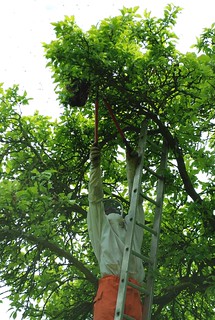
 The peace of Sunday afternoon was disturbed when a friends children called to say, very politely, that err there was a swarm of bees in their garden and might they be mine? Possibly, I said, though you can't pin it on me guv, but I'll come and look anyway. If you're not used to looking at swarms of bees, its the dark blob just to the left of the point of the loppers, and the little specks in the sky to the left again are bees. For some faint idea of how heroic I'm being see how high the ladder is - bees delight in swarming into inaccessible locations.
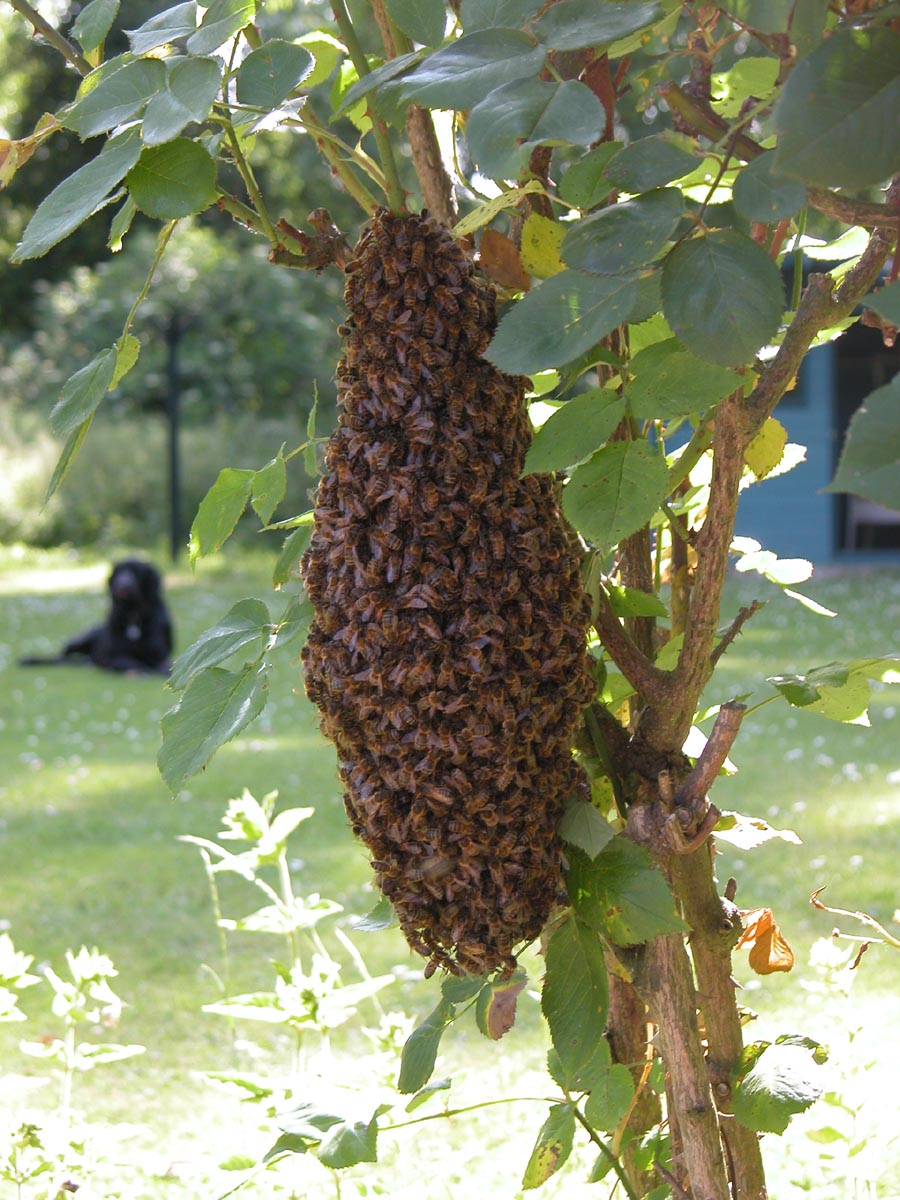
 What I'm doing in the pic is cutting away excess branches. The usual next step is to snip the branch they are on, so the whole swarm falls into the box you're holding with your other hand... except I need both. So Ben, whose garden was holding all this wonder, thought of hanging a bucket from a very long pole that he just happened to have in one of his many sheds.
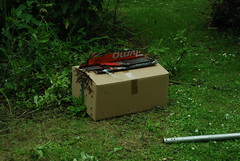 From there it is all easy: drop the bees in the bucket, put the bucket in a cardboard box, loosely put on a lid, and then all the little bees who got all excited and flew up in the air follow the scent of their queen and end up inside the box. I even found a colony-less friend who wanted a swarm, so that was all very good.
At which point you could justly complain that I haven't lived up to my post title. But wait. Today - at very long last - I finally got around to taking the honey off my own hive, for this "spring", unseasonably delayed by bad weather for about a month.
This brings me to my exhibit:
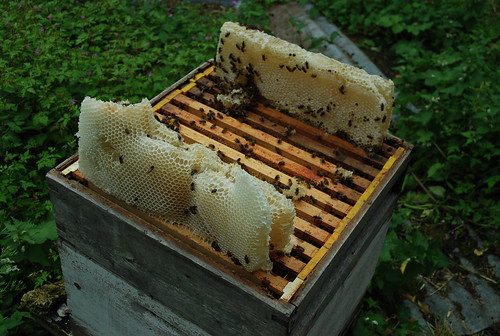
which (the expert among you will recognise) is what happens to your hive if you don't have enough frames to fill the super over winter, so you just leave a gap at the edges and hope you'll remember, come springtime, to fill in the gap. And then don't. Of course, the bees happily build their own comb to fill the gaps. Here's a close-up; and here is the offending super, with the good comb in the foreground (standing on top of the spare hive) with the real hive in the background.
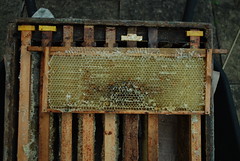 After that its all plain sailing: bring the usable frames back down the garden in a wheelbarrow, cut off the cappings with a breadknife (the nectar, as collected, is too thin to store. So the bees concentrate it by fanning in the hive. When each cell is ready, it is capped off with wax for their over-winter use), and then spin out the honey in a rotary extractor. Or in this case get Darling Daughter to do for me.
That leaves you with empty frames (some damaged but never mind: the bees are very good at repairing them) that can be returned to the bees for re-fill and the autumn recolte.
Oh, and the garden still looks a lot like this.
You need a telescopic tree pruner. A bucket could be hung from lopping/sawing head for the final cut. About £20 for a 3m version. Easy to use and you might not even need protective gear at that distance. Unless things went wrong.
(I'd keep bees but I don't like honey.)
The thing I recall about beekeeping is it's not harder to do your beekeeping better than the bees would on their own, in some respects.
Near me there's a a stretch of street where new phone poles have several places gone in next to old decaying ones. Most of the lines, I think all of the power lines, have been moved, but the lowest tier stuff is still on the old poles.
And in a hole in one of the old, cracked, starting -to-hollow phone poles, growing beehive, comb developing nicely, lots of bee traffic.
I hope the hive can reproduce and swarm, but, best of luck. I'd be afraid to call any attention to it.
Most people just walk by not noticing, and the bees ignore the people. So far so good. It took maybe three or four minutes standing there before a couple of obvious guards flew out and looked at me and lit on my shirt, and they weren't ready to sting. Amazingly trusting/domesticated behavior compared to ones I've been around elsewhere so far, but maybe once they have more invested they'll get more attentive.
But what a bad place to have a whole hive at risk.
[If you don't threaten bees, they *should* be friendly. Mine are; if I'm not bothering them, I can stand a few feet from the hive (tslightly off to one side) and they'll just ignore me. OTOH, a wild hive, in the UK, will die out due to varroa; they need treatment. Good luck to yours! -W]
I can offer you some hornets if you are interested:
http://julesandjames.blogspot.jp/2011/08/jules-pics-more-dangerous-than…
No I thought not :-)
http://media.sacbee.com/smedia/2012/06/13/20/18/10HAIG.Em.4.jpeg
A 3 minute walk from my house, there's a major arterial street with old olive trees about 10 feet from the sidewalk. One of them has had a bee colony in it for the 5 years that I've been here. They go in through cracks in the base - I imagine they could be killed, but no way to remove them. Nobody seems to care though, or maybe even notice them besides me. Each winter I wonder if they've been destroyed, and then I start seeing them flying again in March.
Kind of cool to have a feral bee colony along a busy street in my semi-urbanish area.
Yeek. I knew in the mid-1970s that trouble was on the way, and didn't take up beekeeeping when I moved from the midwest, where I learned it, to California, where big truckloads of hives are shipped long distances transporting diseases with bees. Disaster in the making.
And, yep: http://www.beesource.com/point-of-view/adrian-wenner/varroa-mite-spread…
The libertarian approach doesn't work. Treating the whole field -- feral and domestic alike -- might.
But that's socialism, isn't it? What will the queen say?
The idea in the long run is to breed resistance -- a resistant _behavior_, genetically controlled, that increases the
cleaning activities that have shown success identifying and removing the mites.
That is already identified and queens carrying that trait being shipped out, with the expectation the resistant trait will spread through feral and domestic honeybees. Good idea.
Dunno if it's available in the UK but the original strain came from Russia so it might well be further along there.
Spot on with this write-up, I actually think this web site needs much more consideration. I’ll most likely be again to learn way more, thanks for that info.