

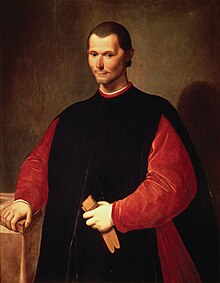
 Continuing with your alas-all-too-regular diet of not-science here. But there is so little real going on. Anyway, Eli is pushing Machiavelli, and a while ago PK asked "How would Hobbes organize society to avert climate change?". I had no answer, so I ignored the question, but now return to it.
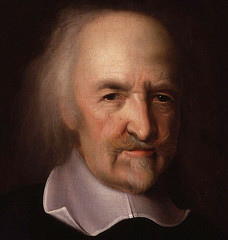
Hobbes has little to say directly about policy: his focus is on the justification and structure of government. Read Leviathan. He is a great believer in a strong central authority, and the meaningless of contracts made without a power to enforce them. So stuff like Kyoto would be out. Hobbes view is that the primary responsibility of government is Peace; or in other words the security of the population; the sovereign can and should do anything necessary to achieve that (see part II for details). Implicit in this is a long-term view; combining that with prevention of disorder, you could plausibly argue for a Hobbesian sovereign to take preventative action on climate change.
Given that, I can see no reason why said sovereign wouldn't like a carbon tax. All the usual arguments against it - basically, the PR-campaign junk that its hard to get past the legislature or voters - collapse in the face of strong long-term centralised government. Hobbes is also keen to stress that it is in our reasoning that we agree, and it is thus conducive to peace; whereas in our passions we disagree, and it is therefore conducive to discord. He would not be impressed by the level of debate at many a blog [*]. Hobbes is strongly opposed to corruption, and argues for monarchy against democracy on the grounds that there are fewer people at the top to corrupt (not that they, individually, would be any better). And carbon-trading stuff is full of opportunities for corruption, so I shall claim Hobbes for my side.
As far as I can tell, nothing else but this is required, for an individual country. He can't help you get an international agreement, though.
I should also add that the Hobbesian sovereign has a duty to "judge what opinions and doctrines are averse, who shall be allowed to speak to multitudes, and who shall examine the doctrines of all books before they are published". If the said sovereign decided that denialists were deliberately spreading falsehoods conducive to discord, he would make short work of them. [Note to the obtuse: this post attempts to say what Hobbes would say. It does not necessarily reflect my own views.]
[*] "that they that exhort and dehort, where they are required to give counsel, are corrupt counsellors, and as it were bribed by their own interest" (L 25, "Of Counsel") is a nice quote, found via this.
One might ask what Cicero might do as well. Or John Locke. Or a whole list of others.
The only important question is what do we do?
Well, I think "What would Jesus Do?" is always relevant esp. in America. I am torn as to whether he would simply levy a carbon tax or institute some kind of Cap and Trade regime so as to let the juices of Capitalism flow.
We get along with taxation that in most of our minds is vague in its objectives and frequently repulsive in outcome when we bother to scrutinize. Despite frequent grumbling we contribute enormous amounts of money largely in a state of ignorance punctuated with disgust with the hazy notion we're doing some good for ourselves.
So what's the digestive difficulty with a carbon tax?
[A good question. The answer must be that we rarely look at everything from scratch, but only at changes from the status quo -W]
I found my new favorite idea over at Metafilter:
"I'll support a commodity-backed financial system as long as the commodity is energy (or some appropriate proxy for energy). Burning oil = burning cash. Installing a solar panel would be like buying an annuity. If you dug up fossil fuels you'd have to record the depletion as a capital loss. So many problems solved! which is why it will never happen
posted by A Thousand Baited Hooks at 1:20 AM on July 15 "
[Its not too dissimilar to a carbon tax, except presumably you're proposing to apply it to all extraction like iron etc too? But installing a solar panel is already like buying an annuity, so we have that bit. The problem with recording fossil fuels as a capital loss (against the countries account?) is what rate to record it at? If you use the market price, then pumping oil cannot be done at a profit, so no-one would do it, so we'd have no oil -W]
>"The problem with recording fossil fuels as a capital loss is what rate to record it at?"
Is that the problem? For someone who owns some land with coal beneath, they can leave it there in which case the asset is valueless or they can dig it up and sell coal with a capital loss occurring. They may well sell coal suffering the capital loss because it is the loss of an otherwise worthless asset.
Does this commodity backed financial system really change things
Or do they have to pay the government? If so, this would be more of a carbon tax than change to commodity backed financial system.
Suffering a loss usually has reduction of tax advantages so is this commodity backed financial system actually counter-productive?
Life in the Dark Ages would have remained solitary, nasty , brutish and short had not the Medieval Warm Period arrived to render it brutish , short , nasty and solitary, and a short , solitary, brutish and nasty Little Ice Age intervened to give us the Scottish Enlightenement that so warmly recieved the work of Hobbes.
As princes need to mulct subjects of the cost of instillling fear, Ser Niccolo would obviously counsel the Borgia popes to favor a strict regime of carbon indulgences.
"...date back to at least 1272, when King Edward I, on the urging of important noblemen and clerics, banned the burning of sea-coal. ... Following Edward, Richard III (1377-1399) and Henry V (1413-1422) also tried to curb the use of sea-coal, as did a number of non-royal crusaders."
However those monarchs were clearly not sufficiently Hobbesian as the laws were ignored.
http://www.epa.gov/aboutepa/history/topics/perspect/london.html
The ban on burning sea-coal applied to the City of London, especially the wards upwind of the Tower, where Edward dwelt.
Meanwhile, back in Northumbria, Alnwick was being prepared for eventual service as a Hogwarts set with a base coat of creosote from its newly installed sea-coal grates, which contributed greatly to the invention of the chimney a century later
And how would Hobbes deal with people like Timmy who pull this sort of crap? The latter's problem is that deep down inside he just knows that the invisible hand will fix everything if completely unfettered. Every one in a while that attitude leaks out around the edges.
[Timmy is fairly explicit about his biases. He argues that choice is the solution, and I largely agree, within the context of the government setting the rules. And he argues in favour of a carbon tax, and I completely agree with him over that.
But what you're complaining about here is him getting the science wrong, as indeed he has (he's also got the no-feedback climate sensitivity wrong; we did that in the comments on some other post I think. He waves his hands and says "oh I read it in some IPCC report" but I'm dubious). In this case, I'd say, Torygraph-gets-climate-science-wrong is hardly a shocker: as far as I was concernred it was so run-of-the-mill as to not merit a posting. But I'd also agree with a more moderate criticism, which is that folks like Timmy tend to seize on stuff that indicates that all the tree-hugging hippies are wrong; I don't see him making the expected errors in the opposite direction, as he would if unbiased.
As to Hobbes, I've alreay given you the answer: the sovereign shall “judge what opinions and doctrines are averse, who shall be allowed to speak to multitudes, and who shall examine the doctrines of all books before they are published”. In other words, Hobbes is entirely happy with censorship. That was I think driven by the problems of his own day, when agitation actually threatened the whole political framework and (as Hobbes saw it) lead to civil war. But in this context, Hobbes would be happy to say that if propaganda is preventing serious debate about an issue where the state needs to get it right, then it should be censored. See previous caveat, of course -W]
> Hobbes is entirely happy with censorship
That's an interesting point. In today's world, such an idea is unthinkable, and even seriously entertaining it risks getting you excommunicated. Freedom of speech trumps everything; telling lies is not only not illegal, it is even constitutionally protected (in those countries that happen to have a constitution).
I have sometimes been thinking about what it would be like to have a judicial regime that criminalised the public telling of well-established counterfactualities. The job of determining whether that actually happened would fall to the courts; but that's what they are already doing now, determining the real facts of the matter in 'Johnny murdered his girlfriend'. And while not perfect at it, way better than the competition :-)
There is some precedent for this: in Germany and Austria Holocaust denial is outlawed, and France has played with the idea of outlawing denial of the Armenian genocide. Not a perfect precedent, as 1) this only concerned one specific 'big lie', and 2) it was the legislature that volunteered as arbiters of the truth. One would leave this rather to the judiciary, helped by relevant scholarship.
It would be a very different environment for public discourse. Hmm.
Thanks for the answer about Hobbes. I take it you don't identify with him beyond equality and a possible agreement on a carbon tax. That's probably wise. Martin is right. The idea that the state is sovereign is anathema in the modern world where sovereignty resides with the people.
[That is, arguably, a misreading of Hobbes. He too believes in the original sovereignty of the people, but says that they have given up that sovereignty in forming a social contract. I don't think it is possible to argue that any individual of "the people" is sovereign, and it isn't really clear what it means to say that they are, collectively. Other than having the ability to vote out their government, which of course Hobbes would agree with -W]
> I don't think it is possible to argue that any individual of "the people" is sovereign
Oh, but it is... you meant to say that it's not credibly possible ;-)
Freedom of speech has nothing to do with where sovereignty resides. Already the existence, and the variation from country to country, of libel law should tell you this. In those countries where freedom of speech is inscribed into the constitution, overriding it is a high bar to cross, but libel (or shouting "fire" in a packed theatre) crosses it. Where the bar should precisely lie is a legitimately political discussion.
The problem I see with those countries that have outlawed Holocaust denial is that they lowered the bar in one case by legislative fiat, without having this meta-discussion.
[This comes close to another of Hobbes points, which is his denial of the separation of powers. Your "freedom of speech" is limited by law. But exactly how much depends on who is interpreting the law -W]