

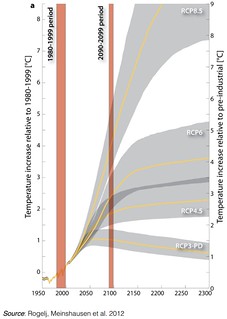
 Says the World Bank [*]. I could see why an imminently 4 oC world would be problematic. But the problem, as Timmy rather bluntly pointed out, is the report saying it spells out what the world would be like if it warmed by 4 degrees Celsius, which is what scientists are nearly unanimously predicting by the end of the century, without serious policy changes (my bold) which is, errm, bollocks. Note that they really are talking about global average temperature here, so it isn't possible to fix this up by saying they are talking about land, or NH land, or somesuch.
That's from the foreword, which is presumably designed to gain attention at the expense of accuracy. The Exec summary is a bit better, reporting Even with the current mitigation commitments and pledges fully implemented, there is roughly a 20 percent likelihood of exceeding 4°C by 2100. That's starting to become something believable. There's rather a degree of vagueness about whose estimates and scenarios are being used at that point; we'll need to read further to find out, into chapter 3, 21st Century Projections.
Even there things are a touch vague, but The nonmitigation IPCC Special Report on Emissions Scenarios (SRES) (Nakicenovic and Swart 2000), assessed in the IPCC AR4, gave a warming range for 2100 of 1.6–6.9°C above preindustrial temperatures. In these projections, about half the uncertainty range is due to the uncertainties in the climate system response to greenhouse gas emissions. Assuming a “best guess” climate response, the warming response was projected at 2.3–4.5°C by 2100, the remaining uncertainty being due to different assumptions about how the world population, economy, and technology will develop during the 21st century. No central, or most likely, estimate was provided of future emissions for the SRES scenarios, as it was not possible to choose one emissions pathway over another as more likely (Nakicenovic and Swart 2000). The range from the SRES scenarios, nevertheless, indicates that there are many nonmitigation scenarios that could lead to warming in excess of 4°C indicates, I think, that we're in IPCC land: these are std climate model projections. And However, RCP6, one of the RCP mitigation scenarios that assumes only a limited degree of climate policy intervention, already projects warming exceeding 4°C by 2100 with a probability of more than 15 percent is, I think, where they are getting their 4 oC from.
So, OK, it is possible to find 4 oC from the std projections. However it isn't possible to say what they do say, viz "warmed by 4 degrees Celsius, which is what scientists are nearly unanimously predicting by the end of the century". Its only a possibility. Now you could say, as mt does and I largely agree, that you need to weight these less-probable-but-not-clearly-assessable probabilities carefully - but that is a different matter. As is all the response and impacts stuff in this document, which I haven't read.
[*] Or do they? Actually This work is a product of the staff of The World Bank with external contributions. The findings, interpretations, and conclusions expressed in this work do not necessarily reflect the views of The World Bank, its Board of Executive Directors, or the governments they represent. So maybe not.
Update: AA makes a good point in the comments, which I should have said upfront: that focussing on 2100, as though the warming will stop then, isn't good. The graph here makes that clear. Nonetheless it doesn't get the Bank out of their textual hole, since they very clearly said "by the end of the century".
Refs
* Climate Scientists Applaud Dire World Bank Report - LiveScience (that's "Dire" as in "worring", I think, not as in "hopeless").
Sure, 4C by the end of the century is very much at the upper end of our expectations, but then warming isn't going to magically stop when we get to 2100. They should have been more careful with the wording but in the absence of serious policy decisions the issue is likely to be with the timing rather than the amount of warming - we might be lucky enough to avoid 4C by 2100, I'm not sure how much comfort we should take that it will take until say 2120 or 2140.
as a matter of style, the post title with the trailing question mark annoys me. maybe because a certain ms. curry uses that incessantly.
[Ah, sorry. I refuse just to change because of Curry. I use whenever I'm directly quoting someone else's headline -W]
The report was mainly written by the Potsdam Institutue (see page vii). The foreward was written by Dr Jim Yong Kim, the WB President. Normally, the foreward and exec summary are not worth bothering with (especially the foreward as it gets written by someone who read the report and was not involved in writing it - even when it's not the person who signed it). I'm surprised anyone, other than journalists, still do.
The difference between the forward and the executive summary is a long way from ideal. (Should we allow them such a mistake? - it is hard to get everything perfect.)
What of the next sentence after
"there is roughly a 20 percent likelihood of exceeding 4°C by 2100." Which says
"If they are not met, a warming of 4°C could occur as early as the 2060s."
Your graph seems to suggest a maximum of about 3C by 2069. So should you be heaping scorn on that rather than a simple inconsistency between forward and executive summary?
I see the exec summary does point out: Such a warming level (4C by 2100 or 4C by 2060?) and SLR of 0.5-1m "would not be the end point"
[I got a bit lost in all their scenarios, between mitigation and not. I thought I'd made my essential point, though :-) -W]
@Crandles, the graph is just the RCPs whereas the 4C by the 2060s is SRES A1F1 (put at 10% chance and 50% by the 2080s). See page 24 and Fig 22.
When everyone you know is running and screaming and crying and you are calm, maybe there is something you don't know?
Oh yeah, forgot rending of clothes. Sorry
WMC: Why didn't you bold "without serious policy changes"? That is a key part of the statement. The report is identifies the RCP8.5 curve with that condition: a scenario with "no mitigation effects."
This report is supposed to point out the importance of action.
So picking it apart just like a denier -- I know you value your contrarian status -- but picking it apart like this -- what's the point?
[Mind your language. I like people to tell the truth. I think that's a good thing. Pretending that 4 oC by 2100 is the consensus isn't the truth -W]
"Policy changes" don't change outcomes.
Changes in actual behavior do.
The consensus is what's _done_ not what's _said_.
The problem is that the IPCC doesn't really assign probabilities to the different RCPs (or SRES scenarios). I'd look at the MIT approach as being a better take on this sort of thing: http://globalchange.mit.edu/focus-areas/uncertainty/gamble. And the MIT models, at least, produce 4 degrees as a highly likely future scenario. Now, 1) the MIT model certainly isn't perfect. One can argue with both the economics and climate components. 2) since the quote is about "unanimous scientists", it may not matter that the group that is taking a proper probabilistic approach shows a warm future.
[That's all a bit flash, but its not clear what model or scenario they are working with there -W]
"2) since the quote is about “unanimous scientists”,"
I wouldn't get hung up about that specific quote, it's probably just Dr Kim getting the wrong end of the stick, and a bit irrelevant to the report itself.
[Yees, maybe. I'm planning to look a bit closer, if I have time. There is still the problem of a report just about 4 oC - well, anyway, I'll have to look at it closer -W]
On a related note, the recent UNEP[1] report is quite interesting, but the supplementary info.[2] for the paper it's (partly) based on is fairly relevant - the whole paper is paywalled, unfortunately. The supplementary info though summarises emissions pathways to various temperature values.
The WB report also references that paper, which is not especially surprising, I suppose.
Finally, the MIT stuff is based on Sokolov et al, 2009 [3].
[1] http://www.unep.org/publications/ebooks/emissionsgap2012/
[2] http://www.nature.com/nclimate/journal/v1/n8/extref/nclimate1258-s1.pdf
[3] http://globalchange.mit.edu/research/publications/1974
BTW I'm not saying that there may not be some issues with the report - I'm not really experienced/qualified enough to spot all. It would be good to get an RC discussion of it (and the general theme, I think - see below). I've also not finished reading it.
Here's what I think was the motivation for the report:
http://rsta.royalsocietypublishing.org/content/369/1934/6.full
More here:
https://en.wikipedia.org/wiki/4_Degrees_and_Beyond_International_Climat…
I also note that, while the report discusses probabilities of 4C by 2100, it does make a number of passing references to the fact that the increases would not stop at 2100 (except for one particular RCP), and in one case (RCP8.5) the continued increase in temp was quite stark.
TBH I think this is a sort of call to arms of what could happen if the current emissions path is not sorted out - it is at the high end of all the scenarios discussed. There may not be a belief that this track will be stuck to, to hit 4C (or 3C), but there is a belief that it does actually have to be changed at some point.
This whole thing feels like haggling, and the 2C commitment and 4C warnings suggest a convergence on 3C. ;-)
Adam,
Thanks, my mistake. If the scenarios say it is possible then I guess it is hard to rule out.
If rate is .17C per decade in the naughties bringing up to 0.8C above pre-industrial, then a 34% acceleration per decade would be required giving increases of:
.23C in teens
.31C in twenties
.41C in thirties
.55C in fourties
.73C in fifties
.98C in sixties
1C in a decade would be frightening if possible. I would have thought that would need a huge forcing like a methane burp, but maybe I am wrong. Perhaps more than 34% acceleration per decade is needed near the start - though we haven't seen any yet making 0% to 34% acceleration per decade seem rather rapid.
Well I probably shouldn't rule it out even if it does feel on an extreme limit of plausibility.
4C by 2100 looks like the IPCC A1F1 number from Table SPM.3
http://www.ipcc.ch/publications_and_data/ar4/wg1/en/spmsspm-projections…
Ok the graph says there's a increasing mean temperature increase from 1998 till 2012. Either it is a prediction from an older model or it is wrong as the experimental data say there is a plateau in that term.
[Were you less lazy, you could follow the links and find out what its a picture of. And were you less badly informed, you'd know that the temperature trend is positive over [1998, 20012]; for example http://woodfortrees.org/plot/hadcrut4gl/from:1998/to:2012/plot/hadcrut4… Though since you've cherry-picked 1998 to get your best effort at a negative trend, perhaps you can find a negative trend from a different series? -W]
I'll start believing GCM worst-case projections after they get Arctic amplification right. The CMIP5 model runs didn't even come early enough to include the recent permafrost feedback results, right?