



 apalazzo |
Two great interviews with Steven Shapin and Simon Schaffer, two philosophers of science.
CBC Ideas - Interview with Simon Schaffer on Leviathan and the Air Pump
CBC Ideas - Interview with Steven Shapin on how science and truth are derived from social interactions within the scientific community
If you like these interviews, visit CBC Ideas - How to think about science although I must say that some shows are better than others.
Also for anyone who is interested in the history and philosophy of science and is ready to go beyond Kuhn and Popper, I highly recommend Leviathan and the Air Pump.…
apalazzo |
There's a battle going on out there. A battle for trust. Do you get the H1N1 vaccine? Is global warming true? Will you go to hell? Is the free market the best way to run an economy?
How to answer these questions? The conventional wisdom is that all members of our society should get informed. Many here at ScienceBlogs would like to convince you that the problem is anti-intellectualism. These evolution-disbelieving folk have been called deniers and the anti-science movement has been rebranded as denialism. But I think that this view of the world is not really representative of what is really…
apalazzo |
I'm siting at my breakfast table when I read this in the NY Times science section:
Dissection Begins on Famous Brain
The man who could not remember has left scientists a gift that will provide insights for generations to come: his brain, now being dissected and digitally mapped in exquisite detail.
The man, Henry Molaison -- known during his lifetime only as H.M., to protect his privacy -- lost the ability to form new memories after a brain operation in 1953, and over the next half century he became the most studied patient in brain science.
This dissection is being documented LIVE ON THE…
 apalazzo |
The graph is from Are there too many PhDs? at Mendeley Blog
In the U.S., we are constantly hearing about how the country is falling behind in science. We need more scientists to fill all of those jobs we want to create. And the cure to that is to fund more PhD programs! Yet, when you ask graduate students and postdoctoral scholars what their individual experiences are, a science career is a very tough road with low pay and few career prospects. It's such a tough path that an entire PhD comic strip was born to alleviate the situation with laughter. Why then, is there such a disconnect?
HT:…
 apalazzo |
Last week was demo week here at the Palazzo lab. Both Zeiss and Nikon dropped off their latest equipment and we had the chance to image some RNA. In addition we finally completed some badly needed lab renovations and as a result had an operation tissue culture area. I went ahead and transfected COS7 cells with a plasmid that we just received from Open Biosystems that contains a gene of interest (a membrane bound protein whose RNA did not contain an SSCR, for those keeping track) and tried out a new FISH probe. Of course we were missing forceps and those great porcelain coverslip racks from…
 apalazzo |
This week we have a special edition of Map that Campus.
A few weeks ago I I wrote about my new voyage on the HMS Palazzo Lab. Well the resident of this campus had some advice on this topic:
In a moral point of view, the effect ought to be, to teach him good-humoured patience, freedom from selfishness, the habit of acting for himself, and of making the best of every occurrence. In short, he ought to partake of the characteristic qualities of most sailors. Travelling ought also to teach him distrust; but at the same time he will discover, how many truly kind-hearted people there are, with whom…
apalazzo |
After a frantic couple of weeks, the lab seems to be finally coming together. This afternoon I sat down and started to peruse the past few issues of Cell Science, Nature, JCB, PLoS etc. and a few of the blogs that I like to check out.
And then I read this strange article in the latest issue of Science: A SMART Plan for New Investigators
The premise is ... that the NIH should not give young investigators a break ... because they are full of crap?!?!!! As a solution the author writes:
Instead of providing special funding directly to new faculty, we should make sure that they receive…
apalazzo |
From Study Finds Science Pipeline Strong, But Losing Top Students, Science 30 October 2009: Vol. 326. no. 5953, p. 654
A new study finds little evidence for leaks in the U.S. pipeline for producing native-born scientists except for a steep drop in the percentage of the highest performing students taking science and engineering jobs. The findings suggest that the United States risks losing its economic competitiveness not because of a work force inadequately trained in science, as conventional wisdom holds, but because of a lack of social and economic incentives to pursue careers in science…
 apalazzo |
Like Nikon, microscopes manufacturer Olympus has a yearly microscopy photo competition, this years winners are up.
First place: Dr. Jan Michels
Christian-Albrechts-University, Institute of Zoology
Kiel, Germany
Specimen: Daphnia atkinsoni (Water Flea)
Technique: Confocal laser scanning microscopy
For more go to the Olympus BioScapes 2009 Winners Gallery
apalazzo |
When I was a postdoc at Harvard Medical School, I was a founding member of the New England RNA Data Club. We organized a monthly meeting, where RNA researchers from around the New England Area would get together and present data. Over three years, we were lucky enough to hear exciting talks and catalyze many new collaborations between labs at Harvard, MIT, University Massachusetts Medical School Worcester, Boston University, Brandeis and Tufts. We were fortunate enough to get speakers as far away as Yale and Darthmouth.
When I left Harvard to start my own lab in Toronto, I thought that the…
apalazzo |
Seminar Series of the CIHR Training Grant in Protein Folding
Dr. Alexander Palazzo
Department of Biochemistry
University of Toronto
Specialized Nuclear Export of mRNA Encoding Secreted and Mitochondrial Proteins
Thursday, November 12, 2008 - 12:15pm
Medical Sciences Building, Rm. 4279
University of Toronto
I'll see you there
apalazzo |
The value of having large public award ceremonies for scientists, is that it gives their work some exposure to the public.
Take for instance Shinya Yamanaka. His discovery of iPS cells in 2006 was one of the most important discoveries this past decade. It not only taught us how to generate stem cells from any normal adult cell, but it also gave us a window into celluar programming. It is now clear that going from stem cell to normal differentiated cell is not an irreversable process. According to Google Scholar this paper has been cited 1400 times!!!!
This past week Shinya was one of the…
 apalazzo |
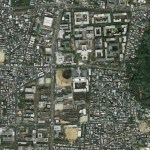
It's that time again. Here's this week's mystery campus:
And the hint: Where cellular alchemy began.
If you know the answer, or just want to take a cheap shot at Willie the Wildcat and his posse, leave it in the comment section.
apalazzo |
Well this week the University of Toronto hosts the 50th anniversary of the Gairdner Foundation.
If the Nobels are the Oscars of science, and the Lasker Awards the Golden Globes, this event is akin to the 50th anniversary of some big Hollywood studio. There are talks by many of today's hottest science rock stars and many smaller celebrations, which include lunches cocktail parties etc.
This morning we heard from Shinya Yamanaka, probably the hottest rock star scientist of our generation. If you've been asleep for the past few years, Yamanaka's lab discovered how to generate iPS cells from…
apalazzo |
Today I used a pipette for the first time in three and a half months.
What a strange feeling it is to work in one's own lab.
While I've been submitting papers and grants, my technician has been busy preparing solutions, ordering equipment and even performing a few "experiments" (if you can call transforming bacteria tan experiment). It's almost as if we've been supplying the ship, one that's getting ready to sail off into the unknown. I was looking after the financing, while my technician stocked up the ship with supplies. We've even managed to recruit a couple of undergrads who are in the…
 apalazzo |
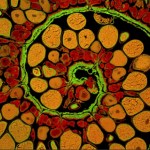
Go and check 'em out.
4th place - James E. Hayden, Anglerfish ovary (4X)
For more visit http://www.nikonsmallworld.com/
This year's event even got covered in the New York Times.
And if you want to enter into next year's competition the deadline for entries: April 30, 2010. Get clicking.
apalazzo |
This weekend, I had the opportunity to sit down with a friend, a cancer surgeon who works at a major teaching hospital in the US. He, his wife and two kids were up visiting us for the weekend.
Over coffee, I was asking him about the state of cancer therapeutics. Although he himself does not administer drugs or design treatments, he is part of a larger team which includes molecular oncologists that perform this task. What I heard was quite surprising.
From the vantage point of academia, we have been told that the development of new anti-cancer chemotherapy has been a disaster (here's one…
apalazzo |
Well this year was a big year again for RNA at the Nobels. Both prizes were essentially given to RNA dependent processes. In the case of Telomerase, an RNA molecule, Telomerase RNA (hTR or TERC), acts as the template strand to help Telomerase Reverse Transcriptase (TERT) elongate the end of the telomere. Here's a great vid explaining the whole process:
In the case of the Ribosome - well it is only the granddaddy of all ribozymes. To illustrate this point, here's a great video from the Steitz Lab with an incredible soundtrack:
(HT: Sunil)
Links to essay's on this year's Medicine &…
 apalazzo |
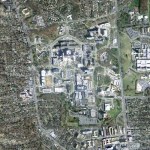
Last week was way too easy. Let's see how fast this one will go.
Here is this week's mystery campus:
The clue is:
Many "U"s into many "F"s!
If this means anything to you leave your answer in the comments section. After 24hrs I'll confirm any correct answers.