

Today’s post is about some cool chemistry – very cool. About 0.01°Kelvin, as a matter of fact (that is, one hundredth of a degree above absolute zero). Physics experiments conducted at such temperatures are already old hat, but chemistry is another story, altogether. Scientists have been attempting to produce chemical reactions at ultra-low temperatures for at least 50 years; a Weizmann research team has finally achieved that goal.
Why try to get reactions to take place in these conditions, which are wholly unfavorable to the usual lab-type chemistry? The answer is that when temperatures drop as low as they can go, quantum effects take over from the classical physics we’re used to. Particles, for instance, begin to act as waves. So any chemical reactions taking place in that range are likely to be as weird and wonderful as the laws of quantum physics, themselves. Plus, we know that chemical reactions do take place at the lowest end of the temperature range, out in the frigid expanses of interstellar space.
The coldest atoms and molecules – that is, matter in its lowest possible energy state – need some help if they are going to interact chemically. So scientists have approached the task by creating very fast, cold beams of atoms and/or molecules, and throwing them at one another. This creates collisions and chemical reactions ensue, but the high-speed collisions generally also involve relatively large amount of kinetic energy, flipping these experiments out of the possible quantum range.
The Weizmann team’s innovation was to create two parallel beams and merge them. That way, collisions could still occur but, since the molecules were all moving at the same speed relative to the others, the net energy of the collisions was nil.
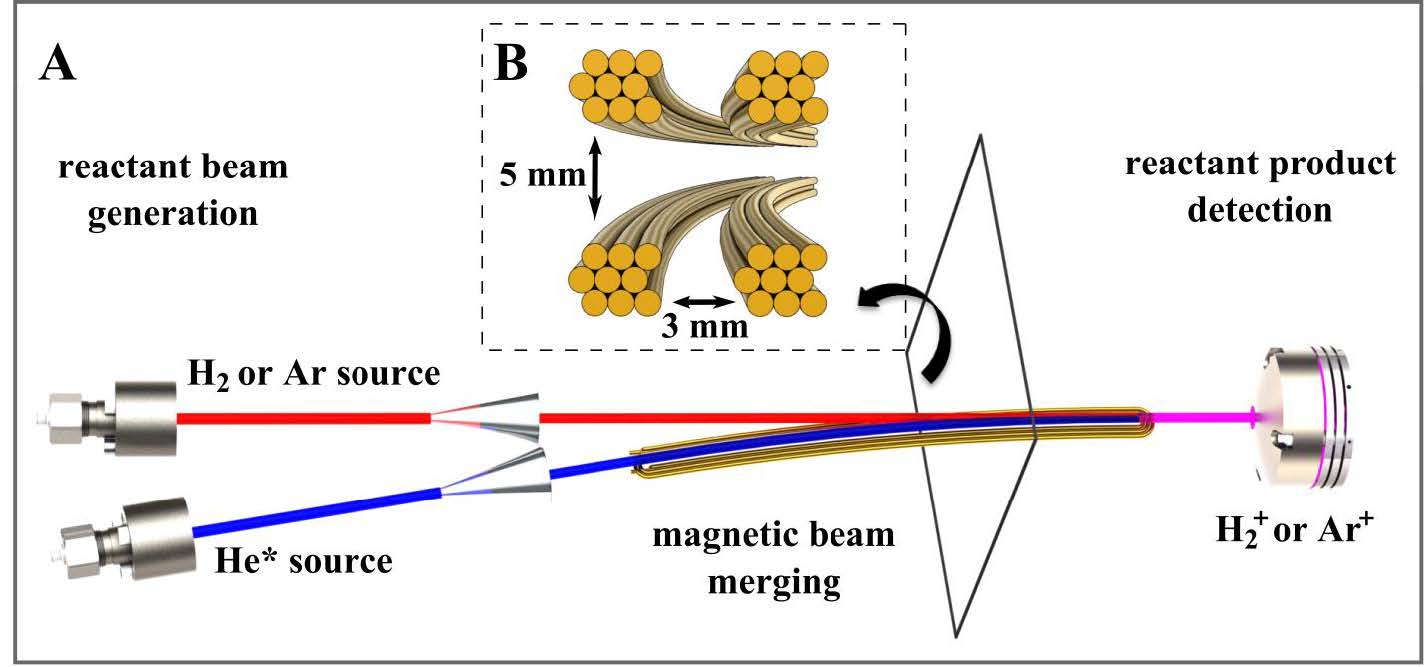
The setup: One beam flies straight, the other is bent to meet it, all in an ultra-frigid vacuum chamber
When the scientists observed the chemical reactions in the merged beam, quantum effects indeed emerged below about 3°K, and certain predictions about how such reactions occur were confirmed. For instance, the reactant atoms and molecules formed transient bonds in which they orbit one another. This gives them a chance to react chemically (in the case of the Weizmann experiment, by exchanging an electron). The reactions took place in peaks, at specific energies – a demonstration of the tunneling that occurs when quantum particles act as waves.
Research group head Dr. Ed Narevicius hopes the new findings will bring about no less than a comprehensive revision of existing theoretical models for chemical reactions. “We’ve shown that our understanding of even the simplest ionization reaction is far from complete,” he says.
Look , when you start looking at having to manipulate anything then you look at energy, no matter how small or undetectable. What is the point of this?
It is true that practical applications are probably not right around the corner. On the other hand, the findings could provide insight into everyday chemical reactions, be used to create ultra sensitive probes for certain types of chemistry, and reveal how complex compounds are being formed in the interstellar medium, where the average temp. is 2K.
ИНтересно))http://vsewmire.ru/
At the start of my physical chemistry classes, I like to tell students we live in a very cold environment where most metals are frozen solid. I say that we are lucky because chemical bonds form easily at 300 K but not at 3 K and not at 3000 K. In contrast physics looks at all temperature, from zero to the big bang.
Even though chemical bonds are purely quantum, looking at chemical reactions at very low temperature gives us more insight into quantum effects. I believe at these temperature anomalies will be found that will challenge us to explain. I think that low temperature physics is as important as high energy, and a lot less expensive too.