

Yesterday, I went on Facebook. Not an unusual activity for someone my age. Or for someone my parents’ age, which I still haven’t gotten used to. But that’s not the point of this.
Several of my “friends” had statuses mentioning "Ophiuchus", whatever that is. One girl’s panicked reaction to this unpronounceable phenomenon had received enough attention to elicit ten of my peers to "comment" on it.
So, I did what any self-respecting person would do. I decided if nineteen-year-old girls were fascinated by it, it was probably just as important as Justin Beiber and Twilight.
But when I went on…
The innovative new opera by Tod Machover, Death and the Powers, opens this Friday for its world premiere in Monte Carlo at Opéra Garnier de Monte-Carlo. Machover gave Festival-goers a sneak peak of this hugely ambitious work earlier this summer at the 2010 World Science Festival, which included a thought-provoking conversation with AI legend Marvin Minsky.
The opera—a brainchild of Machover's Opera of the Future Group at the MIT Media Lab in co-production with American Repertory Theatre—explores transhumanist and existential territory, such as mortality and theory of mind, as well as…
Update: The broadcast went really well. Thanks to everyone for participating. You can check out the replay and transcript with Jill Tarter and Seth Shostak here â Stay tuned for more interactive broadcasts to come. We've got some dingers lined up...
Join us tomorrow for a special interactive broadcast of The Search for Life in the Universe, originally taped during the 2010 World Science Festival. Accompanying the broadcast, we're very excited to have live commentary and a Q/A session with the SETI Institute's Jill Tarter and Seth Shostak.
Are we alone? It’s a question that has obsessed us…
The above video montage was kindly produced by multimedia artist and musician Claire L. Evans (of Universe) to open the WSF 2010 panel "The Search for Life in the Universe," which featured the likes of Jill Tarter, David Charbonneau, and Steven Squyres. Unfortunately, due to a production clusterWTF, it didn't end up running. Which is a shame, because I really like its somewhat chilling but still hopeful subtleties. Claire breaks down her motivations for putting together the piece:
In 1977, taking advantage of a fortuitous alignment of planets, NASA dispatched two spacecraft named Voyager into…
Numbers don't lie, but they tell a lot of half-truths. We have been raised to think that numbers represent absolute fact, that in a math class there is one and only one correct answer. But less emphasis is put on the fact that in the real world numbers don't convey any information without units, or some other frame of reference. The blurring of the line between the number and the quantity has left us vulnerable to the ways in which statistics can deceive us. By poorly defining or incorrectly defining numbers, contemporary audiences can be manipulated into thinking opinions are fact.
Charles…
Hey gang! Remember when we set up a model of the new James Webb Space Telescope in Battery Park? If you don't, the people at Behind the James Webb Space Telescope have produced the cool little video above about the telescope's visit to NYC and the World Science Festival.
I got into this stuff because of science fiction. I was a huge nerd in high school. I remember there was a time that between UPN, TNN, and The SciFi Channel you could watch six straight hours of Star Trek on a Friday night. None of those networks exist anymore. I built a Stargate in my parents’ basement freshman year (see above)--though I never got it to send me anywhere. When my Junior English teacher told me to write a paper on John Steinbeck, F. Scott Fitzgerald, or another famous American author, I wrote it on Phillip K. Dick.
As I grew older, and my knowledge of science fact began to…
In the run-up to this year's Faith and Science panel at the 2010 World Science Festival, there was some concern expressed (here and here) about our sponsors' influence on programming. In light of such criticism, we thought it would be a good time to reiterate the Festival's absolute editorial independence, as addressed last year by World Science Festival co-founders, Brian Greene and Tracy Day, in response to similar concerns:
The World Science Festival produces programs according to the strictest standards of editorial integrity. It goes without saying—but for clarity’s sake we shall say…
The full replay of Hidden Dimensions: Exploring Hyperspace, featuring Brian Greene, Lawrence Krauss, Shamit Kachru, and Linda Dalrymple Henderson, is now available for streaming for a limited time. If you haven't had your mind blown yet this morning, I recommend you head over to our livestream replay pages pronto, grab a tall cup of coffee, and prepare for perspective-scrambling kernels from some of the greatest living physicists.
Watch now >>
The fine folks at NPR's RadioLab have produced a new episode based on Strangers in the Mirror, which features Oliver Sacks and Chuck Close (and was moderated by RadioLab's own Robert Krulwich).
Have a listen over at their site. Or add to your cue wherever podcasts are sold for free (ie, iTunes). And check out their amazing back catalogue of archived shows while you're there.
I've been asked by several people about the famous people recognition demonstration used in this program. To take the actual test developed by go-to prosopagnosia experts, Brad Duchaine and Ken Nakayama, that I based the…
Have a story to tell from the 2010 World Science Festival?
Maybe it was something you learned? (Like, for instance, if the Earth were to be a black hole it would have to collapse to the size of a grain of sand.) Perhaps it was a serendipitous chat you had when bumping into your favorite scientist, artist, or author over the weekend's festivities? (I had a charming chat with Dr. John Mather and his wife about the crude pocket telescopes he used as a child that ultimately inspired him to take a closer look at the cosmos.) Or maybe it was a conversation you had with friends inspired by one of…
Well, another World Science Festival is in the books. And what a trip it’s been. One attendee at this year’s festival suggested that, as if conjuring the gravity of a supermassive black hole, we must have slowed down the passing of time in order “to do so much in 5 days.”
Accusations of timespace manipulation aside, there were plenty of magic moments during the 40+ events throughout the run of the Festival. From Professor Stephen Hawking’s poignant speech in front of a packed house at Lincoln Center during the Opening Night Gala to the all-day celebration of science in the heart of New York…
We'll be streaming the animal cognition program live from the Skirball Center in NYC, featuring Brian Hare, Vanessa Woods, Jeremy Niven, Patrick Hof, and Klaus Zuberbühler. And moderated by RadioLab's Jad Abumrad.
Kick-off is at 3pm today. ScienceBlogs Editor Evan Lerner will be calling the game with me in the L'Blog booth, playing Jerry the King to my JR.
Watch live and join the conversation (and/or correct our typos) in the Cover It Live forum.
Or follow us on the Twitt: @WorldSciFest @GregBoustead @evan_lerner
From the WSF Blog...
One of today's panelists, Vanessa Woods: "Your Inner…
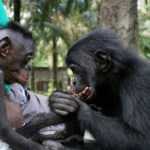
Vanessa Woods joins us from Your Inner Bonobo at Psychology Today. Vanessa is an award-winning journalist and author who studies the cognitive development of chimpanzees and bonobos at sanctuaries in the Republic of Congo and the Democratic Republic of Congo. Join Vanessa and other leading scientists in All Creatures Great and Smart, a World Science Festival program that challenges long-held assumptions about the differences between 'animal' and 'human.'
Who is the smartest of them all?
You have to admit, as a species, we're pretty spectacular. Our phones can navigate our cars through unknown…
Kind of a Big Deal: We'll be streaming the Kavli Prize announcements live from Oslo tomorrow morning as part of a high-end webcast, complete with stateside commentary, featuring Nobel Laureate Harold Varmus, Co-Chair of President Obama's Council of Advisors on Science and Technology, Antonio Damasio, Mostafa A. El-Sayed, Kip Thorne, Elizabeth Vargas.
Watch Live, starting at 8:00am EST Thursday, June 3 >>
Christina Agapakis joins us from the ever-inspired Oscillator, her synthetic biology blog at ScienceBlogs. When she’s not reshuffling DNA sequences in her lab at Harvard, she’s usually there making Lady Gaga video spoofs, or something obvious like that.
I'm almost embarrassed for eleven year old me, in my pink leggings, so enthusiastically raising my hand when Mrs. Foster visited our 6th grade class and asked if any of us wanted to be part of the Science Olympiad team. But then I get mad at myself for being embarrassed; first of all pink leggings are adorable, and second of all the chance to…
Shhhh...I have a secret.
When we send out information about the World Science Festival, the producers commonly use the phrase, "a Festival meant to engage and inspire the public about science." For me, there's no better way to inspire than to offer the public a chance to meet one-on-one with scientists. And I'm not talking about rushing the stage after an in-theatre program, in the hopes that you'll be shoved to the front of the geeked-out mosh pit and win a chance to graze Leonard Mlodinow's foot.
I'm talking about calmly and cool-ly walking up to a scientist and having the…
Want to go to the World Science Festival, but can't bum a ride to New York City? Your favorite program is already sold out? You want to be there for the suspense and drama of the 2010 Kavli Laureates announcement Thursday morning, but you've run out of sick-day excuses at work? Well, buck up, the WSF has your back.
For the first time, the World Science Festival is streaming events live (and in stunning quality), as part of a joint webcast with the folks at Livestream. Customizable widgets and live forums integrated with Twitter and Facebook top off the experience and allow creative science…
Image courtesy of the Cajal’s Butterflies of the Soul gallery at The Beautiful Brain.
Noah Hutton is founding editor of The Beautiful Brain, an online magazine that explores recent neuroscience findings through monthly podcasts, essays, reviews, and galleries, with particular attention to the dialogue between the arts and sciences.
Some of our greatest triumphs as a species have come from those who saw little difference between being a scientist and being a humanist. From Leonardo’s visionary notebooks to Herschel’s lunar poetry, science has provided a necessary resource for some great art;…
Sam McDougle joins us from re:COGNITION at The Beautiful Brain. Sam splits this time between behavioral neuroscience research at the University of Pennsylvania, playing fiddle in an Appalachian string-band, and drumming in an indie rock trio.
In my recent career as an undergraduate, I noticed a curious phenomenon–around my junior year, dorm rooms across the campus were suddenly spending Friday nights captivated by the wonders of the natural world, led along by David Attenborough’s poised intonations. BBC’s Planet Earth box set would soon be as ubiquitous in 18-24 year olds’ DVD collections…