

 vlicata |
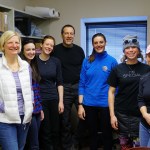
One of the cowboy science teams (or cowgirl science team – see photo) that I was able to spend some time with at McMurdo Station is the Weddell Seal Research Team under the direction of Dr. Jenn Burns of the University of Alaska. This multi-faceted science team spends virtually every single day during their field season tracking down tagged Weddell seals on the Ross Ice Shelf and performing a gigantic battery of physiological tests and measurements on them. Every day this group is either in helicopters (less frequently) or out on snow mobiles (more frequently) re-capturing animals that they…
vlicata |
The Martian is a feel-good, science positive, uplifting film about the power of the human spirit, botany, and engineering. It looked, from the credits, like it had at least 8 scientific advisors from NASA (and possibly other places). Too bad that Ridley Scott only half listened to them. As one of the primary sci-fi filmmakers working today, it’s kind of amazing how a lot of the science in Ridley Scott’s films sort of leaves a chalky taste in the mouth. (Take a look at this link for a scathing review of the science in Prometheus).
It’s clear that The Martian is science-positive – the main…
vlicata |
I just wanted to say how amazingly brave and admirable I believe Robert De Niro's recent decisions have been regarding the screening of the anti-vaccination film "Vaxxed" at his Tribeca Film Festival. As this was apparently one of his first revelations of having an autistic child, his actions are all that more brave and admirable in my opinion (for whatever little my opinion is worth on this matter). To be searching for answers to how? and why? a member of your own family has autism has got to be unbelievably frustrating. To have a member of your family who has autism has got to be a lifelong…
 vlicata |
Hi. Apologies for the radio gap. It turns out that Trish, the co-PI and irresistible force behind this project met with an immovable ice patch and broke her femur a few days ago at the Willy Field airport on the Ross Ice Shelf. She’s “fine” now, and freshly bionic-ized with new hardware pinning together her skeleton. Oh, and we got the shot, out at the airport, while her femur was still in two parts (a shot of one of the C-130 planes framed similarly to a Ponting photograph of the Terra Nova at dock).
Trish’s own experience underscores the originally intended topic of this particular post:…
vlicata |
Internet Links and Social Links at McMurdo Station, Antarctica.
Here are some links of interest related to Trish Suchy and my NSF Antarctic Artists and Writers Project:
Trish Suchy’s blog about our Artist’s and Writer’s project.
David Ainley’s website about his research on Adelie penguins: Penguin Science
The weather in McMurdo is here.
Zach Sudman’s blog (who we photographed in the Dry Valleys):
And here is the blog of Shaun O’Boyle, one of the Artists & Writers who was in McMurdo immediately before we were. He was/is doing a beautiful black and white photography project on McMurdo.
One…
 vlicata |
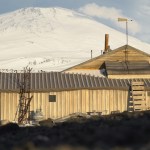
Our most recent helo trip out from McMurdo on our NSF Artists & Writers Project took us to Cape Evans, the site of Robert Scott’s Terra Nova Hut, where they based their 1910-1913 trip to the South Pole. We went with Anthony Powell (the filmmaker from Scott Base who made the movie “Antarctica: A Year on Ice”. He has an engineering/tech “day job” at Scott Base and is a moviemaker in his off time). The Terra Nova Hut is the most elaborate and extensive of the 3 main historic huts in the McMurdo-ish area (the other 2 are Discovery Hut, right at McMurdo, and the Shackleton Nimrod Hut at Royds…
 vlicata |
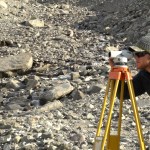
On the next leg of our NSF Antarctic Artists & Writers project we flew to the Antarctic Dry Valleys from McMurdo. It is almost an hour helicopter ride across the ice shelf, and we hopped from site to site all day: landing at Lake Hoare for a moment to drop off someone and pick up Zach Sudman, a stream hydrologist who we spent most of the day with. We flew with Zach another 10 minutes to Lawson Stream – yes a flowing stream (from summer glacier melt) in the Taylor Valley. We video photographed Zach Sudman using surveying equipment to measure the height of the lake and the stream.
Here is a…
 vlicata |
As part of our project we just flew to Cape Royds on a helicopter to take photographs of Dr. David Ainley among the penguins he’s studied for many years. It is about a 10 minute helicopter ride from McMurdo. We arrived in strong winds (maybe 30 mph? – enough to stop you from walking and have to brace yourself from being blown backward during gusts). The helicopter dropped us off and left, and after a short walk we arrived at Shackleton’s Hut (the nicest of the main huts on Ross Island). It’s beautiful and warm inside the hut. Despite the wind it feels comfortable and cozy inside, with lots of…
 vlicata |
Hello again,
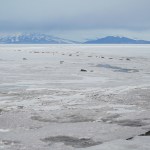
We’ve been on Mars – er, I mean in Antarctica for 1 week now. It’s similar to what one might imagine being on Mars is like, but with breathable air (nice air). The landscape around McMurdo Station is all volcanic rock. Rock and dirt everywhere. Stand in the middle of McMurdo and spin around and you’ll see about 230 degrees of rock and dirt as far as the eye can see, and about 130 degrees of extraordinary beauty looking across the Ross Ice Shelf toward the Trans-Antarctic Mountains. Right across from the station, shown in the picture, is Mount Discovery (slightly obscured in…
vlicata |
Hello,
World’s Fair has been dormant for some time now. Sincere apologies to those who had been following it. We are reactivating it in conjunction with a project called “Antarctica: Persistence of Vision”. The project is part of the National Science Foundation’s Antarctic Artists and Writer’s Program: a science outreach program designed to combine art and science as a way to highlight and promote the beauty and value of Antarctica and the scientific research going on there. At the moment, Dr. Trish Suchy and I, both from Louisiana State University, are waiting in a hotel in Christchurch, New…
vlicata |
It's time again for John Bohannon's annual "Dance Your Ph.D." contest. This year, in my opinion, there are even more high quality entries than in previous years! (I was one of the judges who did the first round of choices...the "winners" were then chosen by a panel that includes several professional dancers (for several years it has been members of Pilobulus)). And they are all now posted online ("winners" at the link above - all the videos are posted here - because really they are ALL winners in my opinion.
And if you can come up with more difficult ways to try to…
 vlicata |
I have a small part in a show called SACRED WASTE which was created by LSU Ph.D. student Bonny McDonald – which is playing in the upcoming New Orleans Fringe Fest. The show involves dance, poetry, ritual, elaborate costumes (made of 100% recycled plastic), and explores many aspects of the relationship between humans and plastic – including the manufacture of it here in Louisiana, and some introductory polymer chemistry! SACRED WASTE was one of 30 shows jury selected to play in the New Orleans Fringe Festival (out of > 200 entries).
This performance art show is a unique…
 vlicata |
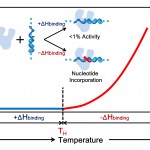
Our lab has a paper called: "Enthalpic Switch-Points and Temperature Dependencies of DNA binding and Nucleotide Incorporation by Pol I DNA Polymerases" that was just published in BBA (Biochimica et Biophysica Acta): Proteins and Proteomics. The study follows up on an observation and prediction we had made some years ago in a different paper.
The study deals with quite a lot of rather detailed thermodynamics of DNA binding (free energy, enthalpy, entropy, heat capacity…) and looks for correlations between such thermodynamic measurements of binding and the functional behavior of a couple…
vlicata |
This summer I am working with a student on trying to start to get some reasonable assessment of one of our ongoing oddball-ish outreach projects. Working with a local videographer, we've been making 2 minute mini-profiles of astrobiologists who work here at LSU (Louisiana State University) - two minute summaries of who they are, what they work on, and why they work on it. Rather than do the seemingly most typical "talking head" style of video, we've tried to do something that more resembles a mash-up between Bill Nye and Independent Film (yes, it is difficult to do that in your…
vlicata |
I was discussing SciArt on several occasions with different people recently and was fishing for a way to classify different SciArt in order to make a particular point - the point being that the type of SciArt I find most interesting and valuable is in the minority. Basically, it seems there are 3 (or maybe 4) general types of SciArt: informational, inspirational, and degradational. I should note that mostly I am talking about SciArt that is performed - mostly plays and movies. Although probably some variant of this can be applied to visual arts or music and such.
Degradational is when the…
 vlicata |
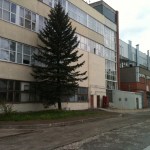
I recently spent a week in Lithuania visiting biophysical laboratories and giving a couple of seminars. My host was Daumantas Matulis of the Institute of Biotechnology at Vilnius University, where they have an EU grant that includes funds for bringing in visiting scientists from other countries (thank you EU!). Although my sampling of the science in Lithuania is quite limited – the labs that I visited exhibited some interesting similarities. Physically, the labs at the Institute of Biotechnology in Vilnius and in the Institute of Cardiology in Kaunas consist of large collections of small…
vlicata |
I recently saw the beautiful (and beautifully ugly) National Theatre production of Frankenstein – written by Nick Dear and directed by Danny Boyle, and projected into cinemas around the world (just like opera simulcasts). Here is a review of the play, written as an open letter to Dr. Frankenstein:
Dear Victor,
I just saw the most recent portrayal of your exploits – the Nick Dear authored, Danny Boyle directed, broadcast version of the National Theatre play. What a masterpiece production – one of the best versions of your story I've ever seen – largely because of the intense focus on the…
vlicata |
I recently read David Kirby's new book on science film consulting. This book is an absolute must-read for anyone even remotely or subconsciously interested in being a science consultant for the next Iron Man or Transformers, or smaller budget real-life dramas with real-life science in them. His book is both easy and interesting to read - and is filled with information. He explores the history of science-consulting, going all the way back to "Woman in the Moon" and of course the still canonical "2001: A Space Odyssey", and discusses a large number of recent examples. He does not glorify…
vlicata |
A news story in ScienceNOW this week describes how City University of New York is planning to rearrange its "General Education" requirements so that non-majors who take science don't have to take lab courses anymore. Scientists at CUNY are, predictably, annoyed and upset. Even non-majors should get to muck around in lab with their own hands a bit before going off to whatever other majors and interests they have.
Here at LSU we've been discussing almost the Exact Same Issue in the Honors College for the past few weeks and coming to the Exact Opposite Conclusion to CUNY. We are re-designing…
vlicata |
Yanling Yang, who just graduated with a Ph.D. from my lab, has a paper in the just published November issue of Biophysical Chemistry. The entire issue of the journal celebrates the 25th Anniversary of a conference called "The Gibbs Conference on Biothermodynamics", and each of the papers is from the laboratory of one of the organizers of one of the previous 25 annual meetings (I co-organized #24). Despite the restricted invitation list, however, all the papers were peer reviewed (some quite viciously according to reports) and some required several months of revisions to qualify for the…