

 Razib mentioned here an article in the Boston Globe "which profiles researchers who suggest that variation in gut flora (the mix of bacteria) might be the cause of differences in body weight." The comments are somewhat skeptical, and I started to write a comment on the topic but it became a bit unweildly--so I've added it below instead.
As I've discussed previously, figuring out the relative contributions of environment versus genetics in obesity isn't an easy feat. As with so many human diseases/conditions, the "cause" is certainly multi-factorial. It's pretty clear that the genetics of an individual do play some role in their weight, but that doesn't mean that "genetics is destiny." Even in people who seem to be genetically predisposed to obesity, a rigorous exercise routine and careful monitoring of diet can minimize the effect of genetics, and allow one to maintain a healthy weight.
But, as mentioned in the Globe article, there's another environmental factor besides diet and exercise that is increasingly being looked to in obesity studies: microbes. In this one, at least, we have some good animal studies that support the hypothesis: varying the gut flora (or having minimal bacteria, as in "germ-free" mice) has been shown to affect weight gain in many studies (including some carried out by the scientists profiled in the article):
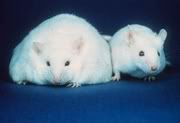
He compared normal mice with guts full of bacteria to a strain of gnotobiotic, or germ-free, mice, which are born without gut microbes and are housed in sterile plastic bubbles. The lab found that while the gnotobiotic mice were able to feast on rodent chow and remain thin, their genetically identical counterparts with bacteria in their guts ate 29 percent less and had 42 percent more body fat. The bacteria made the mice fat.
When the gnotobiotic mice were exposed to bacteria, their guts filled up with microbes and they quickly got fat, reaching the same weight as the other mice in just two weeks.
This makes a lot of sense. While we have our own enzymes and mechanisms to break down and absorb nutrients from food, we're still assisted by our gut bacteria. Lacking bacteria, more nutrients are excreted in waste, resulting in decreased retention of calories and nutrients from each gram of food we eat. Different species of bacteria have different abilities to metabolize the foods we eat; therefore, different "poo prints"--the composition of our bacterial gut flora--can result in different abilities to retain maximum benefits from our diet. The hypothesis is a good one.
However, as Razib notes, a big hindrance to studying this further is that we really haven't a clue about the gut ecosystem (or really, ecosystems, since our "poo print" is somewhat different in each of us). It's estimated that there are at least 400-500 different *species* of bacteria in our gut, and most aren't culturable using traditional methods. It's just not something that we can begin to consider replicating in the lab at this point in time. Molecular studies are being undertaken in order to have a better idea of the diversity in human gut microflora (and how it may affect a variety of conditions, not limited to obesity), but they still suffer from the fact that the gut microflora hasn't been extensively characterized yet. We're likely missing a lot of organisms, simply because we don't know what we're looking for.
Finally, it's not just bacteria that seem to affect weight gain. Indeed, a number of viruses have been suggested to play a role. The best characterized to date has been infection with a serotype 36 strain of adenovirus (a respiratory virus that can occasionally cause serious disease). A new paper even presents a mechanism by which the virus can "make you fat," by reducing leptin expression and secretion (leptin is a protein hormone that plays a role in regulating body weight) and increasing glucose uptake by fat cells.
As I've mentioned many times, these types of infectious etiologies for so-called "lifestyle" diseases or conditions are active areas of research, and remain somewhat controversial. Additionally, the role of the gut flora in obesity has been a bit over-sold at times by folks promoting probiotics, suggesting that taking a supplement of various strains of live bacteria will help you in various ways: reduce weight (and as a result, reduce a number of other health problems), or simply keep you regular (though to be fair, they do have a few small clinical studies under their belt that show efficacy). And while I'm hopeful about the use of probiotics as a treatment, it's still a field that's lacking in a lot of rigorous investigation, and claims of use outnumber real evidence of improvement.
Image from http://gold.uni-graz.at/images/ATGL/fat%20mouse%20www.ccs.jpg

Very interesting. From my understanding probiotics really only show promise while taking antibiotics although I have not read any studies proving they work. I am curious though if bacteria causes weight gain couldn't yeast play a role as well especially since it feeds on sugar?
"researchers who suggest that variation in gut flora (the mix of bacteria) might be the cause of differences in body weight."
Might be true for cute little mice. In humans, though, the "cause" of differences in body weight is too many chili-cheese burgers, too many fries, too many chocolate sundaes and not nearly enough exercise.
Barnes
Interesting. You crow so much about an animal model for other diseases, Hank, but dismiss it in this case?
Laura,
Sure, resident eukaryotes could theoretically play a role as well, either on their own or because of interactions they have with other microbes. I admittedly don't know what research has been carried out in that area, though.
Actually now that I thought about it a little further I don't think eukaryotes play much of a role because increased absorbtion is not associated with the use of antibiotics.
Interesting. You crow so much about an animal model for other diseases, Hank, but dismiss it in this case?
Ok, mebbe we have some controls. Let's feed these cute little mice some chili-cheese burgers, fries and chocolate shakes -- see if they gain any weight.........
"Ok, mebbe we have some controls. Let's feed these cute little mice some chili-cheese burgers, fries and chocolate shakes -- see if they gain any weight........."
And what would that prove, Hank?
GE
Has anyone ever tried simply "rebooting" the system, i.e. wiping out the gut bacteria and starting over? The premise being that these people got a bad gut ecosystem and a random new one would almost certainly be better. Of course, it might not be random at all - there might be something about their basic gut conditions that create the ecosystem they got. Nevertheless, I'm sure that some seriously obese people would be willing to try.
"Has anyone ever tried simply "rebooting" the system, i.e. wiping out the gut bacteria and starting over? The premise being that these people got a bad gut ecosystem and a random new one would almost certainly be better. Of course, it might not be random at all - there might be something about their basic gut conditions that create the ecosystem they got. Nevertheless, I'm sure that some seriously obese people would be willing to try."
Of course, I'd want to know what the connection is between "gut ecology" and obesity. And I don't think that connection has as yet been acertained, David.
GE
Even on high doses of antibiotics, it's pretty impossible to totally wipe out gut microflora. And even then, we don't know what microbes would be most beneficial to try and introduce. Additionally, studies using probiotics have found that for the most part, people just don't retain the introduced strains. Obviously if it becomes well-established that certain types of bacteria are increased or decreased in obese individuals, adding or removing them would be a potential treatment strategy--but it's likely to be an incredibly tricky route to travel.
I have a different objection to the idea.
The point of eating is to get energy from food.
If certain gut flora make people fat, aren't they releasing more energy, and making digestion more efficient? To alter our gut flora so that an American diet can't make us fat would be a deliberate sabotage of the digestive system, rather like infecting ourselves with tapeworms.
It might be far easier than eating less, but it would be wasteful of food and resources.
Fun fact: The entire human population "poohs-out" about a mole (6E23) of E. coli in less than a decade. Quite a pile! Not bad for a species that makes up less than about 0.5% of the gut flora...
MissPrism,
But consider the flip-side. If we knew what combination of bacteria led to increased efficiency of digestion, we could (theoretically) use that in countries where malnutrition is a huge problem, so that people would get as many nutrients as possible from their food intake.
Frankly, I'd be interested in being a participant in that project. I'm a vegan (except for sashimi once a week), I hate greasy food, and I positively don't overeat (I'm too ashamed to eat much in front of people and I don't snack when I'm by myself). However, my weight makes it very difficult for me to exercise more than taking a walk around the block. To look at me, you'd think I was the chili bacon cheeseburger champion, but just thinking about eating one makes me want to hurl. My thyroid is low but OK. I sure wish someone would find out what the heck I'm doing wrong, if it is something I'm doing wrong.
Speedwell,
Since this is a blog, where nobody knows or sees each other, let me be a little blunt:
You're a vegan (which is cool by me), but you write:
I sure wish someone would find out what the heck I'm doing wrong, if it is something I'm doing wrong.
How much food are you eating a day? If you are overweight, with all due respect, and with hope, that you do well in life, you are probably eating too much.
And, I'm not trying to be mean. I'm mebbe 15 pounds heavier than I need to be. It's because I eat too many chili-cheese burgers and not enough brocoli and cucumbers
Hank B
P.s. Also, don't denigrate walking around the block. That's a good step. Just do more of it.
Tara, I agree, that would be a fantastic use of technology. It's just a shame that all the funding and interest come from the opposite direction.
Speedwell,
I'm assuming you average about 1600-2000 calories per day, and avoid wheat, sugar, and alcohol. The running word of mouth is that men who change to a vegetarian diet lose weight and women gain it. The underlying mechanisms regarding the differences in vegetarian diet and gender have never been clarified to me, but may be informative.
You may want to consult a dietician into reduced calorie diets so that you can leverage the dynamics to your favor. Additionally, if depression co-occurs there may be a basic problem with insulin, amp, etc. metabolism (maybe it's stress related).
Most of this is probably remedial, but it seems more effective than just going into denial about some people having unusual dynamics regarding food and fat.
But the opposite result is seen in cattle, which are purposefully fed antibiotics in order to make them gain weight.
The immune system is fickle, and easily influenced by more than just viruses and bacteria. It can be swayed by the seemingly unexpected, such as by what we eat, for example, and affected by surprising sources. At the American Association for Cancer Research's Frontiers in Cancer Prevention Research meeting, scientists are taking a closer look at the link between increasingly common lifestyle factors, the immune system and cancer, with the ultimate goals of preventing and better understanding cancer development.
I hate greasy food, and I positively don't overeat,I'm too ashamed to eat much in front of people and I don't snack when I'm by myself. However, my weight makes it very difficult for me to exercise more than taking a walk around the block.
The premise being that these people got a bad gut ecosystem and a random new one would almost certainly be better. Of course, it might not be random at all - there might be something about their basic gut conditions that create the ecosystem they got.
One year ago, the idea that microbes might cause obesity gained a foothold when the Pennington Biomedical Research Center in Louisiana created the nation's first department of viruses and obesity. It is headed by Nikhil Dhurandhar, a physician who invented the term "infectobesity" to describe the emerging field. Dhurandhar's particular interest is in the relationship between obesity and a common virus, the adenovirus. Other scientists, led by a group of microbiologists at Washington University in St. Louis, are looking at the actions of the trillions of microbes that live in everyone's gut, to see whether certain intestinal microbes may be making their hosts fat.
If certain gut flora make people fat, aren't they releasing more energy, and making digestion more efficient? To alter our gut flora so that an American diet can't make us fat would be a deliberate sabotage of the digestive system, rather like infecting ourselves with tapeworms.
------------------
Thomas
http://infobaze.com/