
 Revere has been covering the situation in Indonesia regarding sharing of influenza viruses with the US and other countries. For those of you who don't follow these issues, Indonesia has been the country hardest hit thus far by H5N1 (113 cases and 91 deaths as of 11/12/07). However, while one might think they would welcome outside help with diagnostics and strain typing, they've been very reluctant to share their viruses. Revere explains:
But Indonesia still refuses to share its human H5N1 isolates, contending they get nothing tangible from an arrangement which is likely to lead to vaccines they won't be able to afford. Under the current system, which allows intellectual property rights to cover vaccines developed from WHO supplied seed strains to Big Pharma, they are probably right. Their position is a grim example of how the crazy patenting system can come back to bite us.
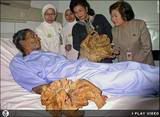
This concern reaches beyond H5N1, and intersects with Dede's (the "Tree man") plight to obtain a diagnosis and treatment for his weird condition. Turns out the Indonesian health minister is not happy about Dede's samples being removed from the country; more after the jump.
Indonesia's health minister, Siti Fadilah Supari, lambasted the US doctor currently treating the 35-year-old man, who has the rare affliction caused by the Human Papilloma Virus.Mrs Supari is angry that Dr Anthony Gaspari has taken blood and tissue samples out of the country to the United States in a bid to diagnose the illness. She claims such samples could be used in the future to make vaccines that the poor could not afford.
Understandably, Dr. Gaspari is upset right back:
"We did take samples, and the reason we did was to render a diagnosis. We did it for humanitarian reasons, to help the patient," Dr Gaspari said, stressing his willingness to put in writing that the samples were not for commercial use.
This article went out over the ProMed service, and there it was noted that it's rather unlikely that this particular papilloma virus and the research surrounding it would come to some kind of commercial use, and with Dr. Gaspari expressing willingness to forgo any commercial use of the samples, it seems this is pretty much dead in the water. It does, however, highlight the difficulties when dealing with different countries and cultures--it's unfortunate that Dr. Gaspari didn't seek approval first (however, would he have received it, and would Dede have been diagnosed if this approval was denied?), and it's also unfortunate, if somewhat understandable, that Mrs. Supari has made such an issue of this, given the successful diagnosis of Dede's condition.
Still, as Revere reports, there seems to be progress in sharing influenza viruses; perhaps this will open the door to more open and less difficult collaborations between countries and researchers over sensitive topics such as these.
Image from http://www.telegraph.co.uk/news/main.jhtml?xml=/news/2007/11/26/wtree12…
How is it in any way understandable that Mrs Supari has it an issue to keep scientists from being able to develop to vaccines? Just because some people in Indonesia would be too poor to afford a vaccine is not an understandable reason to inhibit the development of a vaccine.
The transport of diagnostic specimens across borders is one that needs to be addressed. I deal with situations like this all the time. Usually I am trying to ship human blood into these types of countries, but sometimes they have to send their specimens to me because their government makes the process too difficult for them to get specimens in. Other countries have near total bans on the export of diagnostic specimens. I believe China is that way right now, or was a few months ago at least.
Some the problems associated with this type of attitude are poor diagnostic test methods, interferences in the test method, and improper interpretation of testing results. We typically see the greatest problems in these countries that are difficult to work with. The end result is that the people get poor to improper treatment.
Why not Mike? This unfortunate situation comes about because too often non-dominant cultures are told that the research (scientific and/or social) that is being done on them will be used to benifit them. Only when the work is done the researcher never bothers to use that knowledge to actually help them, or in some cases not even bother to share the results of that research. I work with Native Americans and they are extremely unlikely to cooperate with researchers now because of this. I don't see where it is not reasonable to demand access to affordable medication as a condition of gaining access to the virus samples.
I could understand if Indonesia were limiting the taking of native plants or animals which may produce chemicals that have a medicinal effect as there are natural resources of the country. But it does not seem reasonable to equate a virus, which has the potential to kill or sicken many people, to other natural resources.
Mike - it's not the virus or the infection that is being treated as a resource; it's the information therein.
Not that I agree with Health Minister Supari, certainly not in the HPV case, but what other tack could Indonesia possibly take to ensure fairness in distribution of vaccines? It is fundamentally unjust that people get sick in poor countries, and scientists (and businesses) from rich countries come in, take the information engendered in the course of the illness to establish treatments and preventatives, and then set prices that the sick people and their nations cannot afford. It seems obvious to me that the natural requirement for use of such information, particularly when the information is used for profit, should be low-cost vaccine.
It's a cooperative effort to fight disease, and some agencies even profit from the effort, but Indonesians stand to gain no benefit, despite being the first to suffer the disease. What other measures could be taken to ensure fairness in the distribution of the benefits, given that Indonesia, being a flu hub, has an unaddressably unfair share of the disease burden?
You seem to have a broken link. Did you mean:
minister is not happy about Dede's samples being removed from the country;?
Indeed; thanks AK.
Mike, I can understand without agreeing with her decision. She sees it as a way to strong-arm wealthier countries into helping out impoverished ones; to allow the poorer ones to benefit from products developed after biological samples were taken from their countries. I do think this is a real problem--I simply think the way she's addressing it isn't any kind of solution.
this illness is more to do with a very rare genetic defect in the patient, not hpv, hpv seems to a pretty benign virus. Im not aware of any studies where it has been proven to cause cancer of any type, by inducing disease in animals. (kochs postulates)
If hpv can cause cancer in only humans, are there any studies where people who test positive all develop cancer and those not infected dont, do they control for confounding factors? This study would be unlikely, for the window period is like 40 years, i dont buy it, unless I can see the evidence.
Its so sad what has happened to this country. Shyh ching lo md phd a brillaint army scientist inoculated chimps, mice, monkeys, and embryos with mycoplasma pentrans/incognitus,, and they all sickened and died he found it in no healthy controls, he saw it in dying human patients with the EM so it could not be a contaminent, researchers at the university of alabama confirmed it was a novel strain when they incoculated it into rats and found it to be highly pathenogenic vs ordinary MF.
Dr. garth and nancy nicolson have found this microbe in many patients by PCR misdiagnosed CFS/GWI/RA cases etc. Antibody testing is unreliable, for the monkeys inoculated only had a weak antibody response when near death.
So here we are harping about one rare case of a genetic defect causing disease, while ignoring the hunderds of thousands of people whos lives have been ruined by this horrible microbe that can masquerade as many illnesses. Why do many professional scientists like to ruin the lives of young people with this horrible microbe?
It seems at is was part of the biological weapons program. Project day lily, google it. The only microbe out of hiv, hpv, hep c that induces death and disease in every animal inoculated..............moment of silence for all those suffering now, many of which will end up committing suicide if they are not made aware of Lo and nicolsons work soon and get on ABX treatment, for what can be worse than slowly rotting away with an infection that is being ignored by the CDC and a few idiotic scientists because some people only listen to drug companies and crooked politicians like fauci?
Last time I read the fine print on the back of a medical form it seems like all of us as individuals are in the same boat as the poor people in Indonesia who's virus samples are coveted by Big Pharma.
How so, you may ask.
I recall there being a "waiver" of any of my intellectual property rights to any "information" contained in my biological samples.
Didn't the guy who's liver was the source of some type of anticancer immunoglobulin lose in court when he sued the company who developed it using his DNA without his permission or compensation?
If you are merely a sick person you will pay and Big Pharma and "Medicine" will hold your healthcare over the barrel until you hand over your rights!
From my perspective the Indonesian government's position is regrettable, but understandable. The background of this is more than a century's history of Western exploitation of the developing world. The issue is not so much the vaccines or samples, it is the understandable resentment of a situation where a poor nation is being screwed (again) by Western governments and multinational companies. And before we claim innocence, we are the shareholders who make this exloitation possible.
Notice something about the growths? They occur only at the extremities. Something either triggers the virus growth there, or prevents it elsewhere. That something may be thermal.
I once had a plantar wart on the sole of one foot, and after salycilic acid had failed to remove it I tried a non-chemical cure: I put my foot on a heating pad at my limit of tolerance for 15 minutes a couple of times a day. After a few days of this, the wart literally disappeared (its fibrous parts fell out). What I suspect is that the wart virus required a cool temperature to grow, and raising the temperature well above its tolerance (but not enough to cause a burn) effectively eliminated the virus.
Perhaps Dede could be helped without anything that would make the Indonesian government paranoid. After all, who can assert a monopoly on hot compresses or heating pads?
Does anybody have any online references describing the
specifics of this disorder?
Is this a T or B cell or a NK cell problem?
Would a bone marrow transplant be a solution for this
as in Severe Combined Immunodeficiency disease (SCID)?
Engineer-Poet, in the picture from the other piece on Dede, the lesions are present on the trunk, upper limbs, and face as well as the extremities, and some cooler spots like the earlobes and tip of the nose are relatively spared. I suspect that the natural distribution of keratinized epithelium in the (healthy) body is what's reflected, rather than temperature: ordinarily, the soles of the feet, palms of the hands, outer elbows and knees are highly keratinized, and of course the nails are themselves keratin. In Hansen's disease (leprosy), the causative organism (Mycobacterium leprae) prefers temperatures between 28 to 32 degrees Centigrade, so your proposed mechanism is certainly feasible for some diseases.
Is the root hand and feet true? Does that really caused by HPV? What's
the rate that HPV can result in root hand and feet? I have ever heard
about it at a HPV dating site named pozgroup.com, but the member
failed to prove his story by providing a photo and the original of the
story. So I don't believe it.
I believe that Indonesia is holding out for some agreement that if effective vaccines are to be developed with virus samples supplied by Indonesia, then low-cost vaccine will be supplied so that the people of Indonesia can benefit, too. They're trying for a bit of leverage with perhaps the only lever they have.
I think the government have to do something. I live in Turkey but the government dont do anything for health.
thanks nice text.
thanks..
Forma imalat Forma imalat
sapka Åapka imalat sapka Åapka imalat