

 In parts one and two of the "What caused the Black Plague?" series, I discussed objections that had been raised to the conclusion that the bacterium Yersinia pestis was the cause of this pandemic, and the weaknesses with those criticisms. In today's installation, I'll discuss actual molecular evidence that Y. pestis indeed caused this--and does this research shut the door on alternative hypotheses? More after the jump...
Much of the evidence for or against hypotheses supporting any pathogen as a cause of an ancient disease are based on symptoms and historical records. While we can accumulate historical evidence until the cows come home, this evidence alone can only go so far without isolation of an actual microbe to confirm it.
While this is exceedingly difficult (if not impossible) for historical pathogens, one thing we can do is detect the microbe using other methods: such as DNA analysis. This is the basis of a burgeoning field of investigation called paleomicrobiology--the study of ancient pathogens using molecular methods. I wrote about one example using this type of detection previously, describing research looking to discover the cause of the Plague of Athens. Several other papers have been published using similar methods to investigate corpses which likely died of plague.
How do they analyze pathogen DNA from corpses which are hundreds, or thousands, of years old? Much or all of the soft tissue will be gone, with only skeletal remains--which includes the teeth. When looking for a pathogen that's gone through the bloodstream, we can take advantage of one vascularized area that's been protected from contamination: dental pulp.
 A 1998 paper led by two of the biggest names in this field, Michael Drancourt and Didier Raoult, initially looked into this area using corpses suspected to have died from plague in the 16th and 18th centuries. They extracted DNA from teeth from these corpses and performed a polymerase chain reaction (PCR) analysis on them specific for Y. pestis. They ended up with positive results from half of the teeth (versus zero of the negative controls), but colleagues were still skeptical.
A huge potential problem with ancient DNA analysis is the possibility of contamination with modern DNA. Since PCR is such a sensitive procedure, it takes only a miniscule amount of DNA to end up with a positive reaction. Therefore, in their next paper, in which they extracted teeth from French corpses estimated to be from the 14th century, they used a technique they called "suicide PCR." Using this method, each primer set was used only one time in an effort to minimize contamination. They also didn't use any positive controls as well--again to prevent contamination with modern Y. pestis DNA. In this paper, they found Y. pestis DNA in all of the victims and again, none of the control teeth.
Since then, other investigators have taken a similar approach to investigate plague in ancient corpses. Again using the suicide PCR method, Weismann and Grupe detected Y. pestis DNA in 6th century corpses (thought to be victims of the Plague of Justinian, also thought to be caused by Y. pestis). Drancourt and Raoult have also carried out additional investigations in this area, looking at the strain of Y. pestis that caused both the plague of Justinian and the Black Death Though their results were controversial, they have since applied another analysis method to these samples, and determined that all plague outbreaks were caused by the Orientalis strain of Y. pestis. In a separate but related study, they've determined that, in addition to fleas, the human body louse can act as a vector of Y. pestis in an experimental animal model--which could answer some of the objections Duncan and Scott had regarding the presence of fleas or rats in Europe.
While this line of research seems to pretty much seal up Y. pestis as the cause of the Black Death (and other plague pandemics), there still are criticisms. Another group, for example, failed to find Y. pestis DNA in plague corpses. Drancourt and Raoult argue, however, that the other group's extraction of pulp from teeth was inadequate. Additionally, negative results are difficult to interpret. It could be that they're truly negative; that, as argued, their extraction protocol was poor; that their PCR didn't work for a variety of reasons, etc. Additionally, Drancourt and Raoult's extraction and suicide PCR protocol was largely validated with the independent positive results by Weichmann and Grupe, and have invited independent validation of their positive results by outside labs. Additionally, they've recently published a new method for dental pulp extraction from teeth, which will even further reduce the potential for modern contamination.
I asked earlier if this molecular research shuts the door on other hypotheses, such as that put forth by Duncan and Scott. It should be noted that, while the research by Drancourt and Raoult (and others) has shown that they can find Y. pestis DNA in corpses that are presumed to have died of plague, only a relative handful of these corpses have actually been tested (especially compared to the scope of the pandemic). Most of these have been found in France, and much of the rest of Europe hasn't really been investigated using these methods. Additionally, it's difficult in many cases to definitively identify a "plague pit," due to the chaos at the time. It's typically assumed that any mass graves that date to the approximate time of a known plague outbreak will be a plague grave, but the molecular data are only as good as that assumption.
For those reasons, there likely will remain some doubt about the causative agent of historic plague outbreaks for awhile yet. However, I think it's been pretty well established, using both historical epidemiology as well as paleomicrobiological methods, that Y. pestis was the cause of the Black Death and other plague outbreaks that occurred both before and after the mid 14th century. This doesn't rule out the occasional misdiagnosis, or localized outbreak caused by a different pathogen, but the bulk of the evidence points to Y. pestis as the culprit.
Of course, while Y. pestis isn't the scourge it once was, it's still with us, and still causing outbreaks; more on contemporary Y. pestis infections next week.
References and further reading
Drancourt and Raoult. 2005. Palaeomicrobiology: current issues and perspectives. Nat. Rev. Microbiol. 3:23-35. Link.
Drancourt et al. 2004. Genotyping, Orientalis-like Yersinia pestis, and Plague Pandemics. EID. 10:1585-92. Link.
Drancourt et al. 2007. Yersinia pestis Orientalis in remains of ancient plague patients.. Link.
Gilbert et al. 2004. Absence of Yersinia pestis-specific DNA in human teeth from five European excavations of putative plague victims. Microbiology. 150:341-354. Link.
Houhamdi et al.. 2006. Experimental model to evaluate the human body louse as a vector of plague. JID. 194:1589-96 Link.
Raoult et al. 1998. Detection of 400-year-old Yersinia pestis DNA in human dental pulp: An approach to the diagnosis of ancient septicemia. Link.
Raoult et al. 2000. Molecular identification by "suicide PCR" of Yersinia pestis as the agent of medieval black death.. PNAS. 97:12800-3. Link.
Tran-Hung et al. 2007. A New Method to Extract Dental Pulp DNA: Application to Universal Detection of Bacteria. PLoS ONE 2: e1062. Link.
Weichmann and Grupe. 2005. Detection of Yersinia pestis DNA in two early medieval skeletal finds from Aschheim (Upper Bavaria, 6th century A.D.). Am J Physical Anthropol. 126:48-55. Link.
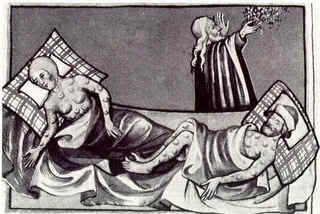
Image from http://upload.wikimedia.org/wikipedia/commons/b/b8/Black_Death.jpg

Cool. Thanks for the series, Tara.
Ditto. ;) Appreciative silence doesn't work too well on the web, and there's nothing quite analogous to applause, but nonetheless those who produce content as excellent as this deserve to be recognized and encouraged. Thanks, Tara, and please keep up the great work.
Agreed! I look forward to reading more. Thanks!
This has been a very well written series, easily understood by a lay reader. Very interesting and informative, both on the plague itself and on how scientists use different approaches to answer questions.
The bit on the louse as a possible plague vector is intriguing. It would be interesting to investigate whether it's possible for a louse to carry both Y. pestis and Rickettsia prowazekii, the cause of epidemic typhus, simultaneously. If it's possible, that might help explain some of the varying symptomatology and transmission times that are confusing the historical record.
Thanks Tara. An excellent look at methodology and the scientific process behind these arguments. :)
Excellent analysis and explanation. Have you sent a copy to Scott and Duncan?
This series has been one of the best things I have read on the internet in quite a while, and believe me, I read a lot.
I think this could be expanded into a great article for The New Yorker Magazine. Thanks.
Interesting series of articles Tara. I look forward to reading what you have to say about contemporary infections.
Thanks very much for this series! I've really enjoyed it.
And! Lice? Ewwww. Does explain a lot though.
Shuddering,
Tree
What an utter waste of time -- examining the DNA of 400 year old corpses. Towards what end, I ask?
Mountain Man-To answer a historical question. To satisfy curiosity. Because it's neat. Because it gives you tremendous geek cred. Works for me.
Mountain man observed "What an utter waste of time -- examining the DNA of 400 year old corpses. Towards what end, I ask?"
In "A Fistful of Dollars," Clint Eastwood's character learned that "sometimes, a man's life depends on a mere scrap of information."
(Some have asked "why only a man;" but if one reviews Sergio Leone's Spaghetti Western ouvre, there are dang few women of consequence. (Although, if one includes "Once Upon a Time in the West," Claudia Cardinale's role was significant.))
A long time ago, I undertook to review an obscure chemical reaction. I told my doctoral advisor that I thought many of the publications were trivial and did not deserve inclusion. He replied "Somebody out there may be more clever than we are." So, I retained all those odd studies. One never knows when odd information will be useful.
Why seek to scale Mount Everest,
Queen of the Air,
Why strive to crown that cruel crest
And deathward dare?
Said Mallory of dauntless quest
`Because it's there.'
Robert William Service
A revolutionary article, I must say!
Very clearly and concisely written! Thank you for this series, Tara. I'd heard about doubts being raised that bubonic plague was the actual cause of the Black Plague, but didn't have an overall picture until I read this.
I'll look forward to reading the next article.
Hi Tara,
Very interesting and well written. I look forward to your next article on Y. pestis. Was there something about survival of Plague in Sweden that ties into resistance to HIV infection? Something about a higher gene frequency in the population? Or was it related to Smallpox? The story also relates to an Ashkenazhi population. Sorry about the spelling, and I Hope I'm not asking for you to repeat the obvious.
As to the stupid comment about why should we look at hundreds of years old bugs --- If your kid gets sick, wouldn't you want your Doctor to know all she can?
Ken
Great article Tara. Why didn't they have paleomicrobiology when I was still a molecular biologist? Might have stopped me from selling out to evil pharma!
Must say though, I'm a little dissapointed with the possible debunking of the Y. pestis-CCR5 link. That and its association with HIV resistance has always struck me as one of the most amazing and elegant biological theories I've read.
It has only killed 200 people since 1998, but Prof Begon said the threat is "growing" in Africa and the US.
The plague is caused by infected fleas carried by rats which spreads easily.
Prof Begon claims that while the majority of cases in the last five years have been seen in African states, there have also been up to 20 victims in the US each year.
The disease, which can kill people within a few days if not treated with antibiotics, is increasingly being passed by rodents to humans and is almost impossible to wipe out.
"Although a number of human cases of plague is relatively low, it would be a mistake to overlook its threat to humanity," Prof Begon told BBC Radio Merseyside.
"Because of the disease's inherent communicability, rapid spread, rapid clinical course, and high mortality if left untreated.
"You can't realistically get rid of all rodents in the world.
"Plague appears to be on the increase, and for the first time there have been major outbreaks in Africa."
Cases of the more dangerous pneumonic plague, which can be spread from person to person by sneezing or coughing, have also been growing since 2006.
But experts said people should be more aware of plague symptoms of black bumps, severe vomiting and high fevers.
Prof Begon has called for better research in developing countries and access to life saving drugs to combat the disease.
The first outbreak of plague swept across England in 1348-49.
Link to news item: http://news.bbc.co.uk/1/hi/england/merseyside/7190260.stm
It's strange having all these old diseases making a comeback. We also have new infectious diseases rearing their heads as well. Somewhat scary!
Well, Mountain Man, maybe it's pointless to you, but I live in a city. And the information in the DNA from those old corpses might just reveal some clue that will prevent an epidemic that includes my own horrible death.
Besides, learning about old stuff is cool.
Thanks Tara. An excellent look at methodology and the scientific process behind these arguments. :
thank you man.Regarding waning immunity, that is a consideration.
I really enjoyed reading this series. Thank you, Ma'am.