
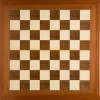
OMG! Did you see the game between U. S. first board Hikaru Nakamura and Russia's first board (and former World Champion) Vladimir Kramnik at the big Chess Olympiad last week? No? It saw one of the rarest and coolest moves in chess. In the following position, it is Nakamura, playing white, to move:
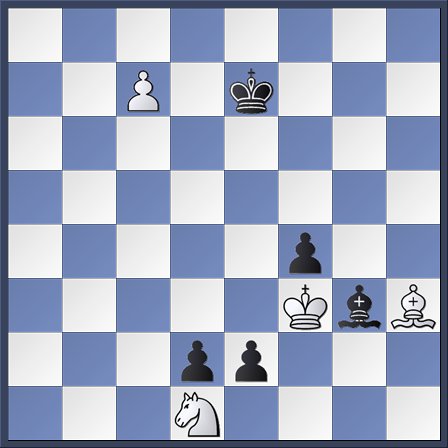
Let me remind you that when a pawn makes it all the way to the other side of the board, it can become either a queen, rook, bishop or knight. This is called pawn promotion. In nearly all situations you are going to promote to a queen, since that is the most powerful piece. When a person promotes to something other than a queen, it is referred to as an underpromotion.
Let me also remind you that white is moving up the board and black is moving down. Now, white might like to play 1. c8=Q, promoting to a queen. But then black just makes a queen of his own with 1. ... exd1=Q+, giving check to the white king, no less. So white's next try would be to play 1. Kxe2 first. But this allows black to save himself with 1. ... f3+ 2. Kxf3 Bxc7! eliminating white's last pawn. White's extra piece would not be enough to win. So what can white do?
The solution is to promote to a knight with 1. c8=N+!:
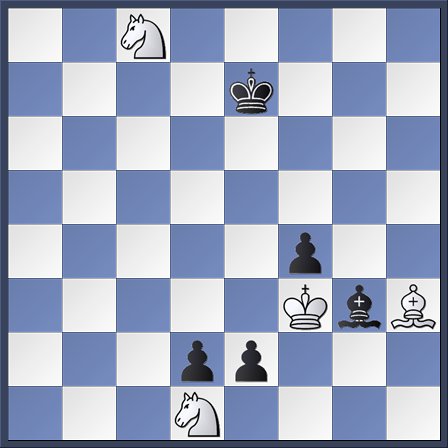
The point is that the knight gives check to black's king. That means that black has no time to make a queen of his own, since he must get out of check first. This gives white time to take the pawn on e2 on the next move. White, then up two pieces, can look forward to victory. Nakamura brought home the point, leading the United States team to a win against the top-rated Russians. Not too shabby!
Actually, this gives me an excuse to show you one of the most famous endgame studies of all time. It's white to play and win in the following position:
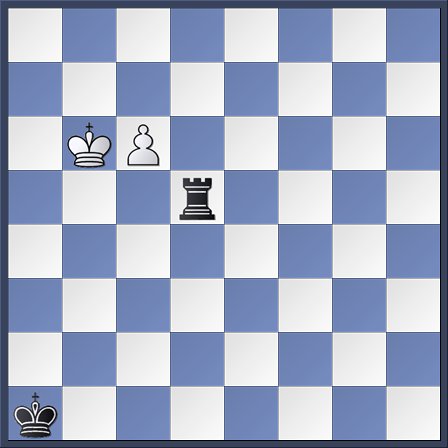
White starts with 1. c7!. Black must do something to stop the pawn, so he must try 1. ... Rd6+. How should white parry the check? If he runs away to the a-file, black will just play 2. ... Rc6 and snap off the white pawn on the next move. If white moves his king to b7, black will play 2. ... Rd7, pinning the pawn to the king. Black will then capture it on the next move, making a draw.
The interesting part happens if white tries 2. Kc5, attacking the black rook. But now black uncorks his main saving idea by playing 2. ... Rd1!
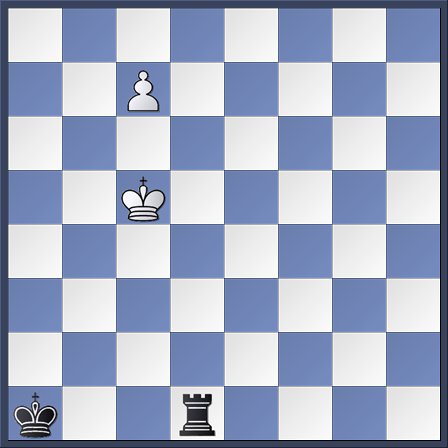
If white now promotes his pawn to a queen, black plays the skewer 2. ... Rc1+, and when the white king moves out of the way, black snaps off the new queen.
So the main idea is now clear. White cannot move to the c-file as long as black has room to get behind him for the big skewer. But white also can't move away from the b-file, since that would also allow black to get behind the pawn. The solution is for white to march down the b-file until there is no more room for black to play behind him. Black, for his part, must keep giving check until he can find a way to stop the pawn. Play continues: 2. Kb5 Rd5+ 3. Kb4 Rd4+ 4. Kb3 Rd3+ 5. Kc2!
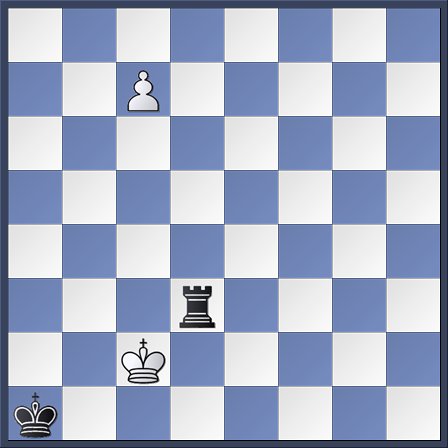
Now black is in trouble. His little trick of running to the first rank to set-up a skewer no longer works. Since it would seem he has no way of stopping white from making a queen, perhaps it is time for him to resign.
But wait! Black has one more trick up his sleeve. He plays 5. ... Rd4!
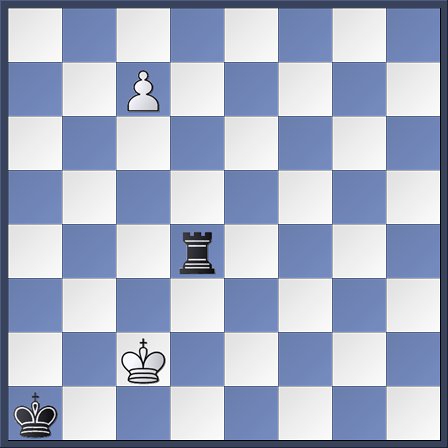
The point is that if white now promotes his pawn to a queen, black uncorks: 6. ... Rc4+, and after white takes the rook with his queen we get this:
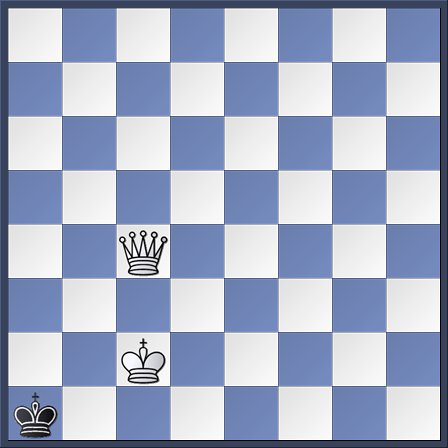
Folks, that's a stalemate. Stalemate's a draw. White wants more! And he can have it, too, by playing the clever underpromotion 6. c8=R!. Now black's little stalemate trick no longer works. It gets worse! White is now threatening to move his rook to a8, giving check to the black king with mate soon to follow. Black's only defense is to black the a-file with 6. ... Ra4 But now white finishes things off with 7. Kb3!
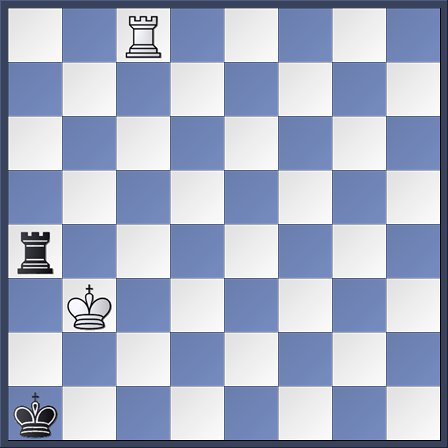
And that's the end of that. White is threatening both to take the rook on a4, and also to give checkmate by moving his own rook to c1. Since black has no acceptable way of stopping both threats, the game is over. Clever stuff!
Naka's game was truly amazing, I captured this frame from the official stream. Look at the other players on the board!
http://i.imgur.com/PqOtJ.jpg
And if you want to see the underpromotion in video, go to http://chess.tv/broadcasts/50 , skip to 19:58:00 mark. Again, every player's expressions, including Naka and Kramnik's, is worth examining.
Two quick notes:
1) Would you consider denoting ranks and files in your chess boards. I refrained from asking this to you until now because I thought you were posting, by and large, for chess aficionados. But now that I see you explaining basic stuff, I thought that's not that case and decided to ask. :))
2) What's wrong with 5. Kxd3 in you exercise?
There was a typo in my initial post. 5. Kc3 was supposed to be 5. Kb3. I've corrected the error. If white had played 5. Kc3, then black could still have done his skewer trick with 5. ... Rd1.
I generate the diagrams using Fritz 11, which makes it very easy to save a position as a jpg file. I don't if it's possible to turn on the lettering.numbering on the side of the board, but maybe there's someway to do that.
I think I found the relevant settings: Go to Tools/Design/Board Design (the shortcut, if your version is differently designed, is: Shift+Ctrl+Alt+O). Tick the "Coordinates" box.
That isn't a stalemate. I see checmate in three.
White goes down one space to check the black king in the corner. Has to move up to the white space. Queen moves left to check king again. He can't take the white queen since that would put him in check, can't move up again because that moves to the same rank as the queen.
So black moves back down to the corner.
Queen moves south, putting the king back in check, covering both other clear spaces because its on the same rank and can't be taken because the king is protecting.
Mate.
Surely.
Unless I read that diagram wrong or there's some rule that says the king can take into check, checkmate in three, not statemate.
Oh, forgot that was black has to move but all is covered.
After 2 Kb5, ...Rc1 draws easily by snapping off the pawn.
'course you could just tear your opponents off if you lose.
It's called the Wookie Defence, IIRC...
Except, djlactin, that 2... Rd6-c1 is an illegal move.
JR, you should have mentioned the name of the composer of the endgame study. I have seen it before (heck, I have been reading about chess for 30 years) but typically have forgotten.
The composer was Fernando Saavedera. My apologies for not having mentioned it in the original post..
Someone posted that to Twitter, and at first I just thought it was another chess problem. Hard to believe that an underpromotion situation actually happened in a major match between leading grandmasters.
@MNb. There seems to be an inconsistency in the move numbering in the post. I mean: in the second diagram of the problem, W has p @ c7 and moves his King to b5. The B R is at d1, so Rc1 is legal.
Nope. The main line is 1.c7 Rd6+ 2.Kb5 and Rc1 is illegal.
The second diagram is a so called analysis diagram, ie it refers to a sideline. It's better not to draw conclusions from it regarding the main line.
Still you have a good point. We can read under that second diagram "black plays the skewer 2. … Rc1+". This obviously must be "3...Rc1+". This is a typo.
huh... "White, then up two pieces, can look forward to victory" hate to do a bishop/knight mate in a time limit...
can you mate with 2 knights?
You need the king to complete it on an otherwise empty board. The knights are more used to hound the king into a bad position from behind his other pieces. I play a knight-heavy game. If I lose both knights early, I've lost, if I keep them both, I've often won.
In general, a king and two knights cannot force checkmate against a lone king. A king, knight and bishop against a lone king can force checkmate, but as you note the technique is tricky. However, a GM of Hikaru Nakamura's calibre would not find it much of a challenge. I suspect that a minute on his clock would be sufficient.
In the game, the material situation is effectively a king, two knights and a bishop for white against a king and a bishop for black. In such a situation black would love to trade off the bishops, leaving white with just two knights, which would just be a draw. In this game, however, there is no danger of that happening, since white's bishop travels on light squares, while black's bishop travels on dark squares. On the other hand, black could not allow white to trade one of his knights for the black bishop, since that would still leave white with enough material to force mate.
Iirc you can mate with two knights if the opponent also has a pawn (which obviously should not have the chance to promote). Maybe a nice subject for the next post on chess?
IMO knights are quite underpowered in chess. They can't really attack, only harry. They don't attack very many spaces and their only advantages over a pawn are that it can project in directions other than forward.
The knight cannot protect itself. If you attack with the knight, the opponent can aways move closer and go from being attacked to attacking and in that position is immune to attack. Whereas a pawn in a position to be attacked by another pawn at least is threatening the opposing pawn and if protected itself and promote that threat to a win. Knights can't. If they're protected, they may not be won, but they can't attack.
Their attack isn't open to being blocked, but they threaten so few spaces, this isn't much of a problem except on a crowded board.
If you want to learn about the power and attacking capacities of a knight you should play through the game Atkins-Jacobs, London 1915.
I've found the knight more useful against poorer players since the oddities of its attack and the fact you can't block make it easier to gull them into concentrating on moving where I want. My game suffers if I lose one knight because I "get" how to use them well. But against a better opponent, I can get carried away and concentrate on making continual knight moves to harry.
Worse, I don't get to play chess with anyone anymore (for the last 20 years, really) and the few I do meet are usually ones who have been playing chess consistently, so I get beaten often. Positional play is my weak point. And I can't really be bothered thinking more than two-three moves ahead.
I enjoy chess, but with someone about my equal and not against a computer. The computer opponent, even if teaching, isn't much fun to be with.
Agrteed. Playing a computer is mind numbing. Heck, I don't even play via internet, I need an opponent of flesh and blood at the other side of the board.
The exception is corr. chess with really nice long time controls.