

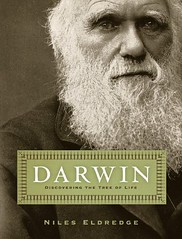
 According to an opinion poll from late 2004, only 13% of all Americans think that humans evolved without any guidance from an all-powerful divine being. In view of this surprising lack of knowledge, I think it is essential that the public is presented with more details about evolution, and this is exactly what this book strives to accomplish. To celebrate the 200th anniversary of Charles Darwin's birth on 12 February 2009, Niles Eldredge, curator of the American Museum of Natural History, designed a wonderful traveling exhibition that documents and discusses the development of Darwin's thinking about evolution, and he wrote Darwin: Discovering the Tree of Life (2005, Norton) as the companion to that exhibit.
This book provides an overview and analysis of Darwin's thoughts that were written in his notebooks and in some of his personal letters, it discusses how Darwin's revolutionary ideas developed, why he kept his theory secret for 20 years even though evolution was not a new idea to the public, and what finally motivated him to publish. The book itself is well researched and documented with numerous quotes and high-quality photographs from Darwin's notebooks, and it also incorporates comments from some of Darwin's descendants who carefully maintained and preserved his notebooks and personal letters and later, published many of them.
From its inception, the author makes it clear that Darwin was working out the details of his theory of evolution so it could successfully weather the inevitable firestorm of criticism from the religious mainstream after publication. The book starts out with a thumbnail sketch of Darwin's travels, his ambitions and his life and the following three chapters delve into his writings in chronological detail. Chapter five reports further developments in the theory of evolution after Darwin's death, including the growing acceptance of the Eldredge's co-contribution, along with that of his late collaborator, Stephen Jay Gould, of "punctuated equlibrium", to the field. Punctuated equlibrium is defined as long periods of observable phenotypic stasis punctuated with rapid transitions where entire species can be replaced by new forms. The author points out several times that Darwin had originally proposed in his notebooks that evolution proceeded in "sudden shifts" but later abandoned that idea.
Several times in these chapters, the author makes the intriguing observation that Darwin was the first scientist who abandoned the traditional Baconian induction (observational) scientifically describing the world. Instead, Darwin consciously turned to the modern deductive method, which relies heavily on predictions and hypothesis testing after an initial period of observation of natural phenomenon.
The last chapter, entitled "Darwin as Anti-Christ", details how religion has increasingly come into conflict with the theory of evolution since Darwin's time up until today. The author also describes and diagrams his compelling hypothesis for how evolution should proceed if it truly is the result of an invisible intelligent designer's manipulations rather than simply a collection of random modifications to pre-existing structures. Not surprisingly, the author concludes that evolution is not a process that is meticulously planned and guided by an intelligent designer hiding behind a curtain in a booth but rather, it is a natural response to environmental pressures.
Overall, I enjoyed this book, but I suspect it was rushed into publication so it could be on the shelf in time for the grand opening of the museum exhibition. As a result, I think the book is somewhat disorganized and repetitive. It would have benefited from the guidance of a strong editor who could identify the nuggets concealed within wordy passages, who could clarify occasionally tangled prose, and who would have challenged the author to plainly reveal the depth of his own admiration for Darwin's contributions.
However, that said, this is a beautifully produced book; it is a sturdy cloth-bound volume, printed on heavy glossy paper, and it is filled with excellent photographs of complete pages from some Darwin's precious notebooks, portions of which are quoted in the text. The author provides interesting insights about this subject that I never tire of learning more about, and thus, it is definitely worth reading.

How long is the Darwin exhibit going to be open? I will be in NYC on May 25th and I'd like to go. Is there are way to get tickets in advance?
According to an opinion poll from late 2004, only 13% of all Americans think that humans evolved without any guidance from an all-powerful divine being.
Define "without any guidance". Personally I accept the evolution theory, including the evolutional history of humans, without any difficulty at all. It makes perfect sense to me. As a Christian (Lutheran) I kind of think, though, of evolution as one of God's tools, a bit like gravity etc., which He uses to do, well, what he pleases. (Including, presumably, shaping up us humans as we are today. I don't expect Him to stop there, or us to be His top priority.)
So while I don't take my Genesis literally and have no time at all for either creationists or the ID people (or their "theories" being taught to schoolchildren), I'd have to think about what my answer would be if asked whether I think humans evolved "without any guidance". It doesn't mean I'm anti-Darwin in any way.
(I do realize that I'm European and that the debate is rather different at the moment in the States. I'm pretty sure that a great many American Christians have no issues with the evolution theory, either, though.)
I greatly enjoy your blog, BTW, and I find wonderful linkage here. I originally found this place through the Science Magazine's NetWatch link to ScienceBlogs, in case you're interested.
May 25th? I might be in NY on 20 May, or thereabouts. Another miss!
http://www.amnh.org/exhibitions/darwin/?src=h_h
The exihibit goes till the 29th of May. I forgot what the full price is, but with my student discount I paid 16 bucks for it. I thought they did a pretty decent job of explaining the basic concepts of natural selection, but the coolest part is all of the specimens and letters Darwin collected and wrote to his friends over his life. They even have a copy of his bible that he took with him to the Galapagos (he WAS planning for a career in the clergy). Take that, fundamentalists.
Yup, roughly 25-29th. My kids have EOGs before that, and my brother and his wife are opening an exhibition in Chelsea on the 25th, so that is pretty much set in stone. Some other day, I guess....
I might be in New York around the 23rd and 24th...
Arrrgh, Alon, what a near miss!
Well, I'm going to start living in New York around August, so from then on it won't be a near-miss...
the Darwin Exhibit does close on the 29th of may. since it is traveling around the country, and ends up in london in 2009, it cannot be held over, despite the great interest and tremendous public popularity.
i (and all my parrots) might be sleeping on a park bench by the time you are living here, alon. so ey .. we can all go camping in central park together! and we can bring lots of cheap beer with us, too! and binoculars, and then we can say we are doing research!
Ugh... is your employment/welfare situation that bleak? And is it something you fear has a good chance of happening, or just a worst-case scenario that isn't that likely?
About the cheap beer, you're going to have to drink it all, because so far it seems I can't drink beer without spitting it.
not yet, but summer is a terrible time to look for/get for jobs in academia/research, and besides, i have given up looking anyway.
I'm not sure what's worse - the country that makes even temporary joblessness lead to utter poverty, or the academia that hires adjuncts instead of full-time professors.
Can't you try the shotgun method again to get some position in the fall?
i've killed many trees in the past years in search for a job. in fact, i've killed several -- rather large -- forests' worth of trees -- i've certainly been the cause more environmental destruction than i've a right to.
Actually, I believe that paper is generally made from rapidly growing species that paper companies replant...and the greater the paper demand, the more replanting they do. So the more paper you use, the more trees there will be...every cloud has a silver lining!
Seriously, I enjoy your blog and hope you find a good situation soon.