

"All truths are easy to understand once they are discovered; the point is to discover them." -Galileo Galilei
Ever since the time of Galileo, Jupiter has been an amazing sight for skywatchers. With its four large moons, even the smallest of amateur telescopes provide amazing sights.
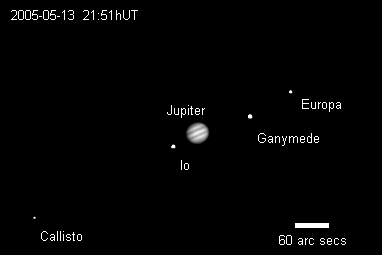
In fact, if you watch Jupiter's four large Moons over the span of a few hours, you're likely to discover the same exact thing that Galileo did.
And we've actually captured some remarkable shots of Jupiter's Galilean satellites.
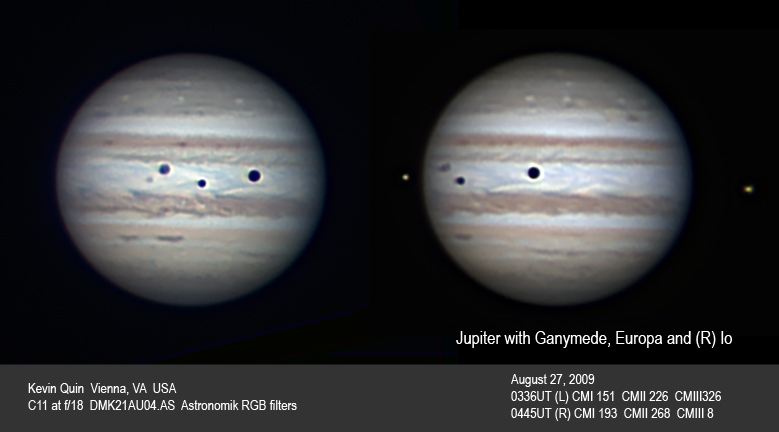
Check out this shot, by Kevin Quinn, of two of Jupiter's Moons, Ganymede and Europa, both casting their shadow on the planet at the same time: a double eclipse.
Of course, if you had the Hubble space telescope, you can pretty much do whatever you want. Including looking at Jupiter at just the right time...
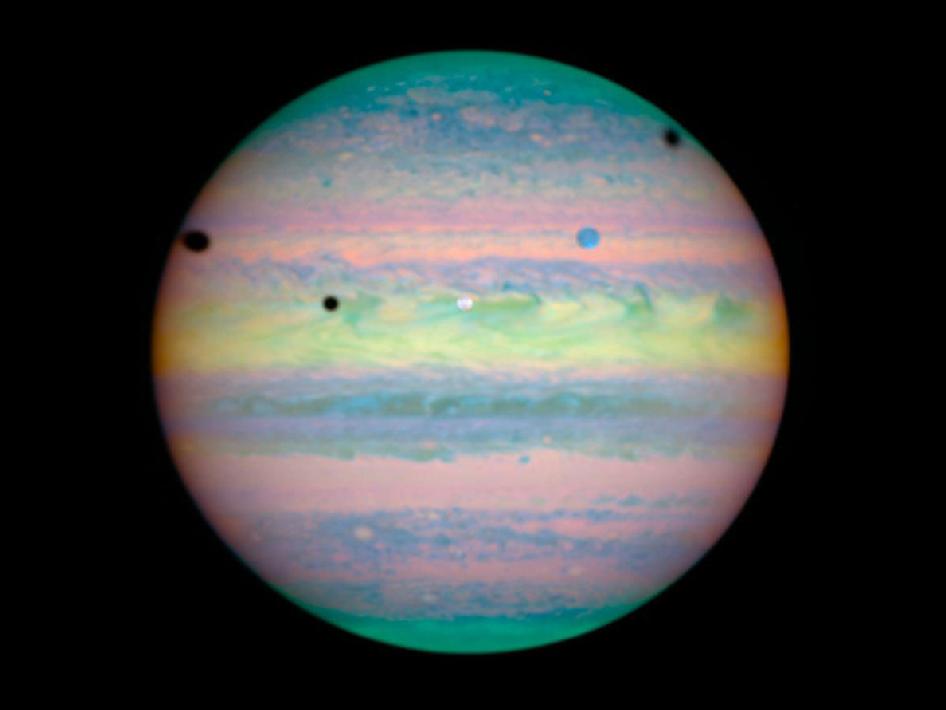
...to see a triple eclipse! That's three of Jupiter's moons' shadows falling on the planet at the same time! You have to really look at juuuuust the right time to make this happen, because the orbits don't often line up like that.
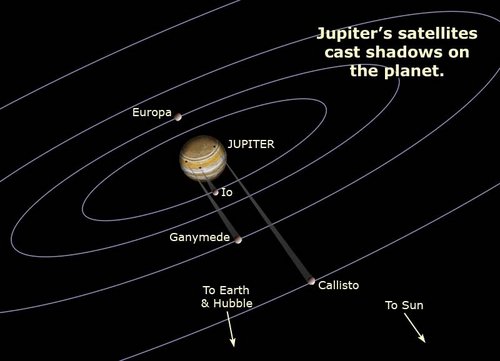
But I want more. What do I want? Hubble, my birthday is many months off, but let me tell you what I really want. I want a photo of Jupiter's moons lined up so perfectly that we don't just get a double eclipse, but that one of Jupiter's moons has its shadow fall on an inner moon of Jupiter!
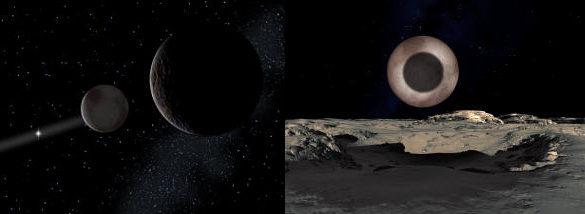
Does this happen? Of course it does; Jupiter's moons orbit at an incline to Jupiter, and it's only a matter of time before they line up correctly! In fact, I may have scavenged an image where it happened: take a look!

But you know what I really want: I want Hubble to capture it! Why?
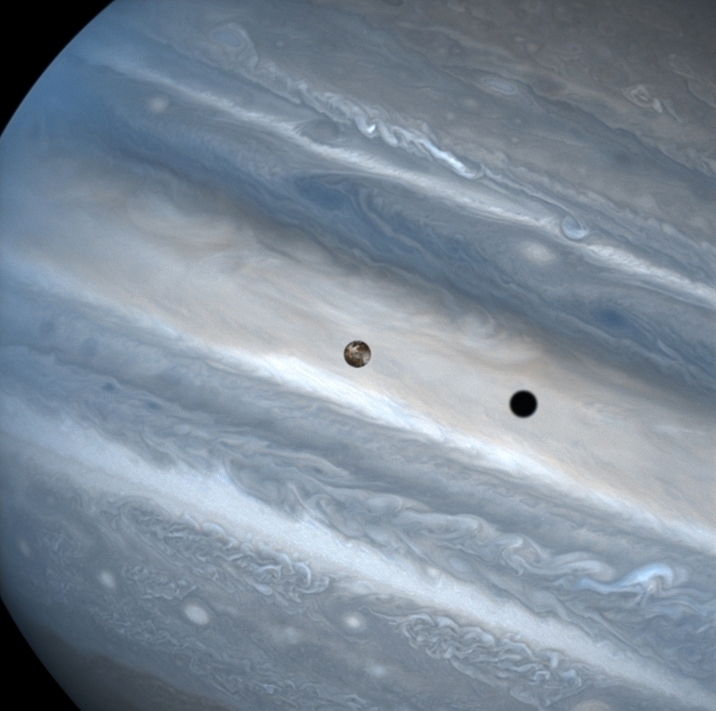
Because with Hubble's resolution, we could actually see one moon's shadow on another moon!
And this is something that really happens, and we actually have the technology to image it today! Here's hoping!
- Log in to post comments
I assume Hubble is still spoken for pretty much 100% of viable operation hours, but surely whatever team manages Hubble could see the value of this. Is it crazy to think this idea would be heeded if spoken into the right ear?
For my birthday, I want Hubble to take a picture of me taking a picture of it. Totally plausible.
What sort of color filter was used on Rainbow Brite Jupiter there?
Can you estimate how often this wonderful alignment happens?
When is the next right time for capturing this event?
Is one of Jove Pater's moons orbit retrograde?
Another question, the moons appear so large in comparison with the planet. Jupiter is humungous. The moons aren't much more than our moon, if that. The distance is humungous. Why do they appear so large? I have an 8 inch dobsonian and when I've looked at Jupiter I've had to convince myself that the nearby lights are not stars because they are just too big and far away from such an (apparent) small planet to be moons. It's how I imagine the moon looks beside the Earth (I think the Moon is pretty large compared to the Earthf) from Jupiter.
@Brian: No, the moons' size looks reasonable to me. Jupiter's radius is about 7*10^4 km, and the Galilean satellites have radii in the 1500-2700 km range. The blue satellite in the triple eclipse figure looks to have about 1/30 the radius of Jupiter, which is very nearly the actual value for Callisto (r = 2400 km) and consistent (to the precision which I eyeballed it) with Ganymede.
For comparison, the Moon's radius is more than 1/4 that of the Earth's. Yes, the Moon is large beside the Earth. Relative distances also matter here, if you're taking a photo from Earth orbit, while the difference in distances to Jupiter and its satellites from Earth is small compared with the total.
1) As to Galileo's quote - he obviously never had to deal with quantum mechanics. :)
@SeanHogge - I think a dude on Earth would be far to small to resolve using Hubble. Would you be willing to pose on Ganymede?
" altın çilek " above is a spambot. Please nukeuser.
@DataJack Are you sure about Hubble's resolution? When pointed at the moon, it's several meters per pixel - too large to resolve the mirrors or Apollo craft. However, being so close to earth, surely it would approach 1 meter per pixel.
Regardless, I'd be happy to pose on Ganymede. When do I lift off? Can we swing by Europa for a space slushie?
So, how much is an hour of Hubble time, and does NASA sell gift cards?
nice...very much enjoyed the video on finding the next site....