

"Some prophecies are self-fulfilling
But I've had to work for all of mine
Better times will come to me, God willing
Cause I can't leave this world behind" -Josh Ritter
You sure can't leave this world behind. At least, not very easily. The reason for it, of course, is gravity.
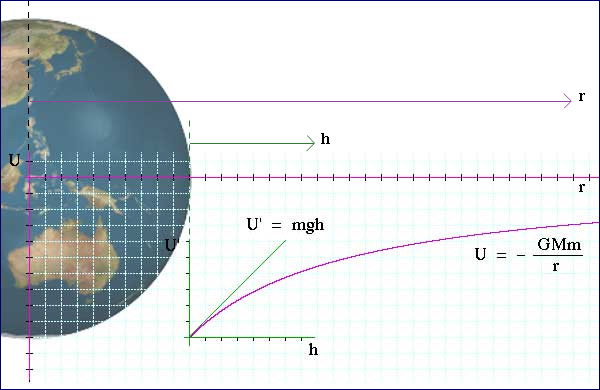
Image Credit: Physclips, via the University of New South Wales' School of Physics.
Here on the surface of the Earth, the gravitational potential well is pretty large; large enough that there's no easy way off. Sure, you can pour a huge amount of energy into a rocket to try and overcome this gravitational potential energy, but I think it's more fun to think about what would allow us to leave for free.
In principle, bringing a large gravitational mass close to our surface might allow us to "jump ship" to the other world. Unfortunately, where we are, even our closest neighbor, the Moon, isn't really all that close.
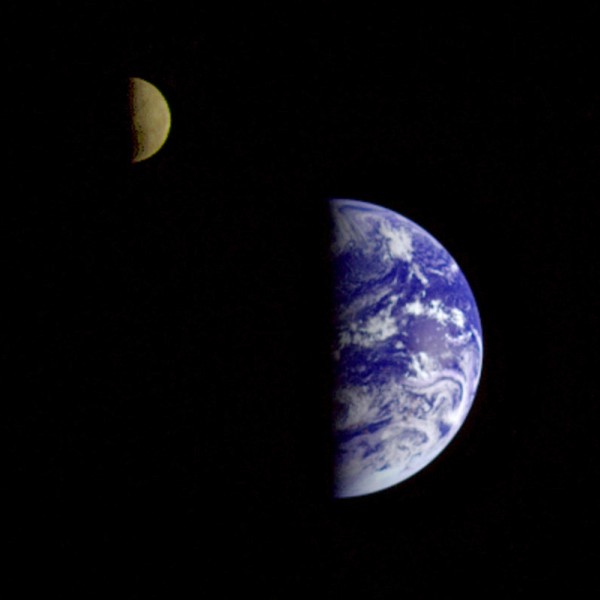
Image credit: NASA, from the Voyager missions.
You might be used to seeing pictures like this, but these are false-perspective pictures, where the Earth and Moon are nearly lined up with the camera. If we illustrated the Earth-Moon system to scale, it looks far less impressive.

Image credit: Larry McNish, of the RASC Calgary Centre.
The Moon is practically useless for helping us escape the Earth's gravity. It's both small and low in mass, a combination that gives it a low surface gravity: just 17% of what we have here on Earth, and the Moon is quite far away, at least relative to the size of the Earth.
That might be the way it is here, in our Solar System, but as we're just starting to learn, the Universe is an extremely diverse place, where every combination of planets and solar systems we can think of very likely exist.
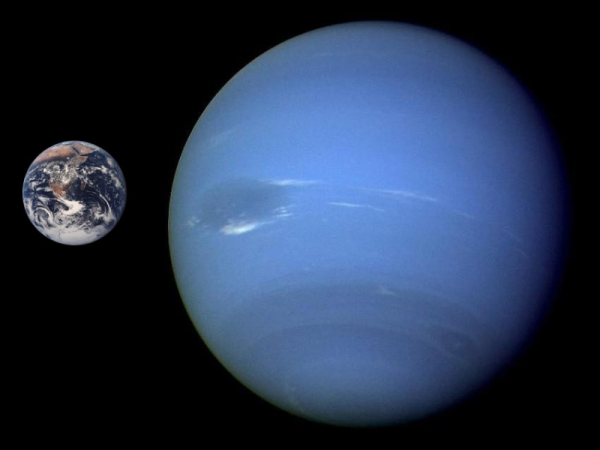
Image credit: NASA, retrieved from Universe Today.
For example, maybe there's a solar system out there where it isn't small, rocky planets that fill up the inner orbits, but a mix of Earth-like, rocky worlds and also gas giants, some of which are even closer to us than our closest planet, Venus, when it reaches perigee.
Wonder what that might look like?
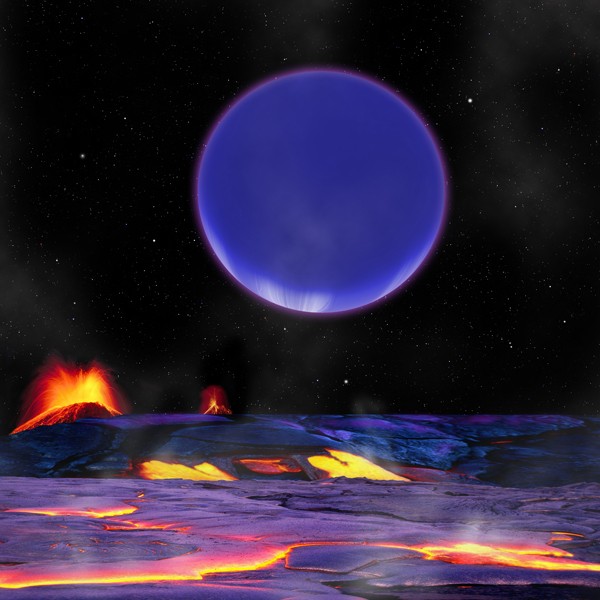
Image credit: David Aguilar, Harvard-Smithsonian Center for Astrophysics.
From even a significantly greater distance than our Moon is, a gas giant planet, even a smallish one like Neptune, would appear huge and towering in the night sky. Our Moon, the biggest single object in the night sky (by angular size) at just over half a degree, would be dwarfed by the way a planet like this appears.
And a skyline would certainly have a different look to it.
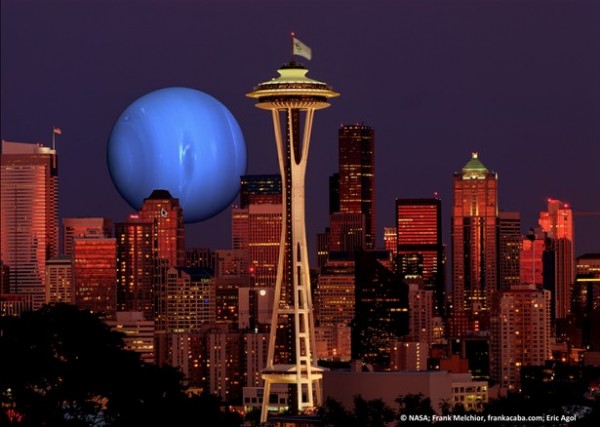
Image credit: NASA, Frank Melchior (frankacaba.com), and Eric Agol (University of Washington).
Fortunately, we don't have to speculate anymore! The star Kepler-36 was just announced to have two planets orbiting it: one is an Earth-like world just 50% larger than our planet, while the other is a Neptune-sized world, nearly four times our size and eight times as massive.
The truly amazing thing about these two planets is that they are so close together! While the Earth-like world orbits its star from a distance of 11 million miles, the Neptune-like world is just 1.2 million miles farther out, making these the two closest planets ever discovered in the galaxy!
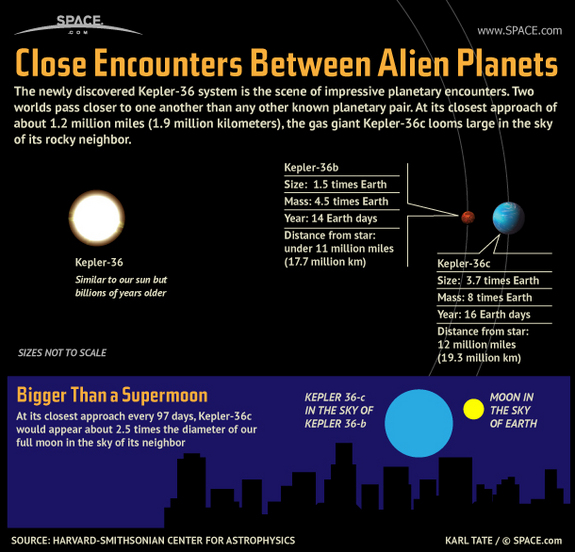
Image credit: Karl Tate / Space.com, info via the Harvard-Smithsonian CfA.
Every 97 days, the inner, Earth-like world overtakes its next-door, Neptune-like world in its orbit. At that time, the planets are separated by a mere 1.2 million miles, or just 5 times the Earth-Moon distance. This is still too far to leap from one world to the next, but it's on the right track.
You see, if you wanted another planet to come by, if its surface gravity was higher than Earth's, we could literally get pulled off of our planet and get sucked into the gravitational well of the other world! If you brought the real Neptune close enough to the Earth, this is exactly what would happen.
Image credit: NASA, retrieved from Universe Today.
Like Saturn and Jupiter (but not Uranus), Neptune has a higher surface gravity than Earth does. If the surface of Neptune came within about 1,000 miles (1,600 km) of Earth's, the gravitational force from Neptune would exceed the gravitational force from the Earth, and objects on the side of the Earth facing the gas giant would be more attracted to the giant planet than to Earth, and would begin accelerating towards it.
Conversely, if you took a planet with lower surface gravity than the Earth and brought it close enough, someone on that world would find that our gravitational attraction was greater than their planet's, and so they'd start accelerating towards our world!
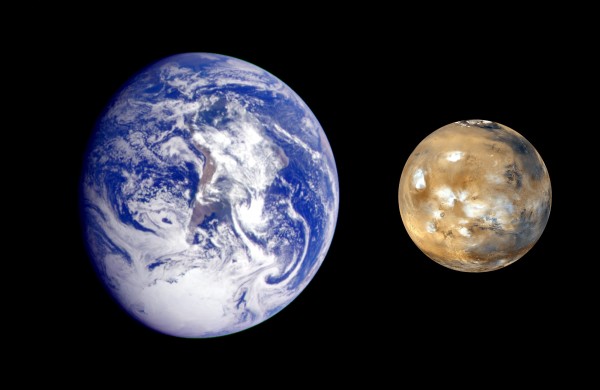
Image Credit: NASA / JPL-Caltech, via http://photojournal.jpl.nasa.gov/jpeg/PIA02570.jpg.
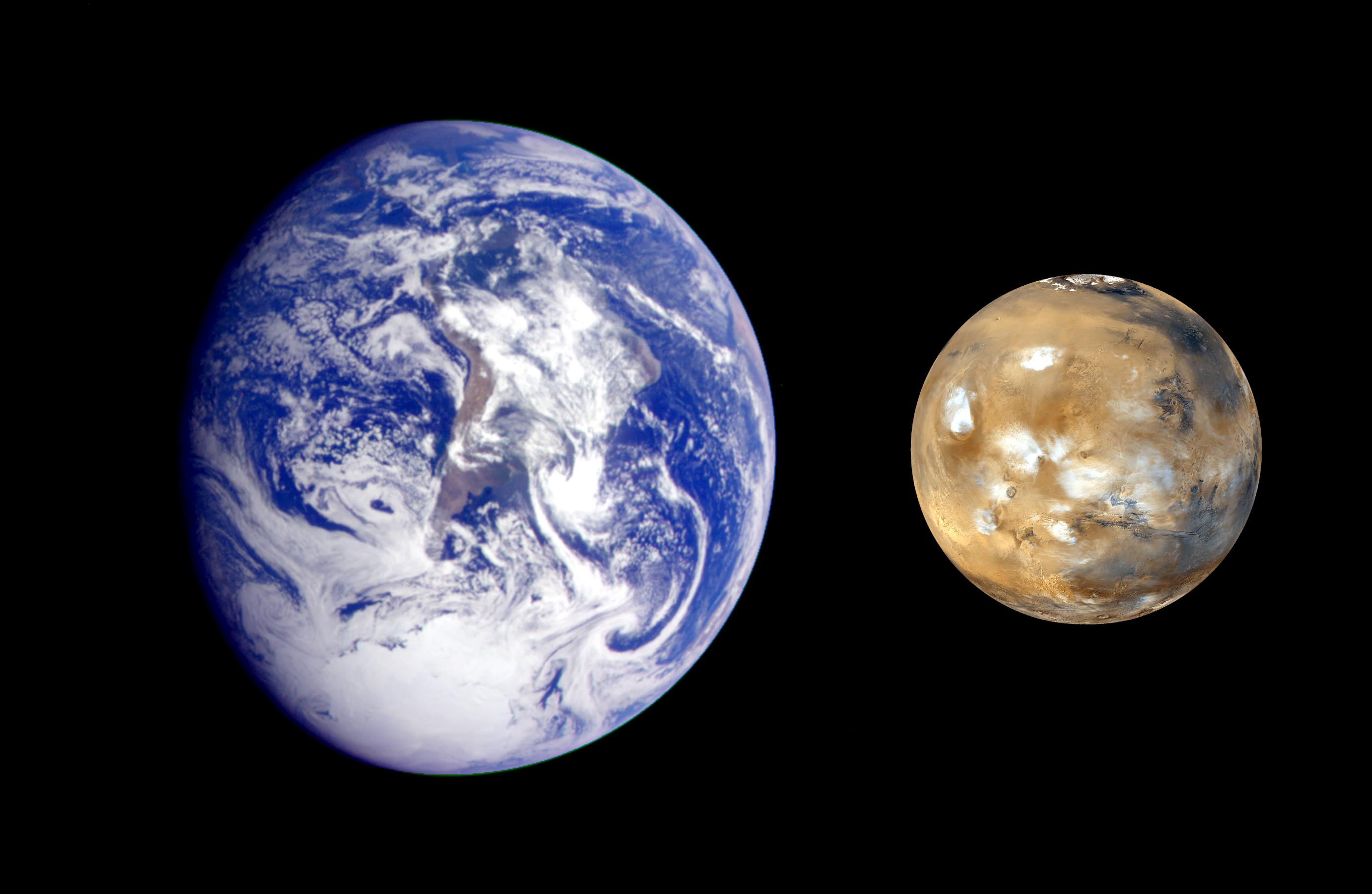
Mars, for example, would only need to come within about 2,000 miles of Earth for someone on Mars to begin accelerating in our direction. There may even be alien worlds out there known as double planets (or binary planets) that are close enough for something like this to happen.
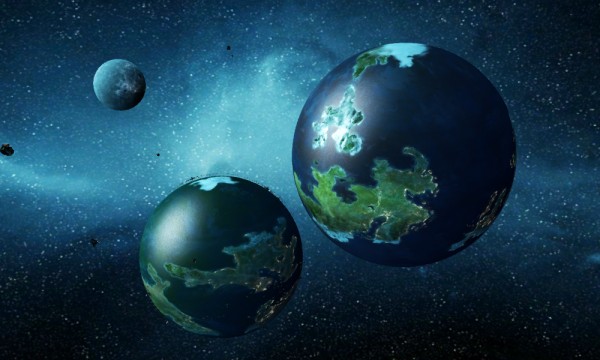
Image credit: Moddb.com, for Maelstrom.
Of course, these are very very close distances for things as fragile as planet. Think about how small and far away the Moon is, and now think about how powerful the tides are on Earth. Now imagine replacing the Moon with something much more massive and about 100 times closer. Now, remember that gravity is an inverse square law, meaning that if it's 100 times closer, the force is 10,000 times stronger.
In other words, it isn't just you that will be accelerated towards an alien world; the world with the lower surface gravity itself will begin to be torn apart!
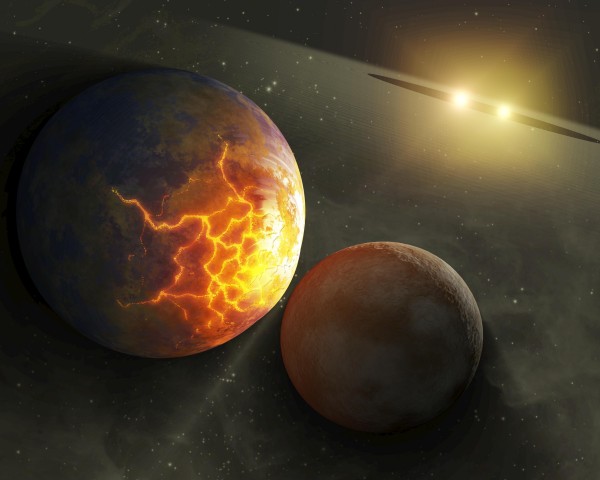
Image credit: NASA / JPL-Caltech.
Earthquakes and volcanoes will certainly abound, but it's more likely that even more severe changes would happen to such a world. It would be unlikely to be spherical, and -- if they were comparable in mass -- both worlds would likely be deformed by their mutual gravity.
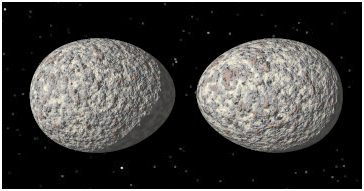
Image credit: Guildworld.com.
It's conceivable that even for the case of Kepler-36, the inner, Earth-sized planet has no atmosphere, because it's been stolen, or siphoned off, by the close-by, larger-massed Neptune-sized world! Atmospheric thievery: in this Universe, it very likely happens!
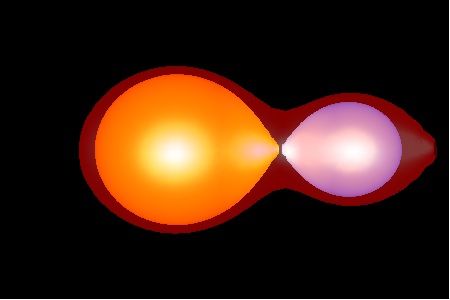
Image credit: Penn State University / Wolfram.
It happens for binary stars, and there's no reason to think there aren't binary planets out there, too, for which the same thing happens.
So it might be hard to leave this world, but the more I think about it, the more I'm convinced that's a very good thing!
(And if you think I got the idea to write about this from this week's Futurama episode, I've just got one thing to say to you.)
Image credit: KnowYourMeme.com.
All glory to the Hypnotoad!
Awesome! Yes, even the glorious Hypnotoad.
I guessed from the feed it would be about launching, but assumed it would be some etheric discussion on how Earth is large enough to make it habitable but small enough to make chemical rocketry possible. (Presumably superEarth astronauts have to go for nuclear rockets, or perhaps elaborate schemes to lift the launchers above most of the atmosphere. Or maybe neither of those work. Definitive post material IMHO.)
Instead I get treated to a stellar performance of how juggling planets are good for thought!
But, what was Harvard-Smithsonian thinking when they lent their science-cred to an infographic with "a Supermoon"? The 'supermoon' that is ~ 1 % closer in orbit, and therefore not visible even if a twin moon would be besides for comparison? At that, I let out a supermoan.
For a free trip out of the gravity well, my favorite solution is the Beanstalk. I'm really, REALLY hoping material science will advance quickly enough that we can build a space elevator in my lifetime. Yeah, it still requires energy, but that can come from the ginormous solar panels on the outbound end.
Ethan, do you have anything to say on the subject?
Typo?
"Earthquakes and volcanoes will certainly about"
You may have meant "will certainly abound".
XKCD had a great graphic illustrating gravity wells: xkcd.com/681/
Torbjörn, although I tend to agree with you from my own experience, the 14% difference in angular size between a "super"moon and a smaller full moon is noticeable to some, who have let me know that they can, in fact, tell the difference, and that if I spent as much time looking at the moon as they did, I'd notice, too. :-)
Artor, I would love for there to be a space elevator in our lifetimes; hopefully carbon nanotube technology will continue to increase to the point where construction of such a structure becomes feasible!
JosephK, yes, thank you, that is fixed.
david, xkcd makes some of the best graphics like that I've ever seen. That is indeed a good one!
"Sure, you can pour a huge amount of energy into a rocket to try and overcome this gravitational potential energy, but I think it’s more fun to think about what would allow us to leave for free."
Free? What does free mean in a universe of unlimited resources and unlimited human imagination? Free is what we can make happen; that could NOT previously be done at any price, by any means.
Of course, we are here on Earth, so our planetary neighbors are what they are. So moving Neptune closer to Earth is not the free-way. How do we leave Earth, to quote Malcom X, "By any means necessary." (finances be damned)!
Time may or may not be an illusion (Einstein); but money (like limited resources) is surely a fiction. (Yes, acknowledging that the necessity of sustainability of planet Earth is of prime important).
Well the Hale Bopp comet cult had an idea; let's pause for a sincere moment of silence. Their sad end was not a free-way.
But the Pentagon is looking for a free-way. "100 Year Starship: An interstellar leap for mankind?" http://www.bbc.com/future/story/20120321-searching-for-a-starship
"Is a Pentagon plan for a spaceship travel outside our solar system a crackpot idea, or a visionary blueprint for reaching the stars?.. 100YSS purpose is clear and focused-human travel beyond our solar system and to another star system.. “So we thought a 100-year time horizon, not for the study, but 100 years of doing research and development, gave us some practicality of developing technologies that we couldn’t foresee today.”.. But the 100YSS is not a fringe activity started by a bunch of dreamers. It has the backing of two high-profile US agencies – the space agency Nasa and the Defense Advanced Research Projects Agency (Darpa), the US military agency that helped create the internet and satellite-based navigation..."
As for funding of this DARPA led 100YSS program, don't believe those who say the project is under funded. Just remember, that at least 3 Hubble telescopes were built.
There was Hubble and then there were these two recently acknowledged Hubble calibre telescopes for satellite spying of people http://www.nytimes.com/2012/06/05/science/space/repurposed-telescope-ma…
Does anyone believe that only 1 James Webb (strength) Space Telescope is being built. Surely two additional such super spy satellite telescopes are being built or already have been launched.
So what about DARPA's 100YSS plan. Do you think it is well funded? When you consider that 2 of the 3 Hubble calibre telescopes were built for national security (spying), let me ask youj, "Are you feeling luck?" and "Who's your Daddy?"
A space elevator turns out to be a very promising structure. Just look at one of the best in field of theoretical physics talk about it: http://www.youtube.com/watch?v=sYYdh84pFng
"Free? What does free mean in a universe of unlimited resources and unlimited human imagination"
He's not talking about money.
He's talking about "no net energy expended".
Stuff goes up, stuff comes down. If both have the same mass, gravitational potential energy is exchanged equally and the lift to orbit hasn't cost any energy.
Ethan's thought experiment begins "Here on the surface of the Earth... it’s more fun to think about what would allow us to leave for free." But "If you brought the real Neptune close enough to the Earth, this is exactly what would happen" is not exactly a "Stuff goes up, stuff comes down" kind of argument. It is NOT a thought experiment about our planet Earth; it is about some other hypothetical solar system. And if it is about our planet Earth in our solar system; then it is certainly not a “no net energy expended” thought experiment.
But having said that, I understand Ethan's point and Wow's point.
Yes it IS a stuff goes up, stuff goes down argument, except this case, it's going up from earth and down to Neptune.
Exactly the same thing.
You're correct " it IS a stuff goes up, stuff goes down argument"; BUT AFTER AND NOT UNTIL "you brought the real Neptune close enough to the Earth".
But bringing Neptune close to Earth is a pretty BIG ASSUMPTION if your stated objective was: "Sure, you can pour a huge amount of energy into a rocket to try and overcome this gravitational potential energy, but I think it’s more fun to think about what would allow us to leave for free."
So do the calculation, does it take more "energy (for) a rocket to try and overcome this gravitational potential energy" of the Earth or to move the orbit of Neptune so that "the surface of Neptune came within about 1,000 miles (1,600 km) of Earth’s".
The unintended consequences of moving Neptune "within about 1,000 miles (1,600 km) of Earth’s surface" are pretty catastrophic both for any astronaut trying to leave "the surface of the Earth" by overcoming the "gravitational potential... for free." The astronaut in space suit instantly flies off the surface of Earth only to collide with Neptune and ditto every other leaving creature on planet Earth as our atmosphere and oceans leave planet Earth instantly.
Ethan of course agrees, " the world with the lower surface gravity itself will begin to be torn apart!"
So a person trying to teleport the planet Neptune to ""within about 1,000 miles (1,600 km) of Earth’s surface" would be either a delusional psychiatric patient (of the Hale Bopp comet variety) in a space suit trying to leave Earth's gravity and drift into a tour of the galaxy OR a mad scientist trying to destroy planet Earth. Depending upon one's talent as a science fiction writer either story could be comedy or tragedy?
Now back to Ethan's final answer, "it (is) hard (not energy free) to leave this world (Earth), but.. that’s a very good thing (because of so many unintended consequences)!" I think my paraphrase is in the spirit of Ethan's meaning.
Yes Ethan's answer is a pretty good answer.
100YSS is also a pretty good answer.
Another answer is:
"Less than 10,000 of the 100 billion star systems in the Milky Way galaxy have inhabited planets. It has long been known that the only effective means of exchanging vast cultural knowledge between such worlds is by physically transporting people of character. Similarly on Earth, vast amounts of corporate data are most effectively backed-up by trucking computer reels to secure sites like Iron Mountain.
When crossing the galaxy, the limitations of physics, economics and biology cannot be ignored. There is no faster than light travel. Starships are unimaginably expensive. Space travel is horrendously hazardous to living organisms. One can never return from such an uncertain galactic voyage. The psychological stress of galactic travel is enormous. Few choose to be such Travelers. The Magicians are those who smuggle Travelers across the galaxy.
Knowledge of Magicians is systematically suppressed on all but one planet. Upon the planet of La, the existence of one Magician, Xavier, is too deeply woven into the fabric of cultural mythology to be denied. The Magician of Time tells the story of Xavier's unexpected return to the planet of La." My mother asked me if this was true; what would you tell your mother?
I miss you mom.
"You’re correct ” it IS a stuff goes up, stuff goes down argument”; BUT AFTER AND NOT UNTIL “you brought the real Neptune close enough to the Earth”."
Nope, it's STILL a "stuff goes up, stuff goes down" even before you actually do it.
It remains true that this is what happens EVEN IF YOU DON'T DO IT.
I don't actually have to drop a bowling ball from the leaning tower of piza to say that it will fall down.
Oh, yea, that's a real argument-whiner. "Yo momma's fat".
That's always a clincher when you want to prove a point.
Moron.
Wowland is a place without humor; every Wow assumes that every point is meant to be proved. Nevermind, Godel's incompleteness theorem. In Wowland, the Wow's are aligned in two political parties; those who wait for Godot and those who do not. Neither side can prove whether Godot actually exists or not; but the evidence is tantalizing and the theories are competitively, well sometimes absurd. But no one laughs or gets a joke in WowLand except the tourists.
Yes of course in Wowland, the tourists are all idiots and their mommas are all fat. Yes those Wows are very serious about this, about everything. I know, I can't help laughing either.
Chelle, you're wrong: light DOESN'T form rods or cones at all, they form packets of quantised energy.
You're insistence that light forms both cones and rods is proof that you are an idiot!
PS I guess now you're being insulting, you'll stop whining about it, yeah? Nah, why should you bother being consistent - you haven't bothered before.
OKThen thinks talking in the third person makes it not his fault.
Having re-read your earlier post, I'd misread: "I miss your mom".
But I guess you'd prefer to snark away, right? Because you can't stand someone telling you you're wrong, you need to show that nobody is any better than you, right?
Pathetic.
Enjoyed this post very much, Ethan. So here's my question: Given the rules of gravity, as you laid out here, what are the odds that we might discover a moon that is capable of supporting life, orbiting a gas giant planet, ala the moon of Endor on Star Wars? Is it physically possible for such a moon to exist without having its atmosphere stolen or be too deformed or too wracked by seismic forces? What say you?
Mostly our air stays on because the velocity of the gasses at our distance from the sun (the temperature at which it would attain thermal equilibrium) is not significant compared to the escape velocity from the earth (11kps).
The bigger difficulty would be having a world that wasn't so ripped by tidal forces that it was too unstable for life to develop.
If we dropped in on one, this may not be a problem (may even be a benefit: we won't be displacing any species which may have developed if we hadn't tromped all over the place). But for life to develop into something meaningfully complex, it needs a few billion years of stability where it will grow.
There are plenty of examples of moons around gas giants in our system that are not so wracked with tidal forces that it's inconceivable they would be stable enough for life. Io seems an unlikely place, sure. :)
In some, the tidal heating may be just enough to allow liquid water where the sun's rays would be insufficient. Europa and Enceladus* specifically. Titan is the only moon I know of with a substantial atmosphere, but I don't think that means it's the biggest obstacle.
Overall seems quite possible for a moon to be as habitable as a planet.
* Which I don't think I'll ever be able to stop pronouncing "enchiladas" in my head and for the record Firefox agrees is pretty similar. :)
Wouldn't planets that close to each other collide?