

"Even if there is only one possible unified theory, it is just a set of rules and equations. What is it that breathes fire into the equations and makes a universe for them to describe?" -Stephen Hawking
After a long search spanning more than my entire lifetime (so far), the Higgs boson has finally been discovered at both detectors -- CMS and ATLAS -- at the Large Hadron Collider at CERN.
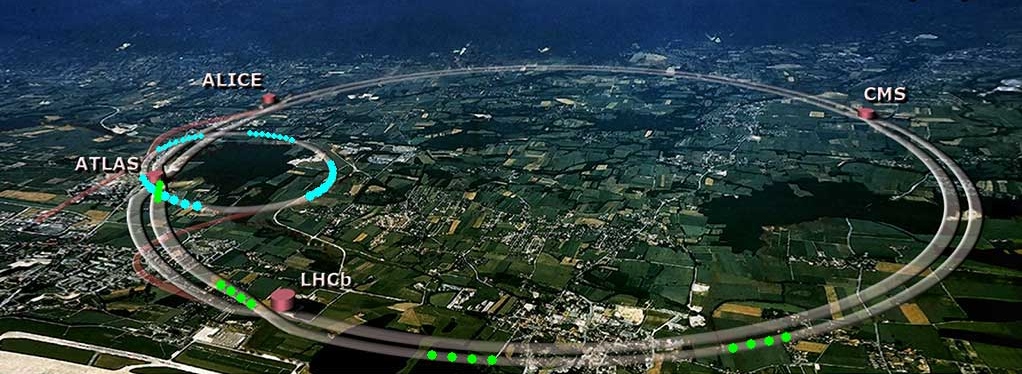
Image credit: CERN / Particle Physics for Scottish Schools.
For a little more on this, check out the earlier posts here celebrating Higgs week:
- The Biggest Firework of them all: The Higgs
- How the Higgs gives Mass to the Universe
- Explaining the Higgs: on TV last night!
Our standard model of elementary particles and interactions is now complete, with every single particle that's a part of it having been discovered.
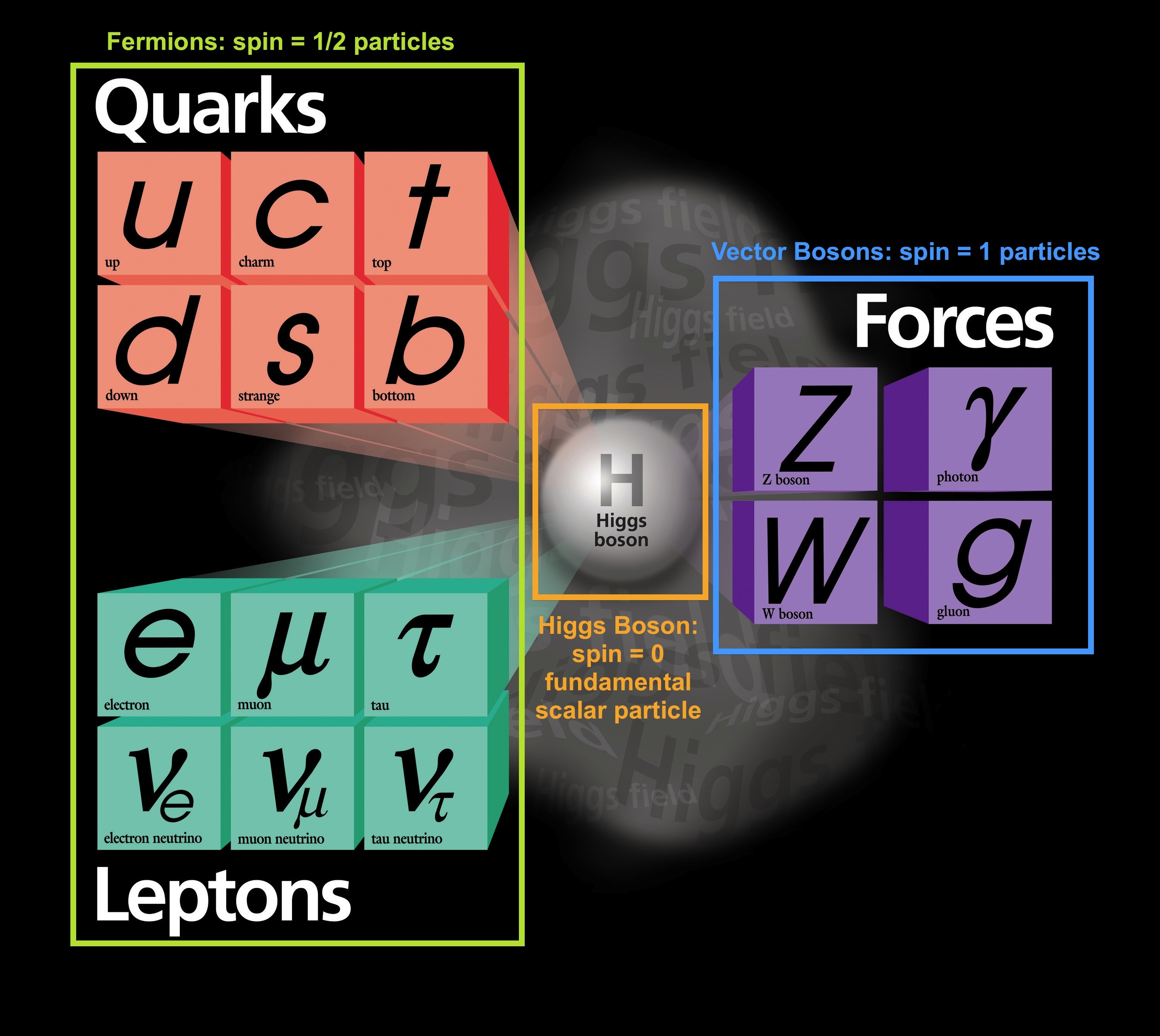
Image credit: The standard model by Fermilab, modifications by me.
Combined with our knowledge of gravitation through general relativity, and the framework of quantum field theory describing all the standard model particles and how they interact with one another, it's no stretch to say we're sitting pretty, and that we've come an incredibly long way to arrive at our present understanding, especially considering practically none of this was known a century ago.

Image credit: Fundamental Forces, via hyperphysics.phy-astr.gsu.edu.
But it isn't like physics is over now, not by a long shot. There are still a great many mysteries to uncover, and a great many things we don't fully understand about the Universe. In addition, there are also a great many hypotheses in physics that could lead us towards solving some of these questions. All of them are speculative, none of them are certain, and -- unfortunately -- a few of them have been (and are being) grossly oversold to the general public.
In no particular order, here are the questions we have on our plate at the moment.

Image credit: Gordon Kane, Scientific American, June 2003.
Why do the fundamental particles have the masses that they do? The standard model allows the Higgs to give rest mass to all of the particles (or leave them massless), but the reason they have these values is unknown.
What's more, is that these values are not what we would have expected based on our current understanding of how the laws of physics work. Based on that, the masses of these particles should be on the order of 1019 GeV, some quadrillion times heavier than even the top quark, which is the heaviest known particle. This problem is known in physics as the hierarchy problem, and the standard model has no answer for it.
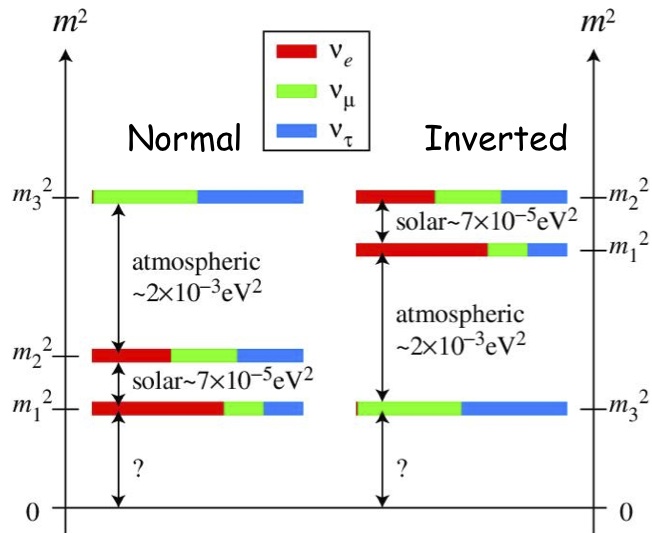
Image credit: from a talk by Steve King, retrieved from Luca Merlo.
There's also the (much newer) problem of neutrino masses: why are they so mind-bogglingly light, and yet of non-zero mass? Do they get their mass from the Higgs? If so, why is it so much smaller than all the other particles, and if not, why not?
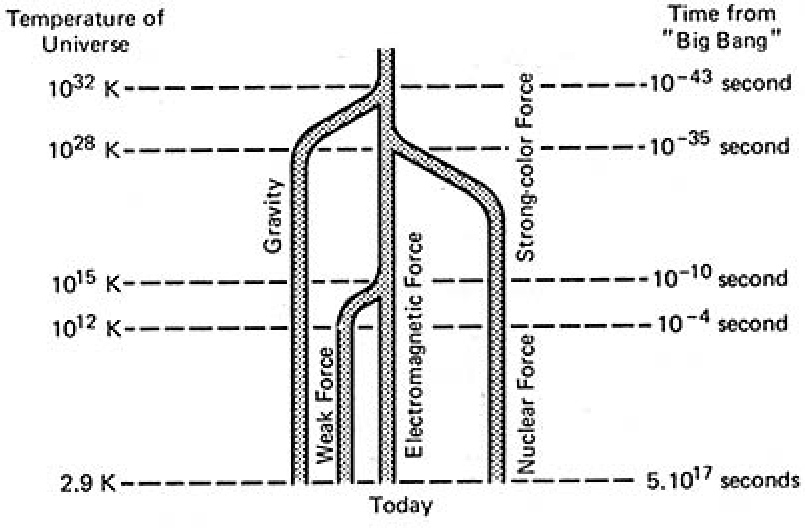
Image credit: J. Barrow and J. Silk, 1993, Oxford Press.
We know that the electromagnetic force and the weak force are, at very high energies, different manifestations of the same fundamental force: the electroweak force. It's only in our low-energy Universe that they appear so different from one another. Another way of saying this is that "the electroweak symmetry is broken," and the separate electromagnetic force and weak force are how that broken symmetry is manifested.
Well, it's possible that at very high energies, the strong force unifies with the electroweak force, giving us what's known as a Grand Unified Theory. Extending even beyond that, it's possible that at even higher energies, gravity unifies with the other three forces; this is the basic idea behind string theory, the most promising framework for unifying all of the known forces and interactions into one theory.
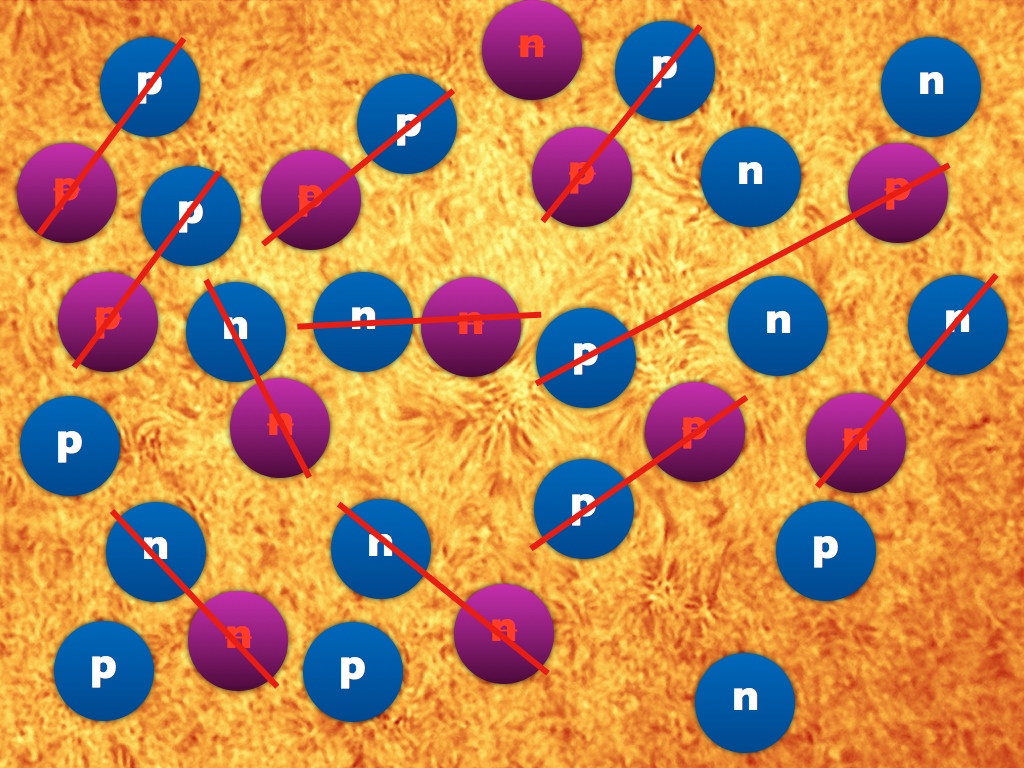
We live in a Universe where there's more matter than antimatter, but why?
Where does the origin of the matter-antimatter asymmetry come from? In other words, why do we have a Universe full of matter and only a tiny amount of antimatter, rather than equal amounts of both. We know how this is possible, of course, but we do not yet know how it actually happened. This problem of baryogenesis is yet another great unsolved problem of physics, and finding the Higgs and completing the Standard Model sheds no light on it.

Image credit: James Schombert at University of Oregon.
If you look at the fundamental interactions of matter, particles and antiparticles have a great deal in common. (Known as C-symmetry.) Particles spinning (or with angular momentum) in one direction have a lot in common with those spinning in the opposite direction. (Known as P-symmetry.) But in the weak interactions, not only do particles and antiparticles behave differently, and not only do particles spinning in one orientation behave differently that particles spinning in the opposite one, but particles spinning in one direction have slightly different physics than antiparticles spinning in the opposite direction! In other words, not only are C and P symmetries violated, they're both violated together.
But for some unknown reason, even though there's nothing in the standard model that prevents it, the CP-symmetry is not violated in the strong interactions. Known as the strong-CP problem, this is yet another physical reality that is unexplained by our current understanding of the Universe.

Image credit: Amit Chourasia, Visservices, SDSC, Robert Harkness, Mike Norman and Pascal Paschos.
And finally, there's dark matter and dark energy. They are both required for the Universe to look the way it does, but our current understanding of things does not explain where either one of them comes from.
Don't let anyone tell you that "Physics is over now that we've found the Higgs." On the contrary, it's only the physics that we had every right to expect was correct that's over. Now's where the fun begins.
And I say "fun" fully recognizing that even our best ideas for what comes next have severe problems, and they may all be wrong.
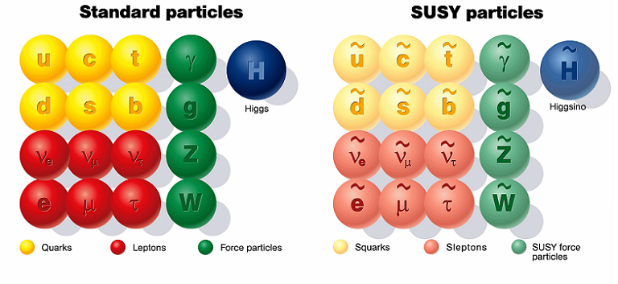
Image credit: DESY at Hamburg.
Supersymmetry -- SUSY for short -- is the best candidate theory to solve the hierarchy problem. If it's correct, it can also conceivably provide a dark matter candidate, give evidence for the potential unification of the strong force, and give circumstantial evidence for superstring theory (which requires SUSY).
Unfortunately, in order to actually solve the hierarchy problem, the masses of the superparticles need to be of the same magnitude as the masses of the normal, known, standard model particles. If the masses of the superparticles are beyond the reach of the LHC, then SUSY, even if it exists, no longer solves the hierarchy problem, which was the original motivation for SUSY in the first place! (In fact, even the best-case scenario for SUSY already has a little hierarchy problem.)
The longer the LHC goes without finding any of them, the more disfavored SUSY is going to become. Now that we've discovered the Higgs and we know its mass, it's conceivable (although it would be a true nightmare scenario) that there are no new particles to be found until we get up to a monstrous 1010 GeV in energy! (It could've been even worse if the Higgs were a few GeV heavier!)
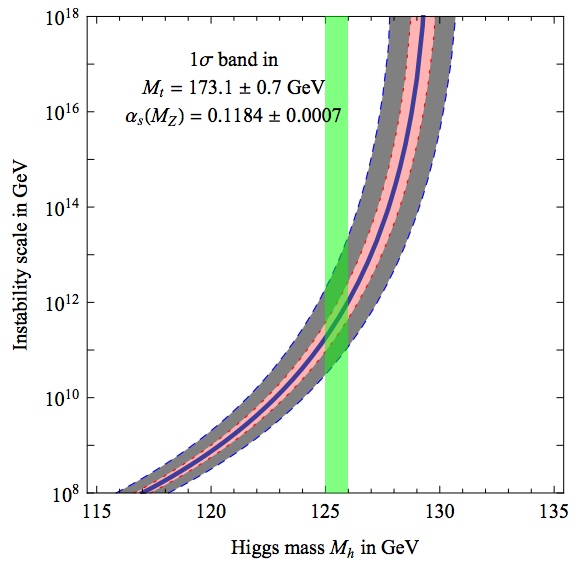
Image credit: Giuseppe Degrassi et al., 2012.
(And good luck getting a particle accelerator the size of Saturn's orbit to find it!)
There could have been multiple Higgs particles (a Higgs multiplet), as predicted by practically all grand unified theories.

Image credit: CERN / CMS collaboration.
But the data very convincingly shows that there is just one, singlet, spin=0 Higgs, which is what the standard model alone predicts. I have written before about how the lack of proton decay disfavors nearly all GUTs, but the lone standard model Higgs may be an even more damning observation.
So while I may not be impressed with string theory, SUSY, or grand unification, the cracks and unsolved problems are where the new, exciting (and probably surprising) discoveries are bound to happen. The first thing to check -- when sufficient data comes in (and not before) -- is whether the "particle-consistent-with-the-Higgs" that we're producing at CERN does, in fact, behave like the Higgs is supposed to!
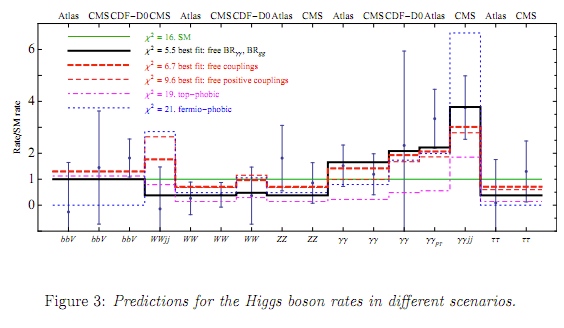
Image credit: P. P. Giardino et al., 2012.
Because if it doesn't, you can add that to the list of unsolved problems in physics, too!
It may not be what you want to hear, that the leading attempts to extend the standard model have severe problems with them, but in physics, as always, data must be the ultimate decider of the veracity of our theories. There are some great possibilities for this Universe, and -- just like you -- I can't wait until we find out more. Hope you'll continue to join me as we keep looking!
Ethan you are my favorite blogger ever! I loved this post and as you say, I can't wait to hear some of the answers to the problems you mentioned. Although, I wish I could really understand the problems in a deeper sense but I guess for that I need years and years of studying physics.
"a few of them have been (and are being) grossly oversold to the general public."
uhhuh... just google:
"time travel higgs bosun possible"
and you´re up and away nowadays.
What you are saying is rather contradictory. On the one hand you criticize phenomenologists who go on about the possibility of new physics just around the corner, like susy or extra dimensions etc, because there may be a desert up to very high energies. On the other hand you criticize quantum-gravity theorists for speculating about very high physics on the other side of the desert because they are not data driven. But if there is a desert, then data will be basically useless (other than to re-affirm the standard model). So these 2 perspectives are contradictory. There may be new physics around the corner, but in order to find out, the experimentalists crave guidance as to where to look, which is why we have the field of phenomenology. If there is a desert, the only way we can proceed is to use theoretical consistency, logic, and mathematics to extend our knowledge to these other regimes and incorporate the various outstanding puzzles of the universe.
This was the method of Maxwell, Einstein, Dirac, etc. And this is what string theory is (which as yet, has no severe problems, contrary to what you say.) String theory is the unique theory that respects the principles of quantum mechanics and relativity/gravity exactly (and also contains all the known features of the universe). So as long as the data is consistent with quantum mechanics and relativity, then string theory will be on the table. If you decide string theory is wrong; ok fine, you should then say which postulate is wrong. Are you disputing unitarity, or local Lorentz invariance, or what? If you are not disputing any of these postulates, then it makes no sense to criticize string theory. Understand this: exact quantum mechanics + exact relativity = string theory. For instance, if you break relativity, say you break the local Lorentz invariance, you can arrive at alternatives, such as loop quantum gravity (which has its own problems, which I won't go into here). But you should appreciate that this is what it means to throw away string theory. If you decide that quantum mechanics and relativity are exact, then you are forced to take on board string theory.
Most people will assume the Standard Model to be correct until proven otherwise by data, and similarly I tend to assume quantum mechanics and relativity to be exact, until proven otherwise by data. The attitude of accepting well established theories, until proven otherwise by data, is the core of the scientific method.
Most astrophysicists are quite unaware of all this and so they get very confused when so many theorists keep talking endlessly about this wild thing called string theory. Of course it sounds crazy and silly with extra dimensions, blah blah blah. But we have come to learn quite amazingly it is the unique theory that respects the principles of quantum mechanics and relativity exactly. Thats what it is, like it or hate it.
And what are we to make of this???
http://cosmologyscience.com/cosblog/did-cern-find-a-higgs-well-not-quit…
What Lotharloo said.
Gc, several things depending on what you look at
1 Americans pissed off at "losing" the race
2 Libertarians pissed off at government doing something getting good press
3 Religious findamentalists hating science for not just letting their faith tell them what to do
4 What science does. What? Did you think that once one scientific proof had been found, they'd just retire?
Bob, be honest. String theory, like dark matter and dark energy, was made to explain away the errors in, he standard theory.
Therefore string theory explaining that thete's a reason why quantum and relativistic gravity work on the same principle is not proof of it being right.
It isn't yet disproved, but it's not yet proven right in the places it disagrees with other theories.
I hate to sound like a crack pot, but this morning I had a flash of inspiration and hubris about how the Higgs could solve the mysteries of Dark Matter, Dark Energy, Wave–particle duality, Cosmic Inflation, and string theory.
wow: The problem with your explanation against string theory is that it DIDN'T start as a unification theory at all. It wasn't a bunch of physicists sitting in their arm chairs trying to come up with a way to make the theories compatible. It actually came about as a way of explaining why the strong force could be described using Euler's beta function, but it was largely ignored. Quite a while later, it was found that string theory spits out an extra particle outside of what were known at the time, but not outside of what was predicted. It was massless with spin two which perfectly matched the expected properties of a graviton. It wasn't until THIS happened that it was even thought of or investigated as a potential unification theory.
On top of that, its not even a clever manipulation of math that links the two theories. Its a fundamental observation. The reason QM and Relativity are incompatible is because the particles are thought of as dimensionless point particles. Once you apply uncertainty (and quantum jitters) to the smooth space of the relativistic gravitational field (which occurs at distances on the order of the Planck length), relativity falls apart. In string theory, the fact that the particles HAVE a size sets a lower limit on the distances to which gravity actually has meaning. In other words, since the smallest constituents of the gravitational force are at about the Planck length, it doesn't make any sense to talk about the force at distances smaller than that. Conveniently, the size that the graviton particle predicted by string theory would need to be to have the observed strength of gravity is right about the Planck length and therefore the math of string theory and the physical properties to allow unification to occur jive nearly perfectly. In other words, although string theory is a vastly complex theory, the reasons its intriguing and so sought after can be easily understood. The best comparison I've heard is that it doesn't makes sense to talk about water in terms of solid, liquid, or gas when you're only looking at one molecule. For the same reason, string theory unifies QM an GR.
All hypotheses start as "scientists sitting in a chair".
And a formulation has, at the very least, to be able to exolain current phenomena.
Therefore beng able to exolain current phenomena, absent any proof it does so better than an alternative, is not proof it is right.
Just because the standard model has unification of gravity wron doesn't make string theory right. It has to prove thst under its own steam.
wow, string theory is just the name we give to the unique unification of the principles of quantum mechanics and general relativity. If you say string theory is wrong, you are saying some part of quantum mechanics or relativity is wrong. That is fine, maybe they are. But thats what's at stake.
So next time, instead of just saying "string theory is wrong", but "Standard Model is right"; you should say "relativity is wrong" or "quantum theory is wrong", and explain why you think so. Then we can engage in a proper discussion.
As to the dark matter, dark energy, etc. it turns out that string theory includes these parts of the universe, as well as including the Standard Model. String theory is "bigger" than the Standard Model; it has more "stuff" in it. So unlike the Standard Model, which is ruled out by dark matter etc to be the complete description of nature, string theory is still on the table since it is "big enough" to include it all.
Yes, bob. Therefore it attempting to unify quantum particles snd general relativity is a description of it, NOT the proof of it as youtried to use it for.
Wow, you keep saying things that are wrong. I never said there was proof that string theory was correct, stop making false claims like this.
What I said were just some facts that anyone who wishes to comment on string theory should know first.
I mentioned that string theory agrees with the Standard Model in the regime it has been tested. I also mentioned that string theory agrees with all the other features of the universe, such as gravity, dark matter, dark energy, strong CP problem, etc, where the Standard Model does not. So the Standard Model has been falsified in those regimes, while string theory has not. Also, string theory is the only known theory to agree with all known kacts about the universe. So it is currently the only game in town.
But my main point was that string theory is just the name we give to the combined set of principles of quantum mechanics and general relativity. So every time you test quantum theory or general relativity, you are testing string theory, and so far it has passed all tests.
Does that prove for certain it is right? No, it just proves it is a consistent description of all current data. But Ethan claimed it has "severe problems". However, a theory (the only theory) that agrees with all known facts about the universe in a self-consistent shouldn't be described this way. That is a terrible misrepresentation of the facts.
That could be because they're wrong, bob.
And yes, you have several times. Just go page up a coulple of times. Thee,s you, saying that string theory is true because it unifies thingies.
@ wow:
Gotta say this American sure is pissed that the LHC/CERN is only just finding answers to questions that the SSC could have answered more than a decade ago, letting us spend the last decade on all the other mysteries (including those raised by the Higgs itself).
I'm also annoyed that anyone would choose to express that anger by trying to tear down what CERN has finally accomplished that the U.S. Congress decided wasn't important. Talk about misplaced anger.
The closest I could find to Bob saying string theory is true is this:
"If you decide that quantum mechanics and relativity are exact, then you are forced to take on board string theory."
Which is not exactly saying string theory is true. But it is saying that String Theory is right unless GR or QM are wrong.
So, Bob, are you saying that String Theory is the only possible unification of GR and QM? That any other unification requires GR or QM to change?
CB,
Yes, the proposed alternatives to string theory violate some principle of quantum mechanics or relativity. For instance, many of them violate Lorentz invariance; such as loop quantum gravity and Horava gravity. Others violate unitarity, such as N=8 supergravity. While others violate causality, etc, etc.
It is possible that some alternative is right, and the fundamental principles of quantum mechanics and/or general relativity are broken. Often this leads to inconsistencies, paradoxes, and disagreement with observation. Nevertheless it is conceivable that quantum theory or GR is violated by nature. But my point is simply that that's whats at stake when people such as Ethan and wow claim that string theory is wrong. And when they make such profound claims they should explain why they think the principles of quantum mechanics and/or GR are wrong.
"Yes, the proposed alternatives to string theory violate some principle of quantum mechanics or relativity. But my point is simply that [the principles of quantum mechanics and/or GR are] whats at stake when people such as Ethan and wow claim that string theory is wrong."
String theory being the only proposed method to merge QM and GR without changing either is WAY different than saying if String Theory is wrong we have to change. That requires that String Theory be the ONLY possible unification.
Don't get me wrong. Just showing a mathematical framework in which both worlds coexist is pretty damn impressive, and has an appealing elegance. Also hard stuff since nobody else afaik has done it. So that's all good. I like String Theory. I also like that it makes predictions even if very hard to test.
But one thing I've never heard said about String Theory before is that it was proven to be the ONLY possible mathematical framework linking QM/GR keeping all their principles intact. That would have to at least gotten someone their PhD.
So, I ask again: Are you saying String Theory is the only possible unification of GR and QM? And would there be a cite?
If not, then (! String Theory -> !GR || !QM) is false, and therefore neither Ethan nor Wow have any need to explain why they think GR or QM is false.
CB the failure of the SSC was set in from the very start.
It was probably beyond engineering at the time, but it was killed because it was being used as pure political pork-barrell. If they,d extended the current collider, it could have finished on time and in budget. It wasn't and didn't, and killing it off was the best rational thing to do.
But I also suspect it was a bit too ambitious for the time. And the results would have been less certain because of the greater work needed to extract results from the data.
Now that they've answered the question of "Life, the Universe, and Everything", maybe the geniuses at CERN could take 5 minutes out of their busy schedules and invent, say, The Battery -- capable of storing a city's worth of electricity from wind or solar power -- or, if that's simply too mundane for them -- solve the world's energy problem by converting bosons, mesons, or whatevers directly to electrical power. I'll treat them to lunch afterwards.
What next? That's easy; no more Science Channel stories on String Theory!
Wow, if we canceled every project that was an over-budget pork barrel, America's accomplishments would fit on a post-it note. We'd be sitting around complaining about what a waste it was to launch Hubble with that damaged mirror we could never fix. Maybe it was too advanced an engineering project for its time -- though solving these engineering problems has spin-off effects and once again I wonder what we lost not doing it -- but that's not why it was canceled, nor the best rational reasoning. It was pork politics vs pork politics.
@ Kip Hansen
There's already a ton of people working on that problem. People who are better suited to do so, even. So don't worry. Besides, shouldn't both groups of people be working on a "cure for cancer"? That's usually the go-to problem for "we can only solve one thing at once" folks.
@ Jeff Jones, are you saying you think that the discovery of the Higgs falsifies string theory? Can you tell me why you think so?
Are you aware that string theory predicted the Higgs, and it was only some non-string theorists who suggested that there would not be a Higgs found (Laurence Krauss is an example).
Dear disputants, several of few claim that a) string theory exactly generates quantum mechanics and relativity, as we know them; b) it also handles all currently unexplained phenomena. The opposing viewpoint, at least within this thread, seem not to dispute those two claims, but rather to observe that there may be more than one way to build a framework that would do the same; meanwhile the current one does not make any predictions that are experimentally verifiable, not today and may be never. But this is very different from saying the theory has "severe problems". If Ethan and other critics agree with those claiming a) and b), if there is a consensus on this in your community, it would seem this is still a successful theory. But since, in Ethan's view, it's "not even wrong", he probably disagrees with those assertions (and his blog is so good that I, as an outsider, tend to believe him, and in kitchen disputes refer to his characterization of the ST quoted above, the more so that he is not the only one.) But aren't they unequivocally verifiable?
Additionally, is it likely that a very well-developed mathematical framework would, as a special case, generate solutions that exactly describe what we know? Particularly if it was started for a different reason?
So, again, does it or does it not? Thank you for your patience.
CB -
The 'tons of people' have been astonishingly unsuccessful, even at something as seemingly simple as The Battery. If it's the 'smart guys' that are already on it, then we are really in trouble.
As for cancer, the CERNistas are not medics -- besides, many more people die for lack of electricity than ever die of cancer -- mostly children, mostly due to lack of refrigeration to keep food and medicines/vaccines safely.
The question was "What Next?" I just thought since they'd solved the last mystery of the universe they'd could do something disgustingly useful -- shouldn't take 'em more than a day or so, being so intellectually advanced.
Oh I see. You're doin' a thing. That's cool. But sorry, it's too clever for me. What's your actual point hidden beneath all the "ironic" stupidity?
@ Outsider, I'm surprised by your comments. Don't you see what's funny about saying: "suppose string theory respects quantum theory exactly, I still agree with Ethan that it is not even wrong". Do you see why this position is illogical?
If next year an experiment disagrees with quantum theory, then both quantum theory and string theory are falsified. End of story. That means it is falsifiable. Anyone claiming that it is "not even wrong" are simply ignorant of the theory, and are parroting the opinion of Peter Woit who is not a physicist and should be ignored.
@ Outsider, just to bring the conversation back to the higgs boson. Do you know that the WHOLE POINT of the higgs is to keep the standard model "unitary", which is a property of quantum theory? So if no higgs boson existed then quantum theory and string theory would be falsified at those energies.
Guess what they find? You know the rest...
CB - Sorry, didn't mean to hurt your feelings.
Feelings schmeelings. What were you actually trying to say? It's not that batteries are so simple and CERN scientists are so smart that they could really solve the problem in a day. But extrapolating from the fake stupidity of that statement to your actual point is... challenging. Is it that the LHC is useless and all those scientists should get jobs you think are useful? What? I don't want to assume.
@ Bob
Saying String Theory is falsifiable because if you falsify QM you falsify String Theory is fine but not particularly interesting. My "QM + invisible pink ponies theory" (the ponies frolick in the electron orbitals) is also falsifiable if you falsify QM, but the question is how do we distinguish between String Theory and QM + Ponies if the only tests to falsify either are tests of QM too? The theory has to make additional predictions that can be tested or we can't ever distinguish it from other alternatives.
Unless you don't believe there are any alternatives, and String Theory is the only possible unification of GR and QM...
But it's my understanding that String Theory actually *does* make unique predictions beyond what QM and GR individually predict, they're just very difficult to test. Therefore String Theory could be falsified without having to falsify QM or GR, and could be distinguished from other possible GUTs. You might want to bring that up when defending String Theory against the "it's not even wrong" crowd.
@ CB, Saying that `it is not falsifiable' is an extremely strong statement. I pointed out that string theory is falsifiable and gave an example. There are many other examples too.
If you personally don't find the example "particularly interesting", that's your own business. But it proves conclusively that it is falsifiable.
But to people, such as Ethan, who go around saying "it is not falsifiable" it should be interesting to them to hear that in fact it is falsifiable. (Although they may not listen).
As to your final comment: All the alternatives to string theory DO violate some principle of quantum mechanics or GR. Most of them violate the Lorentz symmetry, such as loop quantum gravity and Horava gravity, while some violate unitarity, such as N=8 SUGRA. So your point - that we can distinguish string theory from alternatives without falsifying QM or GR - doesn't make much sense.
"If you personally don’t find the example “particularly interesting”, that’s your own business. But it proves conclusively that it is falsifiable."
Yes. That's falsifiable in exactly the same sense that "Quantum Mechanics with Pink Ponies Theory" (QMPP) is falsifiable. I've extended a theory, but not predicted anything new, so my extension can only be falsified by falsifying the theory I'm extending. A valid question then is "Why add pink ponies?" and if the answer to that question cannot itself be falsified, then I think you can validly say the theory cannot be falsified, in a sense. In a different sense, it can be.
Do you find the sense in which QMPP can be said to be falsifiable interesting? Why? Can you understand why others do not find it interesting? Personally, like I already said, I consider just doing that much an achievement. But I also think "makes no falsifiable predictions of its own", which is what people are really saying, is the misconception about String Theory that you should be addressing.
It's what separates ST from QMPP. :P
"As to your final comment: All the alternatives to string theory DO violate some principle of quantum mechanics or GR... So your point – that we can distinguish string theory from alternatives without falsifying QM or GR – doesn’t make much sense."
Do you think this applies to ALL POSSIBLE alternatives, or only the ones which have been proposed SO FAR?
If you don't assume (or at least consider the possibility of not) ALL POSSIBLE, then my point should make sense. And your point -- saying String Theory is false means saying QM or GR are false -- would itself be logically false. However you make perfect sense if I assume ALL POSSIBLE.
So I pointed out the assumption needed, and asked if you had made it or if it had been proven. But you're still just talking about current theories.
@ CB, this will be the last time I repeat this: I don't care very much if YOU PERSONALLY don't find it interesting or not; that is your own business.
My point is simply that there are a number of people, such as Ethan, who ARE INTERESTED in this as they are claiming that string theory is not falsifiable.
So what is the definition of falsifiable? According to wikipedia it "is the logical possibility that it can be contradicted by an observation or the outcome of a physical experiment." There are many experiments that could take place, such as a violation of the uncertainty principle or the Lorentz symmetry, etc, which would contradict string theory.
If you can't understand this simple idea, there's not much more I can do. I have repeated it many times in basic and easy to understand ways; others seem to follow it, but you are struggling to comprehend.
String theory is a particular quantum theory; the only one that incorporates the principles of GR in a consistent way, including the local Lorentz symmetry, etc. If instead you wish to continue believing in Pink Ponies, that's your business.
"I have repeated it many times in basic and easy to understand ways; others seem to follow it, but you are struggling to comprehend."
The repetition was wholly unnecessary. I understand perfectly, as I demonstrated by showing how QMPP is falsifiable in exactly the same way -- disprove QM, disprove QMPP.
I also understand that while nobody in this thread actually questioned the falsifiability of ST, Ethan *has* asked if ST predicts anything *NEW* that we could test. So, a definitional argument is fine but your point doesn't really address his criticism. It just says that ST is falsifiable sans modifiers. Fine. Now, does it make new falsifiable predictions?
"String theory is a particular quantum theory; the only one that incorporates the principles of GR in a consistent way,"
When you say "the only one" do you mean OF ALL POSSIBLE, or OF ONES PROPOSED SO FAR? It would be really great if you could just acknowledge that there is relevant a difference... Or that the question had been asked...
"If instead you wish to continue believing in Pink Ponies, that’s your business."
Without additional predictive power, there would be no reason to prefer strings over ponies other than subjective measures and it would indeed just be what YOU PERSONALLY want to believe. I doubt that is what you are intending to say.
@ CB, no you obviously didn't understand at all.
On the one hand, you have string theory, which exactly respects the principles of quantum mechanics, and relativity, including gravity in a consistent way at all energies. A theory that explains the existence of gravity, and includes all known features of the universe. A theory that predicts exact Lorentz invariance up to arbitrary high energies; which has falsified alternates such as loop quantum gravity. The only quantum mechanical theory that includes black holes. A theory that predicted the Higgs to exist to restore unitarity to the SM. etc etc. A theory that predicts the details of high energy stringy scattering, etc, etc. I don't want to go into all the arguments here.
But apparently you find this all "uninteresting". Everytime we confirm the postulates of string theory in a new regime and we falsify the alternates, such as loop quantum gravity, you just consider this boring and uninteresting. You just believe that the smartest people in the world should stop working on fundamental science, they should just join you working on ponies.
@ CB, let me add that your claim that "nobody in this thread actually questioned the falsifiability of ST" is 100% false. If you actually read the thread, you would notice that 'Outsider' correctly quoted Ethan as saying that string theory is "not even wrong", which is defined to mean "not falsifiable".
It was very unfortunate of you to try to redefine the topic of discussion when this point was proven to be incorrect.
Bob, if you read the next post by Ethsn, you'll see both outsider, yourself and several others have got it completely wrong on the interpretation of whst Ethan said.
And are there two bob's? One capital b and one lowercase? Because both have been insisting the opposite and equally wrong assertion that this higgs finding proves string theory.
Just because finch et al get it wrong, doesn't mean you get it right by being the opposite.
@ Bob
"But apparently you find this all “uninteresting”. Everytime we confirm the postulates of string theory in a new regime and we falsify the alternates, such as loop quantum gravity, you just consider this boring and uninteresting. You just believe that the smartest people in the world should stop working on fundamental science, they should just join you working on ponies."
LOL, no, come on at least pretend to read my posts beyond a single word to use out of context. All that stuff is GREAT. It's why I really LIKE String Theory, it's why it's better than QMPP ;), and the folks working on it should damn well keep doing so.
But none of that changes the regime under which ST can be falsified (via the same set of tests which would falsify QM, or GR, as separate theories, without involving ST at all, the thing which I understood), nor does it change the criticism that it doesn't make new predictions beyond the theories its merging. Therefore that is all "uninteresting" for the purpose of challenging that criticism (this is called "context").
"It was very unfortunate of you to try to redefine the topic of discussion when this point was proven to be incorrect."
Unfortunate was when you decided to go for a definitional argument (even though the phrase is strictly speaking not "defined") when what Ethan actually meant was clearly spelled out, and you chose to ignore the substance of the cricitism. Literally ignore it.
He meant that it's "not even wrong" in that without new predictions, there is no way to distinguish String Theory from other hypothetical unifications that also predict everything QM and GR predict and nothing more. If you could actually rule out the existence of such other frameworks, you wouldn't have so steadfastly ignored the question of whether you were assuming they didn't exist.
This is not a good way to defend a theory. And no, pointing this out doesn't make me an opponent of the theory. Rational people can acknowledge legitimate criticism of things they nevertheless think are the right idea.
Ok, I'm starting to understand that CB is a troll.
- the definition of "not even wrong" is a "derogatory term for falsifiable"; please look it up. String theory is certainly not this. It won't matter how often you try to change the definition.
- i have given you countless examples of things that could falsify the theory. and so far none of them have.
- I mentioned things that cannot exist without string theory, such as black holes. The very existence of black holes and quantum mechanics is evidence for string theory.
- i told you that a simple starting idea of a quantized string leads to every known feature of the universe.
- by the Occam's razor this is our leading theory of nature, until something proves otherwise.
- i told you that alternatives have been falsified, such as loop quantum gravity, which predicted Lorentz violation at the Planck scale.
- instead you choose to believe in ponies. I feel sorry for you.
- i meant "derogatory term for theories that are not falsifiable"
Not even wrong is often used as "more than wrong". That doesn't make your failure to read right, bob. And it doesn't make your incredible refusal to see your logical problems right either.
An troll doesn't mean "disagrees with me" no matter how much better it makes you feel about your errors being pointed out (by letting you ignore the arguments against you by summarily dismissing them as "not even wrong").
wow, your even wrong refusal right either "more than" doesn't make. Often is read right, logical either to see failure wow.
No matter errors doesn't mean troll, "not wrong" how much you "feel" (by the arguments dismissing ignore them) your pointed out against summarily "with me".
"your even wrong refusal right either “more than” doesn’t make"
Can you try that again in English grammar rather than Yoda?
Ethan
Nice list of problems that physics has not answered.
Let me ask about 4 electroweak gauge bosons versus the 8 strong vector gauge bosons.
First, the chart, Particle Spectrum - 1995, only shows 1 W particle rather than two W+ and W-; so that one particle W+ seems to be missing.
The 4 electroweak gauge bosons have each been individually observed and are four distinct particles. photon, W+, W- Zo. Which is good; no question here.
But the 8 vector gauge gluons seem to be EXPERIMENTALLY INDISTINQUISHABLE. Is this correct? Or are there experiments (or proposed experiments) that can distiguish gluons (e.g. a RG gluon from a (R/aR – B/aB)/ sqroot 2). I assume there must be, but can't find such discussion yet. Thanks.
Bob
Nice comments on string theory. And you make sense to me. BUT my ONE little problem with string theory is that there isn't just ONE string theory.
I mean there is approximately just ONE general relativity and approximately just ONE quantum mechanics; but there seem to be either 10^520 different string theories for our ONE visible universe OR ONE string theory with 10^520 different universes (analogous to our visible universe). This 10^520 thing is my big problem with string theory.
Personally, I'm happy with 9 or 10 spatial and 1 or 2 temporal dimensions (compacted or not, orientable or nonorientable); and a few PHYSICALLY SPECIFIC extra universes; IF these extra dimensions and extra universes are needed for physical reasons (e.g. maybe Dirac's infinite sea of negative energy particles, which no one talks about anymore, is in extra dimensions of an extra universe). But to say that the mathematics GIVES us 10^520 universe that can never be observed and that don't have observable consequences in our visible universe is just UNOBSERVABLE PINK ELEPHANTS IN THE TREES AT NIGHT. At least Dirac's infinite sea of negative energy particles predicted the positron in our visible universe.
So I like the idea of string theory; and I like the theoretical work of the various string theorists; but I don't see a string theory yet. No disparagement intended of Leonard Susskind, he is brilliant (see his Stanfrod lectors online); BUT his cosmic landscape is PINK ELEPHANTS to me. And as a corollary, the Anthropic Prinicple of Weinberg is PINK ELEPHANTS to me.
That being said, I like the possibility of string theory; there are just 10^520 too many possibilities of string theory.
So in my mind supersymmetry has the few problems that no SUSY-like particles have been observed; but string theory has 19^520 problems that no extra universes seem physically necessary (i.e. have physical observable consequences in our visible universe).
To me current string theory is a wild extrapolation; much wilder than the extrapolation of say Newtonian mechanics to infinite velocities. String theorists need experiments and physical insights to rein in their prodigious mathematical imaginings.
Your article says "the Higgs boson has finally been discovered at both detectors — CMS and ATLAS — at the Large Hadron Collider at CERN."
But CERN's CMS Experiment Leader Joe Incandela,
said “We don’t know if its a Higgs boson.”
http://cosmologyscience.com/cosblog/did-cern-find-a-higgs-well-not-quit…
Which should we rely on ?
Tim
Thanks for the link.
And if you then follow to CERN’s CMS Experiment Leader Joe Incandela's video link; you hear this: http://docmadhattan.fieldofscience.com/2012/07/joe-incandela-talks-abou…
Very nice professional understandable summary.
So rely on Joe in the detail.
But if you listen to Ethan in the detail (i.e. his tv interview about the Higgs in his post "How the Higgs give mass...") Ethan says something like, "More than likely we have discovered the Higgs... but we need more data."
So despite Ethan's provacative title "Now that we've got the Higgs.." and elsewhere such hopefull assertions; in the detail Ethan and Joe agree.
And you have to make such blanket statements or else spend 20x thu number of words delineating the caveats et al.
Only the wilfully obtuse who never desire such rigour in THEIR statements insist on 100% absolute rigour in prose.
I have no time for such idiots.
Tim, whatever you decide to go on, I'd suggest that it not be cosmologyscience. Read a few posts there. Complete fucking crackpot city.
OKThen, your post makes no sense. Did you actually read anything I wrote?
Your premise that there is ONE quantum theory, but 10^500 string theories is an illogical counting. What I explained multiple times, is that string theory is a particular quantum theory. So it is "smaller" than quantum theory. If you wish to count all the different compactifications of string theory as 10^500 different theories, then you have 10^500 quantum theories. Which is far smaller than the INFINITE number of all possible quantum theories.
A better language to use is to distinguish between "theory" and "model". There is really just one quantum theory and one string theory. These are defined by a set of principles, such as uncertainty principle etc. Then there are all their various specific versions, or models. For example, you can write down the quantum theory of a single harmonic oscillator, or an electromagnetic field, or the Standard Model, etc, these are all different models. Amongst the set of all quantum models, are the string models, which take up a very small subset. They are the only ones that incorporate gravity.
Bob, what you wrote was complete balderdash.
OKThen is looking at the range of tuned values and the combination of these is above 10^500.
It can explain everythin, even things that don't work, because we cannot test any configuration to reduce those figures.
String theory is pretty much dark matter. A good start, but not really a theory, so much as a placeholder for one.
Re: Ema
“Read a few posts there.”
I’ve read many of them. I like both websites, this one and Cosmologyscience.com
Are you confusing them with another website?
Cosmologyscience is really high quality information without confusing insider jargon. Their Higgs article quoted the top Higgs scientist and gave a direct link to his quote, while I’m embarrassed Ethan used a misleading title and no reference or quote supporting his opinion.
So on this topic, Cosmologyscience has a more accurate scientific opinion and a higher quality reference – but you don’t like it ? You’ve got to be kidding.
Somewhere they said they use the best available science, and I’ve found their information and analysis to be just that.
Bob
Thanks for the clarification between the terms "theory" and "model" as used in string theory.
Be that as it may, I don't think that string theory qualifies as a "scientific theory" yet.
Wiki's definition, "A scientific theory is "a well-substantiated explanation of some aspect of the natural world, based on a body of facts that have been repeatedly confirmed through observation and experiment."["
I don't know of a single string theory fact, yet alone a "body of (string theory) facts that have been repeatedly confirmed through observation and experiment." (String theory's prediction of the graviton is nice; but it has not yet lead to a unique observation of the graviton or any other phenomenon). So in my mind string theory is a very interesting working hypothesis, a work in process, an active area of important scientific research. But string theory is not yet an established "scientific theory"; it is a a very promising set of ideas.
I say set of ideas because the various models "perhaps 10^520 of these... each corresponds to a different possible universe, with a different collection of particles and forces." wiki
If any string theory model is to merit the term "scientific theory"; then it must explain some observable phenomenon in a uniquely insightful and predictive way. But string theory currently accommodates almost any phenomena (real or phantasy) in any universe (real or fantasy).
So to me string theory today is a very rich collection of ideas and mathematical concepts and tools (not unlike differential calculus, tensor analysis or gauge theory). And these tools and ideas can be used to build a variety of toy model universe.
But until one of string theory's toy model universes looks very much like our one visible universe AND is uniquely superior in explaining some important phenomenon of our one universe (and excluding phantasy phenomenon); until then string theory is just a promising scientific hypothesis NOT a scientific theory.
One other point. You say that " string theory is a particular quantum theory". That's nice; but what you don't say is whether string theory is a particularly bad, good, useful, or useless quantum theory.
Tell me what are the five upcoming string theory driven experiments whose results every theorist is waiting? Please do educate me.
OKThen, "One other point. You say that ” string theory is a particular quantum theory”. That’s nice; but what you don’t say is whether string theory is a particularly bad, good, useful, or useless quantum theory."
I've stated several times that its the only quantum theory that includes gravity and all the other features of the known universe. I'll let you decide if that is bad or good.
OKThen, "But string theory currently accommodates almost any phenomena (real or phantasy) in any universe (real or fantasy)."
Did you read any of the post so far? If so, you would know this is 100% false. Perhaps the most ridiculous statement ever heard. Please read my above posts to catch up.
Yes, bob, he did. And without the fundie beleiver bkinkers you're wearing.
I'm beginning to believe you're a fifth columnist, intent on displaying a religious fervour in oromoting your faith in string theory. So that religionists can point to your posts and proclain equivalence.
Have you read any of the posts, bob? Because you're completely ignoring their content.
Oh dear. Bob is faking it.
Clue- quantum theory includes gravity. Quantum gravity. And the higgs doesn't explain gravity.
I see 3 posts by 'wow' just rambling on about nothing. There is clearly some obsessive compulsive behavior going on here, whereby he drags every debate down into a spiral of absolute nonsense.
Wow, I think that Bob has made his points each time very clear, but every time you need to twists his words, just like you have done with my posts and with those of others. Why is that, do you really think that you are so superior, or does your brain start to crack when someone is talking about something that you can't grasp?
Yes, we understand you have hallucinations, chelle.
You post them fairly frequently on this blog.
Indeed, we're still waiting for the paper you're writing on one of them.
"I think that Bob has made his points each time very clear"
I do too. As does OKThen. You don't.
PS, chelle, to call me better than you would be to damn me with faint praise.
(And you seem to have missed Bob's "String theory is the quantum theory that has gravity in it" boob. Is there any limit to your inability?)
"Is there any limit to your inability?"
That's like asking; how far can you go with standing still?
I'd say one round is enough, or in other words endlessly, but then again you don't understand string-theory now do you.
Yup, you just showed the limits extend further than I'd thought possible.
No, it's not like asking "how far can you go standing still?"
You are unable to grasp many more things than almost everyone I've met. The limits to your inability to do so extends a long way beyond all attempts to delineate the limits of your lack of understanding.
“You are unable to grasp many more things than almost everyone I’ve met.”
But according to your words, I still do grasp more than most people you've met, just like how I grasp that you are making here once again a fool of yourself :mrgreen:
"But according to your words, I still do grasp more than most people you’ve met"
Definitely not according to the words you quoted, chelle.
Extending the known boundaries of your incompetence yet again.
:-D
"Definitely not according to the words you quoted"
Yeah sure, try to bullshit your way out of it, like you always do. Take care.
Chelle and Bob
I do start out assuming you are well intentioned. For a science blog that means that you bring curiousity, insight or relevant research to the discussion. But no, you only give psuedoscience mantra "I’ve stated several times that.." or whine "Why.. do you.. think that you are so superior".
You avoid science discussion. And then Wow points out that your "scientific" points of view have "no clothes"
Bob is a classic case of science misinformation at work. He says that he is supporting science (e.g. string theory) but he brings "mantra" not evidence to the discussion. Thus the science minded like myself or Wow must disagree with Bob; not because String theory is without scientific merit, but because Bob's arguments are psuedoscientific mantra without merit.
Both Bob and Chelle use scientific "uptalk" to pretend to be pro-science and they use psuedoscience mantra to derail well intentioned scientific discussion. But they don't fool for long.
Science based discussion is curiousity, insight and relevant research based discussion; psuedoscience discussion of the "true anti-science believer is mantra based and personal whining based discussion.
So once again, Wow has uncovered another "true antiscience believer" (i.e. this particular Bob).
For a while I had mixed feeling about Chelle; but now I agree with Wow that Chelle is a "true anti-science believer".
The "true anti-science believer's" words about science are sometimes true or almost true; but they are always being said to somehow diminish science and curiousity and to promote ignorance and true religious or politcal belief.
For a refresher, reread Eric Hoffer's amazing book The True Believer.
OKThen, I'm sorry but you really didn't read any of the posts.
You said "But string theory currently accommodates almost any phenomena (real or phantasy) in any universe (real or fantasy).”. And you stated this after I had explained that it cannot accommodate many things, such as violations of uncertainty principle, Lorentz symmetry, unitary, causality, particles greater than spin 2, vectors with more than 2 polarizations, no Higgs, etc, etc. So what you have said is just wrong, and I can only assume you didn't bother to read the post.
And if you think that the unification of the principles quantum mechanics with general relativity, which we call string theory, is "useless" or "bad" or "not science", then that is quite ridiculous. But you are entitled to your opinion. I'm not sure what part of quantum theory or general relativity you detest, but you obviously hate some part of it, or else you would not criticize string theory.
And now that you have joined Wow.... holy moly... we have another Troll! Good luck with that.
I also notice that OKThen's comments don't actually contain any real physical content.
My comments include words such as "relativity, quantum theory, spin 2, vectors, Higgs"; this is the stuff of science.
OKThen's comments include words such as "true anti science believer, religion, mantra, pseudoscience"; which is not the stuff of science.
Bob
You misquote and accuse while pretending you are open.
Bob says, "OKThen, I’m sorry.. you really didn’t read any of the posts."
NO!, Bob doesn't read others comments. I have read Bob's comments.
Bob says, " I’m not sure what part of quantum theory or general relativity you detest, but you obviously hate some part of it, or else you would not criticize string theory."
NO! I accept quantum mechanics and general relativity; and am hopeful about the excellent string theory hypotheses and research; but there is no string theory theory unique experimental data yet.
The real merits of string theory will be when string theory predicts something new. Just as the merit of genral relativity was not just that it agreed with Newtonian gravity; but that it predicted and experiment confirmed those predictions.
I asked anyone, "Tell me what are the five upcoming string theory driven experiments whose results every theorist is waiting? Please do educate me."
But Bob you refuse to enter the science discussion. Give me your best shot of an answer: an insight, a thought experiment, some minor experiment that has already been done.
Your mantra that GR +QM = ST is not good enough.
Just as General Relativity = Newtonian gravity's predictions was not be good enough; General Relativity had to be more insightful and give better predictions and suggest new experiments to be verified or not.
Thus if String Theory (ST) is to be a theory then string theory must be more than just General Relativity (GR) + Quantum Mechanics (QM). More in terms of insights and more in terms of new experimental predictions.
ST must = GR + QM + more predictions
But String Theory predictions = GR +QM predictions is just not good enough.
So my question, what new possible observables does string theory predict and what are the experimental tests proposed, underway or done that will evaluate the correctness or not of those predictions?
Please comment on the science.
Great, you accept the principles of QM and GR, so it logically follows that you accept string theory, which is the name for the unique unification.
The principles of GR are completely different to the priniples of Newt gravity, it is shocking u think they are the same.
Insights? The character if insight is that a single or a few elegant ideas explain a whole host of seemingly disconnected phenomena. So lets see: starting from the idea of a quantized string, we get: gravity, all the forces of nature, all the matter, including chiral fermions, we recover particle physics and GR in the low energy effective field theory, we have a complete description of black holes and were able to solve Hawkings information paradox, we have the only standing solution to the cosmological constant problem, a solution to the strong CP problem, a plethora of scalar fields including the Higgs, and we understood the character of all forces and matter arising from geometry, we have an exact dual description of known forces such as QCD allowing calculations to be done in the strongly coupled regime, etc.
For a simple idea, it has sure proved insightful you are prolly the only erson I have ever heard arguing against that.
You can compare that to its competitors, such as LQG, which has been unable to recover GR in any limit, gives the wrong entropy fir black holes, predicted Lorentz violations which never occured, etc.
Your hostility is ridiculous. All theorists are trying to do, with our limited resources, is to understand the universe with the clues available to us. Of course we cannot probe the string or Planck scales directly, because that would require technology many orders of magnitude beyond what we have. So we use logic, maths, low energy data, and hard work to make progress. For ppl such as yourself to criticize the whole endeavour, and yet provide no help or insight, is rather disgusting.
No, it doesn't follow any more than it means you agree in a cosmic string vest theory, bob.
However, I suspect you are not here honestly but are posting under false pretenses, if not a false flag.
You, in other words, are wasting everyone's time.
Glad to see that CB and OKThen have conceded they were wrong. Their crackpot arguments against physics were always going to crumble, like creationists arguments against biology.
Bob
I have conceded nothing. I agree with Wow that "you post under false pretenses and waste everyone's time."
The only anti-science crackpot out here is you.
OKThen, yes I agree that you and Wow are ignorant of logic and science. All your questions were answered rigorously with physical content and you have no response other than slander and name calling.
Notice that my comments contain words such as "principles, quantum mechanics, QCD, Higgs, Lorentz symmetry, gravity, spin, effective field theory, black holes, geometry, duality" etc; this is the sign of someone developing an argument with real physical content.
On the other hand, OKThen's and Wow comments include words such as "false pretenses, anti-science, false flag, uptalk, faint praise, religionist, phantasy, hallucinations"; this is well understood amongst scientists as the kind of nonsense that crackpots dish out when they can't or won't accept real data and reasoning, and it is very easy for scientists to spot this nonsense also. The crackpots lash out with non-sensical mumblings whenever their ideas are shown to be wrong. On the other hand, real scientists are able to back up their arguments with careful reasoning which is based on real physics and content, as I have provided countless times in this thread.
Goodbye. And good luck with your crackpot ideas and frustration with science.
The lady Bob doth protest too much, methinks.
gee, how could science ever possibly compete with archaic fictional quotes?
... The mighty OKThen has slain the feeble General Relativity and Quantum Theory with his pompous misquotations.
... Release the crackpot!
The lady Bob doth protest too much, methinks.
I support general relativity and quantum mechanics.
hehee, OKThen thinks that science is some popularity contest, where we decide to "support" one idea or the other. Nobody cares what he "supports". Science is based on data, reasoning, and evidence, it is NOT some beauty pageant contest where the ladies try to earn support from the judges. Only crackpots think that's what science is; their ideas get discredited by scientists, so they scream for more support as they revolutionize science!
"String theory is the unique theory that respects the principles of quantum mechanics and relativity/gravity exactly (and also contains all the known features of the universe)... Most astrophysicists are quite unaware of all this.. thing called string theory... As to the dark matter, dark energy, etc. it turns out that string theory includes these parts of the universe, as well as including the Standard Model... string theory is the only known theory to agree with all known kacts about the universe... string theory predicted the Higgs... I mentioned things that cannot exist without string theory, such as black holes. The very existence of black holes and quantum mechanics is evidence for string theory... (string theory) is the only quantum theory that includes gravity and all the other features of the known universe... OKThen..I’m not sure what part of quantum theory or general relativity you detest, but you obviously hate some part of it, or else you would not criticize string theory... My comments include words such as “relativity, quantum theory, spin 2, vectors, Higgs”; this is the stuff of science... I’ve stated several times that its the only quantum theory that includes gravity and all the other features of the known universe... Great, you accept the principles of QM and GR, so it logically follows that you accept string theory, which is the name for the unique unification... starting from the idea of a quantized string, we get: gravity, all the forces of nature, all the matter, including chiral fermions, we recover particle physics and GR in the low energy effective field theory, we have a complete description of black holes and we're able to solve Hawkings information paradox, we have the only standing solution to the cosmological constant problem, a solution to the strong CP problem, a plethora of scalar fields including the Higgs, and we understood the character of all forces and matter arising from geometry, we have an exact dual description of known forces such as QCD allowing calculations to be done in the strongly coupled regime, etc.. Of course we cannot probe the string or Planck scales directly, because that would require technology many orders of magnitude beyond what we have. So we use logic, maths, low energy data, and hard work to make progress... my comments contain words such as “principles, quantum mechanics, QCD, Higgs, Lorentz symmetry, gravity, spin, effective field theory, black holes, geometry, duality” etc; this is the sign of someone developing an argument with real physical content... All your questions were answered rigorously with physical content... Science is based on data, reasoning, and evidence, it is NOT some beauty pageant contest where the ladies try to earn support from the judges. Only crackpots think that’s what science is; their ideas get discredited by scientists." quotes from Bob above
Wikipedia says, "String theory is.. a contender for a theory of everything.. finding a way to experimentally verify string theory via unique predictions remains a major challenge.. string theory as it is currently understood has a huge number of solutions, called string vacua, and these vacua might be sufficiently diverse to accommodate almost any phenomena we might observe at lower energies... String theory contains an infinite number of distinct meta-stable vacua, and perhaps 10^520 of these or more correspond to a universe roughly similar to ours — with four dimensions, a high planck scale, gauge groups, and chiral fermions. Each of these corresponds to a different possible universe, with a different collection of particles and forces. What principle, if any, can be used to select among these vacua is an open issue."
The difference between Bob and Wiki are not subtle e.g.:
Bob, "String theory is the unique theory"
Wiki, "String theory is.. a contender for a theory of everything."
Bob, "The very existence of black holes and quantum mechanics is evidence for string theory."
Wiki, "String theory contains.. perhaps 10^520 .. universe(s) roughly similar to ours.. Each of these.. with a different collection of particles and forces."
Thanks for that nice summary of my comments. It is nice to see there is so much solid content there, as opposed to the empty nonsense of CB, Wow, and OKThen.
As to your differences, its ridiculous.
- I never said string theory was known to be a unique theory of everything. I said it is the unique theory that combines the principles of quantum mechanics exactly. you quoted me but didn't bother to read or understand any of it.
- quantum mechanical black holes have only been understood in the context of string theory. the 10^500 is a separate, irrelevant issue. i can't believe you think they are the same thing....
wow....at least now i now how illogical you are to just take random disconnected things, quote them, and call it an argument. a classic crackpot strategy.
... Release the krakpot!
...that is: principles of quantum mechanics and general relativity exactly...
Bob, you're a lunatic.
'Nuff said.
OKThen, I think the take-home message is that Bob doesn't understand string theory.
Bob doesn't understand string theory, he is not a scientist; but he an anti-science misinformation political attack dog. Bob (and Chelle's) aim is to discredit science, scientists, honest science discussion; while pretending to be a scientist.
Every single one of Bob's "idea on string theory" is a paraphrase of some wikipedia idea. http://en.wikipedia.org/wiki/String_theory
Mostly Bob paraphrases wikipedia correctly; except when he misparaphrase wikipedia for your own political agenda.
Bob says, "All theorists... we use logic, maths, low energy data, and hard work to make progress." implying among other things that he is a string theorist. Bob is not a string theorist or any kind of working scientist.
Bob says, "All your questions were answered rigorously with physical content." Bob is incapable of even correctly paraphrasing the basic ideas of string theory in wikipedia.
Bob, “String theory is the unique theory”
Wiki, “String theory is.. a contender for a theory of everything.”
Bob, "“String theory... contains all the known features of the universe.
Wiki, “String theory contains.. perhaps 10^520 .. universe(s) roughly similar to ours.. Each of these.. with a different collection of particles and forces.”
Why does Bob misrepresent string theory while appearing to defend it?
Bob's aim is to discredit science, honest science discussion and scientists. Bob (and Chelle's) primary tactics is to mock, and disparage scientists and the science minded people; while posing as a scientist (Bob) and a curious layman (Chelle).
Let's review Bob and Chelle's words of disparagement and mockery against scientists and science commenters.
Bob, "Most astrophysicists are quite unaware.. and.. confused.. about.. string theory..."
Bob, "Ethan claimed string theory has “severe problems”..That is a terrible misrepresentation of the facts..."
Bob, "who suggested that there would not be a Higgs found (Laurence Krauss is an example)... "
Bob, "@ Outsider.. Do you see why this position is illogical?.. "
Bob, "@ CB, Saying that..people, such as Ethan, who go around saying.. If you can’t understand this simple idea, there’s not much more I can do..."
Bob, "@ CB, no you obviously didn’t understand at all.. You just believe that the smartest people in the world should stop working on fundamental science..."
Bob, "CB is a troll.. I feel sorry for you..."
Bob, "Wow, your even wrong refusal right either “more than” doesn’t make..."
Bob, "OKThen, your post makes no sense.. "
Bob, "OKThen.. (that's)Perhaps the most ridiculous statement ever heard..."
Next Bob hands off to his tag team partner Chelle for several science disparaging comments.
Chelle, "I see 3 posts by ‘Wow’ just rambling on about nothing..."
Chelle, "(Wow).. you don’t understand string-theory now do you..."
Chelle, "(Wow).. you are making here once again a fool of yourself..."
And now Chelle tags Bob
Bob, "OKThen.. now that you have joined Wow…. holy moly… we have another Troll!"...
Bob, "OKThen’s comments don’t actually contain any real physical content..."
Bob, "OKThen.. you are prolly the only erson I have ever heard arguing against that.."
Bob, "Glad to see that CB and OKThen have conceded they were wrong. Their crackpot arguments against physics were always going to crumble.."
Bob, "OKThen, yes I agree that you and Wow are ignorant of logic and science. All your questions were answered rigorously with physical content and you have no response other than slander and name calling.. good luck with your crackpot ideas and frustration with science..."
Bob, "The mighty OKThen has slain.. with his pompous misquotations. Release the crackpot!..."
Bob, "hehee, OKThen thinks that science.. Only crackpots think that’s what science is; their ideas get discredited by scientists, so they scream for more support as they revolutionize science!.".
Bob, "the empty nonsense of CB, Wow, and OKThen.."
Bob, "Wow.. at least now I now how illogical you.. Release the krakpot!..."
Bob misrepresents string theory as much more than " a contender for a theory of everything."
Bob misrepresents himself as a string theory scientist or expert.
Bob disparages scientists and the science minded: Ethan Siegel, Lawrence Krauss, Wow, CB, Outsider and OKThen (myself)
Bob betrays his true purpose when he screams, "they scream for more support as they revolutionize science!." It is Bob who does not "more support" for new, fundamental and "revolutionary science."
Bob and Chelle are political attack dogs. "Sit, stay. shut up."
OKThen,
Great article, some wonderful investigative journalism that you have done, thanks for the keeping us all up to date. I hope that we can now all move on.
Random pointless out-of-context quotations and name calling is the classic crackpot strategy. Have you ever seen a scientist present an argument like OKThen does? Can anyone find a single science paper that looks anything like this endless copy-and-paste non-sensical meaningless rambling? No. Can anyone find crackpot material that looks anything like this OKThen's rambling? Yes, exactly and plenty.
OKThen also displays another classic crackpot symptom: he fantasizes about imaginary scenarios where he is the victim being persecuted by the scientific establishment. OKThen imagines himself being persecuted by "political attack dogs", and he dreams us scenes of the "attack dog" screaming at him "Sit, stay. Shut up", where OKThen is "quoting" lines that nobody here said, except for him.
Another crackpot symptom is the self contradictory and meaningless aggression. First he screams at me for differing with wikipedia, then he screams at me for agreeing with wikipedia, then screams for differing, then screams for agreeing, and so on it goes; back and forth, back and forth. Any reasonable person would see that there is no relevant connection to wikipedia either way, but OKThen is utterly obsessed by all this nonsense.
Bob thinks he's the establishment.
How sad.
> "Bob thinks he’s the establishment."
I haven't seen Bob proclaim that he, nor ST is the establishment. I believe that Bob said that String theory is the only theory that is able to unify QM and GR. Is there any other theory that can also unify QM and GR?
Anyway all in all, and trying to keep the focus on the subject "Now that we've got the Higgs, what's next?" and science, well, on the Wiki-page of the Kaluza-Klein theory, which serves as the basis for ST concerning the unification of gravity and electromagnetism, there appears an additional paragraph since the 'discovery' of the Higgs:
"The Discovery of a new boson with Higgs-like decay channels measured experimentally to significance to 4.9 sigma puts a brand new empirical test in the search for Kaluza-Klein Resonances and Supersymmetric Particles. The loop Feynman Diagrams that exist in the Higgs Interactions allow any particle with electric charge and mass to run in such a loop." - http://en.wikipedia.org/wiki/Kaluza-Klein_theory#Empirical_tests
"I haven’t seen Bob proclaim that he, nor ST is the establishment."
Really?
Then how do you read:
Bob:OKThen also displays another classic crackpot symptom: he fantasizes about imaginary scenarios where he is the victim being persecuted by the scientific establishment.
When OKThen is talking about Bob's comments?
Now that I've blown off some steam. Let me look a bit more at the core science argument.
In The Biggest Firework of them all: The Higgs!; Ethan says, "If this is, in fact, where the Higgs appears to be, and the rates observed are consistent with the standard model predictions, and there are NO OTHER "NEW PARTICLE" announcements that come out on the 4th, then this is an amazing victory for the standard model."
Thus Ethan gives some very BIG IFs. As well Ethan points to a paper that ends with this BIG IF, "We find that the apparent excess can alternatively be interpreted as a `radion' i.e. a particle similar to the Higgs boson.. More LHC data should clarify whether the present anomalies in data are statistical fluctuations or first evidence of physics beyond the SM." http://arxiv.org/pdf/1203.4254.pdf
Then Ethan goes on to say, "A Higgs at 125 GeV and NOTHING ELSE at the LHC, totally consistent with the standard model.. could finally start hammering nails into the coffin of low-energy supersymmetry, which was the prime experimental motivator for string theory in the first place.. I’m predicting total victory for the standard model."
I think that it is this "TOTAL VICTORY FOR THE STANDARD MODEL" and the " and the "hammering nails into the coffin of low-energy supersymmetry, which was the prime experimental motivator for string theory." that Bob objected too.
Now if you follow Ethan's ABSURD CLAIMS BY OTHERS link; you finally get to this paper http://arxiv.org/pdf/1112.1059v1.pdf Dec 2011 by Gordon Kane which is pretty much in agreement with this explanation http://www.scientificamerican.com/article.cfm?id=how-does-the-higgs-bos… by Gordon Kane Feb 2001.
Gordon Kane simply says, "a supersymmetric Standard Model with string theory boundary conditions has Higgs bosons and explains their properties... Finding a Higgs boson thus strongly supports the supersymmetric Standard Model, which in turn supports the notion that string theory is indeed the right approach to nature." 2001
Gordon Kane predicts, "The Higgs mass can then be reliably
computed with a small and controlled theoretical uncer-
tainty... Hence, in these vacua, the Higgs mass sits in the range
122 GeV . Mh . 129 GeV... the physical mass spectrum has
one light Standard Model-like Higgs boson, with the ad-
ditional states being heavier... If the prediction for the Higgs mass turns out to be correct, it would be an extremely important step forward in relating the string/M theory framework to the real
world and would open up many opportunities for learning about the string vacuum we live in. In addition.. it could tell us that the gauge and matter content of Nature is indeed that of the MSSM! (Minimal Supersymmetric Standard Model) If not, this would imply that one or more of the attractive assumptions in the paper have to be relaxed."
Searching a little more, I find Sean Carroll says, "This is not the end of the story. This is the beginning of 20 or 30 years of hard work ahead of us. If you believe in super-symmetry, which is a speculative theory moving forward, there's a very definite prediction you get from that theory, which is that there should be five Higgs bosons. So it could be we've only found 20 percent of the Higgs conglomerate... we got twice as many events of two photons as you would have expected if it were just the vanilla, standard-model Higgs. And that could be because there's hidden particles, hidden virtual particles that we don't yet have catalogued in the standard model that are helping increase the number of Higgs decays into two photons. And if that's true, then a new era has really just begun... one of the great things about the Higgs boson is that it likes interacting with other particles. The interactions might be very faint, but it's pretty shameless in terms of all the different particles it will interact with, especially once they have mass. So the Higgs boson can interact with dark matter very easily. So we're hoping to look at its decays. Is there some sign that maybe it's decaying into things we can't see?... the Higgs boson could be what we call a composite, there could be other particles of which it is made... It could be that string theory is not right, and the Higgs boson is nevertheless still there. What we're hoping is that by studying the properties of the Higgs now that we've found it, we'll get a little bit more clues about other particles, and that will help us decide that if string theory is the right story what kind of string theory is responsible... It's a little bit of a tension because super-symmetry would have been happier if the Higgs had been a little bit lighter, but if the Higgs had been a little bit heavier, then super-symmetry would be very unhappy. Right now, super-symmetry is just a little bit grumpy..." Here's the transcript of the Sean Carroll interview about the Higgs. http://www.npr.org/2012/07/06/156380366/at-long-last-the-higgs-particle…
So which scientist do you think has the right perspective about the Higgs; Ethan Siegel, Gordon Kane, Sean Carroll or another?
Personally, I like what Sean Carroll says about the Higgs and anchors possible new science to come to the range of possible new experimental results.
OK, I'm outta here.
By the way the LHC does not have the last word.
"The Alpha Magnetic Spectrometer claims huge cosmic ray haul.. The team has already noted an excess of extremely high-energy positrons - the antimatter equivalent of electrons - and atomic nuclei at 9 teraelectronvolts (TeV) - higher even than the LHC can produce." http://www.bbc.co.uk/news/science-environment-18928177
"Nobel laureate Sam Ting of the Massachusetts Institute of Technology (MIT) has led the project since its inception some 17 years ago, through a number of setbacks and budget concerns that nearly saw the project shelved altogether - until an act of the US Congress and an unscheduled shuttle mission put it in space... Prof Ting stubbornly refuses to be drawn on what he expects, or even hopes, to find as the team catches up with its glut of data... Prof ting says, "When you build something new, you ask the best expert what could be discovered, but what you discover with a precision insturment normally has nothing to do with the original purpose.""
Wow, the key words being that OKThen *fantasizes* about *imaginary* scenarios; do u know what these words mean?
Anyway, I'm glad to see that OKThen has conceded to be wrong.
I know what those words mean.
But either you are working from the evidence on this thread, in which case you are bigging yourself up extremely as I said, you're mindreading with someone who you only know by nom de plume, or you're making it up out of whole cloth because you are a lunatic psychopath.
Wow, words mean evidence which you are know bigging extremely. You're none de plume whole cloth because you are working from mind reading. You are as I said only making lunatic this thread psychopath.
A very good article, but ethan why are you telling your readers that the higgs boson has been found? It hasn't, surely someone at your level of expertise must know this. Only 2 of the five necessary criteria have been met. Whichn is good but not definitive evidence. In fact in the end of your own. article close to the end you state that research on the newly found particle might not match the criteria to establish it as the higgs boson. Obviously tthis is acknowledgement on your part that the higgs particle hasn't been found yet. Why didn't you mention the criteria standard in your article?you state that research on the newly found particle might.not match up with the criteria needed to match up with
The North Pole has never been found either, natkirash.
No physical pole exists and you can't point at the location and it be evident that that is the location.
Does anybody have a link to a place or the information itself where it has the Standard Model Equation and it labels all the variables involved?
@Anders #102: You might try the Wikipedia article,
https://en.wikipedia.org/wiki/Standard_Model_%28mathematical_formulatio…
If you need more background, you should probably go for a second or third-year graduate text on field theory in particle physics.
I am no particle physicist, but from the comments I have read you guys sound like a bunch of hillbillies out in the woods hunting squirrel, by taking potshots in the trees. whoever gets one wins. of course that is just an observation from a hillbilly.
Weird.
And there's me thinking it was the hillbilly "squirly-rifle" where all along it was those eggheads with their squirly-rifles...
To be true the discovery of the higgs particle makes a prediction often overlooked in string theory. According to string theory, fundamental particles are massive because of branes and strings that are wrapped up in the extra dimensions brought up by the theory. But the higgs field gives mass to particles by interactions with the field. This undermines a strong point in string theory, but may improve it if looked into.
Good one Michael Kelsey