

"The colors of a rainbow so pretty in the sky.
Are also on the faces of people going by." -Louis Armstrong
It's no secret that white light is the light that we see when all the colors shine together and are seen at once. This has been known for over 400 years, when Isaac Newton demonstrated that white light could be broken up into all the known colors by dispersing it through a prism.

Image credit: Adam Hart-Davis.
All that we're doing is breaking white light -- in this case, sunlight -- up into all of its component colors. This can be done artificially (such as by configuring a prism) or naturally (in the case of a rainbow), and covers wavelengths both inside and outside what our eyes can perceive.

Image credit: Antonine Education, retrieved from Kerry Clavadetscher.
While the Universe contains wavelengths of light that range from many meters long (radio waves) down to ultra-energetic, high frequency gamma-rays (with wavelengths as small as a single proton), it's only light ranging from about 400 nanometers to a little over 700 nanometers that provides us with the light visible to our human eyes.
Lucky for us, that's where a good deal of the Sun's light falls, especially after atmospheric absorption is taken into account.

Image credit: Robert A. Rohde, as part of the Global Warming Art project.
But I was recently asked a question (that was also posted here) that I hadn't been asked before: How many colors are there really in the rainbow? In more technical terms: How many distinct frequencies can a photon have in the frequency range visible to humans?
You might think -- off the top of your head -- that the answer is infinity; why wouldn't you be able to just have an infinite number of frequencies that occur in that range?

Image credit: © 2012 Russell Rolen.
If light were a continuous, classical wave, that's exactly how it would work. But light, remember, is an intrinsically quantum phenomenon, and so if the energy of the photons coming from a source are finite and discrete, then so must be the frequencies (and, interchangeably, the wavelengths) coming from them.
After all, this is how atoms work.

Image credit: Marcel Patek.
Atoms can only emit and absorb light of very specific frequencies, and hence we can observe absorption and emission lines unique to individual atoms. Not only that, but atoms can be combined in extraordinarily intricate patterns to create a myriad of molecules. Many different types of molecules with many different wavelengths of absorption/emission, to be sure, but a finite number nonetheless.
But the Sun is not made of neutral atoms.

Image credit: NASA's Solar Dynamics Observatory (SDO).
The Sun is a miasma of incandescent plasma, and the rules that govern atoms and the specific wavelengths that they can emit and absorb light at do not apply to plasmas. Instead, they can emit at an arbitrarily large number of frequencies, dependent on the temperature of the plasma. For the Sun at just under 6000 K, with some regions slightly hotter and others slightly cooler, it emits about 40% of its energy in the form of photons that fall in the part of the light spectrum visible to our eyes. And oh, are there a lot of them: somewhere on the order of 1045 visible-light photons come from the Sun every second. While this number isn't infinite, it means you'd have to go to a sub-Planckian precision to discern a frequency difference between two photons that were very close in energy.
On the other hand, your eyes are very much made up of neutral molecules that are highly restricted with respect to the wavelengths of light they can respond to.

Image credit: Benjamin Cummings / Pearson Education, Inc.
While the rods cannot discern color at all, they are sensitive to as little light as a single photon, hence they are most useful under extremely low-light conditions. But under brighter conditions, the cones move forward in the eye, with each cone cell sensitive to a particular set of wavelengths of visible light, capable of discerning about 100 different shades of that color.

Image credit: Ivo Kruusamägi from Wikipedia.
Since most humans have three separate types of cones (making us trichromats), a total of (100)3 = 1 million colors are discernable to a typical human. Some humans are born without one of the three types of cones, creating a condition known as color blindness; color blind (dichromat) humans can only see (100)2 = 10,000 distinct colors. On the other hand, some humans have four distinct types of cones, making them tetrachromats and allowing them to distinguish up to (100)4 = 100 million separate colors!
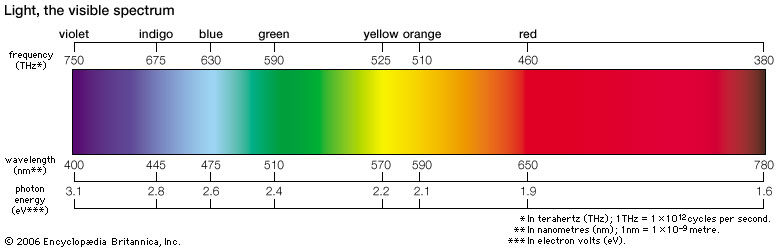
Image credit: Encyclopædia Britannica, Inc.
So going off of unique frequencies, there are more colors in a rainbow than there are stars in the Universe or atoms in your body, but that goes far beyond what we can perceive. Your imperfect eye can (probably) only discern about a million distinct colors when you view a rainbow, or anything else, for that matter.
But oh, what a spectacular view it is to be able to see all that our eyes permit.

Image credit: Shanana Rocks.
It may just be a tiny fraction of the information actually encoded in the light of the Universe, but now that I've been asked, I've got to conclude that what we can see is pretty amazing for a simple trichromat!
That's not completely true. The Rods-system is used during the day for our 'peripheral' view, it senses contrast and movement. So it has is indeed a one photon sensitivity level, this gives us the ability to sense if someone or something is moving towards us from the side, a very important defensive tool I would say, even during the day. Or in offensive way, think how Magic Johnson could pass the ball to someone who seemed to be completely out of sight.
Something that has always bothered me is when I see nature documentaries state "this is what bees [or insert animal of choice] see in the ultra-violet." I have never sat down to figure out the exact variations in the "seven" colors of the rainbow but would love to know what color (or more specifically the frequency) they are actually seeing. I am assuming it is arround 350-300nm but the ambiguous term of "ultra-violet" or "infra-red" seems almost a slap in the face to something as specific as green or blue.
Two other color related stories well worth mentioning...
1.) Radiolab on NPR -
http://www.radiolab.org/2012/may/21/?utm_source=local&utm_media=treatme…
did a show about 2 weeks ago that was a lot of fun. I only caught the end of the show refering to the ancient greek notion of a "blue sky" (which practically didn't exist). One professor eventually made an experiment with his daughter to never equate the daytime sky with the color blue. As intrinsic as we find it she had the hardest time associating a color to the sky until she turned about 3-4 (don't remember exactly). Even then he admits he was somewhat pushing her to guess the color blue.
For a british equivalent here is Stephen Fry talking about the ancient greek color "blue" on QI: http://www.youtube.com/watch?v=mhdH88uM8bw
2) There was a BBC Horizon maybe 6 months ago on color where they compared a western person's perception of color to an indiginous tribe person's perception of color. Surprisingly, they found an association to language that completely caught me off guard. If the society had a name for the color, it was then distinguishable to the person. The western person could name all of the colors that we know but fell short of the tribe person's clarity on the blue-green spectrum. They showed the colors on screen and I couldn't tell a difference.
On the other hand, the tribe person's language only accounted for 5 overall colors, with an emphasis on blue-green. There were colors that were effectively oppisites to us that they had no idea were even different. (Specifics on the Horizion show might be a bit off, it's been quite some time since I watched it but the basics are there).
Back to my original comment, it makes my brain hurt trying to differentiate colors that our species cannot physicaly perceive. At the same time, my brain hurts worse knowing that simply the word "blue" has forever shaped my notion of color and there is no going back. I almost want to create the color figgity-floppity-floop just to expand humanity's grasp on the universe a bit more :)
“While the rods cannot discern color at all, they are sensitive to as little light as a single photon, hence they are most useful under extremely low-light conditions.“
Whilst agreeing with chelle this is not completely true, I don't think he/she is completely correct either. Cones need higher levels of incident energy to operate so are useless in low light, but both cones and rods are present across the visual field. The rods provide the high resolution black and white image, the cones a low resolution colour one. This is why it was possible to squeeze some low bandwidth colour information into the unused frequencies in a standard black and white transmitted TV signal and produce an acceptable colour image. without degrading the black and white one. Without this colour TV might have taken much longer to become established. Different encoding methods for the colour information are (soon probably to be "were") used around the word, but the american NTSC system was so imprecise at reproducing colour that NTSC was jokingly referred to in Europe as being an abbreviation for "Never Twice the Same Colour"
I have heard (sources lost in the - monochromatic - mists of time) the women have a tad more color sensitivity than men.
Any truth in that one? Would it "explain" why peacocks have glorious tails, but not peahens? Ditto the coloring of goldfinches?
.... and then, there is the mantis shrimp, sporting eight to (depending on your source) sixteen flavors of cone.
Can't see an article about rainbows without thinking of this lady
http://www.youtube.com/watch?v=_c6HsiixFS8
The Stupid, IT BURNS!
I just yesterday thought about the fact that the rainbow actually looks like it contains a discrete set of say 4-5 bands, instead of a continuos set of colors. I was thinking about why this is. So, looking at the picture of the prism above in the article. Is that fake? Because it definitely illustrates my point....
Rods and cones don't sense movement nor do they sense lines or shape.
That is done by any nerve ending working to suppress or enhance neghbouring and more distant nerve endings.
The wiring of the rods and cones. Not the rod or cone itself.
Earlier this week, Science News had a report (http://www.sciencenews.org/view/generic/id/343056/description/Mantis_sh…) on a study of mantis shrimp vision. Their just-noticeable difference is about 15 nanometers. The article states that maximal human color differentiation is just 1-2 nanometers. So the full spectrum contains less than 300 distinguishable colors.
J Stackpole @0343: I don't know if there is a difference in sensitivity, but the brighter colorings of male birds compared to females of the same species has a different cause: the need to attract mates. The males have to demonstrate health and fitness to the females, and brightly colored displays (of which the peacock is an extreme example) is one of the ways they do it, even at the cost of making the males more conspicuous to predators. It's the avian rough equivalent to "Hold my beer and watch this."
Michael @0855: Your count is true for what could be called pure colors (i.e., monochromatic light). But most real colors are combinations of wavelengths; e.g., magenta is a combination of red and blue rather than a monochromatic color. I suspect Ethan's 10^6 figure is an overestimate (it assumes that the different types of cone cells have responses that are fully independent of each other, a point on which I am skeptical), but there are certainly thousands of distinguishable colors, as you can verify by visiting the paint department of your local hardware store.
"Lucky for us, that’s where a good deal of the Sun’s light falls, especially after atmospheric absorption is taken into account."
Seems to me that this probably has less to do with luck and more to do with evolution. If you're going to be limited in potential spectrum you can perceive, it makes sense that selective pressure would push you towards the wavelengths of light that are most abundant.
This hypothesis should be testable. Is there any noticeable difference in the wavelengths of light present, say, 10 meters underwater? One could maybe look at the light sensitivity of animals whose habitats are at different water depths, and if should correlate nicely with the abundant wavelengths at that depth.
Most birds are tetrachromats with the 4th cone type sensitive to UV light. A lot of birds have color patterns only visible in UV. So as pretty as a peacock is to us, it must be even more amazing to the peahen. The point though is that it is different, and there is no reason that a (hypothetical) difference between sexes in human color vision would necessarily apply to birds.
The coloration is indeed driven by sexual selection. An interesting example would be the Phalarope genus of wading birds. In these birds it is the females who have the bold, colorful plumage and the females who display and compete with each other for male attention. Once the egg is laid, it is the male who cares for the egg and young while the female takes off.
Oh, and Michael's calculation is relevant to the question of how many colors are in a rainbow (as we perceive it).
For all those who say that Ethan's passage about rods is not entirely true, check your biology books again.
"Rods have a high area for visual pigment and thus substantial efficiency of light absorption. Because they have only one type of light-sensitive pigment, rather than the three types that human cone cells have, rods have little, if any, role in colored vision."
besides, this is the main reason why when looking through a telescope at low light sky objects, everything is in black and white, only when there's enough light for cones to activate do we start to see color.
Now I have a hypothesis to explain why the hell the other people can't see a difference between this and that shade of grayish blue, or why I recognize plant species by colour of foliage. It's the four types of cones. Or working in and around graphic design for quite a few years:D
Yes! Teachers were fooling us till now. I always thoughts that there are not just 7 colors. I am happy. I am right.
@Mattias Davidson
About the colors of a rainbow.
it is my understanding that there is a difference between the spectrum produced by a prism, and the color range of a rainbow.
In the case of a prism-spectrum every sub-section is pretty close to monocromatic. There is good separation of wavelength over the whole range of the spectrum.
A rainbow arises from a combinations of refractions and internal reflection in droplets of water. One color, at one end of the spectrum is fairly pure, but the further away from that end the more "polluted" the light is with other light. In the spectacular photograph that Ethan added to the article the red band looks most vibrant. Presumably that's the more monochromatic color.
Summerizing:
A rainbow does not present clean separation of wavelengths
It would be interesting to examine a good representation of an astronomical spectrum. Maybe some astronomer has taken an modern observatory spectrum, and has converted it to a viewable format. A spectrum obtained by a modern telescope is stored in some digital format that will need converting if it's to be displayed as a color image on a computer screen. It would be interesting to see whether our eyesight perceives such a spectrum as continuous, or whether we will tend to see bands of color.
Roy G Biv
Red,Orange,Yellow,Green,Blue,Indigo,Violet
The image with image credit Adam Hart-Davis is, by the looks of it, computer generated. That picture shows the principle, but not what you actually get.
Incidentally, prisms are no longer in use in astronomy. A spectrum is obtained with an obtical device that is called 'diffraction grating'.
@ Cleon
Don't think the rainbow "works" as you describe.
from wiki:
"A rainbow spans a continuous spectrum of colours—there are no "bands". The apparent discreteness is an artefact of the photopigments in the human eye and of the neural processing of our photoreceptor outputs in the brain."
"no banding of any type is seen in a black-and-white photo of a rainbow, only a smooth gradation of intensity to a maximum, then fading towards the other side. "
" Because the peak response of human colour receptors varies from person to person, different individuals will see slightly different colours, and persons with colour blindness will see a smaller set of colours."
you are right that it's not a clean separation, but in Ethan's article there is no mention that it is.
again from wiki:
"The colours visible in the rainbow are not pure spectral colours. There is spectral smearing due to the fact that for any particular wavelength, there is a distribution of exit angles, rather than a single unvarying angle."
however think the mechanism you portray is not correct: "One color, at one end of the spectrum is fairly pure, but the further away from that end the more “polluted” the light is with other light."
this is not so. The color is depended upon the wavelenght of the light. And the act of dispersion is what makes it in both rainbow and prism.
AI, you don't often find all those colours represented. And further to SL's point, you'd need perfectly spherical evenly spaced and exactly the same size to get any pure colours in a rainbow.
My intuition for many years has been, that the typical person perceives 7 colors in the rainbow because the three different band sensors have three peaks, two crossovers, and two outside ends. I am encoruaged by Sinisa's point about "artefact of the photopigments" as a little confirmation of this intuition.
I never heard about possible human tetrachromats until I read this article (thanks!). If my intuition is correct, they should see 9 colors in their rainbows. Since we can't ask birds or bees to describe what they see, I wonder if there is any such description from the possible human tetrachromats?
Meanwhile... I saw another extremely interesting video about a study of how human language affects color perception. For example, a set of colored patches has one patch with quantifiable just--human-noticeable-difference from the others, yet the difference is noticed or not noticed reliably, depending on the observer's culture. That is: one set of colors has a different patch that is clearly noticed by Europeans, but not by members of a certain African culture, and another set of colors has a different patch that is clearly noticed by the African culture, but not by Europeans.
That study makes me wonder if my intuition is over the rainbow...
PS - Cody's mention of the "BBC Horizon" spot - that is the one I was thinking of, showing the correlation between human color perception and language. I found that quite astounding - now, I think any study that depends upon human descriptions of color perception must seriously consider the possibility of cultural factors, regardless of the physics and biology involved.
@Eric Lund (15 Aug 10:25 am): You're quite right!
I derived my value in response to Ethan's title, "How many colors are really in a rainbow?", by using the human wavelength JND (1-2 nm in green/yellow, several-10 nm in red/violet), together with the ~400 nm span of the "rainbow."
I find it extremely fascinating that there are so many observable colors which have no "wavelength" at all. The various browns, beiges, greys, pinks, and so on, do not map to any single location in the "visible spectrum."
They are composite creations of our visual system; someone more philosophically minded might even try to label them as "pure qualia" (since they don't map to some objective entity).
Consequently, I'm not even sure how to sensibly count how many such composites are distinguishable (in the JND sense). Ethan's value of ~100^3 is an upper bound, but as you and others have pointed out, the three human receptors have nontrivial overlap in wavelength space.
Sinisa,
Ethan said; "they (Rods) are most useful under extremely low-light conditions.", while you speak of "rods have little, if any, role in colored vision.
The meaning of my comment was to point out, that 'Rods' play an important role on keeping an eye on 'side-effects' which is in reality sometimes the most important part of our vision. I hope you got my hint regarding some very focused experiment.
I still don't get the prism picture above. Why is it 1 color - border - 1 new color - border - 1 color...
Instead of
one color.... turning gradually into... another color... turning into...
And my original point is that I actually looked at the rainbow the other day and thought I saw the same pattern in the rainbow. Although not at all as clear as in the prism picture above.
So does it have to do with sunlight being more intense for certain wavelenghts? Or that my eye is more sensitive for certain wavelenghts? Or a combination?
Or
Is it all an illusion and btw the prism picture is fake...
@ Chelle
You quoted this sentence: “While the rods cannot discern color at all, they are sensitive to as little light as a single photon, hence they are most useful under extremely low-light conditions.“
This sentence is completely true! Yes, rods play part in peripheral vision also, like you and others pointed out, but that doesn't make the above quote any less true. My objection was to you and couple others saying that the above sentence is not entirely true. It is entirely true.
@Michael Kelsey
"I find it extremely fascinating that there are so many observable colors which have no “wavelength” at all. The various browns, beiges, greys,...."
I believe you forgot about the intensity. The color spectrum (not the rainbow) has several components, one of which is intensity as well as wavelenght. If talking about additive color space, grey is white of less intensity, brown is orange of less intensity.. etc.
"They are composite creations of our visual system;"
Not really. There are many colors which are not pure spectral colors, but it has nothing to do with philosophy. Just imagine two rainbows side by side, with one being slightly brighter than the other. Both have i.e. green color in them, but one is lighter green while other is darker green, so that's two colors, not one green. And so on. I don't think anyone said that the rainbow has all the colors we can perceive. Or that spectral colors are all that there is :)
So when you apply all the different intensity values we can observe to every one of those spectral colors, you already get much much more than by just using wavelenght.
The colour table can be replicated as HSV.
Hue
Saturation
Value (or chroma)
The difference between red and pink is saturation.
ERIC LUND:
I certainly agree with your point about evolution; my (implicit) point was that a heightened color sensitivity in the female is what made it worth while for the males to get more and more colorful. Another example of an evolutionary arms race, but between members of the same species.
Sinisa,
You are right, its a matter of semantics, it took me some time to get what you meant, thanks.
"light, remember, is an intrinsically quantum phenomenon, and so if the energy of the photons coming from a source are finite and discrete, then so must be the frequencies (and, interchangeably, the wavelengths) coming from them."
*cough*Doppler Effect*cough*
Ethan, very nice. Thanks.
"It is suspected that a human female could inherit... as many as six different types of color-sensing cones... Theoretically, a pentachromat, assuming the same spectral resolution of 100 intensities for each of five cone cell types and the same cognitive combinatorial capacity, may be capable of distinguishing up to 10 billion colors. However, most animals with possible pentachromatic vision have significantly simpler brain structures than the human optical system and in actuality will probably not be able to "combine and multiply" individual colors to create new shades and hues to create such a large range of colors." wiki
But of course our scientific instruments have effectively far more than 3 cones or even 6 cones (our instruments being in a sense our artificial cones). So the false colors that our mind can scientifically imagine (with the help of our instruments, i.e. artificial cones) is essentially infinite.
Cody Lawson thanks for your stories, particularly 2)
It reminded me of a perspective on art by Milton Glaser, "But the only purpose of art is that it is the most powerful instrument for survival—art is so persistent in all our cultures because it is a means of the culture to survive. And the reason for that, I believe, is that art, at its fullest capacity, makes us attentive." http://bigthink.com/ideas/16180
@ Sinisa Lazarek
"besides, this is the main reason why when looking through a telescope at low light sky objects, everything is in black and white, only when there’s enough light for cones to activate do we start to see color."
It's also why averted vision -- not looking directly at what it is you are trying to find -- is such a useful tool for finding dim objects (or finding Polaris in the early evening). The fovea is loaded with cones, and few rods. So a dim star that you can see in the periphery of your vision will vanish when you try to focus on it.
If you ever gt the chance, take a look at "the blinking planetary nebula", where you can see the effect of your fovea's insensitivity to light nicely.
@ CB & Wow
I have such a love-hate relationship with averted vision. It's nice being able to tease out that extra detail in a galaxy but it drives me nuts not being able to actually focus on it haha. You do get better but it's just not the same thing.
Have you guys ever checked out carbon stars? Been working on the Astronomical League's Carbon Star list for a while now and it's amazing seeing that red color just slowly creep in. You will be glancing at all the stars trying to hone in on it, completely oblivious to any color, but after about a second the red just slaps you in the face.
T Draconis is a really good example. It's pretty dim so not the easiest to find but its companion (I don't think it is a real dbl) looks almost hyper white to T's crimson. A true gem. S Scuti is also a really nice one (and much easier to find). I stumbled onto it last year at the Okie-Tex Star Party and got hooked on the stars!
Wow, thanks for the tip.
Cody, I honestly never really look at stars. I probably should, when I have it's been neat, but I'm hooked on deep sky objects and I've barely scratched the surface of those. Like I just learned about another one I need to see and it's in the part of the sky I'm most familiar with. :)
Cody, as long as you don't have a squint, try using the averted vision towards your nose. A little easier to maintain and a little denser in detectors.
Another tip is to let your eye rest on nothing (a good reason to have a GoTo scope) for some time. You will find it easier to look at detail without having to concentrate (which causes you to look directly at the object).
There is a deep misunderstanding of quantum theory and light presented in this article. Ethan claims that classically the spectrum of light would be continuous, but quantum theory makes the spectrum discrete, with a picture of various wave-modes presented as evidence. But this is wrong. What quantum theory does is make the *amount of energy* in each frequency mode discrete, but not make the frequencies themselves discrete. To get discrete frequencies is completely separate, and appears classically also. It comes about from the existence of boundary conditions. For instance, if you consider light in a metallic box, the electric field is forced to vanish at the walls of the box, and this leads to a discrete spectrum classically. The only new thing quantum theory adds is to make the energy in each if the discrete modes in the box discrete also. A very different idea.
Sigh. Let me see if I can help.
Wow: yes, a color has 3 dimensions; one set of terms for these is hue, saturation, and value. However chroma is a synonym for saturation, not value. The difference between red and pink is saturation AND value.
Cleon: The Adam Hart-Davis image above is a photo, not computer simulation. It does look like that.
Sinisa: Banding might not be evident in the values in a black and white rainbow photo if adjacent differing hues were of the similar value (depending on characteristics of the photo emulsion).
Ethan: the resulting discussion might have been focused a little better if the original question had been about hue, which correlates with wavelength. Still, an interesting post.
No, the colour wheel has three dimensions in the HSV colour scheme.
It has four in the CMYK scheme.
Pink is red with green and blue in equal proportion in the RGB scheme.
Now, do you know what "gamut" means? Did you know that there are colours that can be mapped in one scheme canot be maped in another? That's why we have pantone spot colours.
Your incredulity about colours is like someone hearing a sine wave on the oscilloscope and saying "gosh, all those notes and despite containing all the frequencies, there are notes that aren't possible to recreate!"
Forgetting that nores aren't all one single pure note but have harmonics and timbre and, moreover, are mixtures of many frequencies at different strengths, but the note is representing the main strength note.
A high C on a flute doesn't sound luke a high C on a guitar.
PS thanks fot the value-chroma thing, the books on it are very vague and change their terminology if you're reafing one about photography or computer imaging and assuming you know what they mean.
However, you're still pretty darn clueless when it comes to colours. Maybe you did art theory at school and nothing since.
Bob, quantum theory quantises the light into packets. They don't quantise the energy of those packets.
Eben the uncertainty principle doesn't do that. It just puts a limit on how accurate you are measuring it, not on what its value is.
Wow, thats wrong. Quantum theory *does* quantize the energy in the packets - that's what makes it a packet.
@ Bob
No, the packet (or why call it packet when it's called a photon). The photon is a quant of light. That's what QM does.. it makes light a certain quanta of photons. And it's energy is depended on frequency or wavelenght inversely. QM only says that the wavelenght can't be smaller that planck scale. It doesn't quantize the energy of a photon into some smaller packets...
Sinisa, what are you talking about? Have you taken courses on quantum mechanics? What are you basing this on.
I have studied quantum mechanics for many years, and can tell you with certainty, that for a given mode (or frequency) of light, quantum theory quantizes the energy of that mode. That is what Max Planck did to fix the UV catastrophe of classical physics, it is what Einstein did to descibe the photoelectric effect, it is taught in every quantum course on earth.
@ Bob
you are talking about a black body radiation and the solution to a problem which classical thermodynamics couldn't solve.
you say: "What quantum theory does is make the *amount of energy* in each frequency mode discrete, but not make the frequencies themselves discrete. "
but Planck's formula can be written in different forms.. for frequency, for wavelenght etc.. If energy is depended on frequency, how can you say it's one but not the other? You mentioned a metal box... and talking about photoelectric effect. What does that have to do with rainbow and color anyway? As you know very well, light is both wave and particle and neither at the same time. Just using particle explanation and disregarding wave one is not ok IMO. Besides, you really don't need QM in order to explain difraction of light.
Sinisa, this is quite embarrassing for you, since you have no clue what u r talking about.
If you study monochromatic light of a fixed frequency, its energy is a continuum classically, but discrete quantum mechanically. The energy is not just determined by the frequency, but also by the amplitude if the wave. Classically the amplitude is continuous, so the energy is, while quantumally it is discrete. The frequency is irrelevant to the discussion of discretization.
What part of this don't you understand? Do you know any of the basics of quantum theory?
@ Bob
"If you study monochromatic light" - not talking about that here, we are talking about sunlight which is anything but monochromatic.
"Classically the amplitude is continuous, so the energy is, while quantumally it is discrete." - everyone agrees with this
"The frequency is irrelevant to the discussion of discretization." - true, we were all talking about wavelenghts untill you started.
"What part of this don’t you understand?" - I don't undertsand you. Except talking about photoelectric effect which is irrelevant to the topic of rainbows and color.
Ethan's sentence: "But light, remember, is an intrinsically quantum phenomenon, and so if the energy of the photons coming from a source are finite and discrete, then so must be the frequencies (and, interchangeably, the wavelengths) coming from them." - you said this is wrong. I disagree with you. That's all.
And also you might have overlooked this: "The Sun is a miasma of incandescent plasma, and the rules that govern atoms and the specific wavelengths that they can emit and absorb light at do not apply to plasmas. Instead, they can emit at an arbitrarily large number of frequencies, dependent on the temperature of the plasma. "
"Do you know any of the basics of quantum theory?" - Enough to know my way about it. I won't argue that you know more about QM. But I think you made wrong arguments on the wrong topic. Sunlight, rainbow, color. Remember?
What? You say everyone was talking about wavelengths, not frequencies. And then you quote Ethan referring to frequencies....what???????????!!!!!!!
Ethan claimed that quantum makes frequencies of light discrete. I pointed out that the discretization of frequencies of light is not due to quantization of light, it is due to boundary conditions, even true classically. Quantum discretizes the energies, not the frequencies. Okay.??? Please learn before responding!!!!!
Bob: "Wow, thats wrong. Quantum theory *does* quantize the energy in the packets – that’s what makes it a packet."
What I said: "Bob, quantum theory quantises the light into packets. They don’t quantise the energy of those packets"
No, a packet of light is one photon. It has an energy that depends on the frequency or wavelength (equivalent statements).
But there's nothing in QM that makes the energy in a photon quantised.
The mechanisms of emission by relaxation of an exited electron state in an atom is quantised by the mechanism of orbital energy states being quantised, but that's the mechanism for producing a photon, not about how photons act.
If this were not the case, then we would not have black body radiation: the photons would only be allowed to be of set quantised energy states, and you would not get white light, but light of a mix of some set of distinctly disparate photons.
Conduction bands would work differently yoo.
"Quantum discretizes the energies, not the frequencies. Okay.??? Please learn before responding!!!!!"
Well tell us what the difference between the energy of a photon and its frequency is.
Because AFAIK it's the same thing with a multiplicative factor added in.
I.e. a photon of double the energy has double the frequency.
Or is that somehow diffferent in "real physics"?
Bob, you may be taking the Casmiir effect a little too seriously here.
In a case where you have two conducting plates in parallel, you have to fit in photons that have an integer/2 number of wavelengths that fit inside that gap because the potential at either plate has to be zero (if grounded or effectively so).
Given that the quanta if we supposed the CMB to be a conductive surface would be a wavelength of about 26 billion light years, that quanta is indistinguishable from continuous.
Yes wow, in your case of the CMB... The frequencies are continuous, the energies are not... That is my point.
@ Bob
"Quantum discretizes the energies, not the frequencies. Okay.??? Please learn before responding!!!!!"
Bob, I take care to research the material before replying. And nowhere in the books or material online did I ever come across what you say above. A photon on it's own is a quanta of light with EVERYTHING associated with it being discrete. Frequency, wavelenght, energy.. etc. But to say that ONLY energy is quantized and nothing else is new to me. So please provide some source or formula or whatever which backs up your claim. Thank you.
"The frequencies are continuous, the energies are not… That is my point."
Then your point is that you're an imbecille.
Since the energy is a constant times the frequency if the frequencies are continuous then the energy is continuous.
I wonder if Bob is chelle with different socks on.
Nah.. Bob knows but for some reason chooses to disregard others. Or he has forgotten but thinks he remembers. Or maybe he is too stuck in String theory that everything else became a sort of blur (if he's the same Bob as in previous topics).
Chelle on the other hand knows nothing and is just hooking other people to waste energy debating with him about pointless things.
Ah, I think I've worked it out. Bob is talking about photons being the quanta of light.
But this has nothing to do with the colour of either light or objects.
So what the point he's trying to make is still nonexistent.
For a given frequency, the energy of light can take any real value classically, while it can only have discrete energy values in the quantum theory.
The formula is:
Energy = (number of photons)*frequency*(Planck's constant)
See that factor "number of photons"...it is a discrete integer. This is the new thing that quantum brings.
The gap between a pair of energies is frequency*(Planck's constant), if you send (Planks's constant) to zero, the gap goes to zero, and the distribution of energies becomes continuous.
This has nothing to do with whether the frequencies are continuous, that is a totally separate issue. Sometimes the frequencies are continuous, both quantum and classical, and sometimes the frequencies are discrete, both quantum and classical.
But for a fixed frequency, only quantum makes the energies discrete! If you can't understand this, then you don't understand anything about the theory of light.
I'm amazed by all the people here trying to overturn quantum theory... it agrees with every observation ever performed. please accept data...please!
He's not talking about rainbow and color at all. He started by saying Ethan's sentence that photon's have discrete frequencies is wrong. I don't understand how that can be, but ok...
Sinisa, do you know what the word "discrete" means? You said that a single photon has a discrete frequency and a discrete wavelength? This is meaningless. A photon has a frequency. that's it. you can't say if that single frequency is discrete or continuous, its just a number. you can only talk about discrete or continuous when you have a *distribution* of things.
In particular, for a fixed frequency, you can study the distribution of allowed energies. well, it turns out that distribution is continuous classically, and discrete quantum mechanically. why? because in the quantum theory you must *count* the number of photons!
Well for Bob The Builder, here's a little potted history.
The question being asked is:
"How many distinct frequencies can a photon have in the frequency range visible to humans?"
Now, note that response to a photon has to be perceived as different to be visibly different. As a very crude analogue, the CCD on a digital camera has a quantum of "one electron ejected" but also a thermal noise. A signal producing one electron at a rate indistinguishable from noise is no difference at all. And the same goes throughout the entire CCD amplifier range until the pixel blooms or hits the maximum charge.
So, obviously the answer cannot be infinite.
Our systems for visual acuity also can only respond to certain colour ranges for each of the three colour receptors. And since all perception of light has to be via the detection of this less efficient (since it is neither 100% receptive nor constant throughout the sensitive range) mechanism to produce a signal that discerns as different.
Note that ALL of this is about the PERCEPTION of colour.
Not the light being emitted or reflected.
How many colors are really in a rainbow?
Posted by Ethan on August 14, 2012
(60)
Share on email More »
Image credit: Paul Nicklen / National Geographic, 2008.
Image credit: Paul Nicklen / National Geographic, 2008.
“The colors of a rainbow so pretty in the sky.
Are also on the faces of people going by.” -Louis Armstrong
It’s no secret that white light is the light that we see when all the colors shine together and are seen at once. This has been known for over 400 years, when Isaac Newton demonstrated that white light could be broken up into all the known colors by dispersing it through a prism.
White light through a prism
Image credit: Adam Hart-Davis.
All that we’re doing is breaking white light — in this case, sunlight — up into all of its component colors. This can be done artificially (such as by configuring a prism) or naturally (in the case of a rainbow), and covers wavelengths both inside and outside what our eyes can perceive.
The Electromagnetic Spectrum
Image credit: Antonine Education, retrieved from Kerry Clavadetscher.
While the Universe contains wavelengths of light that range from many meters long (radio waves) down to ultra-energetic, high frequency gamma-rays (with wavelengths as small as a single proton), it’s only light ranging from about 400 nanometers to a little over 700 nanometers that provides us with the light visible to our human eyes.
Lucky for us, that’s where a good deal of the Sun’s light falls, especially after atmospheric absorption is taken into account.
The Solar Spectrum
Image credit: Robert A. Rohde, as part of the Global Warming Art project.
But I was recently asked a question (that was also posted here) that I hadn’t been asked before: How many colors are there really in the rainbow? In more technical terms: How many distinct frequencies can a photon have in the frequency range visible to humans?
You might think — off the top of your head — that the answer is infinity; why wouldn’t you be able to just have an infinite number of frequencies that occur in that range?
Harmonic nodes
Image credit: © 2012 Russell Rolen.
If light were a continuous, classical wave, that’s exactly how it would work. But light, remember, is an intrinsically quantum phenomenon, and so if the energy of the photons coming from a source are finite and discrete, then so must be the frequencies (and, interchangeably, the wavelengths) coming from them.
After all, this is how atoms work.
Spectra of different atoms
Image credit: Marcel Patek.
So with this basic issue underway, we next have the statement:
"Atoms can only emit and absorb light of very specific frequencies, and hence we can observe absorption and emission lines unique to individual atoms."
This too is true.
It does not cover reflection nor oddities like spectral broadening or shifting of frequencies (I.e. flourescent lights).
Next we get from the sun's involvement:
"it means you’d have to go to a sub-Planckian precision to discern a frequency difference between two photons that were very close in energy."
So here talking about thermalised BB radiation not being quantised to any useful extent.
I.e. NOT saying "photon frequencies are quantised".
Now we get back to our reception equipment:
"On the other hand, your eyes are very much made up of neutral molecules that are highly restricted with respect to the wavelengths of light they can respond to."
Which is also true. With a frequency dependent efficiency that also plays a role:
"with each cone cell sensitive to a particular set of wavelengths of visible light, capable of discerning about 100 different shades of that color."
Which is entirely true too (I assume the 100 shades is correct, since 256 bits per pixel is considered accurate for photographs and displays, I'm inclined to agree that this number is researched and accounted for)
Then a bit of maths:
"a total of (100)3 = 1 million colors are discernable to a typical human"
Absolutely true too. 100% the same way as 8bpp allows 16.4 million colours in the RGB colour scale. Just simple combinatory maths from any teenagers' maths class.
So Ethan isn't saying that the light emitted is discrete in its frequencies.
The reception is a different matter.
Bob doesn't seem to have understood this. Probably concussion from the blow to the head by his knee as he desperately wanted to say "YOU WRONG!".
Bob, do you know what it means?
Apparently not.
Apparently you don't even know what is required to argue your case.
Nor what nonsensical is.
A Photon has one frequency you say? Well that is a discrete number. Not a range of numbers like you get from, say, looking at the fourier transform of a musical note played on a real instrument.
READ A BOOK.
And this time, try to learn from it.
"Energy = (number of photons)*frequency*(Planck’s constant)
See that factor “number of photons”…it is a discrete integer. This is the new thing that quantum brings"
See that frequency? That's a continuous number. That means that the total energy is continuous.
Or are all photons monochromatic on your planet, Bob?
Finite number of discrete photons coming from the sun == finite number of discrete frequencies in the sun's spectrum. What Ethan said is trivially true.
@ Bob
"Sinisa, do you know what the word “discrete” means? You said that a single photon has a discrete frequency and a discrete wavelength? This is meaningless. A photon has a frequency."
OK Bob, let's get to basics. Frequency equals speed of light divided by wavelenght. And wavelenght equals c/frequency. Since sunlight is plychromatic, meaning is a mixture of different wavelenghts, it follows that there are photons with different wavelenghts. Hence, photons with different frequencies.And since E=hf or as you like to say that energies are discrete, which is same (notice the "=" sign) as saying the frequencies are discrete. So in a given "sample" of sunlight you might have some photons which have wavelenghts in infrared, some in visible spectrum etc.. Each one of those has it's own wavelenght, thus it's own frequency. How can you separate wavelenght from frequency. That's what discrete means. At least that's my take on it. You might have another, and would really like to hear it.
CB: "What Ethan said is trivially true."
Except it isn't what Ethan said.
"While this number isn’t infinite, it means you’d have to go to a sub-Planckian precision to discern a frequency difference between two photons that were very close in energy."
But perception (look at the title of the thread: How many colours are really in a rainbow) of that is much more limited.
Maybe you need to explain exactly what your issue is, Bob.
Because its absolutely unclear what you're complaining about.
Wow:
You mean that IS what he said, as you just quoted, while also noting that a spectrum with an exceedingly large number of discreet frequencies would be difficult or impossible to distinguish from a continuous spectrum in practice.
Bob took issue with the statement of a discreet spectrum, claiming only energy is quantized. But quantized energy means for a finite amount of energy a finite amount of photons means a finite amount of frequencies in a spectrum. As Ethan said.
whether or not the frequencies of light are discrete or not has nothing to do with quantum theory. only the discretization of the energy.
E=n*h*f....the n is discrete so energy is.
if you consider frequency to be discrete in certain circumstances, that's fine. it would also be discrete classically. only the energy discretization is new.
its laughable how so many people here can't get basic physics, and think they can revolutionize physics by over-throwing quantum theory.
"You mean that IS what he said, as you just quoted"
You didn't read the quote, did you. Just stopped when you throught you'd been proven right.
"it means you’d have to go to a sub-Planckian precision"
It means that there's no difference between it being infinite and not.
Try, like I said, reading the title of this thread. You'll find out where Ethan says that there is a limited number of frequencies IN WHAT YOU CAN SEE.
Ethan is talking about that, not the photons.
"whether or not the frequencies of light are discrete or not has nothing to do with quantum theory."
Then why did you bring it up so many times????
because it was Ethan's claim...and at the heart of this blog
"because it was Ethan’s claim"
You kept whining on about:
“Quantum discretizes the energies, not the frequencies. Okay.??? Please learn before responding!!!!!”
"What quantum theory does is make the *amount of energy* in each frequency mode discrete, but not make the frequencies themselves discrete"
Now you say:
"whether or not the frequencies of light are discrete or not has nothing to do with quantum theory."
and that it was all Ethan's fault.
I note you still can't manage to say what the hell your problem here is.
My whole point from the very beginning has been consistent and the same...you just quoted me repeating the same idea.
Ethan claimed, and it was echoed by many people including Wow, CD, Sinisa, that quantum gives a discrete frequencies, when it would be continuous classically.
This is a fundamental misunderstanding of light. So i corrected it. It is a shame that Wow can't understand basic physics.
Your point has never been the same point twice.
You claim all the same, but your quotes you say I made showing this had you say it was about QM and it was not about QM.
The fundamental misunderstanding here is that you have no clue about what your problem is.
"Ethan claimed, and it was echoed by many people including Wow, CD, Sinisa, that quantum gives a discrete frequencies, when it would be continuous classically"
TRY IN ENGLISH!!!
See, SL, this is why I consider this to be chelle with another num de plum. The same half-assed english masquerading as thought.
quantum gives a discrete frequencies.
"a" singular.
frequencies: plural.
No noun this is being applied to.
What does quantim give discrete frequencies to?
I have said many many times:
Quantum makes the energies discrete.
Quantum is irrelevant to whether the frequencies are discrete.
Most people on this blog disagreed with these points, and they are wrong. In fact Ethan claimed quantum makes the frequencies discrete, and many people parroted this false claim.
"Quantum makes the energies discrete."
The energies of what discrete?
"whether the frequencies are discrete."
The frequencies of WHAT discrete?
"What does quantim give discrete frequencies to?" ummm.....light....... (this is the claim that you all made, not me).
do you have the slightest clue what the topic is?
"“What does quantim give discrete frequencies to?” ummm…..light……."
OK, where does ethan say this?
...the energy of *light* is made discrete......wow...you don't even know that the topic is about light? ok, now i see you are a troll...
"the energy of *light* is made discrete"
Where does ethan say this?
You can't say, can you.
Why? Because you are LYING.
the energy of light is discrete...that is what I AM SAYING....well actually it was first said by Planck and Einstein
so wow thinks that Planck and Einstein were liars. what a despicable claim, and so ignorant...
"the energy of light is discrete…that is what I AM SAYING"
So your problem is that you're saying that the energy of light is discrete and that Ethan is saying that the frequency of light is discrete?
But you have said that you know that the energy of a photon is a constant times the frequency.
If that frequency is discrete, then the eneregy is discrete.
THE PHOTON IS DISCRETE in frequency and this is the same as saying the energy is discrete.
Which is ENTIRELY why nobody knows what the hell your problem is.
No, bob, YOU are the liar.
what does is mean to say the "photon is discrete in frequency"?
And it's only the PRODUCTION of the photon that is ensured to be a discrete, quantised number if the event producing it is between two quantum states.
I.e. the decay of an excited electron in an atom will produce QUANTISED light, light of specifit frequency.
This, however, doesn't mean that all light has to be. pair production produces photons that have continuous values of frequency, as will photoemission from, for example, an LED.
"what does is mean to say the “photon is discrete in frequency”?"
It means that a photon from electron shell transitions has a specific, discrete value for its frequency that depends on the energies of the two shells it is transitioning between.
Like this:
http://hyperphysics.phy-astr.gsu.edu/HBASE/hyde.html
Or are you saying that Einstein were lying?
and if i have a current sloshing back and forth and a particular frequency, the light will come out a specific "discrete" frequency. big deal...
this is a total abuse of the word "discrete". discrete means that the distribution of values has gaps in them, instead of continuous. you are not referring to a distribution.
thanks for the link that proves my point. notice they only refer to the discretization of ENERGY that quantum introduces? can you understand this utterly elementary point?
"discrete means that the distribution of values has gaps in them"
And the allowed frequencies to let electrons (NOT CURRENT YOU CLUELESS BABOON) slosh about is discrete. Has gaps in them. Not continuous.
Therefore the photons FROM That process are discrete. Has gaps in them. Not continuous.
"notice they only refer to the discretization of ENERGY that quantum introduces"
NOTICE how it's THE ELECTRON SHELL they're talking about?
Your bleating also ignores Ethan saying:
"Atoms can only emit and absorb light of very specific frequencies, and hence we can observe absorption and emission lines unique to individual atoms"
Now if, as you say, Ethan isn't saying this, how come I could quote that from what Ethan says?
You lying sackocrap.
Oh, and you know that ENERGY that is quantised? Well, if that's the ENERGY of a photon, then the FREQUENCY is quantised.
And if that ENERGY that is quantised is due to Quantum Mechanics, then the FREQUENCY is quantised due to Quantum Mechanics.
Speaking of rainbows, I was looking through some old (digital) photos and realized that I'd photographed a rainbow with supernumerary arches, but I don't recall seeing the supernumerary arches when I took the photo. A few months ago I also saw a bizarre sundog - the arc was completed at the top and there were arcs below the images of the sun as well. Maybe it was a sundog + aura; I hadn't had the time to look up the geometry of the various effects. Naturally I didn't have a camera ... grrrr.
@mattias: That would be an illusion. Although the Fraunhofer lines were observed long ago, they are not observable in a rainbow or even easily observable with a prism for that matter. If you go to the National Solar Observatories site you can get a false-color high-resolution spectrum of the sun as a JPEG image; the image will give you some idea of where the Fraunhofer lines (and other dark lines not observed by Fraunhofer) are and how they might affect what you see. Also keep in mind that instruments such as spectroradiometers were developed because the human eye is no good at measuring frequency and intensity of light; our eye detects one thing and our brains do something strange with that information - the end result is something which benefits our survival as a species but is not very useful for scientific measurements.
@mattias: Here's a link to a relatively small JPEG of the false-color solar spectrum: http://www.noao.edu/image_gallery/images/d5/suny.jpg
The image shows light from 400 to 700nm and you can see that the more obvious dark bands are not between colors but within colors (for example, several within the green band and the very stark Sodium Doublet in the yellow - the Sodium D lines are actually absorption lines from the earth's 'Sodium layer' at ~80km altitude).
hey I just want to admit I like your posts
that is sooo cool!!!
i <3 rainbows!!! Especially rainbow cupcakes!
i am soooooooooo awsome and thar are 6 colors in the rainbow
I think 6 colors are in the rainbow
There re 3 colors if the rainbow, the primary colors, red, yellow, blue they mix together making secondary colors such as green orange indigo an violet, but I don't count the secondary colors because it is just primary colors mixed together
No there are three colour receptors in the male human eye. That is why we have "three colours", though our genetics allow four or even five colour sensors and for these people, there are more colours in a rainbow.
Hell, the bumblebee sees a rainbow we don't: they can see in the UV.
This can be proven by putting a sensor of light in the path of a "rainbow" from a prism.
Smarty pants,
First of all, you got the primary colors wrong. Rainbows are additive colors, not subtractive ones. Your primary colors are the subtractive ones, applicable for instance to the mixing of paints. For additive colors, such as a rainbow (or the computer screen on which you are reading this) the primary colors are red, green and blue.
Now, on to the second point. There is a difference between what really exists and what you perceive with regard to colors. For instance, if you additively mix red and green, you will get a color perceived by the human eye to be yellow. If you excite sodium atoms, you likewise will get a color perceived as yellow. The two are very different, however. The light from the sodium atom is monochromatic. That is, it consists only of photons with a single wavelength. The red/green mix is not monochromatic. The situation of a rainbow is more similar to the sodium light than it is to the mix of red and green. The yellow from a sufficiently small section of a rainbow is monochromatic, not a mix of red and green wavelengths.
(to be sung to the tune of "10 little indians")
How many colors are in the rainbow?
How many colors are in the rainbow?
How many colors are in the rainbow?
Count them and you see
Seven!
Violet, indigo, blue and green
Violet indigo, blue and green
Violet, indigo, blue and green
Yellow, orange and red
Seven colors are in the rainbow.
Seven colors are in the rainbow.
Seven colors are in the rainbow
Count them and you'll see
Seven!
I believe there are an infinite number of colors in the rainbow but I thought that song I learned in second grade was cute.
Your content is excellent
Please send e-mail
With photos
amesing
I believe that the picture of the prism is a fake because I have done an experiment like that and the rainbow I saw had red, orange, yellow, green,blue and violet. I saw each of these colours very clearly and the picture of the prism above has only red, yellow, green, blue and indigo.
These pictures are very pretty and i only see red orange yellow green blue indigo and violet. So i guess that's all the colors!!!!!
There are 9 colors
Royl g cbiv
Red, orange, yellow, lime, green, cyan, indigo, violet
@131 'Someone'
it appears you missed out 'BLUE' in your list .....;)
@131 'Someone'
it appears you missed out 'BLUE' in your list ..... ;)
If indigo is considered a color, t h e n so is teal, lime, yellow-orange, orange-red, burgundy @nd fusia-pink !
Indigo is a weak color, everyone's always talkin' @bout Indigo.... It's just between Purple & Blue, it's barely distinguishable ?