

"It's a brilliant surface in that sunlight." - Neil Armstrong
Indeed, all that glitters so brilliantly in the cosmos does so because of the stars that have formed throughout it.

Image credit: NASA, ESA, and the Hubble SM4 ERO Team.
Over the 14 billion-or-so years that our Universe has been around, we've formed hundreds of billions of stars in our galaxy alone.
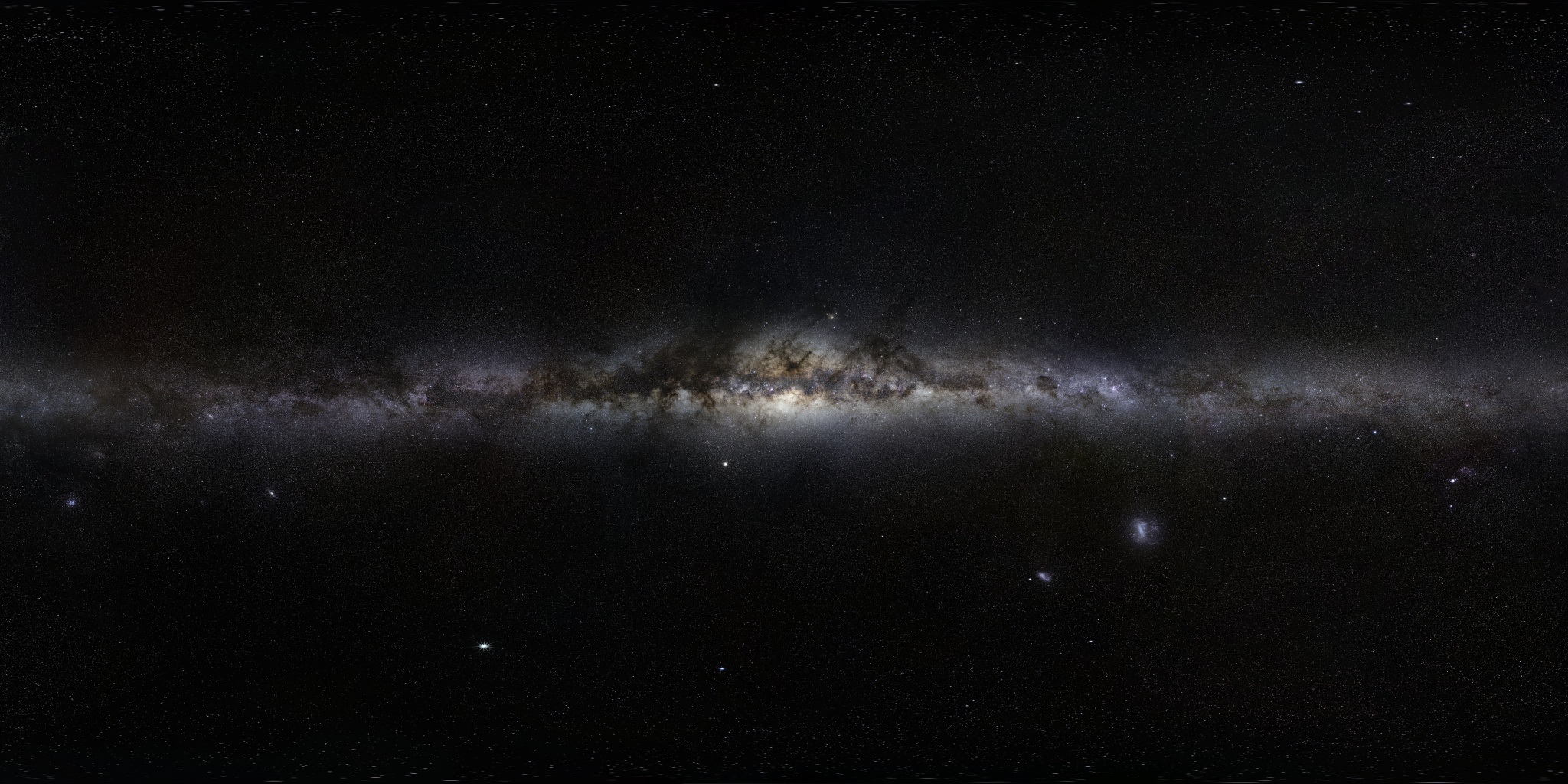
Image credit: ESO / Serge Brunier (TWAN), Frederic Tapissier.
Given that our galaxy is just one of at least hundreds of billions in the observable Universe, the number of stars that have formed over our Universe's history is a tremendous number, when you add them all up.
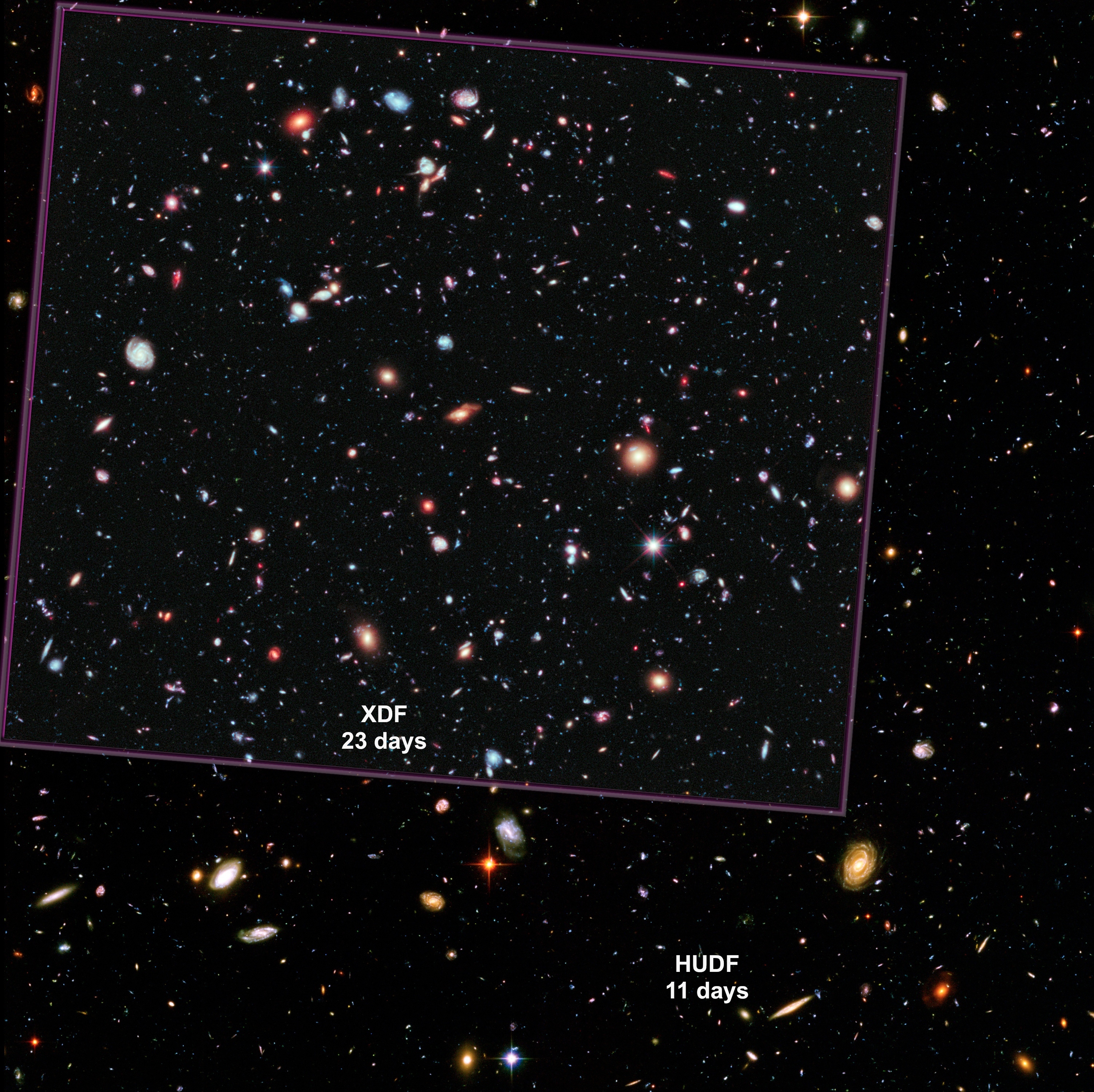
Image credit: NASA, ESA, G. Illingworth, D. Magee, and P. Oesch (University of California, Santa Cruz), R. Bouwens (Leiden University), and the HUDF09 Team.
But one of the fun things we discover is -- by looking back at the younger galaxies in the Universe -- the star formation rate back then was much higher than it is now! A typical galaxy from long ago is forming more stars on average than a galaxy now.
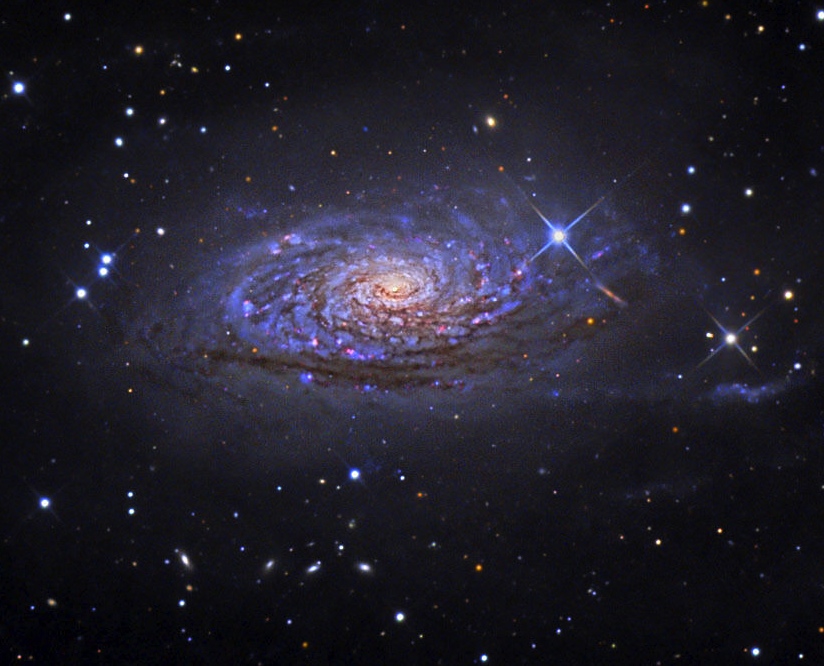
Image credit & copyright: Tony Hallas.
This galaxy -- the Sunflower Galaxy -- is typical of galaxies today. You can identify star-forming regions in galaxies from the characteristic pink glow that star-forming regions give off, thanks to their ionized hydrogen.
Do you see how, above, there are only a few, small pink regions in that galaxy? This is a classic example of a mature spiral galaxy, where it's full of gas, dust, and stars, all clearly visible in the snapshot here, but only a few sparse regions are currently forming stars.
This was not always the case for this galaxy, and it won't always be the case for this galaxy going forward into the future, either. Why not?

Image credit: NASA, ESA, S. Beckwith, and The Hubble Heritage Team (STScI/AURA).
Because events are going to happen that cause this gas and dust to contract and form stars. It can happen in large bursts, like due to a gravitational interaction (above), it can happen gradually over time, triggered by something like a nearby star's explosion, or it can happen in the most spectacular way imaginable: in a huge rush caused by a major merger with a comparably-sized galaxy.
In this last case, the entire galaxy will become a star-forming region, and this is known as a starburst galaxy.
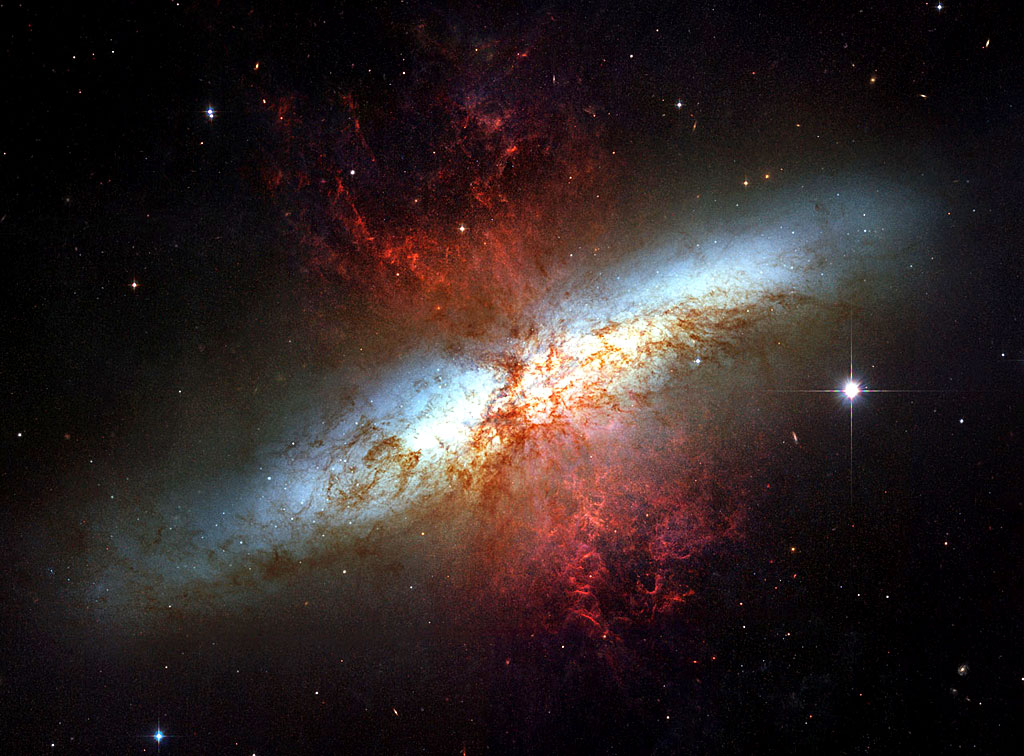
Image credit: NASA, ESA and the Hubble Heritage Team (STScI/AURA).
Incidentally, this will be us in about 4 billion years, when the Milky Way and Andromeda undergo a major merger. Our night sky will look something akin to this, as our entire system of merging galaxies will be forming new stars.
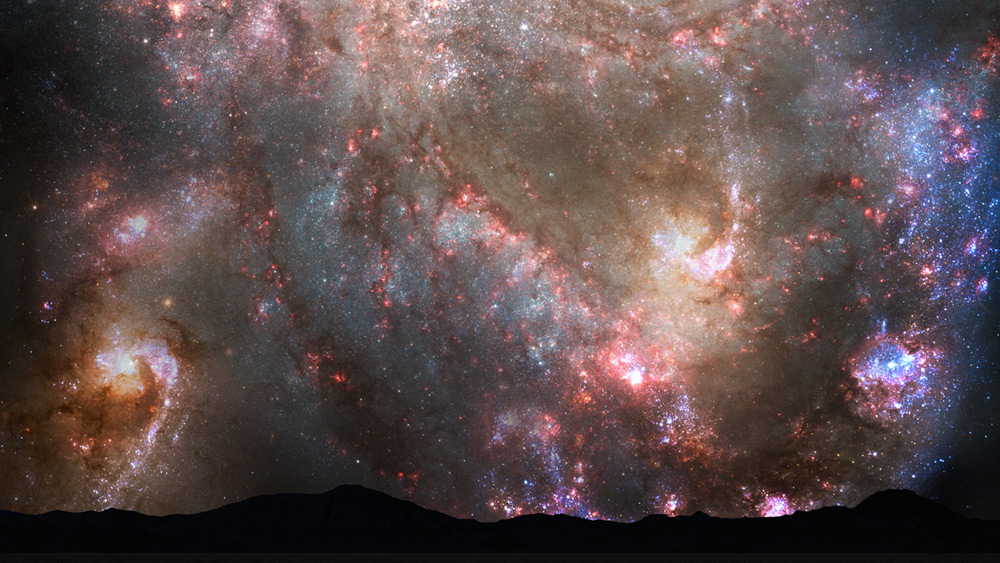
Image credit: NASA, ESA, Z. Levay and R. van der Marel (STScI), and A. Mellinger.
But -- you may be curious -- how long can this process go on for? Sure, we'll form stars in great, periodic bursts when rare, catastrophic events occur, and very slowly and intermittently otherwise. But at some point, we're going to run out of the hydrogen gas that -- at one point -- comprised 92% of the atoms in the Universe. Because stars work by fusing light elements into heavier ones, at some point in the future, we'll have fused all the elements we're going to form.
Well, here's what you definitely shouldn't do.
You shouldn't, David Sobral, make statements like this (bold emphasis mine):
You might say that the universe has been suffering from a long, serious "crisis": cosmic GDP output is now only 3% of what it used to be at the peak in star production! If the measured decline continues, then no more than 5% more stars will form over the remaining history of the cosmos, even if we wait forever.

Image credit: Charles M. Schulz.
Let me tell you something about our galaxy. Our unexceptional, unremarkable, uninteresting-save-that-it-contains-us galaxy. This guy, shown vertically so you can get a good look at it.

Image credit: Alan Dyer.
Sure, with your eyes, you're going to notice mostly the stars, and -- in pink -- the small and sparse star-forming regions. But you may also notice the dust lanes!
Here's the thing: if you add up all the normal matter in our galaxy -- all the protons, neutrons, and electrons -- most of it is still neutral hydrogen gas! We're in no danger of running out anytime soon.
However, we went through intense periods of star formation in the distant past. We observe these -- in and around our galaxy -- all across the Universe as still being an ongoing thing.
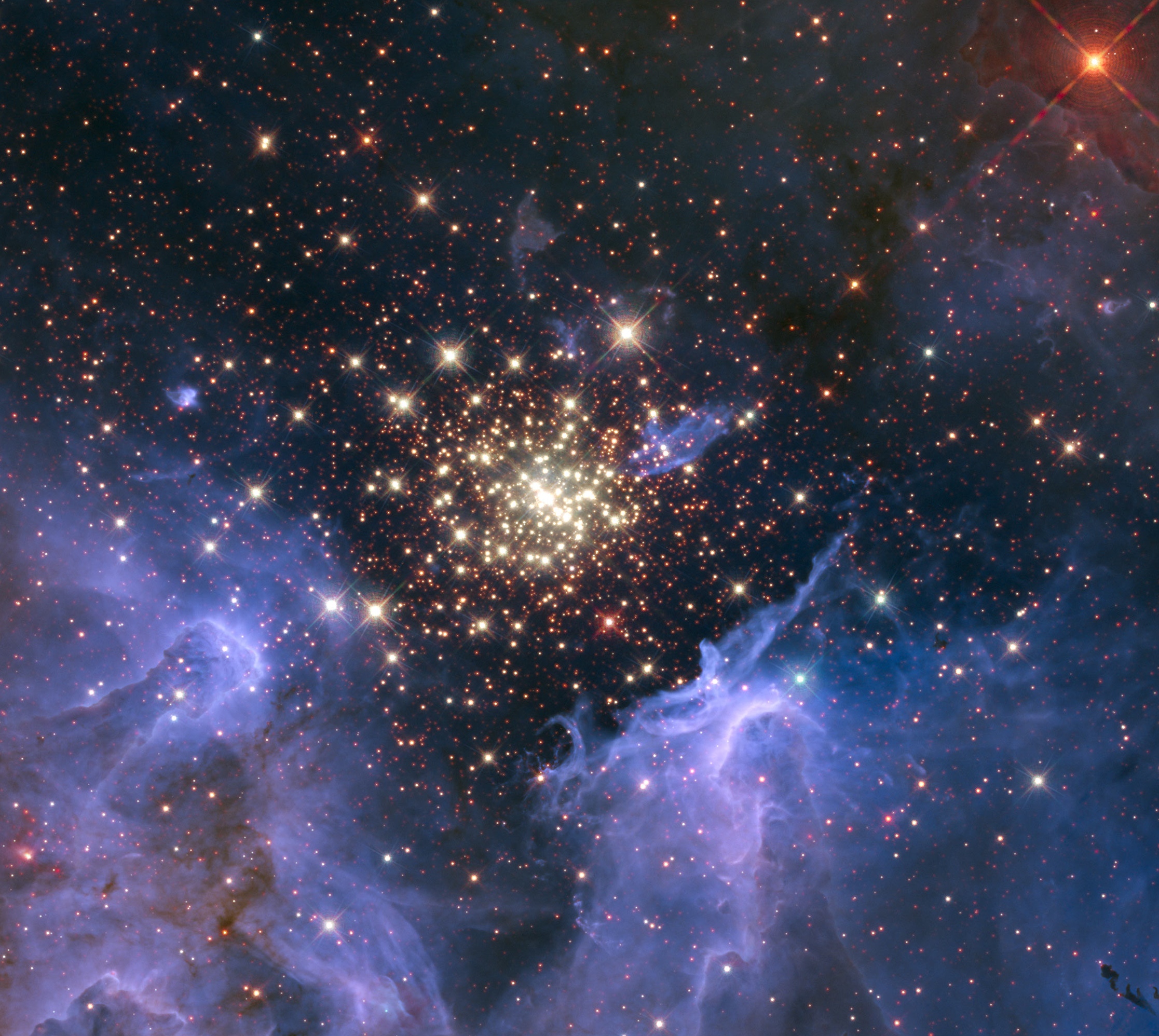
Image credit: NASA, ESA, R. O'Connell, F. Paresceysics, E. Young, the WFC3 Science Oversight Committee, and the Hubble Heritage Team (STScI/AURA).
When this happens, only about 10% of the gas that made up these star-forming regions actually gets locked up in stars, with the remaining 90% evaporating and getting blown back into the interstellar medium, where it will someday form stars again in the future.
Furthermore, most of the stars (in terms of mass) that form will eventually die in either a supernova or a planetary nebula, returning a huge fraction (perhaps half of a star's worth) of unburned fuel back to the interstellar medium on top of the large gas fraction that never formed stars during the initial starburst!

Image credit: Kunihiko Okano's Gallery; http://www.asahi-net.or.jp/~RT6K-OKN/.
Since it's in a gravitationally bound system -- a galaxy -- it's only a matter of time and gravity, neither of which are going anywhere, before all of the gas eventually forms stars.
The thing is, it's going to take a looooong time -- many trillions of years, by my estimates -- until we're out of fuel. Why's that? Because, when Sobral says "If the measured decline continues," that's his big flaw. Yes, there's an initial burst of star formation that's huge, and occasional bursts like that will punctuate the timeline of the Universe and dominate the measured star formation rate. But there's a slow, steady component on top of that, and as long as gas is abundantly present within our galaxy, that measured decline will not continue arbitrarily far into the future.
And the thing is, Sobral's a good enough astronomer that he knows it.

You KNOW better, man. You. Know. Better.
Yes, it's interesting that the star formation rate has declined, and it's interesting that it's declined at the rate we've observed. But it's not going to drop to zero any time soon, and if you sum up the total number of stars in our Universe's future, it's actually far greater than the number of stars that have already existed up until this point in time, a far cry from the "only 5% more than we have now" figure you may have read.
Although we might be approaching the peak of star density within our galaxy, we can very strongly say that the vast majority of stars that will ever call our galaxy home haven't been born yet.
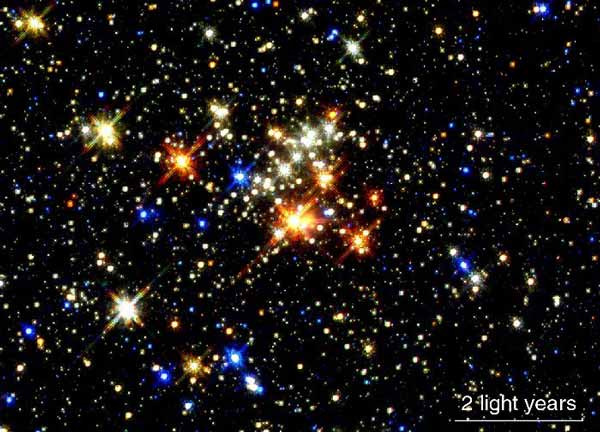
Image credit: Don Figer (STScI) et al., NASA, of the Quintuplet Star Cluster.
We won't live long enough to see them, either, as many trillions of years into the future is far too ambitious to count on, even for those of you counting on the singularity. But based on the physics and astronomy we know, there will be new stars for ages and ages to come, outnumbering even the full complement of stars that have ever existed up until today.
What a wonderful blog entry! Fascinating!
Reminder of our insignificance, yet gives great reassurance that even when life as we know it ends in our neck of the universe, there is tremendous opportunity for it to arise over and over and over again. Nice post as usual and that vertical pic of the milky way is impressive to say the least. what a beautiful image.
Awesome! What about the Big Rip? I mean, at scales of trillions of years won't cosmological evolution impact processes such as star formation? Also, will long-lived stars, namely M-dwarfs, come to dominate?
And what about black holes? Won't they tend to increase in number and mass over billions and trillions of years? Any possibility that this might compound to become significant enough to affect your projections?
Our ripping apart the LMC is the cause of massive increases in the production of stars both in that dwarf galaxy and ours.
"Every Galaxy will have New Stars for Trillions of Years!"
All scientific predictions are
1) about the future
2) based on scientific theories
3) falsifiable
In general a prediction is a statement about the future, based on scientific theories to which we really don't know the answer. We have an answer based on the theory; but if it has never been tested and determined by experiment or observation; thus there is the possibility of new science being discovered if the prediction is shown to be incorrect.
The statement "Every Galaxy will have New Stars for Trillions of Years!" is not a scientific prediction; because it is not falsifiable. Such a statement can neither be used to prove or to disprove current cosmological theories; because it is not falsifiable.
"Cloned woolly mammoth will be brought back to life in the next 10 years." is a scientific prediction because it is:
1) about the future
2) based on scientific theories
3) falsifiable
http://news.yahoo.com/blogs/technology-blog/scientists-bring-extinct-wo…
"Every Galaxy will have New Stars for Trillions of Years!" is a metaphysical statement; since it is not falsifiable (at least not for a trillion years).
Well, you could be pedantic and say that all science theories are predicting the past... The theories change when the future becomes the past and the prediction doesn't materialise.
The statement “Every Galaxy will have New Stars for Trillions of Years!” is falsifiable just like any prediction. Wait to see if it turns up or not.
But the premise upon which the claim "95% of the stars in the universe that will ever exist have already been born" is based on faulty reasoning and curve-fitting.
I.e. non scientific guessing.
And the prediction, like the obverse, could be proven or disproven merely by waiting a trillion years.
But the basis of the predictions for one exists in reality. The other doesn't.
Great blog entry and I quite liked the point that you made about *our galaxy*. But the study has nothing to do with our galaxy. It has to do with the Universe as a whole, statistically. As as a whole, the star formation rate density (which is the amount of mass of new stars produced in a given average volume) is really low compared to the past, so *on average* the total stellar mass density will not really grow that much (because there are soooo many stars already compared to the rate of formation of new ones).
Obviously, this is a statistical observation - but you know very well that saying "humans are getting on average more obese in developed countries" *does not* mean that a particular person/(galaxy) is getting obsess. Let me know if this makes it clearer - the conclusion is for the Universe as a whole, and for an average volume of the Universe, not for a single galaxy, not for our galaxy
David,
If what you are talking about is "star formation rate density," the number of stars formed per-unit-time-per-unit-volume, I would be greatly confused. That seems like an extremely uninteresting thing to measure, as the expansion of the Universe will dominate everything unless you use comoving volume.
If you do use comoving volume, and scale out the expansion of the Universe -- for instance, considering the galaxies within a comoving volume -- then I would imagine your conclusions change dramatically. Yes, most of the stars are old, but the once the stars that we have now burn out, that's hardly the end of "stars" in any galaxy in the Universe.
The articles that have been written up about your research give the strong impression that we are almost done forming all the stars in all the galaxies in the Universe, a conclusion that is certainly not true. I did not mean to be critical of your research, but rather how it was picked up and interpreted by the press, as it created a faulty impression about the Universe that I sought to correct.
"the conclusion is for the Universe as a whole, and for an average volume of the Universe"
Here's the problem in a nutshell.
The volume of the universe is getting bigger AND stuff is falling off the edge of it.
You also have the problem of backcataloguing: those distant galaxies are much, much, MUCH younger.
And, moreover, were formed in the past. 10 billion years ago, those stars didn't have a universe 10 billion years old to look at.
Obviously what we measure, and refer to as star formation rate density (which is a fundamental measurement of galaxy formation and evolution), is using co-moving volume (otherwise, as you say, it would be meaningless and simply dominated by the expansion of the Universe).
The Universe is certainly not done forming stars, but it is doing it at a rate which is much lower and which has been declining continuously over the last 11 billion years. The decline measured by us allows to predict the total mass of stars per co-moving volume and compare to actual measurements of stars per co-moving volumes (from e.g. infrared light and info from the full SED): it's a really great match. So our measured decline as a function of time is able to fully reproduce the evolution of the stellar mass density (co-moving, again, of course). This encouraging "prediction"-power is what is used to extrapolate to the future: if the star formation rate density continues to decline it is very very simple: the fraction of mass formed in new stars formed at time t divided by mass of existing stars becomes smaller and smaller and smaller.
But, of course, the complete shut-down would only happen at t=infinity. There will be trillions and trillions of new stars being formed from now to the future: but the point is that relative to those that exist (in mass) they will only represent a 5% increase in this scenario (averaged over the Universe, not necessarily valid for any single galaxy).
"star formation rate density (which is a fundamental measurement of galaxy formation and evolution)"
No, collapse of hydrogen gas clouds are a fundamental measurement of star creation.
Where there is no gas, there is no chance of gas collapse.
Where there is no perturbation of the gas, there is little chance of gas collapse.
There are lots of stars being born at the leading edge of a spiral arm of a galaxy. Naff all at the arse end of it.
The density therefore is nothing to do with the rate of star creation, and you haven't even addressed what the heck you mean by "galaxy evolution".
Unless you think that globular galaxies are older spiral galacies and the latter morphs into the former, which AFAIK is still about as well supported as Brane Theory, what on earth is galactic evolution?
Hence I've ascribed it to the only thing that makes sense: the formation of the stars within that galaxy.
David,
So, where I said:
Are you suggesting that the star-formation-rate-density is going to continue to decline at the steep rate it's declined at arbitrarily far into the future? No slowing or asymptoting of the decline?
In short, stars form for a reason.
And that reason is mechanistic, not statistical. It doesn't give a stuff for "star formation rate density".
The latter is measured from the former, the former doesn't follow from the latter.
Cause THEN effect.
"...many trillions of years into the future is far too ambitious to count on..."
I just wanna watch the collision with Andromeda, will that be OK?
Ethan,
We can only hope to know/quantify what we can actually measure. This is what is measured: over the last 11 billion years there has been a continuous decline - that's one of the simple results coming out of the paper. No slowing down in the decline, just a continuous decline - which is actually quite simple: log(SFRD)=-2.1/(1+z) where z is redshift and SFRD is the star formation rate density.
I realize now that most people here are thinking about the star formation history of our galaxy, or particular galaxies. That's not what this is about: it's about the Universe as a whole - the whole population of galaxies at a given time. And this is only possible because the volumes we targeted are really large and spread across independent regions in the Universe. These are volumes of about 1000000 Mpc^3 co-moving (even though we are looking at "slices" in time, these "slices" do have a little nice depth).
Wow: have a look at a few textbooks, articles and talk with friendly astronomers/cosmologists: they will explain why statistical studies of the Universe are absolutely fundamental. That doesn't mean that individual cases and very detailed physical studies of individual gas clouds/star-forming regions are not absolutely fundamental to unveil the physics behind star-formation - of course they are, because without them any other study becomes meaningless.
Let me put in my 2 cents (as layman, not a professional astronomer)
Looking at David Sobral's paper
THE PROPERTIES OF THE STAR-FORMING INTERSTELLAR MEDIUM AT z = 0.8–2.2 FROM HIZELS: STAR-FORMATION AND CLUMP SCALING LAWS IN GAS RICH, TURBULENT DISKS, 2012, by A. M. Swinbank, Ian Smail, D. Sobral, T. Theuns, P. N. Best, J. E. Geach http://arxiv.org/pdf/1209.1396v1.pdf
Sobral et al's work appears to be an excellent piece of work.
"The majority of the stars in the most massive galaxies (M⋆ >
∼ 10^11 M⊙) formed around 8 –10 billion years ago, an epoch when star formation was at its peak. Galaxies at this epoch appear to be gasrich (fgas = 20 – 80%)... In order to refine or refute these models, the observational challenge is now to quantitatively measure the internal properties of high-redshift galaxies, such as their cold molecular gas mass and surface density, disk scaling relations, chemical make up, and distribution and intensity of star formation."
See right here Sobral et al are making a scientific prediction with the words, " In order to refine or refute these models, the observational challenge is now to quantitatively measure"
Whereas Ethan makes a metaphysical statement, "Every Galaxy will have New Stars for Trillions of Years!" Sorry Ethan and Wow, but this is metaphysics not a scientific prediction. And now I am not being pedantic; because falsifiabelity (i.e an observation that will "refine or refute (a) models" in the sense that Sobral et al's work is at the heart of a scientific prediction!!!.
Sobral et all dare to make a real scientific prediction. They point to exactly what observations are needed to "refine or refute these models". They say, "the observational challenge is now to quantitatively measure the internal properties of high-redshift galaxies, such as their cold molecular gas mass and surface density, disk scaling relations, chemical make up, and distribution and intensity of star formation. " Very Nice. Excellent actually!!
Sobral et all go on to say why these measurements are important. "Indeed, constraining the evolution of the star formation and gas scaling relations with redshift, stellar mass and/or gas fraction are required in order to understand star formation throughout the Universe. In particular, such observations are vital to determine if the prescriptions for star formation which have been developed at z = 0 can be applied to
the rapidly evolving ISM of gas-rich, high-redshift galaxies)"
Part of Sobral et al's conclusion is "Overall, the scaling relations we have derived suggest
that the star formation processes in high-redshift disks
are similar to those in local spiral galaxies, but occurring
in systems with a gas rich and turbulent ISM. Given the
paucity of gas-rich, clumpy disk-like high-redshift galaxies, the next step in these studies is to spatially resolve the cold molecular gas via CO spectroscopy in a well
selected sample in order to better constrain the interation between star-formation and gas dynamics. Through comparisons with cosmologically based numerical simulations,
such observations may begin to differentiate whether the
dominant mode of accretion is via three-dimensional cold
gas flows accrete from the inter-galactic medium, or from
two-dimensions from outskirts of the disk as gas cools
from the hot halo."
I do not pretend to understand Sobral et al's work in the detail or in the larger context of astronomy cosmology research. But it seems mighty unsicientific of Ethan to censure Sobral et al based on what they say in the popular press rather than what they say in their published paper.
Ethan says, " “If the measured decline continues,” that’s his big flaw... And the thing is, Sobral’s a good enough astronomer that he knows it." Ethan can you honestly say that you looked at Sobral's published research before you made this statement. "That's a big flaw if Ethan didn't, and he's a good enough scientist that he knows it."
And I might add that Ethan's censor of Sobral et al better applies to his own imprecise popular science predictions, "If you sum up the total number of stars (or planets, or galaxies, or black holes, or microorganisms, or spatial dimensions, or inhabited planets, or poets, or books, or computers, or anything) in our Universe’s future, it’s actually far greater than the number of stars (or planets, or galaxies, or black holes, or microorganisms, or spatial dimensions, or inhabited planets, or poets, or books, or computers, or anything) that have already existed up until this point in time".
So what exactly is the point of Ethan's metaphysics. Certainly not to "refine or refute some scientific model or theory."
Excellent scienbtific research and predictions Sobral et al
"Whereas Ethan makes a metaphysical statement, “Every Galaxy will have New Stars for Trillions of Years!”"
Nope, it is exactly the same science as the earlier statement.
Sobrel is reifying (or the media in describing it is doing so and Sobrel is not clarifying) the observation of an epoch of high stellar formation at a time ago and making that something real.
Look at the moon.
Look at the craters.
Around the same time, the solar system was bombarded with debris and formed craters all over the system.
Masses of the bastards.
But does that mean we aren't seeing any craters being formed today?
No comets?
No.
The oort cloud is the source of comets and the asteroid belt another.
Still plenty where that came from.
And so comets will continue to fall in for billions of years in our solar system.
Sobrel may be making a scientific prediction in your opinion, but it's no more scientific a prediction than mystic meg. Just because you can see whether she's making accurate predictions doesn't make her astrology predictions scientific.
"I just wanna watch the collision with Andromeda, will that be OK?"
Well the first million years waiting were the worst. Then the next million years? Even worse. After that it just went downhill.
To call a part of the cosmological narrative of the standard model metaphysics is not to disparage it.
All histories of the universe as told from the prehistoric to biblical to modern times to our great great grandchildren times are in part fanciful stories that tell more about the storyteller than about the universe.
Story tellers start out with the reasonable, the earth, the sun, the moon the seasons etc; things in the universe that have been or can be observed by any human.
But then all stories of the universe, make necessary metaphysical assumptions. These are the things that can never be observed but that seem reasonable and necessary to tell a coherent story of the universe. And scientific story tellers are no different, scientists make reasoned metaphysical assumptions.
Thus even though, all of the theories of science do not fit together perfectly (i.e. there are gaps in our knowledge, there is conflicting evidence, there are multiple reasonable interpretations); scientists (like other storytellers) often tell a big picture, big history, big bang story of out universe that goes from before the big bang (and may even include multiverse, bublble and other universes) right up to the present and beyond to the future (sometimes to as far "Collapse of iron star to black hole
10^10^26 to 10^10^76 years from now". And the variety of these big universe stories are many (as there are scientist telling); because each one makes a little different metaphysical assumption.
For the fate of the universe we have open universes, closed universes, big crunches, big bounces, big freezes, cyclical universes, multiverses, extra-dimensions etc. In my mind these fates of the universe are all part of the metaphysics of cosmology. they are part of the ultimate narrative of particular thoeries (based on the same scientific evidence) but interpreted differently by some different underlying assumption (i.e. metaphysical assumption, unprovable at least yet).
Now for me personally, I draw the line between metaphysics and physics between events that are in the observable and events that are not observable in the time range observed by scientists EVER.
The smallest time interval ever observed is about 10^-25 seconds. (various measured quark/gluon or electron/photon emissions)
The largest time interval ever observed (i.e. oldest object) is about 10^18 seconds (approximately the age of the universe)
Thus, for me, events outside of this observed time range (10^-25 sec to 10^18 seconds) are metaphysical.
Yes. the Planck time 10^-43 seconds, is a useful number for trying to build a GUT or some other theory; but no such event of this small duration has ever been observed. For sure, you and I can mathematically state that the sum of 10^100 time parts of 10^-100 seconds each equals 1 second exactly. but such mathematics is about a metaphysical problem; not a physical problem. And the "planck time" is such a metaphysical quantity. though I admit, one of physical interest.
Similarly Ethan's trillions of years; I consider metaphysical. It is part of the narrative of his particular interpretation of standard big bang cosmology; but it is not part of the observation of any current scientific theory. And Sobral et al's observations may force Ethan to change his big histories narrative a bit.
Observations constrain the big picture narratives by eliminating varies subtheories and those subtheories assumptions which can no longer be considered as reasoned.
And to think that a current scientific theory about the universe will still be standing when and if observations increase by 3 orders of magnitudes (i.e. Ethan's trillions) or by 25 orders of magnitude (Planck time) is vewry presumptuous. An awful lot of new physics can occur with even 1 order of magnitude increase in astronomical capability.
So that's where I draw my metaphysical line.
Metaphysics is that part of a narrative of a scientific theory which is an necessary assumption or an unfalsifiable extrapolation of a scientific theory.
Wow, where do you draw the line between metaphysics and physics?
OK, where did I call your asertion of metaphysical disparagement?
I called it wrong, not disparaging.
Just because Mystic Meg, the TV Astrologist makes a prediction that you can test doesn't make Astrology science.
This paper, as far as it has appeared to be so far, is little more than the proclamations that Israeli Air Force pilots produced more Girls than Boys.
I.e. an interesting point.
But devoid of context given it: that somehow genetics were being affected.
Same here.
Where did you make the statement other than just now that you were calling something metaphysics?
So how can it either be relevant for me to answer a question on this newly introduced and unanchored proposition, or for you to raise it as something I have mischaracterised, given that you only now just raised it?
OKThen,
I do not like your personal definition of metaphysics, in that you lump in predictions of theoretical physics that are impractical to observe with something that has nothing to do with physics altogether.
I think Wow has understood my point that I am arguing: Sobral et al. have discovered the leading term in the star formation density rate in our Universe, which is an interesting measurement. On a log-scale, a simple straight line (i.e., a power law) fits the data to this point. This is:
1.) not surprising,
2.) interesting that it was measured,
3.) likely very closely related to the rate of starbursts / major galaxy mergers, and
4.) likely to continue to follow this pattern for billions of years into the future.
But it is not likely that this is always going to be the dominant term. As galaxy mergers eventually cease (due primarily but not exclusively to dark energy), and as longer-lived main sequence stars die and return large amount of pristine gas to the ISM, and as galaxies continue to contain very large amounts of gas relative to their amount of mass in stars (the ratio is still greater than 1 in most late-type galaxies), other terms will take over as the Universe continues to age.
That's not metaphysics; that's theoretical physics. It's not to decry Sobral's result, it's to decry extrapolating Sobral's result as being the dominant term for ever and ever into the future, even as that term continues to drop rapidly. If you were (somehow) around when the Universe was 100 years old, would you conclude that the expansion rate was always dominated by radiation and always would be, and that the "orders of magnitude" into the future one would have to extrapolate to have matter dominance (and eventually, dark energy dominance if you knew of it) would no longer be physics?
Just because you won't be alive to see it doesn't make it any less physical.
Ethan's explanation reminded me of the Long Tail phenomenon in online marketing.
I think Ethan and Sobral are basically in agreement or at least not contradicting each other, only they're talking about radically different timescales and distances.
My question is: how long will the merged milky way/andromeda galaxy last? By that I mean will the galaxy have collapsed into a black hole due to gravity or is the angular momentum* such that it's still happily spinning around in for example the year 12 trillion (isolated from everything else due to dark energy)?
*) I'm not a physicist but I think this is the correct term here.
In my mind physics theories have domains of relevance outside of which predictions can not be tested. In my mind, those ideas of a physics theory that are outside of realm of prediction/testing may be very important ideas for a theory (e.g. the singularity of general relativity); but they are nevertheless metaphysics.
In my opinion.
Inside the event horizon of a black hole is metaphysics.
Outside the event horizon of the visible universe is metaphysics.
HAVING SAID THAT, the science of physics depends on these metaphysical assumptions (e.g. GR singularities, inflation before the big bang) and tests the theories built upon metaphysical assumptions by making predictions that can be tested in the visible universe; NOT BY TESTING PREDICTIONS OUTSIDE OF THE REALM OF OBSERVABILITY.
In my mind PREDICTIONS OUTSIDE OF THE REALM OF OBSERVABILITY ARE METAPHYSICAL.
Merriam Webster defines "Metaphysics 1) a division of philosophy that is concerned with the fundamental nature of reality and being and that includes ontology, cosmology, and often epistemology"
So the fact that metaphysics includes much of cosmology is not really a controversial point. Again I ask, Wow and Ethan where is your line between separating physics and metaphysics in cosmology? Where?
Please give me your clear definition.
As to the scientific merits of Sobral et al work, I think it is excellent work; but I defer to the opinion of his fellow professional astronomers. What is the professional reaction to their work to date. that I cannot check.
Projections can always be tested.
The thought experiment that led to SR required something moving at light speed or nearly.
We have tested the consequences of that projection to lower speeds. But at the time, the instruments were incapable of measuring it. Same with the precession of Mercury from GR.
But because a projection can be tested does NOT make it scientific. Just verifiable. And just because some scientific process cannot be tested today does NOT make it nonscience or metaphysical.
The model you have for that projection, if it is scientific, is a scientific projection, even if it can never be tested by humans.
What sobral here seems to have is an interesting scientific fact being projected as a scientific theory. It is no more scientific a theory than "The number of deaths of cyclists on the road has increased, therefore more cyclists will die next year than ever before".
A projection,but no more scientific than Roger Pielke's polynomial fit to climate data used to "predict" cooling "any time now".
PS His methods and science to reach that conclusion about the age of stars and the past abundance of events seems entirely scientific.
The projection is entirely statistical form fitting.
"Another central branch of metaphysics is cosmology, the study of the totality of all phenomena within the universe."
http://en.wikipedia.org/wiki/Metaphysics
"Definition of METAPHYSICS
1 a (1) : a division of philosophy that is concerned with the fundamental nature of reality and being and that includes ontology, cosmology, and often epistemology"
http://www.merriam-webster.com/dictionary/metaphysics
Ethan and Wow, if you don't like the definitions of "metaphysics"; then take it up with Merriam-Webster or Wikipedia. Cosmology is a part of metaphysics; this is how the words cosmology and metaphysics are still used and have been used since ancient times.
I agree that a larger and larger portion of cosmology is what we would call hard physical science and within the modern scientific tradition of observation and experiment, i.e. falsifiability. But still a lot of cosmology (including very technical mathematical cosmology) is largely narrative and descriptive and completely outside of the realm of falsifiability.
The history of great scientists motivated by philosophical and/or metaphysical ideas is a long and profound intellectual tradition. Two of the best known modern philosopher physicists are Einstein and Heisenberg. Einstein's search for a general relativity was motivated by "Mach's principle (or Mach's conjecture[1]) is the name given by Einstein to an imprecise hypothesis often credited to the physicist and philosopher Ernst Mach." wikipedia.
Heisenberg of course was very involved in the development of the Copenhagen interpretation of quantum mechanics. But there are other interpretations, "According to a poll at a Quantum Mechanics workshop in 1997,[13] the Copenhagen interpretation is the most widely-accepted specific interpretation of quantum mechanics, followed by the many-worlds interpretation.[14] Although current trends show substantial competition from alternative interpretations, throughout much of the twentieth century the Copenhagen interpretation had strong acceptance among physicists. Astrophysicist and science writer John Gribbin describes it as having fallen from primacy after the 1980s." such intrepretations are metaphysical alternatives.
Metaphysics is a word with an accepted definition. Many great scientist have no problem thinking philosophically and metaphysically and acknowledging the metaphsical assumptions and consequences of their best scientific idea. the interplay between science and philosophy is continuously at work; think Dirac's infinite sea; think anthroplogic principle, thinlk...
So again I ask; where do you draw the line between physics and metaphysics. Think about it.
It's kind of like asking where do you draw the line between biology and physics. There is not a hard line; it's a usage line. Biology deals with living things; physics with inanimate things.
It's kind of like asking where do you draw the line between psychology and physics. There is not a hard line; it's a usage line. Psychology deals with internal experiences; physics with external events.
It's kind of like asking where do you draw the line between mathematics and physics. There is not a hard line; it's a usage line. Mathematics deals abstract concepts (such as number, geometry, sets, topology); physics applies mathematical concepts to the external world.
I know economist who think everything is economics, physicist who think everything is physics, philosophers who think everything is philosophy, comedians who think everything is comedy. And they all do make a certain point from a certain professional narcissistic point of view (that's a joke).
“Metaphysics means nothing but an unusually obstinate effort to think clearly. The fundamental conceptions of psychology (or physics, or cosmology, or biology) are practically very clear to us, but theoretically they are very confused, and one easily makes the obscurest assumptions in this science (or any sciewnce) without realizing, until challenged, what internal difficulties they involve.”
― William James, The Principles of Psychology Vol 1
I'm going to make pancakes for breakfast now.
No, I'm taking up the fact that you introduced "Metaphysics" on the very same post as you blathered on idiotically about how calling something metaphysics (which you only just there did) wasn't saying it was bad.
I'm not arguing with Mirriam and Webster because they, very sensibly, haven't been talking complete bogshite on this topic.
You claimed something incorrect.
You were called out on it.
Then you segued on to "Oh, if you don't like metaphysics..."
BOGSHITE.
You are not going to push the error you made off by making out you were being persecuted for talking metaphysics. You're being called out for talking bollocks.
Just because you can test a prediction DOES NOT MAKE IT SCIENCE.
FUCK ALL to do with metaphysics.
Wow
You started the BOGSHITE when you said, "Sobrel may be making a scientific prediction in your opinion, but it’s no more scientific a prediction than mystic meg. Just because you can see whether she’s making accurate predictions doesn’t make her astrology predictions scientific."
I assumed (perhaps incorrectly) that your words, "mystic meg" , and "astrology" were sarcastic disparaging metaphors to my use of the word "metaphysics."
So I responded to your bollocks by saying, "To call a part of the cosmological narrative of the standard model metaphysics is not to disparage it."
Obviously, I was wrong; apparently you just wanted to insult Sobral et al's scientific work. And you were apparently referring to a real TV astrologers. I did not know; I don't watch TV astrologers. Sorry if I misplaced your disparagement. Do try to write in clear unambiguous sentences next time.
But it would be nice if your disparagment of Sobral et al's research was based on reading their paper. http://arxiv.org/pdf/1209.1396v1.pdf
Have you read Sobral et al's paper yet???
No, you started on the bogshite, OKThen.
When you proclaimed: "The statement “Every Galaxy will have New Stars for Trillions of Years!” is not a scientific prediction;"
And continued in that vein when you went on to say: "See right here Sobral et al are making a scientific prediction with the words,..."
Because you have the completely wrong idea about science and what prediction is telling you about it being science.
NOTHING.
Mystic Meg makes predictions on who will win the lottery.
NOT SCIENCE.
Weatherman makes predictions on the weather tomorrow.
SCIENCE.
Prediction tells you NOTHING about whether something is scientific or not.
YOU started with the bogshite.
Then wibbled off on "Oh, talk to the dictionary" for reasons which can make sense only in your deranged mind.
Nothing wrong with your comments here, OKThen.
"Prediction tells you NOTHING about whether something is scientific or not."
- Wow
If you drop a stone and it is going down, it is a "projection of an entirely statistical form of fitting.".
Newton would be ashamed, to do such a ridiculous assumption.
"In science, a prediction is a rigorous, often quantitative, statement, forecasting what will happen under specific conditions... Notions that make no testable predictions are usually considered not to be part of science... until testable predictions can be made." wikipedia
Wow
Please clarify your ideas.
Dare to educate (e.g. upon the place of prediction in science.)
Give your perspective and insight.
Put your tiresome and pointless venom aside.
Can you explain in clear civil language?
I am waiting.
Now go look up "superset" OKThen.
Here's another one for you:
All answers are replies, but not all replies are answers.
Mystic meg is making predictions based on non-rigour astrology.
Soberl is making predictions based on non-rigour (scientifically) curve fitting.
Ethan is making predictions based on rigourous fact.
Ah, yes.
But in my opinion that a notion (regardless of rigor in facts, theory and math) is not a scientific prediction; if it can't be tested. It is part of a necessary metaphysical assumption (e.g. cosmic inflation before the big bang) or of the interesting metaphysical narrative (e.g. the ultimate fate of the universe) of a theory of physics.
My opinion on this may not be yours or Ethan's; the notion of anything a trillion years hence is to me science fiction or metaphysics.
I accept your judgement that Sobral et al's work is based on "non-rigour curve fitting" and not as rigorous as Ethan;s thinking. And I also accept Ethan's conclusion that Sobral et al's work is " interesting that it was measured... likely to continue to follow this pattern for billions of years into the future."
But in my opinion, Sobral's et al's less rigorous scientific prediction fits solidly inside the tradition of the scientific method; whereas Ethan's prediction is outside the scientific method. And I might add that it is outside in a way that is unnecessary and unhelpful to the advancement of science.
Guth's cosmic inflation event before the big bang is a necessary metaphysical assumption upon which current cosmology can build a more precise cosmology (or not). i.e. does such an inflationary event set up and lead to a universe such as we observe or not and in fact lead to an imporved cosmology, i.e. one whose predictions about the observed universe are better than pre-inflationary cosmology predictions. Yes/ no?
Ethan's prediction of 1 trillion years hence is scientifically passive. It is neither a necessary assumption (e.g. Dirac's infinite sea of fundamentally unobservable negative energy particles); nor an necessary conclusion (e.g. one that can be tested and verified or not). Of what scientific use (other than metaphysical narrative) is the discussion of new star formation 1 trillion years hence; in a world where the oldest observed measurement is 13.7 billion years? (not a rhetorical question)
The 4 billion year hence collision between Andromeda and the Milky Way is a prediction that fits within the evidence of the 13.7 Billion years of the universe. Many galaxy collisions are recorded in the astronomical record. Galaxy collisions are within the domain of relevance of classical mechanics and classical astronomy.
1 trillion years hence is outside the domain of relevance of any science. not just astronomy. I don't think we have the scientific rigor in facts, theory or mathematical techiques to predict anything 1 trillion years hence. (by the way, the half-life of a proton as 10^32 years is a prediction about the stability of protons measured in the universe today (not a trillion years from now).
In my mind, 1 trillion years hence predictions are either
- metaphysical extrapolations that are scientifically unnecessary (regardless of rigor).
- science fiction
- predictions about something in the universe today (e.g. protons half-life of 10^32
- really necessary assumptions (e.g. in a cyclic universe, the future better set up the conditions of the past)
In my mind, an unnecessary conclusion (e.g. the ultimate fate of our universe, or even 1 trillion years hence) is not fundamentally, scientifically any different than an unnecessary assumption (e.g. god).
In my opinion, Occum's razor applies not only to unneccessary assumptions but also unnecessary conclusion (prediction). In my mind an unnecesary conclusion is one that neither becomes a necessary assumption nor becomes a testable prediction.
Here, the idea of a unnecessary conclusion not becoming a necessary assumption (I suppose is where your superset remark applies); but I'm not sure how or if we disagree. Perhaps you can help me? Tell me where my thinking is wobbly? or Just agree to disagree?
"But in my opinion that a notion (regardless of rigor in facts, theory and math) is not a scientific prediction; if it can’t be tested."
And your opinion is wrong.
This is fine. It's why science wins over religion.
A human CAN be wrong.
The Creator Of All Mankind? Oh, no, that's a sin!
Your opinion is wrong.
It's a useful yardstick, but it is really a nouveau-science abuse of the ancient ideas of Popper.
We don't use the same definition of life as they did in those days.
And it's not even correct.
Wait 1 trillion years. Or bequest it to your ancestors to check up on in a trillion years time.
Eminently testable.
"Testability, a property applying to an empirical hypothesis, involves two components: (1) the logical property that is variously described as contingency, defeasibility, or falsifiability, which means that counterexamples to the hypothesis are logically possible, and (2) the practical feasibility of observing a reproducible series of such counterexamples if they do exist. In short, a hypothesis is testable if there is some real hope of deciding whether it is true or false of real experience." wikipedia
Yes, I understand, "Every Galaxy will have New Stars for Trillions of Years!" is eminently testable.
We just won't know if this scientific hypothesis is correct or incorrect for trillions of years.
Rigorous scientific hypothesis testable in trillions of years versus
not so rigorous scientific hypothesis but testable and refinable every 5 or 10 years?
Hmm, it's a tough choice but I choose....
the next 100 iterative results and follow on refinements of Sobalt et al type hypotheses.
"We just won’t know if this scientific hypothesis is correct or incorrect for trillions of years."
"Every Galaxy will have New Stars for Trillions of Years" is NOT the hypothesis, OKThen.
This may be the root of your problems here.
The hypothesis is standard stellar evolution. The consequence is that every galaxy will have new stars for trillions of years. Because the mechanism for star formation and the availability of that mechanism does not seem to be ready to stop star formation.
As a CONSEQUENCE stars will continue to form.
Sorbel's statement is taking the hypothesis "If we fit the star creation rates to a curve and extrapolate..." then only 3% of stars remain to be born.
Hypothesis is not scientific. Conclusion is therefore not scientific.
Let's just keep it simple and quantitative, since that is what this post was supposed to be about, and realise that actually even in the media "version" the news are actually really quantitative/accurate. The findings mean that galaxies will, indeed have "new stars for trillion years", so, really, the arguments of this post are just a consequence of not reading the actual press release in detail/the actual paper and jumping into conclusions about this based on *some* press titles (but not contents). So let's be quantitative, show that Ethan's point is true and that it DOES NOT contradict the new results:
- Let's see if Ethan's point about the Universe producing new stars for trillions of years are consistent with the observed values and let's make something even better: let's quantify. Let's not just say "new stars", let's have a number for it (see details of the calculation below - here are the results):
-Let's start now, T=13.5 and take all stars formed from now to T=1013.5 (one trillion years into the future. So just take the integral of log(SFRD) = -0.14xT -0.23 (T is in billion years, but SFRD is mass of new stars per year per volume) and compare what the total number of stars predicted in a trillion years with those that exist today, per co-moving Mpc^3:
In a trillion years: 0.520 billion "sun-like stars"
Right now: 0.502 billion "sun-like stars"
In the next trillion years: *18 million more stars will exist* per co-moving Mpc^3 when compared to today; that seems a lot, but now do the ratio between then and now: what do you get? 3.6 % more stars. Now wait forever if you want to get close to the 5% increase mentioned. So Ethan, let's just be clearer about this; why not updating the title to : "the Universe will have millions of new stars for trillions of years!", then add *but that will never be 5% more than the current number of stars that already exist! :)
Notes on how to calculate this based on our observations:
- Currently, there are about 0.502 billion sun-like stars (I'm using 1 solar mass = 1 star, since ethan mentioned that there would be a certain number of stars born, not a certain amount of mass in stars born) for every cubic co-moving Megaparsec. Since most people here seem to be familiar with our own galaxy, they will soon realise that you can fit quite a lot of milky ways in a cubic Megaparsec (since our galaxy occupies something like ~300 kpc^3, so something 300 thousand times smaller than a cubic Megaparsec.
- Of course, most of the volume in the Universe is *not* occupied by galaxies, so the average cubic Megaparsec will not have that many galaxies (and that's why the average is about 0.5 billion stars per cubic Megaparsec).
- Good! So now we know something ver quantitative, widely measured and that we can use.
- Another thing we can measure: for a given average co-moving Mpc^3, how many stars are being born per year? This is what we have measured, using multiple large volumes at very precise look-back times (using the H-alpha emission line; quite widely used in our own galaxy and well-callibrated) so we can compare the evolution.
- The number of new stars per year per co-moving Mpc^3 is given by (completely based on *OBSERVED* values, no extrapolations): log(SFRD)=-2.1/(1+z), where SFR is in Solar masses per year per co-moving Mpc^3 and z is the redshift. If you prefer as a function of time log(SFRD) = -0.14xT -0.23, again SFRD in the same units, but T in billion years. So it's that simple.
Richard,
Got a mechanism?
We have one for the inundation in the solar system that peppered many solar system bodies with humungous levels of craters. We have explanations and mechanisms for why some of the bodies do not show craters, and in some cases, a different cratering pattern over different areas.
If you only have "looking at the stars created that we can spot..." you have correlation but no reason to predict that only 3% remain to be born. There's enough gas to create several orders of magnitude more stars to replace the ones we have.
Over the next trillion years, that pay be 3% replenishment rate, but a thousand times that you still have 30 times as many stars, making it 3% of stars or less have already been born.
In short, the claim: "If the measured decline continues, then no more than 5% more stars will form"
Begs the question: how do you know the IF will come true?
Really Ethan and myself are saying that that is not going to be the case.
You might as well say "IF wishes were fishes, we'd all cast nets".
True, but the condition is highly unlikely to be true. If it were, though, you bet we'd all cast nets.
You seem to be confused: I thought we were talking about actual measurements and what the measurements tell us. As a community we do have a few mechanisms that are responsible for this, but we are still working on really understanding which are most important:
- There is less pristine gas available now than 11 billion years ago
- It is harder for gas to fall into and cool down enough to form stars in galaxies now than in the past. "Beast"galaxies have very effective feedback mechanisms which prevents them to form new stars (read about radio-loud AGN mode), and even smaller galaxies have feedback mechanisms (such as supernovae) that can put a stop to star-formation by blowing up the gas
- Environment: as structure grows and galaxies fall into clusters/groups and dense regions, the quite violent physics happening there can really strip the gas and, even when you get a sudden "triggered" episode of star formation almost galaxy-wide, those tend to be very short-lived and feedbak mechanisms + physics of clusters are really effective at shutting them down permanently.
- "Mass" and the dark matter haloes of galaxies: it seems like both the mass and perhaps the "shape" of the dark matter haloes which dominate the gravity profile in galaxies also plays a role in this.
So the mechanisms are here for us to explore them - and that is what we are doing. The feedback mechanisms and the increasing difficulty of getting both the high-enough density and the sufficient cooling for gas to form stars is likely to be blamed.
Wow:
Come one, if you know that something has behaved in a particular way, every year, for the last 11 billion years, surely assuming that it will go on like that at least for the next few billion years is certainly more likely than saying (like you) that it will suddenly change its behaviour, unless *you* come up with an explanation of why it should suddenly change.
Are you going to invoke new physics? New processes that *only* come into place right now? You are the one that need to provide explanations and mechanisms, because you are the one saying that things are about/will change completely: that is the only way you can break an 11 billion year old trend.
Except that's not what you're doing, is it David.
Unless you're going to claim that the quote is incorrect or from the journalist not your work, 5% replenishment rate over the lifetime of a star still has around 30x as many stars yet to be born, not 3% left in all of eternity.
If a volcano erupts and you, 20 years later notice it hasn't done more than rumble since, you would NOT be right in claiming that at this rate of activity reduction, the volcano would be dormant within the next 5 years.
Even though that "trend" when drawn out that way would indicate it.
Gravity has behaved in a particular way for as long as we can see. So if it continues to bahave in the same way it has, tomorrow the "sun will be up again", and that will continue for a long time. Is that a crazy prediction? Of course you don't know when the laws of physics will change...!
But back to your argument :
"Except that’s not what you’re doing, is it David."
That was exactly what we did (just read the paper and a few good articles on that) - we measured the cosmic/Universe-wide average of the star-formation rate density at very different times in the history of the Universe. This is how much star formation is occuring in an average large volume of the Universe. And to get that we of course observed large volumes over completely independent regions of the Universe, each containing 100-1000s galaxies.
That was what we measured and we measured it for various look-back times.
No-one's talking about replenishments or lifetimes of stars here; we are talking about actual measurements; actual data.
If you want a vulcano analogy here's one: we have looked at sample of 1000 vulcanoes, traced back in time and measured their activity. The data clearly shows a decline in the average activity of the total sample, indicating that the Earth's vulcanic activity is now much lower than in the past. Based on that we could predict that the Earth's vulcanic activity will continue to decline in a certain amount. So just like the prediction is not valid for any single galaxy, it is not valid for any single vulcano. It is for the Universe as a whole.
Is that concept so hard to understand? The prediction is not a for a specific galaxy - you may well find a galaxy that will still increase in mass by a factor 10, even 30, but the global Universe-average will not do so, unless you can claim a change in physics. - that's all we're saying.
Main problem about the arguments here: timescales.
Obviously, if a phenomenon that takes place over 0.1s is measured over 0.01 s there is no way in hell you can actual understand/measure/make any prediction about it.
If you measure it for t>>>0.1s (say 1 year), then you start to have an idea. If you measure it for a billion years and you still have no empirical prediction ability over such thing you are clearly doing something wrong...
So your arguments about vulcanos and the Universe 100 years after the Big Bang are not applicable here. Star formation (even if you think about individual bursts/ individual star-forming regions) happens on timescales of ~million years, so obviously you need to have statistical data over a range >> 1 million years. A range of 11 billion years is a range of time which is 11 000 x larger than ~individual star-formation episodes, and that is why you can actually have an idea of what is going on.
That becomes even more so because we are not just looking at a single galaxy, but at statistical samples of 1000+ galaxies adding up to a range in time which is >10 000 times larger than the typical star-formation timescale.
That is why you can hope to make a decent empirical prediction.
That said, Wow, please make up your sophisticated theoretical model to give me an actual prediction. Things it need to reproduce for me to believe it:
- Evolution of the star-formation rate density
- Evolution of the stellar mass density
If it complies to both and get a completely different result then you should publish it right away in Nature and you'll solve all problems to do with galaxy formation and evolution.
But until then, stop arguing against A NUMBEr if you don't have another one to compare with.
How can you say that a number is wrong, if all you have are qualitative arguments?
David
Your explanation is excellent.
It brings the discussion back to theory and observation of our universe. And it convinces me (as a layman) that your research methods are very rigorous.
In my mind, you and your team have set a very high standard. Any theory based on first principles or higher order terms which will dominate the far, far future; must first be in agreement with the facts of astronomical observation that cover 11 billion years of our universes history.that is a very high standard indeed.
I have returned to my conclusion that Sobral et al's research is absolutely excellent research. I look forward to their follow on refinements of their research that take account of more and different observations, etc. etc.
David, may I ask one question.
Does your work shed any light upon the difference in near galaxies (i.e. near galaxies whose light was emitted in the last billion years) versus old galaxies (those whose light was emitted 9 to 11 billion years ago)? My question is: If you take a pile of data from galaxies of any particular type; can you tell which ones are old versus which are near? Or maybe the distribution of galaxy types is different for old versus near galaxies? So to speak does the fossil astronomical record, tell us clearly that galaxies have evolved over the 11 billion years of observed data in this or that way.
David, I am interested in understanding your answer, opinion, perspective. I have no intention in arguing with you. I just want to learn.
Thank you David for taking the time to comment on this post; and interpreting your teams research with us. Looking at David's home page http://www.roe.ac.uk/~drss/SOBRAL/Welcome.html I see that he is focused upon "understanding of how, when, why and by which mechanisms galaxies form and evolve." Excellent! I will be following your work.
My only criticism of your work David Sobral et al is that your actual research paper is quite unreadable (at least for a layman like me). Yet I know from your comments here that you David can express yourself very well at the layman's level (mine). I know that blog comments are not a research paper. But take a look at Ed Witten's research papers; he is a master of simply communicating the complex (in the abstract and introductions and throughout the technical technical detail of his paper) in a way that a layman like myself can understand. Read page 2-3 the introduction of his most recent paper a random example http://arxiv.org/pdf/1209.5461v2.pdf Al the best David, and thank you again for the education!
And thank you Ethan for bringing Sobral et al's research to us. It has been an education for me. I'd be interested in hearing any of your final thoughts. I have no arguments left. I know that among the best scientists (e.g. Einstein and Bohr) there are differences of opinion. And the important part of the scientific discussion is not who ultimately was shown to be correct; but that the discussion moved the science forward by challenging each scientist to defend there best ideas.
So yes, Ethan and Wow, i hope you have more to discuss with David. I will be listening.
Ciao.
David,
The thing that troubles me greatly about your conclusion -- and it should trouble you too -- is that if we're 95%+ through forming stars in the Universe, even as a large-scale average, it means that we are going to end up, as the age of the Universe gets arbitrarily large, with large gravitationally bound structures like galaxies, groups, and clusters, with very large amounts of hydrogen that never get locked up and burned in stars.
I recognize that's what you get by extending your SFR measurements arbitrarily far into the future, but that's exactly why I don't think they're likely to be right arbitrarily far into the future. Put hydrogen in a gravitationally bound structure for an arbitrarily long amount of time, and eventually it will all burn/fuse together, given gravity, the ability to radiate/cool, and time.
It may take trillions or even quadrillions of years to get through it all, but unless you have some way to eject it from the galaxy before you burn it, you're going to eventually burn it all.
Your extrapolation doesn't lead to that conclusion and has no physical mechanism to explain what all that hydrogen does instead, and that's the prime reason it's incredibly suspect to me.
I think your observations are robust and your measurement of the evolution of the SFR is quality, and it's reasonable to extrapolate it into the future. But -- just as any small effects don't become visible until they become large compared to a dominant, decreasing term -- I think extrapolating it infinitely far into the future, as you do, is fundamentally flawed.
If you do not, I'd be curious to learn what you think happens to that hydrogen that prevents it from eventually forming stars, even given an infinite amount of time.
Thanks Ethan for bringing that up: that's a much more interesting discussion and certainly something that is yet to be solved.
There are actually quite a few problems which state just that: why don't galaxy clusters, which have tremendous amounts of gas, form stars? How can massive galaxies, which can have non-negligible amounts of stars, prevent themselves from forming them?
From a purely observational point of view, it does seem like the scenario which you suggested is indeed likely to become largely spread, i.e., there will be enough gas to form stars in the future, but it simply will not be able to collapse + cool down enough to form stars in a significant way. Likely physical feedback mechanisms seem to result from AGN (radio-mode/maintenance mode) feedback (preventing massive galaxies to form a significant amount of new stars), cluster physics/mechanisms operating at high densities (ram pressure stripping) - which can particularly "kill" lower mass galaxies; and supernovae feedback (which for the smallest/lowest mass galaxies is argued to be able to almost fully expel the gas - along with potentially changing the profile of the dark matter haloes etc).
Excellent research is being done at all those areas, and evidence towards that keeps being accumulated (i.e., enough gas available, just physics preventing forming stars at very high rates), so these would certainly be worth a post here or elsewhere.
OKThen:
#Does your work shed any light upon the difference in near galaxies (i.e. near #galaxies whose light was emitted in the last billion years) versus old galaxies (those #whose light was emitted 9 to 11 billion years ago)? My question is: If you take a pile #of data from galaxies of any particular type; can you tell which ones are old versus #which are near? Or maybe the distribution of galaxy types is different for old versus #near galaxies? So to speak does the fossil astronomical record, tell us clearly that #galaxies have evolved over the 11 billion years of observed data in this or that way
#
We have also been looking at the differences in morphology of star-forming galaxies in the last 11 billion years (I'm not sure this is what you are referring to?). We find that for star-forming galaxies, disky/spiral galaxies are the majority and this changes relatively little across time. They tend to be galaxies like our own milky-way, forming stars at the "typical" rate at the time they are being seen. There are also merger and very irregular galaxies which tend to have much higher star formation rates relative to the epoch they reside in, but we also find that the decline in the cosmic star formation rate density *is not* a result of the reduction of merger activity, as was previously suggested many years ago and sometimes assumed as a given. That has now been demonstrated by a few other studies as well.
This is still something we are working on, and perhaps not very simple to explain (nor necessarily accurate in detail), but we are actually finding that at least statistically and if you compare like with like, the evolution over the last 11 billion years is relatively simple (to first order): most galaxy properties stay relatively unchanged. What does change significantly is the "typical" rate at which galaxies form stars - that continuously declines over the last 11 billion years.
#
I fully agree with your point regarding the "readability" of my/our papers, but I think it is hard to make them different since they are specialised journal papers. That said, I do try my best to communicate the results in simple ways with talks (e.g. the fabulous life of Mr Universe), popular articles/papers and other outreach activities (including a "crazy" history of the Universe as a drug addict who took dark energy that I wrote and that you can hear here http://soundcloud.com/once-upon-a-universe/confessions-of-an-energyholic). I/we should all do more on this though!
David,
The difficulty with physical feedback mechanisms is -- unless you can expel the unburned fuel from the galaxy itself (which is, as you correctly state, only true for tiny, isolated dwarfs) -- they will all extinguish over long enough timescales, meaning that you *will* eventually form stars.
As far as my knowledge of it goes, the science behind it is not really settled enough (or at least, I'm not knowledgable about it) to feel comfortable writing about it at this stage. My expertise is on large-scale structure formation, DM and DE, and Early Universe physics.
My hunch is that, as the SFR density drop below a certain threshold, the slope will change, either becoming constant or dropping at a much slower rate, drastically altering (upwards) the total number of stars as we allow t --> infinity. It may take much longer than trillions of years, but it's hard to envision a self-sustaining star-suppression scenario that last an infinite amount of time without expelling the gas. (And violent relaxation won't do it.)
I'll keep thinking about it, but if you know something definitive on the issue I'd love to be pointed in that direction.
"But until then, stop arguing against A NUMBEr if you don’t have another one to compare with."
You don't have to have a number of angels that can dance on the head of a pin to decide that someone saying "Six" is wrong to say so.
Your extrapolation of your data is merely that: extrapolation.
No physics behind why it should be so, and a lot to say that is bunkum: the mass of dust in the Milky way (or andromeda, or Black-Eye Galaxy, et al).
You can project that figure all you like, but if all you have is a curve and you're fitting it, then you're not any more scientific than Roger Pielke who keeps fitting polynomials to the global temperature and says "it will be cooling down soon!".
You're not as deliberately wrong as he is, since he knows why he's doing this.
David
Thank for your answer.
Ethan and David
Regarding your discussion. You seem to be in agreement; but there still is something missing in your understanding.
Let me offer my speculative hypothesis. Warning: I am an amateur and my speculation is completely bogus unless Ethan or David say it has some merit.
I defer to David Sobral and Ethan Siegel's opinion on MY SPECULATION. They are professional astronomers. I am an amateur. IF THEY SAY NOTHING ASSUME MY HYPOTHESIS IS COMPLETELY BOGUS
My speculation follows:
The problem is so much hydrogen is trapped forever in stars and galaxies and can never get out and form new stars.
So I searched and found that the problem might be EVEN BIGGER!!
Have the missing cosmic baryons been found? ,E. Behar, S. Dado, A. Dar, A. Laor, 2011 http://arxiv.org/pdf/1102.0201v1.pdf
"90% of the cosmic baryons remain missing in the local universe (redshift z ∼ 0)... , it suggests that the IGM of the local universe contains most of the currently missing cosmic baryons implied by big bang nucleosynthesis, the observed angular power spectrum of the cosmic microwave background (CMB) radiation and the Thomson opacity inferred from its polarization, but only ∼ 10% are present in the galaxies, galaxy clusters and UVO absorbers in the local universe."
YIKES, I did not know!!!
If IGM hypothesis is correct; then most of the universe's hydrogen is not forever locked in dead stars in galaxies; it is free floating in the IGM (intergalactic medium). and we didn't even know it was there.
So now the paradox of Sobral et al's research is even bigger. Why is "the “typical” rate at which galaxies form stars – that continuously declines over the last 11 billion years?"
If Ethan is correct and if even more missing cosmic baryons (i.e. hydrogen) has been found; then there may be some serious error in Sobral et al's research. But what kind of error?
I hypothesize that Sobral et al have made a very simple serious systematic error. Their data is biased in the following way. (David or Ethan can very easily confirm that my idea is completely bogus or a possibility).
The Sobral et al's data shows that "for star-forming galaxies, disky/spiral galaxies are the majority and this changes relatively little across time. They tend to be galaxies like our own milky-way, forming stars at the “typical” rate at the time they are being seen... (But) the “typical” rate at which galaxies form stars – that continuously declines over the last 11 billion years."
Why? Of course the data is correct; but is it somehow systematically biased? ditto the mathematical analysis.
I conclude yes, Sobral et al's data is systematically biased in the following way.
At a given period of time (now or 11 billion years ago) there is a range of galaxy luminosity; but faint spiral galaxies at 11 billion years are either not seen in Sobral et al's data or do not contain enough information to be part of his galaxy survey. And galaxies that are very active forming new stars are brighter than galaxies that are less active in forming stars. Therefore, the greater galactic distance, the greater is Sobral's data biased galaxies that are actively forming new stars.
Now I search and find this paper:
Constraining the Bright-end of the UV Luminosity Function for z ≈ 7 − 9 Galaxies: results from CANDELS/GOODS-South, Silvio Lorenzoni, Andrew J. Bunker, Stephen M. Wilkins, Joseph Caruana, Elizabeth R. Stanway, Matt J. Jarvis, 2012 http://arxiv.org/pdf/1210.8417v1.pdf
"The bright high redshift galaxy candidates we found
serve to better constrain the bright end of the luminosity
function at those redshift, and may also be more amenable to
spectroscopic confirmation than the fainter ones presented
in various previous work on the smaller fields (HUDF and
ERS)." OK.
So I think that Sobral et al are systematically missing faint high redshift galaxy or systematically eliminating them because they do not have enough useful spectroscopic data. And furthermore, I think that there is plenty of new hydrogen in the IGM (intergalactic medium) to feed new galaxies formation of new stars. And I suspect that the actual star formation in galaxies in our visible universe may be flat or even increasing when the systematic biases are removed.
Thus despite Sobral et al's excellent research, the star formation rate of the universe is constant due to the continuous influsion of IGM hydrogen into galaxies. Thus Ethan's statement to me is possibly correct in that it restates the hypothesis that the actual star formation in galaxies in our visible universe may be flat or even increasing when the systematic biases are removed.
Obviously, better data (e.g. James Webb Space Telescope) will help determine if there is systematic bias. But I think that Ethan or David have enough data and insight to form an opinion on my hypothesis of systematic bias.
I defer to David Sobral and Ethan Siegel' opinion on this matter. They are professional astronomers. I am an amateur. IF THEY SAY NOTHING ASSUME MY IDEA IS COMPLETELY BOGUS.
OKThen:
One of the big points of the data we took over 5 years and using over 50-70 nights of some of the best telescopes in the World (and the point of using 3 different telescopes) is so that we would be equally sensitive down to something like Milky-way star formation rates (1-3 solar masses per year) all the way back to 11 billion years ago. That is why we have used the VLT (8-m) and observed very deep pointings at the highest redshift, but we also did very deep observations at all the other redshifts.
Compared to previous studies and other heterogeneous compilations this is actually one of the big differences in what we did: we really are comparing like with like, both because of the technique and selection we apply, but even down to the same physical star-formation rate limit of things we can see.
Also, even with completely heterogeneous compilations of studies, you can really completely exclude that the star formation rate of the Universe is constant. I don't think no-one would argue against the decline and its steepness either, regardless os the method that you use.
But, of course, you can argue about whether 11 billion years is anywhere representative to predicting the global system. Maybe it isn't.
But what if we had data on the Earth's weather all the way back to 4-5 billion years ago in multiple slices and with multiple baselines. It doesn't matter how we would fit it or not: wouldn't that be at least as powerful as any theoretical guesses that we may have about how it behaved and how it will behave in the future? Again, of course, if we have only registered patterns over the last 100 years of so and the system is more like 6 billion years old, of course there is little hope in predicting what it will do...
Also, Wow, if your arguments were close to what actually happens, then we would have seen it very clearly when we predict the evolution of the stellar mass density evolution (mass of stars that are in a given volume in the Universe) and compare that with observations from a range of teams and studies and that really do go down to very faint galaxies (in terms of their stellar mass). If we were missing a significant fraction of the total star-formation in cosmic volumes, then our prediction (over the last 11 billion years) of the amount of stellar mass per volume would be a significant under-prediction of what's actually out there.
The reality is that our measurements are able to predict what is actually observed in terms of mass of stars per volume as a function of time. Also, the method to measure "stellar masses" in galaxies is completely different from what we use for measuring star-formation rates in galaxies, so you would need to be quite imaginative to come out with a complicated range of systematics that could make both agree.
If my point was "you're missing stars" then you'd have a point, David.
My problem isn't with your measurements.
It's with extrapolating those measurements. The "IF" you propose is unsupported by any science.
IF Mystic Meg could see the future, she could predict the next winner of the National Lottery.
Though it is fully correct, it hinges on the IF.
Which has no support in any understood process and contra-indicated in many tests.
We only have the one universe, so we can't use other universes not following your IF to discard it.
I'm sure you have heard about empirical models right? Models which are not necessarily based on theory but that do a good job at describing and predicting certain phenomena. So you are saying empirical models are not science. I'm saying you're ignoring the bulk of what science is.
Science is always full of "If"s. Even fundamental things such as "if the laws of physics do not change with time", or "if space-time continues to exist has it does not". Nothing guarantees that's the case. And yet you and everyone else think of such If's as quite good assumptions.
A stupid data-collector robot goes on and measures the trajectory of the Sun for thousands of years at very different locations on Earth. It concludes that there is a period of about 24hours and on top of that a period of 12 months. It then predicts, assuming (IF!) that the system will continue to behave like it did in the last thousands of years, the positions of the sun, seen from each point on Earth, for the next thousands of years.
You say the robot is not scientific. I say he's doing great empirical science, with a testable prediction, which new observations can refine or refute.
And I'm sure you've heard about curve fitting as a non-science method of prediction, right?
You actually need a theory to explain the empirical model.
Go get one, tiger.
You need a theory to UNDERSTAND the empirical model. But you do not need a theory for it TO WORK.
That's the key difference. And of course, there are thousands of people working on UNDERSTANDING the observations, including our group. If someone had a fully successful theory to explain all of it already you would not be discussing this with me, but with that someone who had just won the Nobel Prize.
Baby steps, wow, baby steps. Measuring it first and understanding it later is often much better than the other way around: because it avoids so many human biases and people pushing to detect what they should be detecting.
Plus, if I had both the empirical model and the theory to fully explain it, I would be out of a job.
Except that there is no "WORK" there.
You're predicting the future, David. Until a lot of time has passed, there's nothing to say "This model is WORKING".
Dark Matter has similar problems, but at least people proposing it are considering different ways of finding out what the hell it is (i.e. proposing mechanisms and causations).
You don't need to fully explain it either (hell, we don't have a theory of GRAVITY fully explained), so stop with the strawmen there.
Have a theory that explains it AT ALL.
"Continuing the line to the future" isn't a theory. It's an activity. And one that has no basis to be accepted.
Rejecting the "If..." means your papers conclusion is falsified.
And currently you have NO REASON to accept the "If" presented.
It's that simple (to explain why I said it "works" - http://home.strw.leidenuniv.nl/~sobral/FIG3_G.jpg for the prediction and measurements comparison):
1) If you assume the star formation history we obtained, we can PREDICT the stellar mass density at any given time in the Universe. That means 11, 10, ... 1, billion years ago or at any time from 11 billion years ago. That is one of the things we did.
2) So let's test it. There are independent, high-quality data - so we CAN TEST THE PREDICTIONS. What about 10 billion years ago?
- Spot on.
3) What about 9 billion years ago?
- Spot on
... (and so on): see http://home.strw.leidenuniv.nl/~sobral/FIG3_G.jpg for the prediction and measurements comparison
n) what about now?
- Spot on.
Conclusion: at all times for which there are data to confront the predictions, the predictions pass the test. So it *works* (and this is what I meant by working). It predicts. It is tested. It passes the test.
Ok, so that does have (At least some!) some prediction power, because it makes clear predictions, it is confronted with completely independent observations, and it is able to predict the right values. So sure, maybe it will break down in a long, long time, but since it predicts the evolution of the stellar mass density really accurately over the last 11 billion years (80% of the total "life" of the Universe), and it is based on a continuous decline which is modelled using a really simple (it is not a far-fetched weird, complicated polynomial!) is it really that hard for you to at least consider the possibility that it may well provide a decent guess - based on what we know now?
David
Thank you. I'm sure your paper explained your research diligence in technical terms; but I do appreciate the layman's explanation. As I said, my hypothesis was an AMATEUR SPECULATION, a learning hypothesis. Thank you for taking the time to address my learning hypothesis and teach me.
Just to clarify: the "prediction" for the future is obviously not *AT ALL* a "conclusion" of the paper we are discussing. It is a mere curiosity. Something nice to play with and make an interesting guess.
The conclusions are measurements and the description of the evolution in the H-alpha luminosity function (which, by the way, are tremendously important and have high *prediction* power for new space telescopes currently being planned/built such as WFIRST and Euclid), the evolution of the star formation rate density and the fact that it predicts the measured evolution of the stellar mass density.
In many other papers we also interpret and discuss the several effects that are probably driving what we see, including the role of the environment, the role of galaxy mergers, the morphologies and disk dynamics, metallicity gradients, dust extinction properties, clustering and the dark matter haloes that host the star-forming population across time and many other key aspects.
When we do combine everything I'll let you know whether we get a nice and simple picture which supports or refutes the "crazy" extrapolation of the trend.
Wow
Which of Sobral et al's conclusions exactly do you disagree with?
Come on. I thought that you had a Ph.D in astronomy. If so, then engage David as a scientist about a specific problem with his conclusion. And I'm an amateur. For guidance take a look at Ethan's scientist to scientist conversation with David. Excellent, we all learned something if we were listening.
We are learning nothing from your protestations of what? What exactly is your point?
And what's up with your problem with empirical science?
Perhaps your view empirical science (experimental and analytic methods) as lower in the hierarchy of science than analysis based on first principles. e.g. " A calculation is said to be ab initio (or "from first principles") if it relies on basic and established laws of nature without additional assumptions or special models. For example, an ab initio calculation of the properties of liquid water might start with the properties of the constituent hydrogen and oxygen atoms and the laws of electrodynamics. From these basics, the properties of isolated individual water molecules would be derived, followed by computations of the interactions of larger and larger groups of water molecules, until the bulk properties of water had been determined."
Is that your point?
Wow says, "You actually need a theory to explain the empirical model. Go get one, tiger." Your insults express your ignorance not David's. Try to make a scientific point.
But David says, "Wow, please make up your sophisticated theoretical model to give me an actual prediction. Things it need to reproduce for me to believe it:
- Evolution of the star-formation rate density
- Evolution of the stellar mass density
If it complies to both and get a completely different result then you should publish it right away in Nature and you’ll solve all problems to do with galaxy formation and evolution.
But until then, stop arguing against A NUMBER if you don’t have another one to compare with."
So Wow get a number or point to research that takes Sobral et al's data an analyses it the way that you suggest.
But Wow you are a good enough scientist to understand the catch. There is no theory yet to calculate from. And no theoretical astronomer is going to do the extremely difficult calculation that you suggest (with todays theory) unless there is a possibility that there will be a significant prediction in the NOW of our visible universe that can be tested NOW or with the next generation super James Webb space telescope (next 100 years). Because if Sobral et al's curve fitting is as good as it gets prediction wise for the next billion years of observation; a good theoretical astronomer will do research whose predictions can be verified or not in the today (next century or less).
As Ethan said to David "I think your observations are robust and your measurement of the evolution of the SFR is quality, and it’s reasonable to extrapolate it into the future."
So in my mind, if I accept Ethan's problem is correct; then in my mind there has to be some physics that we can understand today that suggest, aha here is how that hydrogen trapped in stars and galaxies gets out. e.g. this is the untrapping principle. But without understanding an untrapping of hydrogen principle; Ethan and Wow's first principle a concern is just a hunch.
As Ethan said, "My hunch is that, as the SFR density drop below a certain threshold, the slope will change, either becoming constant or dropping at a much slower rate, drastically altering (upwards) the total number of stars as we allow t –> infinity. It may take much longer than trillions of years, but it’s hard to envision a self-sustaining star-suppression scenario that last an infinite amount of time without expelling the gas. (And violent relaxation won’t do it.)"
So agreeing with Ethan's hunch and making it a specific quantifiable conjecture and then doing some math is just another form of "curve fitting as a non-science method of prediction"; if by "non-science" you mean we don't understand some first principles (e.g. the untrapping of hydrogen from dead stars principle).
Personally, it is my opinion that "science" never understands in the ultimate detail "first principles."
Sometimes empirical science is better science than our best first principles science.
- science doesn't get to the point of first principle analysis and understanding until after an awful lot of empirical science.
- even after a lot of empirical science, first principle science may be too difficult to do, e.g. Robert B Laughlin, 1998 nobel prize in physics points out, "it is presently too difficult to calculate from scratch which crystalline phase of ice will form at a given temperature and pressure."
So we need the empirical tables of data and extrapolations. And extrapolating Ethan or your hunch to a trillion years is worse than Sobral extrapolating about current observations and star data over the 11 billion years of empirical observation.
And by the way the phases of the universe, galaxies, stars, and planets are a whole lot more complex than the the phases of water.
So Wow are you a Ph.D. astronomer or not. Because you really sound worse than an amateur. So zip it or engage Sobral as a scientist, rise to the challenge; THINK, EDUCATE, DARE TO CLEARLY EXPRESS YOUR BEST IDEA.
This is clearly spin from the liberal media. We will never hit peak star. You are just trying to frighten consumers so they use their star-powered vehicles less and get on trains the run on steam.
You really make it seem so easy with your presentation but I find this matter to be really something which I think I would never understand. It seems too complicated and very broad for me. I am looking forward for your next post, I'll try to get the hang of it!|
Greetings! Very helpful advice in this particular post! It is the little changes which will make the largest changes. Many thanks for sharing!|
If it's true that star production will cease in ONE trillion years from today than the steady star production decline in the universe would have to come to a halt in 100,359,696,906 years after today and only a single star would form between then and 1 trillion years after today. If instead it's true that star production will cease in 100 trillion years from today than the steady star production decline would have to halt in 119,594,696,906 years after today and there would only be a single star formed between then and 100 trillion years after today.
I corrected my previous figures which were wrong. Here are the correct figures based on rate of star formation decline over last 5 billion years for star production in milky way galaxy. which is the best one to use because elliptical decline faster than ours. In reality it's going to decline slightly slower than rate of the last 5 billion years in milky way but assuming it was same rate of decline for Star formation rate in milky way then there are 2 answers. The final star formed cannot be later than 236,457,009,019 years from now because the next one wouldn't be until 100 trillion years after today, OR it is the final star produced is in 217,552,815,151 years from now because any later and the next one wouldn't be until after 1 trillion years from now. In reality of course it would be slightly later than these dates as star formation rate will decline a bit more.
It seems to me that decrease in star formation in the universe may be more about galaxy collisions and interactions dispersing the stars in galaxies creating elliptical galaxies with little or no star formation than using up all of the hydrogen.