

"Great spirits have always encountered violent opposition from mediocre minds." -Albert Einstein
It may be hard to believe, seeing as how it's been our leading theory of gravity for nearly a century now, but Einstein's General Relativity is possibly the most frequently challenged scientific idea of all-time. Of course, it's emerged victorious from each and every one of those challenges, making a slew of unintuitive predictions that have been spectacularly confirmed each time they've been tested.

Image credit: Miloslav Druckmuller (Brno U. of Tech.), Peter Aniol, and Vojtech Rusin.
This includes the bending of distant starlight by the predicted amount by gravitationally strong objects such as the Sun, as is only visible during a total solar eclipse (as shown above), and goes well-beyond to gravitational lensing (of both the strong and weak varieties) of extremely distant galaxies by intervening sources of mass.

Weak Lensing (L) by Mike Hudson of http://mhvm.uwaterloo.ca/, Strong Lensing (R) by NASA, ESA, K. Sharon and E. Ofek.
There are plenty of other tests that have succeeded, ranging from test of the gravitational time delay of light to the decay of binary pulsar systems to the Lense-Thirring effect (relativistic Frame-Dragging) and more.
But perhaps the test you're most familiar with comes every single time you use your GPS device.

Image credit: RC Davison of BrightHub.
Without relativity, the errors in a GPS signal, even if you calibrated it daily, would accumulate to give you an incorrect position of 10 kilometers after just 24 hours! In order to compensate and make our GPS devices work properly, we need an understanding of two things:
- Special relativistic time dilation, or the fact that objects moving more quickly experience the passage of time differently, and
- General relativistic gravitational redshift, or the fact that light red-or-blueshifts its frequency dependent on the relative gravitational field of the observer and the emitter.

Image credit: wikipedia users Vlad2i and mapos.
Gravitational redshift is a little bit counterintuitive to most: a photon (or light-wave) that has to climb out of a gravitational field loses energy and becomes longer-wavelength, or lower in energy, while one that plummets into a gravitational field gains energy and becomes shorter-wavelength, or higher energy.
But it's not going to be counterintuitive to you any longer, because you're going to follow one of the simplest thought experiments (that I first heard described in a talk by Mark Trodden) that tells you exactly why gravitational redshifts-and-blueshifts must be real.

Image credit: MHSA Physical Science Review.
If you begin at rest, high up in a gravitational field, you have plenty of gravitational potential energy, but no kinetic energy. And if you let that object free-fall, it gains energy, meaning that it's more energetic at the bottom.
In other words, an object at rest that's in a shallower gravitational potential well has the same amount of energy as an object with some kinetic energy that's deeper in a gravitational potential well. The three objects below -- effects exaggerated for clarity -- all have the same amount of total energy, and that's just classical, basic mechanics.

Image credit: Ray Shapp / Mike Luciuk, modifications by me.
But now, instead of a single particle, imagine we had two particles: an electron (which is a form of matter) and a positron (an anti-electron, a form of antimatter). When electrons and positrons collide at rest, they produce two photons that are exactly equal in energy to the rest mass (via E=mc2) of the electron/positron.
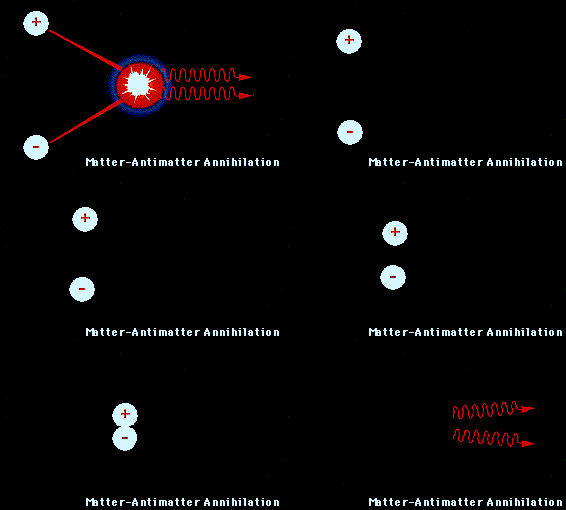
Image credit: NASA's Imagine the Universe, by Goddard Space Flight Center.
Consider these three facts, now:
- If I had an electron/positron annihilate from rest high up in a gravitational field, they would make two photons of a very specific energy at the point where they annihilated, high in that field.
- If I had an electron/positron annihilate from low down in a gravitational field, they would make two photons of that same energy at the point where they annihilated, low down in that field.
- If I had an electron/positron at rest high up in a gravitational field and I released them, letting them fall, they would gain energy, turning that gravitational potential energy into kinetic energy as they fell.
Agreed? So tell me, when that electron/positron pair that I released reaches that lower point in that gravitational field, where they have kinetic energy, and now they find each other and annihilate, what is the energy of the photons that they produce?

Image credit: Ray Shapp / Mike Luciuk, modifications by me.
It's going to be greater than in case two, because you have the rest-mass energy of the electron-positron, plus the gravitational potential energy that must be turned into kinetic energy of the photons, which means we have bluer (higher-frequency, higher-energy) light the deeper we are in the gravitational field!
It also means that if we produce light of a certain energy deep in the gravitational field, it's going to gravitationally redshift -- and lose energy -- as it climbs out of that field!

Image credit: Pearson Prentice Hall, Inc.
If light didn't change its frequency in a gravitational field, it'd be possible to build a perpetual motion machine simply by having electrons/positrons annihilate deep in a gravitational field, building a mirror to reflect those photons upwards and out of the gravitational potential well, re-form them into electrons and positrons again (which you could do if and only if they didn't lose energy as they climbed out of the gravitational field), and then let them fall back to Earth, gaining kinetic energy which you used to turn your turbine/produce power.
And you know what I think of schemes like that.
So the next time someone questions relativity, ask them about the gravitational redshift; there's no wriggling your way out of what science tells us is true about the natural world!
You misunderstand relativity, and thus should not defend it, because it needs to be defended correctly or it shoots you in the foot. The argument that you give holds just as well for gravity that is not general relativistic! Especially, you should never ever write stuff like "slow clock", because it misses the whole point of relativity. It is the clock process that is compared and defines time. You need a synchronization proceedure to compare clock states at different space-time points, which are four (!) different points at least if you want to compare two clocks. There simply are no slow or fast clocks (except for broken ones). The "flow of time", i.e. the rate at which time changes, is always precisely a meaningless dt/dt=1, even at the event horizon of a black hole.
OK, matter becomes more energetic because it is being accelerated by gravity. Light on the other hand, isn't accelerated, its wavelength is decreased without decreasing its velocity. To do that, there has to be something funny going on with time, surely?
Changing the photon into a pair of particles makes it much easier to understand - I've never understood light. Or gravity for that matter. Combine the two and you have what looks to me like black magic.
@Vince: You can take the view that light _is_ accelerated when falling into a gravity well: specifically, it gains ("kinetic") energy (and momentum). This can be quantified when you talk in terms of photons: the momentum is related to the wavelength (technically, it is proportional to the wavenumber or 1/wavelength), and the energy is proportional to frequency. Increasing frequency (blue shift) means increasing energy. The velocity doesn't change because photons are massless, and therefore always travel at 'c' in vacuum.
Now, this description/interpretation brings in quantum mechanics, while the underlying general relativistic mathematics doesn't require that. It makes use of the differing behaviour of clocks as a function of gravitational potential to derive the frequency shift.
One of the cool things about physics is that the facts don't change depending on your interpretation. In this case, both methods will give you the same final result.
haha Ethan that does make sense as much as it could to my non physic trained mind... I wonder if we could ever have a convo without me constantly asking you to explain!!
Loving your info & so glad I found someone that explains so simply & easily...Thanks!
"One of the cool things about physics is that the facts don’t change depending on your interpretation. In this case, both methods will give you the same final result."
I would rather put this as if the facts change depending on your interpretation, then there is a way to tell which interpretation is correct.
E.g. Mercury's perihelion precession.
For Newtonian motion, it is an anomaly and needs explaining. For GR, it is expected.
The facts (perihelion) change from anomaly to concordant, depending on interpretation.
"it’d be possible to build a perpetual motion machine simply by having electrons/positrons annihilate deep in a gravitational field, building a mirror to reflect those photons upwards and out of the gravitational potential well,"
If zero energy loss were managed you'd be able to do it on the earth's gravitational field (or, better, the Moon's).
It's just the power production would be lower for the same investing of "motor".
In the Falling Steel Ball diagram, you say it "gains energy" but it has exactly the same energy at the top and the bottom: 600 J. It is just in a different form.
Sascha
I go to you site sometimes; because you do seem to understand phyiscs well. But I do not go to your site every day or even every month because you get tied up in philosophical/physical knots that may be important to you but to little or nothing to educate me about physics.
I go to ethan's site Starts with a Bang almost every day; because on his site I learn.
Now for my criticism of you Sascha. You are a professional physicist, you know that Ethan's site is a teaching site. And yet every time you come here and post a comment; it seems that you come to criticize Ethan's understanding of some aspect of physics.
I grant you might have a better explanation about some aspect of physics than Ethan. But I will not grant that you Sascha ever give a better explanation of physics than Ethan when you make a comment as a guest on Ethan's site.
What you do Sascha is give Ethan a stick in the eye. A stick in the eye is very seldom useful or necessary criticism. Among civil people( and Ethan demostrates and brings a very high degree of civility to discussion on his site),; among civil people a deeper explanation, a helpful additional insight, a link to an explanation that further clarifies such and such detail of physical importance is the civil response.
Sascha Vongehr be civil; bring more to the table than a stick in the eye!
Michael Kelsey is a professional physicists, he always brings deeper insight and clarification to the table; never a stick in the eye, never even a harsh word. Always his words are civil and focused upon more clearly explaning the science.
Wow is a professional astronomer. He indeed is harsh about pseudoscience and nonsense. But there is a line he does not cross. He mocks but never the stick in the eye.
Look above read Michael Kelsey's explanation. Nice.
Look above at Wow's explanation and professional slightly different opinion and Michael Kelsey and also Ethan. Nice.
Where is your informative professional explanation and insight Sascha? Ethan is a professional. and no professional knows and understands or can explain everything perfectly.
So make your point, add your insight to Ethan's explanation without the stick in the eye.
I must admit, I learned from Ethan's post. Yes his explanation was good, clarified my thinking. And yes your piddling stick in the eye carried a smidgeon of a science idea (though unexplained). so I did some google to better understand the use of special and general relativity in GPS.
Sascha, you are a smart knowledgeable philosophical physicist PhD with a wide range of understanding. So bring some science to the discusion; and leave the stick in the eye for use on your own web site.
Oh look at Sascha's current post on his own site.
SUICIDE ALERT!!!
The most current post on Sascha Vongehr' site alpha meme is
New-Year Resolution: Should I Kill Myself In 2013
http://www.science20.com/alpha_meme/newyear_resolution_should_i_kill_my…
Some of Sascha's comments in response to other commenters in this post of Sascha's is:
Sascha says, "If I commit a rational suicide, all that understand me will be fine with it. In fact, I will make the less people cry the sooner I finish... I will kill myself very slowly so to say in order that we may all enjoy the pain. ;-)... last time I checked, prozac was basically for free in the UK."
So Sascha drop the stick in the eye pointed at others.
And drop the stick in the eye pointed at yourself.
Destructiveness and Self-destructiveness are two sides of the same coin.
You need to talk with someone professionally. Not just a friend; but also a psychiatrist.
Sascha, your philosophy is bullshit if you think it is leading you to suicide.
SUICIDE ALERT!!!
All talk of suicide must be taken seriously!!!
If you know Sascha personally contact him immediately.
Sascha, I will write more to you on your blog.
I have tried to post on Sascha's blog; three times now.
Each time unsuccessfully. I get the message "Service unavailable"
I am concerned about Sascha!
"There simply are no slow or fast clocks (except for broken ones). "
It's patently obvious that the description "fast" and "slow" is with respect to one another, not compared to themselves where indeed there can be no such thing as "fast" or "slow".
I really can't stand this kind of lame attempted pedantry. "Gee, there are two ways in which to interpret this statement -- one which is patently false, and one which is clearly correct. Even though I go through this exercise automatically a thousand times each day, correctly interpreting other people's sentences in the context which makes sense, I will now suddenly do the opposite and call that being smart."
Well, it isn't.
@ Daniel Clements:
You mean like he said literally in the next sentence? He excluded the word "kinetic" before the word "energy" in one sentence. I'll grant that at least this nitpick is technically correct.
The familiar graphical 'illustrations' of gravity are getting a bit long in the tooth, especially in this age of computer-generated 3-D plots. Not only that, they're wildly inaccurate; what's reallly happening is that (roughly speaking), an object in free fall is actually moving normal to the surface you see depicted at the top. Far away from where the Earth dents it, this is nearly perpendicular to the two spatial dimensions, i.e., the objects worldline has almost no spatial component. Closer in, normality to the surface gives you a much more noticeable spatial component, and further, this component always points towards the Earth.
And that is gravity, modulo the +++- signature of space-time, the coupling to stress-energy rather than mass, etc.
Now, why can't someone come up with an easy graphic to illustrate this?
I thought that GR effect on GPS clock is due to it being in a weaker gravitational field than the clock on earth. It's a time effect but opposite the one of SR.
The blue/red shift might be interesting in signal processing. But the clocks have no relation to blueshift.. no?
The blueshift and the clock change are tied together as intimately as frequency and energy of the photon.
The photon isn't being shifted in frequency from its point of view. What's happening is that time is slowing down for it. Therefore what you think is 1 second, it thinks is 2 seconds and therefore puts twice as many beats as it would in 1 second.
So you see a shift to double the frequency.
A shift to blue.
"The photon isn’t being shifted in frequency from its point of view. What’s happening is that time is slowing down for it."
ahhh.. didn't look at it from that perspective. thanx.
Its still inaccurate, but it's close enough to get you thinking correctly.
Like many things, the only solid explanation of the situation is the maths.
It's better than Calvin's Dad's "The trees are sneezing", though.
Well my comment on Sascha's site finally got posted. So his site is still up.
I emailed and left a phone message to the Science 2.0 site where Sascha's blog is. No response yet.
When I hear if Sascha is OK or not: I will let you know.
Either way, I am so pissed at Sascha.
If his post is meant to be serious intellectual philosophy then publish it in a journal; not on a blog where his philosophical bullshit might influence some depressed teenager.
I know depression first hand; Sascha's post is irresponsible.
Many years ago, y shrink said to me, "If you kill yourself; I will kill you."
Sorry for being off topic.
I am not a special or general relativity skeptic. The evidence to me is pretty strong. It'd be nice to have a quantum gravity; but that's not being a skeptic.
But I do have questions that I can't answer with words or mathematics. Maybe someone can help clarify for me.
I read recently, "since (delta lambda) is finite in every ionertial frame pa free electron cannot emit or absorb a photon" This was on pg 85 of Special Relativity for Physicists by G. Stephenson and C.W. Kilmister, 1958
Question 1)
Can somebody explain this to me. I assumed a free electron (i.e. one in an interial frame) could emit and absorb photons and gravitons.
Question 1b)
But if it can't; then I don't understand how it it could emit or absorb gravitons (i.e. the hypothetical graviton). Yes, yes, I understand that gravity is the curvature of space. But there still is a gap in my thinking; if I can't more correctly think of a spin 2 graviton being absorbed or emitted.
Now my second question is more complicated.
1) I assume that every photon in interstellar space is in an inertial reference frame (Is this correct?)
2) But from any particular photon A's point of view; any length measure (on a geodesic parallel to its motion) is zero due to special relativity length contraction
----a) since the photon A from its own inertial reference frame has a velocity of zero
----b) but for photon A's point of view all other phtonic and baryonic matter must be moving at the speed of light c relative to photon A (maybe this isn't exactly correct)
BUT NOW MY QUESTION: So it appears to me that (from photon A's point) of view there is no time measure and there is no length measure. But the photon A must sense gravity somehow. So my question, what is the fundamental thing that a photon A is feeling? I know the easy answer is that photon A sense curvature. But my question is does photon A in some sense sense Energy as in = (m^2c^4 + p^2c^2)^1/2. As in the summation of such energies of various objects other photons or galaxies.
OK those are my questions. I've been searching the internet and textbooks to better understand the idea of a photon in a kind of intergalactic inertial frame of reference. But I can't find anything.
So. I am not looking for any non standard answer to my questions 1 and 2. I am looking for the standard special and general relativistic answer, insight or just clearer way to think upon these two questions.
thanks for any insight. On my question 2 in particular; I have gotten myself to the point of thinking that I understand and then back to square one where I realize I am totaly confused.
Any clarity will be appreciated. Thanks.
There is an implicit distinction in relativistic physics between moving very close to the speed c, (particles in particle accelerators), and moving *at* the speed c (propagating electromagnetic energy).
Moving at speed c is disjoint from moving close to speed c, like the graph of the relation y=1/x is discontinuous for x=0
For any speed that is not c there is an inertial frame co-moving at that speed. For propagating electromagnetic energy there is *no co-moving frame*.
Another example: the wave-character of propagating electromagnetic energy. As we know, there is a periodicity, and with different pathlengths you get phase differences, hence interference effects.
Now, if you assume that 'for a photon time stands still' then the periodicity in electromagnetic waves cannot be a property of the photons. But it must be, how else can you get the interference effects. So that's a self-contradiction. The assumption 'for a photon time stands still' leads to self-contradiction.
The point is that you're sitting near the photon and the reference frame has a different metric than you.
Like I said, it's not accurate, but it gives you the right idea.
Oh, sorry, thought you were improving the explanation I'd given.
Seems like the world isn't solely for my benefit :-)
Cleon
Thanks and yes.
But here is my conceptual problem.
Thus is photon A (from its own point of view) in an inertial frame or not in an inertial frame?
I'm not trying to be argumentative; I'm trying to understand.
So I reason that photon A must be in an inertial frame from photon A's point of view; or else it is not in an inertial frame. But if it is not in an inertial frame then it is experiencing some kind of inherent acceleration (i.e. some kind of persistent redshift or blueshift). So this is a problem.
Now I assume that my thinking is wrong. Because among other things, I can't make it clear to myself.
So any help in, helping me to understand more clearly will be appreciate.
But yes, yes, I have reread what you have said and you make sense.
So I must still be misunderstanding something. You see an electron or a galaxy or any object has wave properties; but we do talk about an inertial system of Einstein or an electron or a photon in a falling elevator.
So though yes I see the periodicity problem that you bring up; it doesn't seem to be a problem for an electron.
I can accept that my question is entirely non sequitur, impossible, contradictory, whatever; I'd just like to understand a bit more why?
From a technical point of view, Cleon has nailed it: one cannot "ride" the photon in relativity. There is a reason it is called a null vector in relativity: from its point of view, photons traverse an arbitrarily large distance instantaneously, as lengths all contract down to zero and time dilates infinitely.
So no, OKThen, you cannot create an inertial frame for a photon due to the fact that it -- being light -- moves at the speed of light.
But I get the analogy that Wow is trying to make and the conclusion is this: rather than speed, the property of the photon that changes is its wavelength as you change the curvature of the spacetime it passes through. Something (sorry, Sascha) that newtonian physics makes no prediction for.
I don't quite understand this exercise because it seems sort of tautological to me. Not that it's not correct — it's self-consistent and empirically correct.
But the implication, if I understand this correctly as a pedantic rhetorical exercise, is that you can start from a Newtonian perspective and this thought experiment will strongly imply GR. But it won't, because the particle physics portion has relativity implicitly already built into it — this isn't made clear.
On the other hand, this is a valuable exercise for anyone who already has some understanding because it elegantly demonstrates a simple, expected relativistic result. But that's not how this is presented — it's presented as a means of convincing relativity skeptics. But they won't understand the particle physics or, if they do, they'll have some crankish alternative view.
When I read the GPS bit, I also had a bit of trouble because of the weird formulation. I would have said something like, "GPS is designed to include relativity and so, if relativity weren't true, GPS would accumulate huge errors every day."
I think that GPS is very handy as a means of demonstrating to the general public that relativity has been proven correct in a way that they encounter on a daily basis — they hear about all the counter-intuitive relativistic weirdness and they think that maybe it's just scientists bullshitting and it's all theory irrelevant to anything real. GPS counters this.
But only mildly.
Because the relatively very uninformed/uneducated public will, nevertheless, simply find relativity absurd. They believe in absolute time and space, full stop. You're not going to change their minds until you accelerate one of them personally to a significant fraction of c and have them experience time dilation.
And the cranks? You'll never convince them, either. I spent a number or years reading sci.relativity. I have an interest in cranks. The people that actually work hard at refuting relativity or, say, Cantor's Diagonal Method, will just keep on keeping on. Their whole process is to continually refine entirely alternate self-consistent worldviews — they can't be defeated, just ignored. They cause some damage, I suppose. But that's really quite insignificant compared to the much more pervasive willful ignorance about huge swaths of basic science that allows a huge number of people to think that any scientifically established idea that they find absurd is, really and truly, most likely absurd.
Honestly, I think that with regard to SR, at least, Michelson–Morley is well within the range of popular, lay comprehension. We're working against commonsensical intuition, here; and Michelson–Morley proves that this particular intuition is simply wrong. That's the enabling first step.
Most contemporary scientists and educators are opposed to much, or any, historical contextual pedagogy in science. But I think this is a mistake because very often (though not always, of course) the historical progression is one of moving away from common intuition to things that seem, in comparison, to be weird and difficult — it can be very helpful to move students over that hump in the same ways that past scientists did because often (though not always) the historical progression matches the most natural progression of dawning comprehension in individual people. Conversely, as I think this post slightly demonstrates, ahistorical presentations from those who are very aware and versed in the contemporary comprehension tend to unwittingly be a bit tautological and/or misidentify what the uneducated need to understand in order to have that moment of epiphany.
Yes, yes Ethan.
And it does seem that there is no such thing as an inertial frame for a photon. Though I don't really understand why.
Also, I don't know what you mean by "null vector of photon"; I can't seem to google anything that I can understand on it.
"And it does seem that there is no such thing as an inertial frame for a photon. Though I don’t really understand why."
That's implicit from a whole bunch of different perspectives. Start with the fact that the photon has no mass. And the invariance of c. When thinking about "inertial frames" you're already in a context that invalidates the idea of a photon having an inertial frame.
I'm having trouble following your arguments because they seem very odd to me — knowledgeable in some sense, very uninformed in others. It's strange and perhaps I'm the one who is underinformed or I'm just misreading you.
There was never a proper debate as to whether Einstein's relativity genuinely replaced Newtonian physics. The effect you refer to is usually deemed a test of the equivalence principle and that is implicit in Newtonian physics anyway, so no comparison in the test. Newtonian physics is itself “a” relativity theory because incorporates Galilean relativity. So to call many skeptics of Einstein's relativity as “relativity skeptics” is a misrepresentation because they can accept “a” relativity theory it is just may not be Einstein's relativity they accept. As far as the starlight bending circa 1919 it means under Newtonian physics that light would have mass, and if it bends more than expected then mere extra effect to be added; nothing prevents it to be still worked upon from the Newtonian physics way of dealing with things by forces in Euclidean space, gravity operating through mass by inverse square law etc., anything extra as I said just add as an extra effect. What Einstein has is a long series of changes, he starts from special relativity, changes for light he decides it must have zero rest mass, so when he gets light bending under gravity he can't then give Newton's answer that it would mean it had mass, so changes gravity to being space-time curvature. As far as the maths is concerned whatever gets interpreted in Einstein's way can just be interpreted back to how Newtonian physics would interpret it. The starting point of Einstein seems to be assume that light speed (in vacuum) free of influences (such as gravity) is a constant, from that it compels him to make the changes as to how Newtonian physics deals with things. But treating it all as mere convention as per Poincare who worked on relativity theory before Einstein, then its just a maths trick. A maths trick added to Newtonian physics is no real change in Newtonian physics. Set clocks by Einstein synchronization process is just meaning - are hiding what would otherwise being variable lightspeed as time dilation and related effects. So all it all its just: manipulating the maths and referring to the maths terms in a different way. What Newtonians would refer to as forces in Euclidean space just gets changed to the Einsteinian language of spacetime curvature.
" a null vector is a non zero vector that is orthogonal to itself"
Hmm, a spacelike vector is positive, a timelike vector is negative, but a null vector seems to be neither but not zero. "It is particularly important to understand that a null vector is not a zero vector"
"If the 'length squared' of a vector computed with this pseudo-metric is positive, the vector is called space-like; if negative the vector is called time-like; if zero, the vector is called null or light-like."
"Two nonzero vectors __ and ___ are said to be orthogonal if their inner product __ is zero. Null vectors are thus self orthogonal."
OK searching google books online finds stuff for null vectors and relativity.
OK, I'm beginning to understand; and I need some persistent studying.
I'm thinking maybe A First Course in General Relativity, 2nd edition. by Bernard F Schutz.
Robert M. Wald's General Relativity
and Weinberg's Gravitation and Cosmology
I've tried, they are too difficult, at least to start with.
Any other suggestions besides Schultz?
thanks.
@Ethan: Not so fast. You argue via energy (not geometry), and the relation between energy and wavelength is QM, so you could do the same for non-relativistic gravity. That special relativity kind of includes a lot of QM already is an important point that I also try to put across (with no support yet from you), however, that argument is not the one you are trying to make here.
@OKThen: You are the only one here who needs a shrink. If my stuff is beyond many punters reading comprehension, so be it, but I will address issues straight and not treat my readers like little children. Suicide rates are skyrocketing because those contemplating it are talked to like little children. I take them seriously and will not bow to the idiocy of dismissing their perspective as irrational, not given a background of exploiting, warfaring, mass imprisoning society telling us to stay alive in order to procreate it.
@CB: Look at the comments and realize that no, people do not all get that there are no slow clocks. And no, they are not slow relative to each other, not as long s a proper comparison proceedure is not given (see twin paradox! - it is not certain which clock is slower). Time has no further time to allow it to do anything, so it does not flow at all, not fast, not slow.
"and the relation between energy and wavelength is QM,"
No, the relation between energy and wavelength is Classical.
Maxwell.
Sascha
I'm glad you haven't suicided.
I will comment on your irresponsible, dillusional, self indulgent, dangerous and irrational thinking on your blog.
Don't waste our time HERE with your "intellectual" blather.
At least for the velocity dependent time dilation, this was observed 60 years ago after the invention of the synchrotron when fast muons were seen to have longer lifetimes then slow muons.
@SLC:
But that's an SR-effect, isn't it?
Here we're talking about a GR-effect: the change of photon's energy induced by acceleration (or the easy-to-handle mathematical equivalent of bending spacetime, as you may prefer) due to objects with rest mass.
Question for the professionals on here (and a bit OT):
OKThen made reference to electrons emitting gravitons. If they did, would that not violate conservation of angular momentum? Electrons are spin 1/2 particles, and can only exist in a spin +1/2 or -1/2 state. Therefore, during an interaction, the maximum change in spin angular momentum an electron can undergo is 1. A gravition is a spin 2 particle. Therefore, an electron emitting a graviton would result in an overall increase in angular momentum.
Ordinary matter is made up of conglomerations of spin 1/2 particles. The same argument applies to neutrons and protons as well. By this argument, no ordinary matter could emit gravitons.
Obviously, I'm missing something here. I am sure that professional physicists have considered this and that there's an answer. Could someone please fill me in? Thanks.
muon experiment does not show time dilation independent of a belief in the maths manipulated to suit SR. Given SR maths then speeds are relativistic speeds and to account for muons existing further that they are expected to get as per that belief, then time dilation is introduced to try to account for it. Going by Newtonian physics the muons have gone faster than expected without the relativistic speed addition restriction. Its just all playing in the maths manipulation.
@SeanT:
Spin 2 is just a symmetry-description needed to fulfill the postulate that even contrarily charged particles always gravitationally attract.
Spin is not an angular momentum of the kind to be conserved: [Wiki:
However, in quantum physics, there is another type of angular momentum, called spin angular momentum, represented by the spin operator S. Almost all elementary particles have spin. Spin is often depicted as a particle literally spinning around an axis, but this is a misleading and inaccurate picture: Spin is an intrinsic property of a particle, fundamentally different from orbital angular momentum.]
Schwar_A,
I understand that in QM "spin" is not a literal spin. However, I thought that QM spin did have an associated angular momentum, and that this is subject to conservation.
For instance, an electron bound in an atom can make transitions from higher energy states to lower energy ones thereby emitting a photon. The change in orbital quantum number, l, must be + or -1 for this transition to occur. I was always taught in my p. chem class that this was because of angular momentum conservation, namely the fact that the photon is a spin 1 particle, so the electron's angular momentum must change accordingly. Is this only the case for a bound state, and not applicable generally? Is that what I'm missing?
AFAIK, angular momentum is NOT one of the conservation laws that has ever been observed to be broken, so I am assuming that it must still be conserved for interactions involving gravitons. Even if spin angular momentum and orbital angular momentum are separately conserved, the original question still stands: how can ordinary matter emit a graviton since normal fermions can only change their spin angular momentum by +/-1 whereas the gravition has a spin angular momentum of 2?
I think it's really cool that photons don't experience time (so to speak). So there it is boiling off some whatnot in the Hubble Deep Field, and wham there it is in my eye. I am in direct contact with the most distant stars, as if it had reached out and touched me!
... but timeless photons make the concept of "frequency" a little problematic. Oh well, none of this stuff means what it looks like it means.
.... the most frequently challenged scientific idea?? Sorry, that would be Darwinian Evolution.
Schwar_A,
I read you link a bit more closely, and it seems that my example above is the real answer to my question. Total angular momentum is conserved, but spin and orbital angular momenta are not separately conserved. So I guess, the short answer to my original question is that the electron can emit a gravition only if it experiences as corresponding decrease in its orbital angular momentum. Thanks for the help.
the comment: I think it’s really cool that photons don’t experience time (so to speak).
which is nonsense, because given the thought experiment setup of a beam of light being observed at c from an inrtial frame "A " then by the Principle of relativity there should be an inertial frame "B" for which the light is stationary and observes instead "A" travelling at speed c. It could not observe a speed if time had ceased.
Ethan, is it possible to post images here? I thought about it for a bit, then decided I might as well do a graphic of my own. Here's my own first-drafty attempt. The green lines are lines of simultaneity and the blue lines are normal to them at every point. To a first approximation, objects in free fall move along these normal lines and this is what is commonly known as 'gravity'.
" Spin is often depicted as a particle literally spinning around an axis, but this is a misleading and inaccurate picture:"
Indeed for an electron to spin with the momentum we give it and the size we KNOW it has, it would require that the edge of the electron be moving faster than light.
Therefore it cant be macroscopic spin.
Re SCHWAR_A
Read carefully, I specifically said velocity dependent time dilation which = special relativity.
Re Wow
Electrons, Protons, and Neutrons have intrinsic angular momentum = 1/2 in natural units. Photons have intrinsic angular momentum = 1 and gravitons have intrinsic angular momentum = 2 in natural units. The concept of a physical object spinning makes no sense in QM as "particles" are represented by fields.
Re anti-Einstein
Mr. anti, your comment is totally nonsensical. The reason why a synchrotron is needed is because of the mass of the muons is a function of velocity. If Newtonian physics held, the mass would be independent of the velocity and there would be no need of a synchrotron, which amounts to a delay in applying the electric field that accelerates the muons. The time delays required are exactly as predicted by special relativity.
By the way, if special relativity is wrong, then please explain how quantum electrodynamics is able to predict the anomalous magnetic moment of the electron to an agreement with experimental observations to 10 significant digits.
@ Wow: Yes, the relation could have been curvature (geometry) and the Maxwell field if Ethan would have argued that, which is what I explicitly wrote (read my comment again)! What he writes is basically that energy is preserved in a certain theory. However, it would be also preserved in a gravity theory that has a different red shift, and the bringing in of the creation of particles serves here onlu to confuse via their quantized energy requirements! You cannot argue red shift via energy conservation between two different, equally self-consistent theories.
"However, it would be also preserved in a gravity theory that has a different red shift"
What does that mean?
The Earth has a different redshift to an incoming photon than the Sun does.
But that's pretty empty of any new meaning.
So what new meaning are you trying to introduce with your "different red shift"?
And if you knew that your statement
“and the relation between energy and wavelength is QM,”
was incorrect, why the hell did you say it?
"Electrons, Protons, and Neutrons have intrinsic angular momentum = 1/2 in natural units."
They aren't. however, real spin angular momentum. To do so, the edge of the electron would be going faster than light.
Coment: By the way, if special relativity is wrong, then please explain how quantum electrodynamics is able to predict the anomalous magnetic moment of the electron to an agreement with experimental observations to 10 significant digits.
Calling SR wrong can be problematic, in a sense it is. What I actually referred to was the maths trick of convention – Set clocks by Einstein synchronization process is just meaning – are hiding what would otherwise being variable lightspeed as time dilation and related effects. So all it all its just: manipulating the maths and referring to the maths terms in a different way. What Newtonians would refer to as forces in Euclidean space just gets changed to the Einsteinian language of spacetime curvature. – So the answer is the maths has been bodged.
comment: They aren’t. however, real spin angular momentum. To do so, the edge of the electron would be going faster than light.
hence why SR is just bodged maths, when it fits things its because its bodged, abd when things don't fit then it has to be bodged some more.
Given two inertial frames "A" and "B" if A observes B at non-zero speed v then we would expect by Newtonian physics that B observes from its frame that A has speed v.
But when v =c we descend into madness of SR and as per earlier comment of someone saying time stops
Einstein built on nonsensical thought experiments and then the maths had to be bodged to fit them, and then real experiments have to be bodged to fit that bodged maths.
"hence why SR is just bodged maths"
Nope, it's because there is energy in spinning momentum and terms were used that were ANALOGUES of what was considered to be happening at the time the terms were coined.
I'm afraid the only bodging being done here is by you.
Re anti-Einstein
Excuse me, what experiments were "bodged"? The Michelson/Morley experiment was performed in 1889, when Einstein was 10 years old. The result was totally incompatible with Newtonian mechanics and Galilean relativity. The difference in measurements of the earths velocity taken 6 months apart is 37 miles/second. If Galilean relativity was correct, the difference in the observed speed of light of 37 miles/second was eminently observable by Michelson's equipment which was capable of measuring a difference in light speed of 4 miles/second. Michelson got a null result, within experimental error. Thus, the results of the experiment didn't agree with the theory. Einstein's 1905 papers, which posited that the speed of light was independent of the speed of the observer agreed with the result of the Michelson experiment. That's all one can expect from a theoretical prediction, agreement with experiment. There is nothing "bodged" in the calculation, it falls out naturally from the speed invariance assumption of light (e.g. Lorentz invariance).
Furthermore, another fact which Prof. Siegal didn't mention was the discrepancy in the precession rate of the elliptical orbit of the planet Mercury. When the effects of the interplanetary effects on the motion of Mercury were calculated, using perturbation theory and the Hamiltonian formulation of classical mechanics, the result differed from observations by 43 seconds of arc/century. these calculations and observations were done before Einstein was born. This was a mystery until General Relativity was proposed in 1915, calculations from which explained the discrepancy. The notion that the observations were "bodged", whatever the hell that means or that the calculations were "bodged" is preposterous. There are no adjustable parameters in the calculation, which is the only way they could be fiddled to fit the data.
By the way, General Relativity also predicts the existence of black holes, which have been unambiguously observed. The notion of black holes makes no sense in Newtonian Mechanics.
“hence why SR is just bodged maths”
Wow: Nope, it’s because there is energy in spinning momentum
Read the comment properly it was referring to the speed of light bit being bodged
SLC: Excuse me, what experiments were “bodged”?
The maths of SR is bodged and the experiments then bodged to fit with that maths.
SLC: The Michelson/Morley experiment was performed in 1889, when Einstein was 10 years old. The result was totally incompatible with Newtonian mechanics and Galilean relativity.
Thats just a typical false claim. The experiment is consistent with the classical principle of relativity as per Newtonian physics. When we look at the maths of SR it is just based on the bodge of lightspeed constancy, which leads to a long series of bodges involving time dilation etc. If we don't do that then we can still deal with it by the maths of Newtonian physics.
SLC: the discrepancy in the precession rate of the elliptical orbit of the planet Mercury.
Can be dealt with in the context of maths of Newtonian physics, as I have earlier stated is context of forces in Euclidean space with extra effects added when required (I.e the adjustment parameters you talk about).
SLC: By the way, General Relativity also predicts the existence of black holes
The concept that became called blackholes were dealt with in context of Newtonian physics long before, Mitchell considered what would be the effect of light trying to escape from a very massive star.
Re anti
Mr. anti is totally irrational. How could the experiments be "bodged" to agree with special relativity when they were performed 16 years before Einstein published his papers on special relativity in 1905.
Mr. anti is ignorant, as well as irrational. There are no parameters to be adjusted in the calculation of the discrepancy in the precession rate of the orbit of the planet Mercury. All the constants are computed independently (e.g. the universal gravitational constant, the mass of the sun, the masses of the other planets, etc.). The result is that there is a 43 seconds of arc which Newtonian mechanics cannot account for in the observed precession rate of the orbit of the planet Mercury. This problem was was known for at least 50 years before Einstein's 1915 paper and was not solved until Schwartzchild's 1920 paper which utilized General Relativity.
Furthermore, Newtonian mechanics cannot predict the existence of a black hole because the velocity of light, c, is not a constant. Thus, the Schwartzchild radius is meaningless because it relies on the value of c being constant.
I must say that I find Mr. anti to be remarkably ignorant for a grown man.
Re anti-Einstein
By the way, there is nothing in General Relativity that requires that a star must be massive to collapse into a black hole. If the Sun, which is not a massive star, were to collapse inside its event horizon (radius ~ 4 miles), it would become a black hole. In fact, there is nothing in General Relativity preventing a golf ball from becoming a black hole if it were to collapse inside its event horizon.
SLC: How could the experiments be “bodged” to agree with special relativity when they were performed 16 years before Einstein published his papers on special relativity in 1905.
Its being bodged to fit with the maths that came in 1905.
SLC: There are no parameters to be adjusted in the calculation of the discrepancy in the precession rate of the orbit of the planet Mercury.
That is false. Oblateness of the sun is one factor that can be introduced to a calculation based on idealisation of perfect symmetric sun.
SLC Furthermore, Newtonian mechanics cannot predict the existence of a black hole because the velocity of light, c, is not a constant.
Mitchell dealt with black holes in context of Newtonian physics. And as pointed out constancy lightspeed bit is a bodge in the maths.
SLC:I must say that I find Mr. anti to be remarkably ignorant for a grown man.
You make it a mistake it is you that is ignorant. Sinec you are unable to cope with the facts you are reduced to acting rude and stupid.
SLC: How could the experiments be “bodged” to agree with special relativity when they were performed 16 years before Einstein published his papers on special relativity in 1905.
Its being bodged to fit with the maths that came in 1905.
add: because when we look at the maths we find that for the experiment where we had light going at c+v in one direction and c-v in the other direction etc with c and v non-zero, in the maths pre-1905, we find that from 1905 that is bodged to being c with what would be variable lightspeed then made an effect on time; a bodge in the maths 1905 which an experiment pre1905 is made to fit
"Read the comment properly it was referring to the speed of light bit being bodged"
Oh, I get it, you're bollocking just like chelle did about how the meter is defined as something to do with the speed of light, right?
Anti-science bullshit and completely uninteresting.
wow: Anti-science bullshit and completely uninteresting.
which sums up your position.
Lets assume gravitons being permanently emitted equally into all directions by an object with positive rest mass to cause this object's gravity field.
To keep the object's original energy the emitted energy of all gravitons has to completely return. If it does not, the object should start moving towards the less returning energy direction.
This is my speculation - but how is the graviton's energy flow and balance actually handled theoretically?
They are not really emitted like light emitted from an incandescent source.
They are virtual and only when something is nearby and exchanges a similar *on with the other object that the *on has an effect.
So the electric field (Photon) swaps with another electrically charged particle (another Photon) and that swap causes the force of attraction or repulsion.
That is the time when the emitted energy "has to return".
anti try something a little more grown up than "I know you are, but what am I?", hmm?
wow: anti try something a little more grown up than
that would be beyond your ability to comprehend, so I have to talk down to you
Re anti
The value of c was measured by Michelson some 10 years before the Michelson/Morley experiments were performed, using a light source that was at rest relative to the interferometer. He won a Nobel Prize for the measurement. In Newtonian terms the apparent result of the M/M experiment was that v = 0, i.e. the earth is at rest. Since this is nonsensical, the only other possible explanation was that c was a constant, independent of the speed of the observer.
As for the oblateness of the sun, the interior would have to be spinning at least 100 times as fast as the atmosphere to generate a quadrupole moment sufficient to explain away the 43 seconds of arc. Calculations by Dicke showed that a rotation speed of 10 times that of the atmosphere yielded a quadrupole moment only sufficient to account for some 3.5 seconds of the 43 seconds observed.
Re wow
I'm beginning to think that Mr. anti is a Poe. Nobody could be that stupid.
SLC: The value of c was measured by Michelson some 10 years before the Michelson/Morley experiments were performed, using a light source that was at rest relative to the interferometer.
I have no problem with that, and it shows the principle of relativity, and that is consistent with Newtonian physics. Adding the constancy of lightspeed is just an unacceptable bodge.
SLC: As for the oblateness of the sun, the interior would have to be spinning at least 100 times as fast as the atmosphere to generate a quadrupole moment sufficient to explain away the 43 seconds of arc.
You wanted an example of one of the “other” factors involved, and I gave it. Of course more can be taken into consideration. GR gives 43 secs arc take away 3.5 for oblateness and its not such a good match. Add more factors and it becomes less so.
So you and your buddy wow stop acting like idiots and pay attention to what is being said, rather than make stuff up.
SLC: The value of c was measured by Michelson some 10 years before the Michelson/Morley experiments were performed, using a light source that was at rest relative to the interferometer.
I have no problem with that, and it shows the principle of relativity, and that is consistent with Newtonian physics. Adding the constancy of lightspeed is just an unacceptable bodge.
Add on because its like what your buddy wow said
wow : bollocking just like chelle did about how the meter is defined as something to do with the speed of light, right
I.e bodging or bollocking (as wow calls it) the maths as used by the Michelson-Morley experiment.
Anti Einstein
Yes you are anti-science.
You neither understand nor want to understand science and scientific evidence.
Trying to reason with you Anti Einstein (i.e. anti science) is a waste of every one's time; because of the breath and depth of inconsistency, incomprehesion and intellectual dishonesty in your anti-science (i.e. anti Einstein's) position.
So Anti Einstein please go to Ethan's comment policy web page
http://scienceblogs.com/startswithabang/2012/09/23/weekend-diversion-yo…
Read it carefully and understand it.
Because if you continue with your nonsense; you will be asked to confine your nonsense to that web page alone.
Relativity-deniers are deep cranks. I compared them to anti-Cantor cranks for good reason. Their commonsense intuition is deeply insulted — they *know* these things are wrong. Like all such, they will be impervious to evidence or reason. There is no benefit to engaging with them
Ellis: Relativity-deniers are deep cranks. I compared them to anti-Cantor cranks for good reason. Their commonsense intuition is deeply insulted — they *know* these things are wrong. Like all such, they will be impervious to evidence or reason. There is no benefit to engaging with them
calling someone with good intuition a crank is just being insulting, and good intuition means having a good understanding of logic, and no evidence disproves logic.
OKThen: Read it carefully and understand it.
You should try re-reading it because its you being insulting.
Keith, are you surprised that your prediction would turn out to be proven so quickly?
@Wow:
Thank you.
"someting is nearby" seems to me very relative due to the huge reach of gravitation.
One Photon would accelerate exactly once - to have a permanent acceleration you need a "stream" of photons.
Something very similar seems to exist related to gravity.
Graviton as a kind of instantaneously swapped virtual particle seems to contradict speed of gravity c...
"“someting is nearby” seems to me very relative due to the huge reach of gravitation."
Being massless, the energy of the graviton exchanged that is "allowed" to exist long enough to do that is very small. But it can be arbitrarily small. And so the force falls off with distance to infinity.
This is how we figure EM and gravity to be carried by massless particles. If they had mass, there would be a maximum range because the field would have to borrow at least the rest mass energy of the exchange particle.
Light speed is not Constant (to observer) !!
All that we receive with our eyes are the facts of the past (unchangeable). Wavelength of incident light is coming from the past. On incident light, a formula c = λ f stands up. And λ is unchangeable (by our motion). Terms f and c change.
Sorry, I can't receive E-mail. I don't have PC.
http://www.geocities.co.jp/Technopolis/2561/eng.html
Yes it is!
our eyes can't see infra-red, but we still know the speed of that! And the fact of the past is that the speed of light is constant!
No, only f changes, c is a constant!
Meh, while I'm here, in case you're still around:
Nothing is being instantaneously swapped. The virtual particle only exists once it has swapped with the other object another virtual particle. This is why there's no need to have as you put it:
it doesn't exist unless it gets involved in an exchange, and then its existence causes the change in momentum required to create the view of a force acting between the two participants.
This is for the model that has particle exchange as the mediator of force.
Quantum fields are another model and have a different explanation within that model.
No, only f changes, c is a constant!
Then, on incident light, c = λ f doesn't stand up ? I show a one more picture below.
In outer space, from the right and the left, plane waves of star lights are coming vertically. λ of coming light cannot be varied by observer's motin. f and c vary.
No, c is a constant. Wavelength changes because frequency changes but not velocity.
Then, how about λ , when there is no observer ?
It's my last post.
Even when there's no observer, wavelength changes and frequency changes and c remains constant.
Also nothing was in your last post. It was meaningless. You didn't give an illustration and then just flat out claimed that wavelength could not change, why not explained, then frequency changes, why again not explained, and therefore c changed, except without explaining why frequency changed but not wavelength, you are running the very definition of "begging the question".
In outer space, a mirror is reflecting a star ray. On incident ray and reflected ray each, a formula c =λf will stand up (seen from the mirror). In this two formulae, term f is the same always. So, when λ is not the same (usually, it's not the same), c must not be the same.
Nope, f can be different.
c=λf
If f changes and λ, then c can be the same.
Since f does change when λ changes, this is just fine.
We'll assume that a frequency f (of two rays) is measured at the point one meter away from the mirror. Where will the remainder of the different value go?
If we assume that the frequency of the two rays is measured one meter away from the mirror,there is no remainder of the different value.
They're two different photons. There is no "remainder" to find.
Why did you not ask yourself "If the speed of light is measured at one meter from the mirror, where will the remainder of the different value go?"?
It's just as valid a question. Yet not one you asked.Ever. Even of yourself.
Allow me to write once again, please (it is my last post).
If f (frequency) of two rays (at two points) is different, number of waves that exists within 1 meter will increase or decrease endlessly. Plainly, it is impossible.
Plainly it is not. You can do an actual experiment to show it's possible.
What IS shown impossible is light going slower than the speed of light in that medium.
Even you know it's possible.
If wavelength changes, then number of waves that exists within 1 meter will increase or decrease endlessly.
Einstein's accelerating chest thought experiment is flawed.
Its foundational to General Relativity.
One chest at rest in Earth's gravity field. One chest pulled by a genie in a region of the Universe where there is no gravity. Both have an acceleration equal to the gravitational pull of Earth. Never mind the fact that this place is imagined and this experiment cannot be and has not been done. This invalidates the free fall part. The free fall part is also invalid because falling is accelerated and not a state of a constant velocity, so he has to make the accelerated state a constant one with sleight of hand.
In any case the chest at rest relative to the Earth's surface is not the same as the chest being pulled by a genie in an imagined zero g environment.
Here's why: gravity on Earth is at 9.8 m/s2
An object dropped will start falling with zero velocity and will see that velocity increase as it falls. Each and every object dropped from a height X would take the same amount of time to hit the floor below.
In the imagined Zero G environment, the genies pulls the chest with a constant acceleration that mimics gravity. 9.8 m/s2
Each object dropped from the same height X will not fall at the same rate. Each subsequent object will fall as if the force of gravity were increasing. IE the acceleration means specifically that the ship is moving progressively faster with each instant of time.
For example:
9 balls dropped in succession by someone standing in the chest on Earth means each ball falls at 32 feet per second, each one taking say half a second to drop about 4 feet.
Each ball takes the same amount of time to hit the floor.
9 balls dropped in succession by someone standing in the chest being pulled by a genie in a zero-g environment at an accelerated rate means each ball falls faster than the one dropped prior.
It starts at say 32 feet per second and then increases exponentially. Each subsequent ball falls to the floor with greater velocity, covering that distance in less and less time. Unlike the experiment done on Earth. On Earth the rate of drop 'resets' with each ball.
Equivalence is wrong
"Einstein’s accelerating chest thought experiment is flawed."
No it isn't.
"Its foundational to General Relativity."
Not that either.
"9 balls dropped in succession by someone standing in the chest being pulled by a genie in a zero-g environment at an accelerated rate means each ball falls faster than the one dropped prior."
No it doesn't. It starts off at zero and is left behind by the hand accelerating away at the rate of 9.81m/s^2.
Whereas the earth gravity one, the ball starts off at zero and is drawn away from the hand accelerating away at the rate of 9.81m/s^2
Each of the nine do that. Not one changes. Both scenarios stay the same.
You are wrong.
Lightspeed is not Constant (to observer) !!
Imagine spherical waves of light (or light sphere) that are sent from two sources in relative motion. Except the emission theory, what explanation is possible ?
Sorry, I can’t receive E-mail. I don’t have PC.
http://www.geocities.co.jp/Technopolis/2561/eng.html
Interesting concept of a realativistic-redshift.
Would no the best "proof" for this be made for the frequency of sunlight vs. other sized stars vs. man-made fusion.
Surely quantum mechanics can calculate the theoretical wavelength of fusion reaction.
"Lightspeed is not Constant (to observer) !!"
No, the speed of light IS a constant (to the observer)!!!!
FOUR exclamation marks, therefore I'm twice as right!!
"Imagine spherical waves of light (or light sphere) that are sent from two sources in relative motion. "
I did.
What's the problem?
Lightspeed is not Constant (to observer) !!
To a swinging stick, speed of light varies. Like sound waves, water waves. Follows Galilean transformation.
Sorry, I can’t receive E-mail. I don’t have PC.
Lightspeed IS constant to observer!
Sorry, I can't explain your stupidity, it won't listen, because you don't have a brain.
nakayama,
Perhaps you've never been exposed to the theory of special relativity. Let me try an explanation. The special theory of relativity is really nothing more than the statement that the laws of physics are the same for any observer in an inertial reference frame (that is, for all observers whose motion is not accelerated). It was well understood prior to Einstein that the laws of mechanics were the same for all observers in an inertial reference frame, but Einstein extended this to include the laws of electromagnetism that had been discovered by Maxwell near the end of the 19th century.
Maxwell's laws unified the previously separate fields of electricity and magnetism. One of the key findings of Maxwell was that electric and magnetic fields could oscillate and by doing so produce a travelling wave. His equations worked out that the speed of this wave was independent of anything other than two constants that were previously known from electrical and magnetic measurements. That is, the speed of these waves was a constant value. From previous measurements of light, it was known that the speed predicted for Maxwell's waves was precisely the speed at which light travelled, and thus we came to understand that light was an example of these waves.
Now, Einstein's postulate was that the laws of physics, including Maxwell's laws, were the same for all inertial observers. That would then include the notion that light has the same velocity for all unaccelerated observers. Based on common sense, this seems preposterous. If you are holding a flashlight, and I am moving away from you at 90% of the speed of light, how can I measure the same light speed from your flashlight as you do? Well, Einstein's genius was that he didn't let this bother him; he just worked out what the consequences would be assuming that his postulate was true. It turns out that in my example above, my measurement of time and space would differ from yours. If you were wearing a watch in my example, I would observe that your watch ran slower than what you said it did. I would also measure distances to be smaller than you would. Because of these differences in distance and time measurements, my measured value for the speed of light from your flashlight would match up perfectly with yours.
Of course, this doesn't do much toward having it all make sense. Common sense, however, is a poor guide. What we need to do is some experimental work to see if time dilation (as the change in time measurement is known) and/or length contraction is a real phenomenon. Well, experimentally we find that time dilation is real. We can observe, for instance, unstable particles in cosmic rays that should not have survived to reach the surface of the earth because they decay too rapidly to survive. These particles are very energetic, however, which means they move close to light speed. The time that we measure for them to reach the surface of the earth is longer than the time that an observer moving with the particle would measure. Therefore, the particles survive. If that's not convincing, we've actually used an atomic clock being flown around the earth on an airplane to confirm time dilation. No experimental result has ever been found that contradicts relativity. Therefore, we conclude that light really does have a constant velocity for inertial observers.