

"In any field, find the strangest thing and then explore it." -John Archibald Wheeler
Sometimes, things get difficult. Sometimes, there are challenges you have to face that you never even expected, much less were prepared for. And sometimes, it seems like there's no point in even holding on to hope that things will get better. But as long, as The National would tell you, as you're no
you've still got something worth striving for. Even if there's something newer, shinier, and more powerful than you.

Image credit: NASA / Hubble Space Telescope.
Even on Mars.
Nine years (and three days) ago, on January 24, 2004, Mars Opportunity began its mission on the surface of the red planet.

Image credit: NASA / JPL-Caltech.
Despite plenty of advance testing here on Earth and countless simulations anticipating what Opportunity would face, no one quite knew exactly how the rover would perform once it arrived on the Martian surface. And at a typical distance of over 20 light-minutes from its controllers, it needed to be able to make its own driving decisions and maneuvers.
And designed for a 90-day mission and 2.5 million turns of its wheels, powered by its on-board solar panels, only time would tell exactly what Opportunity would actually wind up doing.
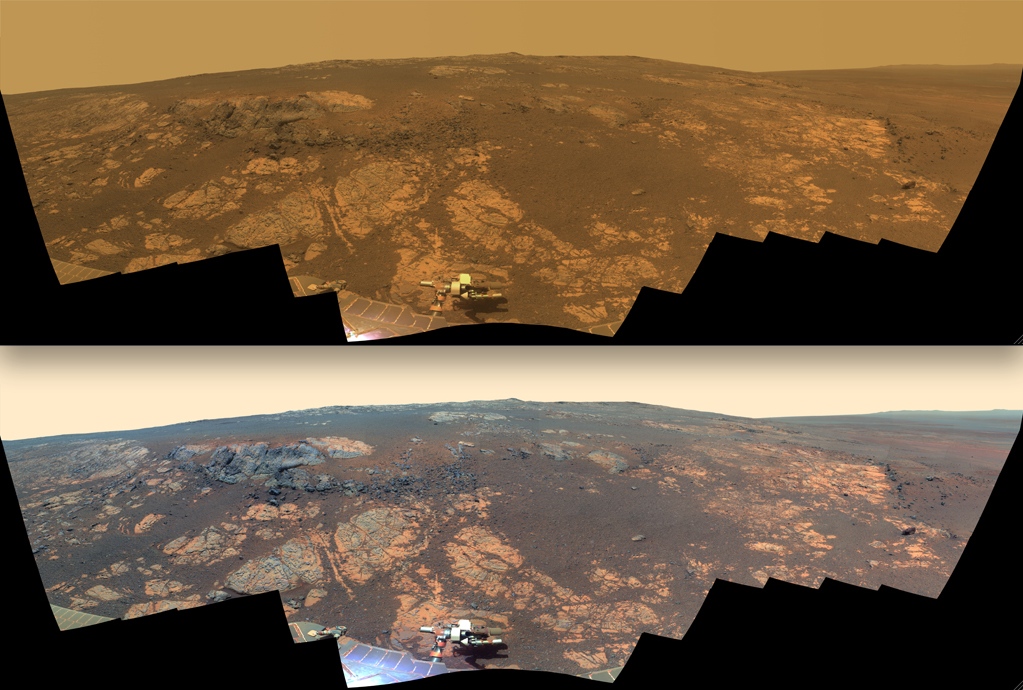
Images credit: NASA / JPL-Caltech / Cornell / Arizona State Univ.
But it's been more than 3000 days, over 70 million turns of its wheels, and a lifetime's worth of discoveries that make Opportunity the most successful planetary science mission of all-time. And it's still going. The panorama above -- shown in both true color (top) and false color (bottom) to highlight the different features in the terrain -- is just one of a myriad of images from this unforgettable mission.
While the world has moved on to focus on Curiosity, the latest generation of Mars rover, Opportunity is still going strong, and has a lifetime of achievement behind it. Let's take a look back.

Image credit: NASA / JPL.
It discovered the very first meteorite -- an iron-nickel fragment -- on the surface of another world.
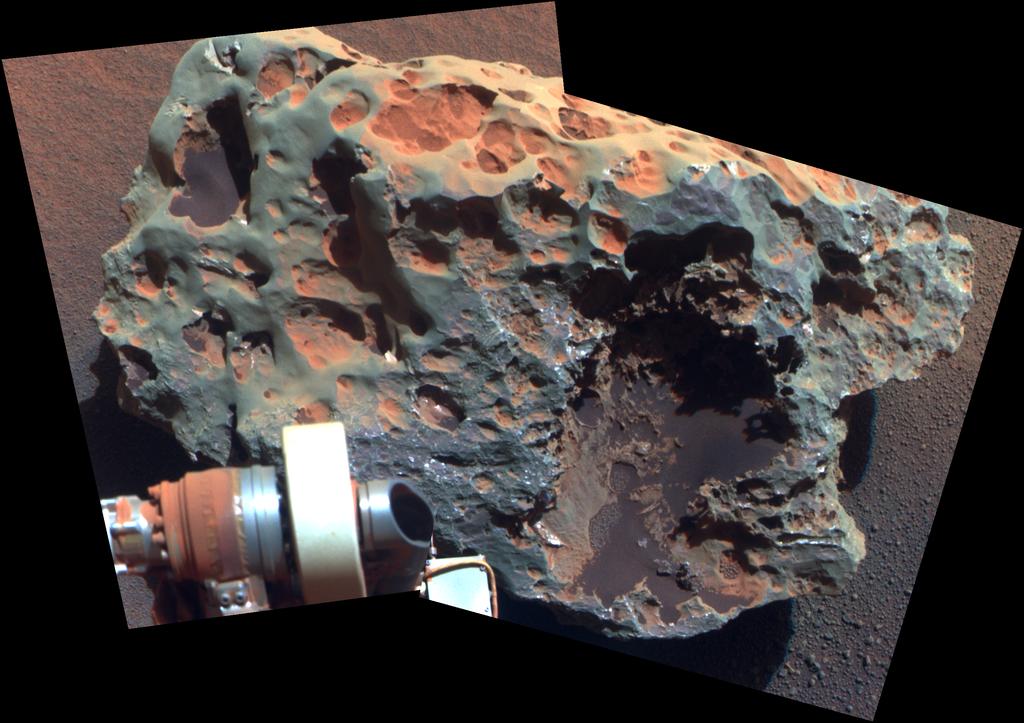
Image credit: NASA / JPL-Caltech.
It exhibits the same surface features that windblown sand creates on iron-nickel meteorites found in the desert here on Earth: exactly what you'd expect to find on Mars.
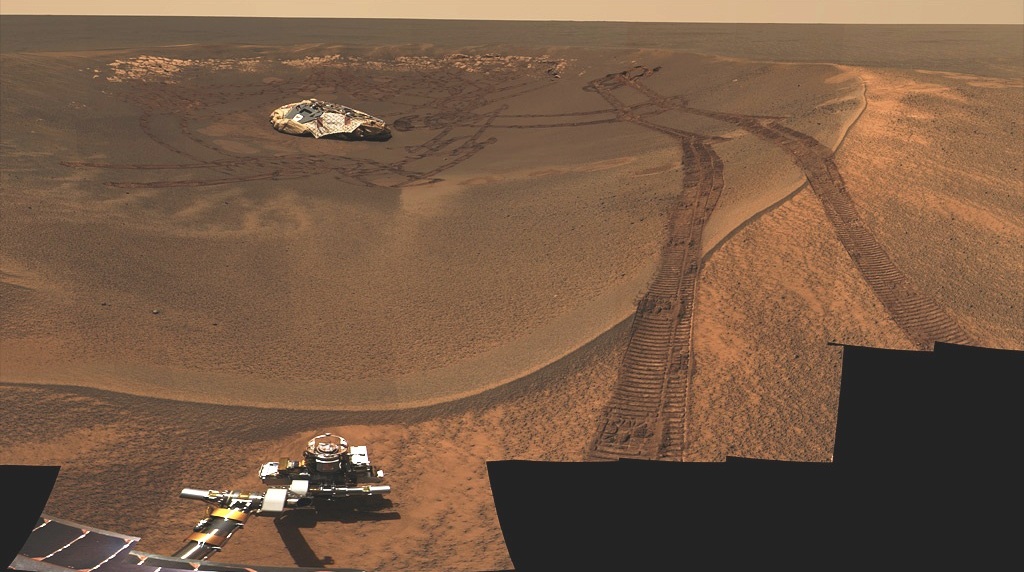
Image credit: NASA / JPL.
Since it began its journey at Eagle Crater on Mars in 2004, Opportunity has taken an unprecedented journey to some spectacular places, including Endurance crater,

Image credit: NASA / JPL.
where Opportunity was able, for the first time, to take a look at some of the sedimentary history of the Martian surface. The hills and cliffs inside this crater are so steep that pieces of Mars' geological history were revealed, as the photo of Burns cliff inside the crater shows.

Image credit: NASA / JPL.
It also visited a slew of other interesting features, including the beautiful Erebus crater,

Image credit: Mars Opportunity Rover / NASA / JPL.
The deep and spectacular Victoria Crater, with one of its many outcroppings (Cape St. Vincent) shown below,
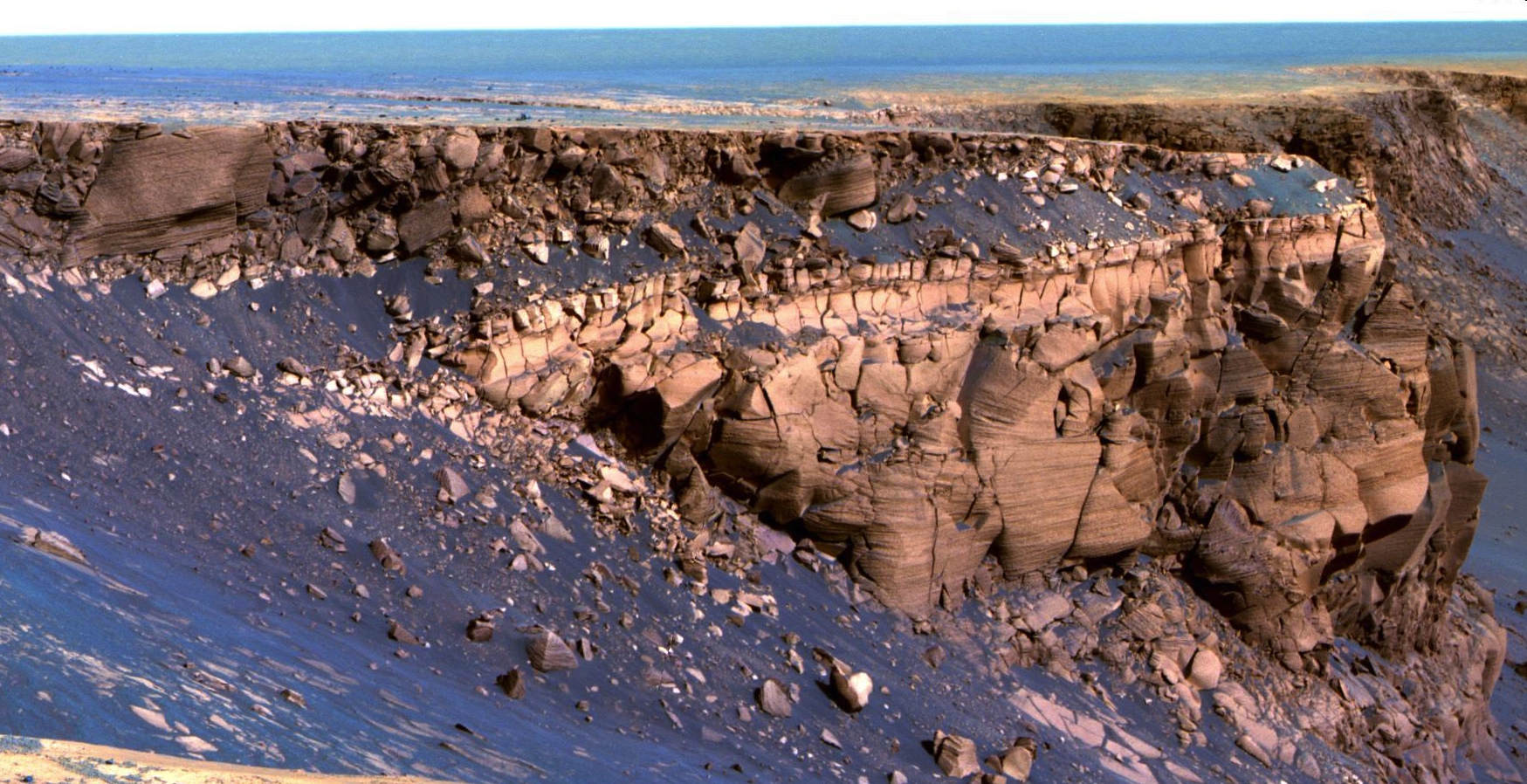
Image credit: NASA / JPL / Cornell.
and in the area surrounding Victoria, Opportunity found "Martian blueberries," or hematite spheres that look to be evidence of past water on Mars.
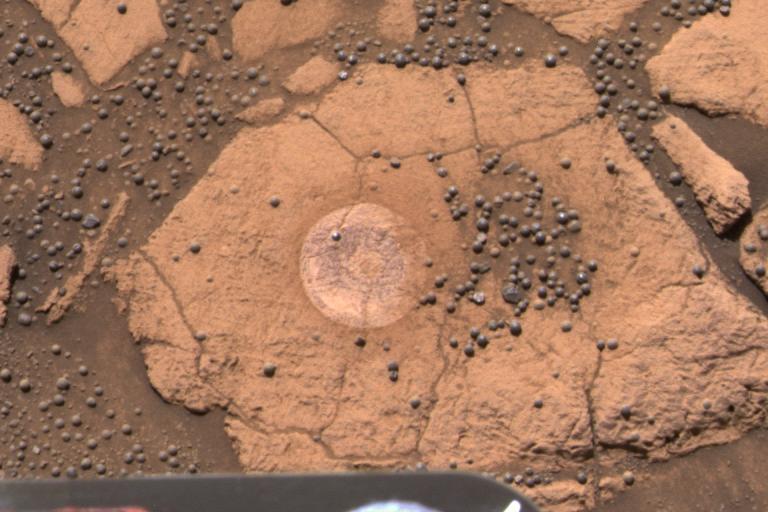
Image credit: JPL / NASA / Cornell University.
Blueberries were found at other sites, too, but after visiting Victoria crater, the decision was made that Opportunity would run the first Mars-half-marathon, and head to the gigantic Endeavour crater, despite the fact that its solar panels were only operating at 50%, thanks to being covered in years of Martian dust.

Image credit: NASA / JPL.
But a simple gust of wind came along and partially cleared off the panels, giving the eponymous rover the opportunity to make the spectacular journey in less time than anyone had anticipated.

Image credit: NASA / JPL.
Last year, during Martian winter, it took the most spectacular panorama of its entire journey: an 817-image-composite of Greeley Haven.
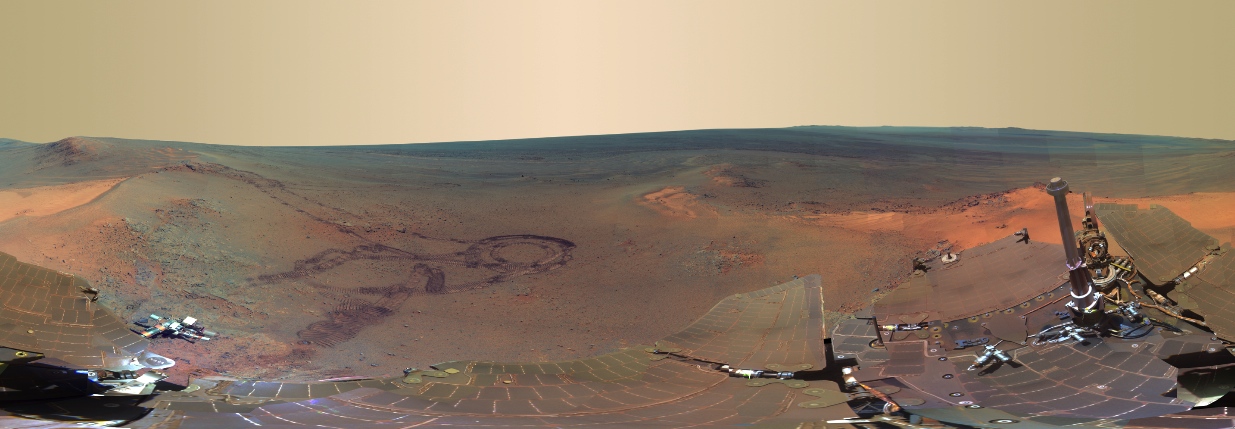
Image credit: NASA/JPL-Caltech/Cornell/Arizona State Univ.
And the journey continues. The half-marathon has pushed Opportunity's total mileage up over 22 miles so far, which means that later this year, if all goes well, it should become the most-traveled vehicle on any world beyond Earth, breaking the 30+ year old record held by a Russian lunar rover.
And if you want to know what a 3-year, half-marathon journey looks like, from Victoria to Endeavour craters, the Opportunity team has put a spectacular video together.
It's the longest-running-rover in history, and it's still full of life. As she enters her tenth year on the red planet, don't forget about Opportunity, the Methuselah of Mars!
Thanks, Ethan! It's good to know I'm not the only one (excluding the JPL staff and science teams) still paying attention to MER Opportunity. I've got both the MER and MSL missions in my bookmarks, and check them both daily to see what's new.
Opportunity's overall performance is rivalled, I think, only by that of the Voyagers. It's currently at 35.6 times its mission design lifetime (3204/90 sols), and 59 times its design travel (35,455.34/600 meters).
Very nice summary.
Without you I just wouldn't be updated on this.
By the way anyone who questions the quality of American technology just needs to look at the performance of Opportunity and Voyagers.
Please keep us posted. thanks.
Spirit and Opportunity spoiled me a little with the relatively fast pace they embarked on their missions, which was a noticeable difference with the steady start made by Curiosity. Curiosity has been gradually flexing its considerable scientific muscles, though, and the drill - when it is finally used - will provide detailed chemical analysis which the MERs were never able to deliver.
I followed both the MERs with more or less regularity, right through to Opportunity's current prospecting on Matejevic Hill, on Cape York at Endeavour Crater, and unmannedspaceflight.com is one of my daily-visit sites.
Curiosity's will be a mission that gradually builds in excitement, I think, with incidental surprises all along the way, for those with patience to follow.
"By the way anyone who questions the quality of American technology"
It has a very large component of stuff written and built by other space agencies.
Indeed, that and the lack of proper management is why that probe slammed into the planet because of the mismatch between SI and Imperial units.
And one reason is that the USA do not wish to spend the money that's necessary on NASA since it doesn't go bang and make good TV (probably), so a lot of the work wouldn't go ahead if it weren't for international collaboration.
It's really only the politicians and other rhetoricians that bull up competitive one-upmanship, though getting results out first can be quite fraught. But at the design stage, there's a lot of sharing goes on, balkanisation be damned.
I defer to Wow's explanation.
Yeah. It's accurate to say that these rovers demonstrate the prowess of American engineers, but more complete and far more impressive to say how it demonstrates the prowess of engineers and scientists around the world, and even more importantly their ability to work together to accomplish a goal. Not just accomplish, but to go beyond anyone's wildest expectations.
Oh and something I find myself saying in just about all MER articles:
The only way in which Opportunity was "designed" for 90 days was in the decision not to include a solar-panel-cleaning mechanism. And in fact it was the decision not to include one that resulted in the 90 day prime mission, not the other way around. The thinking was that without a cleaning mechanism that 90 days was about how long the solar panels would deliver enough power to ensure they could accomplish their goals (they didn't know wind gusts would be strong enough to clean the panels for them). So the choice was between a limited 90-day mission, or a longer mission but with the added complexity, weight, and potential for failure in a cleaning mechanism.
Once it was discovered that the Martian wind was stronger than expected and capable of cleaning the panels, all talk of 90 days went out the window because that was the one and only reason for the 90 day mission.
Of course actually having the rover still functioning after 9 years is still completely amazing. But the primary reason for it is the environment of Mars being different, not components of the rover performing beyond their designed abilities.
that's un-possible, CB!
I've hear from reputable places like The Daily Mail, The Heartland Institute, GFWP, and many blogroll commentators that solar panels don't last 5 years out of the 25 claimed, now you're saying they do better than expected?!?!?
Once again the Daily Mail has uncovered my lies. I'll get you one day!
@CB #6: Can you point me toward a more detailed writeup about the MER mission design? I was able to find a comment on the JPL MER Web site supporting your description above (http://marsrovers.jpl.nasa.gov/mission/spacecraft_rover_energy.html),
"The power system for the Mars Exploration Rover includes two rechargeable batteries that provide energy for the rover when the sun is not shining, especially at night. Over time, the batteries will degrade and will not be able to recharge to full power capacity. Also, by the end of the 90-sol mission, the capability of the solar arrays to generate power will likely be reduced to about 50 watts of power due to anticipated dust coverage on the solar arrays (as seen on Sojourner/Mars Pathfinder), as well as the change in season."
Them and their little tutu, too!
I don't have any canned links, sorry. Most of what I know comes from being an avid watcher of the program since before it launched. I remember the press conference where they first talked about the Martian dust devils and wind gusts -- you'd never seen anyone happier about being wrong in their predictions. At that point the mission became basically open-ended (depending on operations funding), because dust is the reason why it was limited so highly in the first place.
I also recall reading something about the decision to not include a dust-sweeper and how it was that decision that resulted in the 90-day mission plan. But again, sorry no link.
I'm sure there's a book out there that discusses all of this in detail.
Great article. Thanks so much for the update. Please keep blogging.
Michael Kelsey
Maybe this is what you are looking for.
"Expert:
Virginia Ford
Principal Engineer
Jet Propulsion Laboratory
Question:
How much longer do you think the solar panels will last? Why do you think they have lasted this long?
Answer:
The solar panels were designed to last for three months, but we always try to design so that we have margin. When you evaluate the life of a component, you think about what things could happen to make this device fail. In aerospace engineering, we are always trying to work at an extremely high level of reliability. That is because, once a system is launched, we can rarely go fix anything that fails. So we always design so that if the worst case situation we think of occurs we will survive. One of the main reasons that we thought the solar panels would fail is that we thought they might become coated with Mars dust. We didn't know much about how the dust works - what will attract it or what will repel it? is it rough and skratchy so that it would damage the solar cells if we try to brush or blow dust off. We just didn't know what would work best to keep the important surfaces clean. So we decided the best approach would be to do little, with an attempt at avoiding protrusions which would collect dust. So to finally answer your question, the solar panels have lasted this long because the dust isn't as nasty as we thought it might be. They look like they will last quite a lot longer because the power they are supplying is still strong. Of course, we cannot predict when some other event might cause failure. A wire might break, a storm could blow a rock onto a rover, an electrical part might fail. Hopefully, our plan to design to overcome the worst case we can imagine will enable both rovers to continue sending us wonderful data for another three months or longer!"
http://passporttoknowledge.com/mars/involved/faqmay12004.html
The above is a small piece of what seems to be a pretty interesting interview from and with:
"May 1, 2004
ON-AIR FAQ
PASSPORT TO KNOWLEDGE is very grateful to Mark Adler, Morten Bo Madsen, Virginia Ford, Todd Barber and Eric Rice from NASA's Jet Propulsion Laboratory; Patrick Whelley, Amy Knudson, Steve Ruff, and Laura Mehall from Arizona State University; Jascha Sohl-Dickstein from Cornell University; and Shih-Han Chen, Maciej Hermanowicz, and Courtney Dressing from the JPL Student Astronauts for generously contributing their time and knowledge to support this unique service."
Also there are other related pages. For example, this page may also have what you want
http://passporttoknowledge.com/mars/mission/oralhistory.html
"ORAL HISTORY
In the course of researching and developing "To MARS with MER" and its 6 video programs, P2K has been fortunate to spend many hours in conversation with the men and women behind the rovers, whose hard work gives life to the robotic explorers. Their insights and anecdotes explain how NASA's Mars Exploration Rovers project really came together, in more detail than any broadcast could ever find time for. In this section, you can read some of the fascinating "Inside Story" of NASA's Mars Exploration Rovers project, in these pages of ORAL HISTORY. "
Hope that helps
Hey, nice work OKThen. Thanks.
And I even learned something -- fear that trying to brush off dust would just scratch the panels was a factor. Makes a lot of sense.