

"The mind, once expanded to the dimensions of larger ideas, never returns to its original size." -Oliver Wendell Holmes
When General Relativity supplanted Newton's work as our theory of how gravity works in the Universe, it didn't just change how we view how masses attract, it gave us a new understanding of what the questions where and when actually mean. It gave us the very fabric of spacetime.
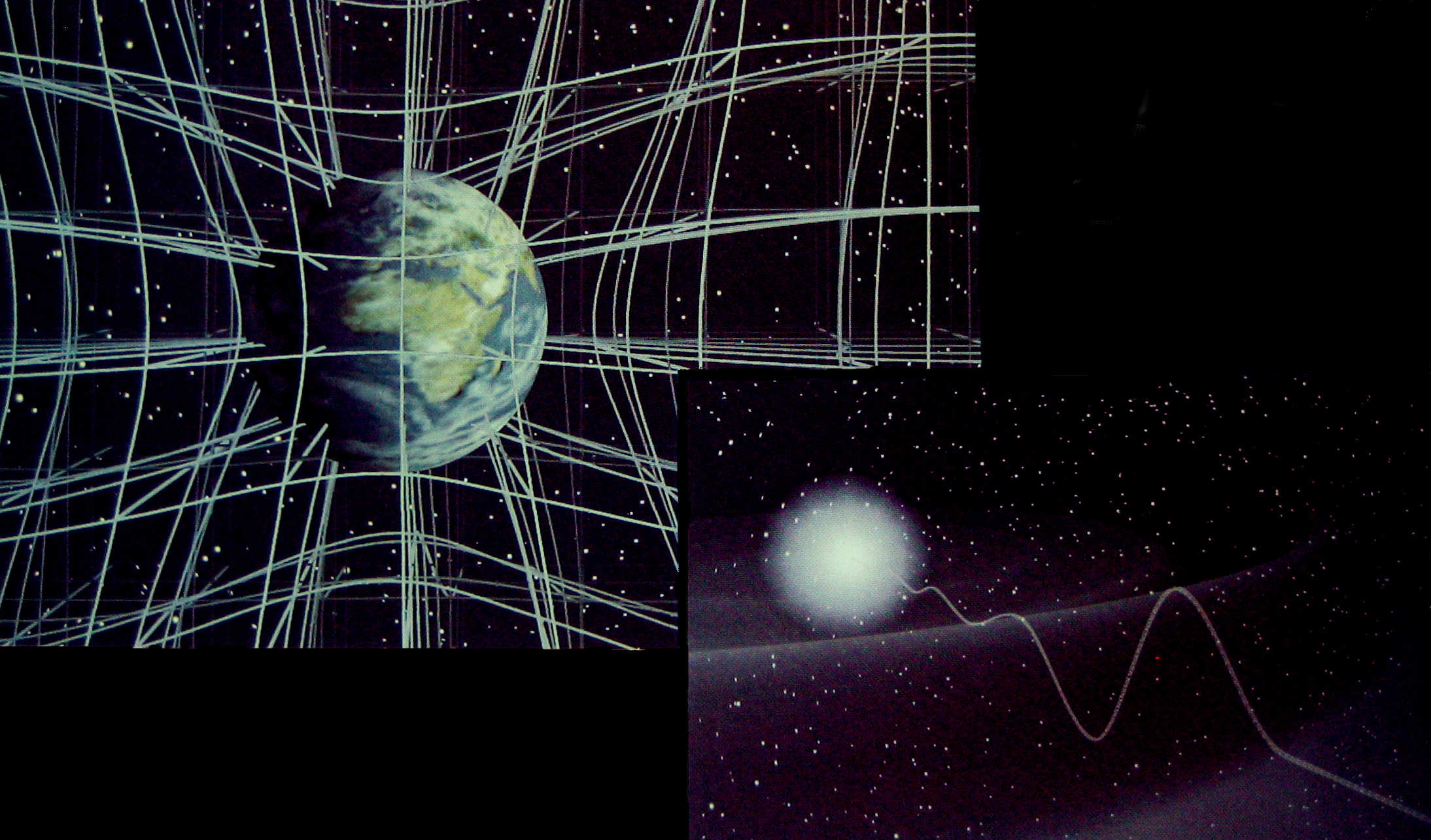 Image credit: Christopher Vitale of http://networkologies.wordpress.com/.
What this meant is that no longer could we view objects like matter and radiation as existing in some fixed, grid-like framework, but that the very Universe itself -- including space and time -- evolved in a predictable, understandable way depending on what was in it!
 Image credit: ESO / VLT.
By time we realized that the Universe extended far beyond our galaxy, and that a great many of the nebulous clouds and spirals in the sky were actually their own, distant galaxies, many of the consequences of relativity had already been worked out.
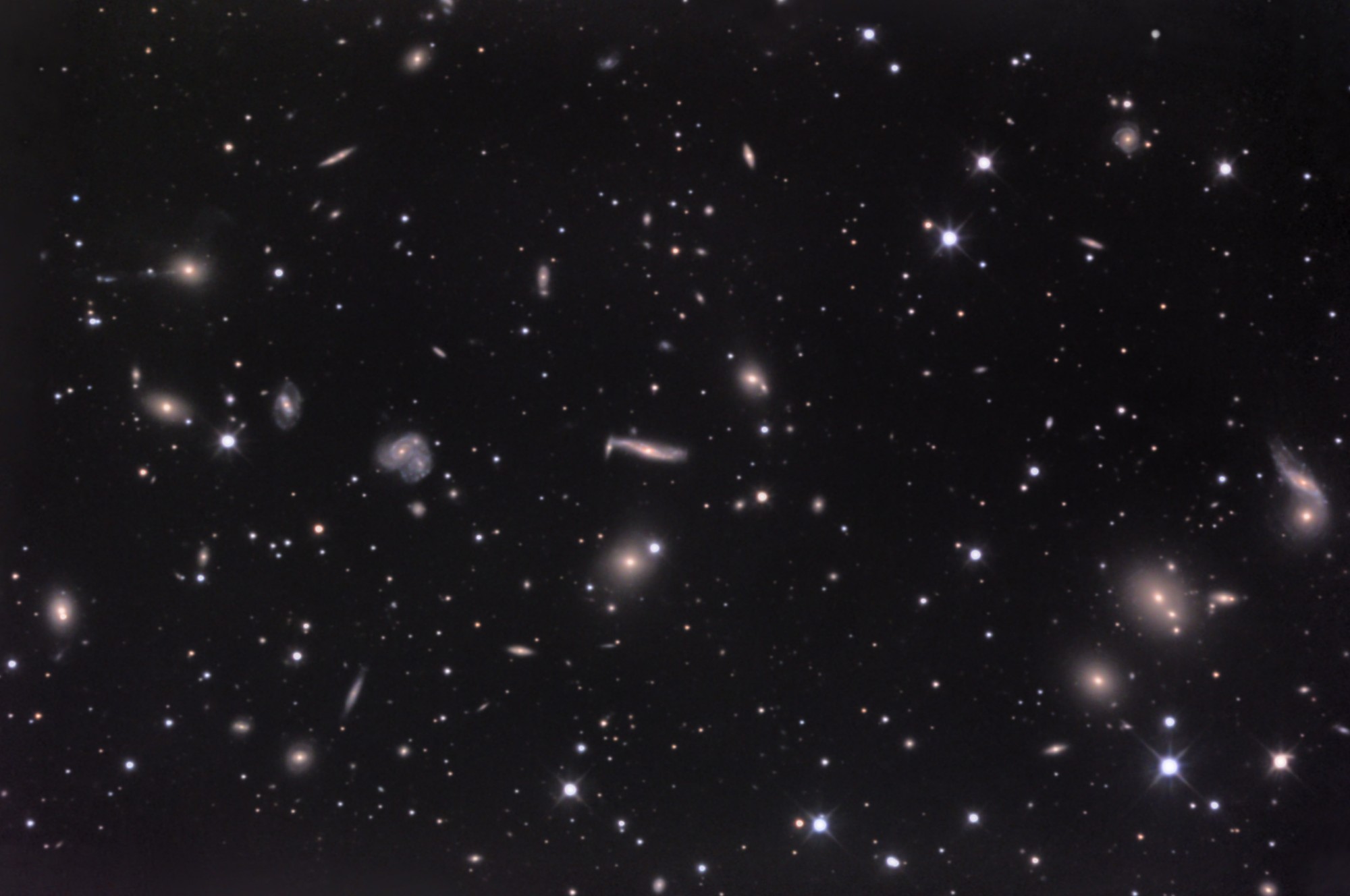 Image credit: Jim Misti (Misti Mountain Observatory).
As we found that these galaxies -- the vast majority of them -- were receding away from us, it left us with only one reasonable conclusion that was consistent with both relativity and our observations: the Universe was expanding.
This, of course, is what led to the Big Bang model: the realization that if the Universe is expanding, it must be cooling, as that's simply a consequence of what happens to radiation (it gets redshifted) in expanding spacetime.
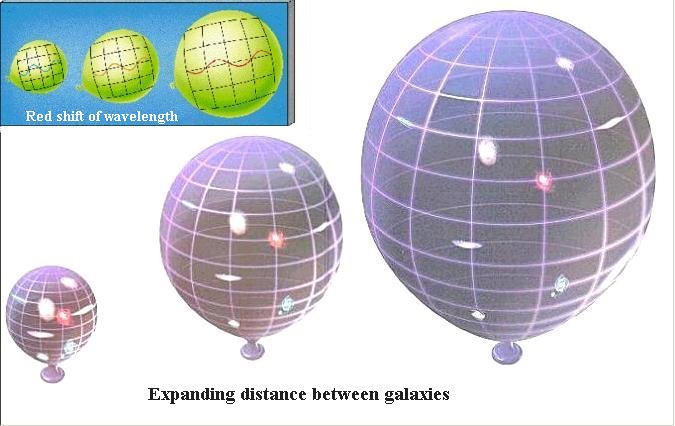 Image credit: James N. Imamura of U. of Oregon.
Well, if the Universe is expanding and cooling, that means that in the future, it will be larger and cooler. But it also means that in the past, it was hotter and denser! In fact, we can extrapolate all the way back to an arbitrarily early time, where things were as hot and dense (and compact) as we care to allow them to be.*
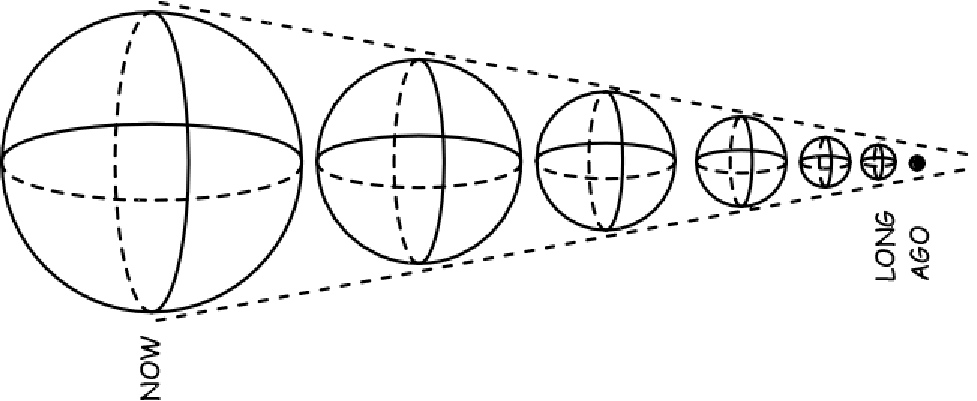 Original image source unknown.
We also know, observationally, that the Universe is roughly uniform in both density and temperature on the largest scales.
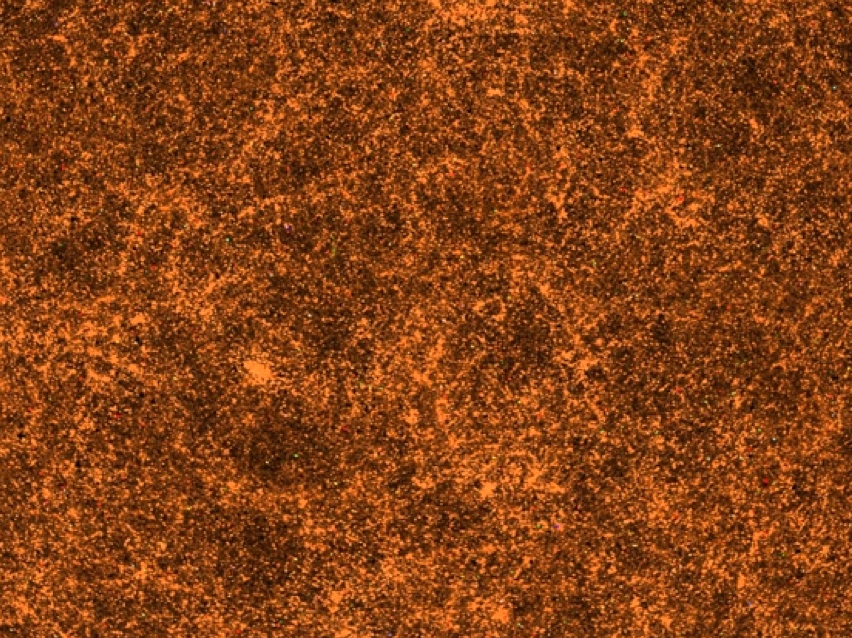 Image credit: SDSS III, data release 8, of the northern galactic cap.
Now, here's where things are interesting, from a theorist's perspective!
Because General Relativity -- given an expanding Universe -- tells us the relationship between space, time, and all the matter and energy in the Universe, that means that if we can figure out what's in the Universe today, and if we can accurately measure how it's expanding right now, we can know how big the Universe was at any stage in either the past or the future. (At least, beginning from the point where we can describe it by the Big Bang.*)
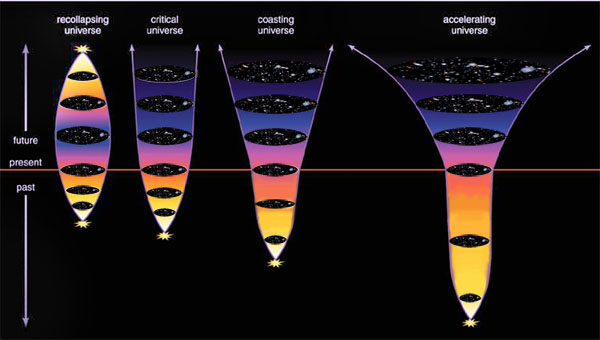 Illustration credit: NASA.
We now know that the Universe is expanding, today, at around 71 km/s/Mpc, which is known as the Hubble parameter. This rate was faster in the past and will be slower in the future, but that's what it is today.
We also know what the Universe is made up of, as far as energy content goes.
 Image credit: © Annenberg Foundation 2013, via http://www.learner.org/.
About 73% of the Universe's energy is dark energy, which is the energy intrinsic to empty spacetime. Another 27% or so is normal matter (protons, neutrons, electrons, neutrinos, etc.) and dark matter combined, and a tiny (but known) fraction-of-a-percent is radiation.
That's it. Armed with that knowledge -- plus general relativity -- we can figure out how the Universe has grown and continues to grow over time. Here's what the graph looks like (on a log-log scale).
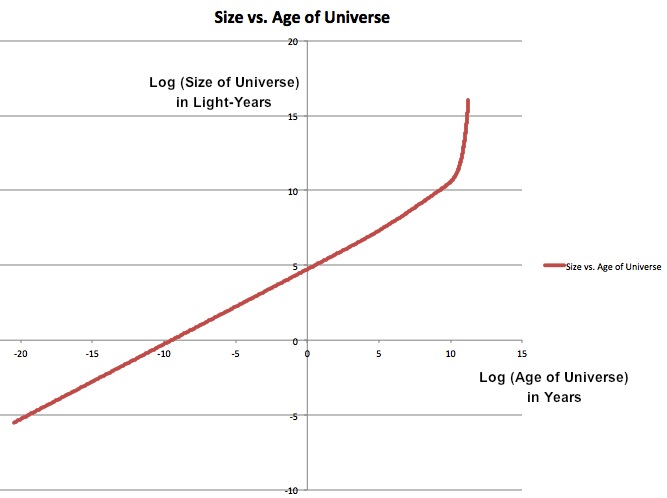 Image credit: me!
It doesn't look all that impressive; after all, it's just a curve. But there's a ton of information encoded in this curve! Let's highlight some of my favorite "points" along the Universe's history.
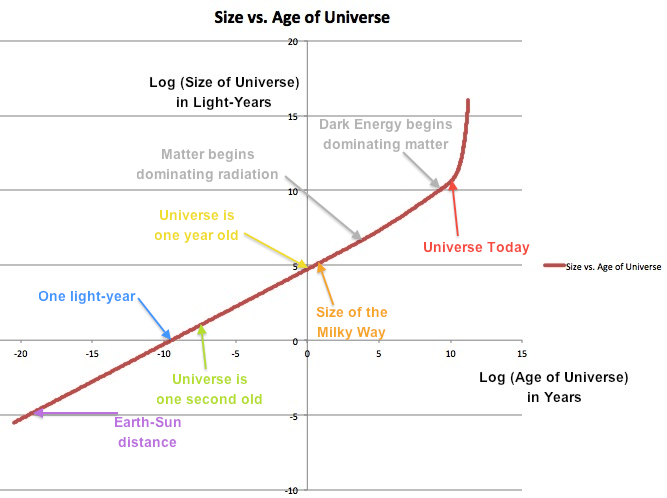 Image credit: me! (Again!) Look, I'm a lousy image-maker and I'm proud of this!
Today, the observable Universe (that's the part of the Universe that's causally connected to us) is 13.7 billion years old, and has a radius -- that is, the distance from us to the most distant edge that could possibly have ever interacted with us -- of 46.5 billion light years. As you can see, that number is about to get a lot bigger as time goes forward; that's dark energy's fault!
But going back, dark energy was less important; just a few billion years ago, matter was the dominant component of the Universe affecting our expansion, and even earlier than that, radiation dominated. (You can check that the slope of the line changes; this reflects the different behaviors of matter, radiation and dark energy in an expanding Universe over time!)
Some fun milestones:
- The diameter of the Milky Way is 100,000 light years; the observable Universe had this as its radius when it was approximately 3 years old.
- When the Universe was one year old, it was much hotter and denser than it is now. The mean temperature of the Universe was more than 2 million Kelvin.
- When the Universe was one second old, it was too hot to form stable nuclei; protons and neutrons were in a sea of hot plasma. Also, the entire observable Universe would have a radius that, if we drew it around the Sun today, would enclose just the seven nearest star systems, with the farthest being Ross 154.
- The Universe was once just the radius of the Earth-to-the-Sun, which happened when the Universe was about a trillionth (10-12) of a second old. The expansion rate of the Universe back then was 1029 times what it is today.
And after 13.7 billion years, 46.5 billion light years of expansion, and trillions of stars born, living and dying in our local group alone, here we are.
 Image credit: Kerry-Ann Lecky Hepburn (Weather and Sky Photography).
Don't just enjoy it, enjoy understanding it! And now you know where we've been and how we got here, including how large our Universe was at every step of the way!
* -- The earliest we can extrapolate back is now known to be somewhere between 10-37 and 10-20 seconds, as there was an inflationary epoch of indeterminate duration, with awesome consequences, before the Universe could be accurately described by the Big Bang model.
So, from your graph, does this mean that over the next billion years the universe is going to expand one hundred thousand-fold? That sounds like it might be unfortunate for anyone living during this explosive growth. How will this effect things locally? Will galaxies start to dissipate as the interstellar distances explode? I'm thinking it's a good thing I won't be around for that.
Brad,
No, that graph is on a log-log scale, so it means that over the next 10^11 years, or about 7 times the present age of the Universe, the radius of the visible Universe will expand some 100,000-fold.
It will affect every galaxy that is not already gravitationally bound to us. The Universe will be noticeably lonlier.
This might be a stupid question, but I always have trouble explaining it to people. Why does the universe not have a center? If we started out from a point and proceeded from there, why is there not a central point even if it is beyond our observable universe? I get that in an observable universe there is no center but in the actual entire universe isn't there?
Can I ask, how did the universe expand so rapidly at the beginning? If it was 100,000 light years after 3 years, it must have been expanding much faster than light speed.
I think I understand this stuff, and then - you go and throw more information my way that is troublesome.
Here goes - prior to 1 second, the universe was one light year in diameter. So SOMETHING was moving faster than light. Or not.
Maybe it has to do with individual particles not moving, but the space expanding between them. Is there a limit on how fast space can expand? apparently not. Clearly at that point, a very large proportion of the universe was inaccessible from any point.
Here's another question that seems probably overly simplistic, but what happens to a particle embedded in space which is expanding so rapidly? Is it ripped apart? I guess this question implies some physical connection, like hooks, between space and its particles.
Ethan, you have disrupted my (simplistic) understanding. Help someone.
@Phil Schaffer:
Exactly, that's it.
@Waydude: There are two ways to answer this - depending on if the (entire, not just the observable) universe is finite or not.
If it is finite, you can use the usual balloon analogy: the universe is the three-dimensional analogon of the two-dimensional surface of an expanding balloon. Obviously, the center of the balloon is not part of its surface; in the same way, the point where the Big Bang happened is not part of the universe.
If the universe is infinitely large, it never was concentrated to a point. It was infinitely large right from the start, i. e. the Big Bang happened at every point at once. (Even if it is finitely large, you could also say that the point where the Big Bang happened has "spread out" to comprise the entire surface, hence in that case also, the Big Bang happened at every point at once.)
@Waydude
There are some issues in your question, and I'm not nitpicking. I'll try to explain briefly.
"If we started'... who is we? If "we" is an observable universe, then no, it didn't start as a point, but as a region. A quantum region. And in QM there is no real point and size.. it's fields and energies. Just like an electron is not a point moving arounf nucleus, but a probabilistic cloud.
"but in the actual entire universe isn’t there?"
What is the actual entire universe? Do you know? I don't. Do you know it's size? It's shape? Is it finite or infinite. Is it a continuum of bubble universe, etc? If so, where is the center? If you look at i.e. all Earths oceans, is there a center to all of them together?
Hope this helps you. When thinking about what is "beyond" our "bubble", it really helps to let go of a "sphere" view.
I guess the most precise, and even poetic way (in line with General Relativity) would be to say that every one is a center of their own universe. Since space and time shrink and stretch for every single observer differently. Every observer has a unique picture of the Universe. And everyone is in the center of it's own picture.
Thank you. Nice post.
Is there an edge to the expansion?
@ Bjoern & Sinisa Lazarek, re Waydude:
Previously we saw that the Universe is very very flat, whereas the balloon analogy requires it to be closed. So either the Universe (not just the observable part) is infinite, or at least very very large. But also previously Ethan suggested belief in a multiverse with recursively embedded regions of inflation, in which case our local Universe, meaning the region of spacetime with inflation history like what we observe. In which case there would be an edge out there somewhere, although far beyond our ken. I mean, presumably all of our region of inflation would have been reciprocally observable "originally", so the notion of a "center" seems well-defined. ... Nie?
Ethan, more like this please!!
Thanks for the replies. No need to worry about nitpicking, I do a podcast on religion and that is one of the ways we critique. Sometimes to learn, you have to learn to ask the right questions and why the way you think and ask questions reflects the misunderstanding.
You didn't approach the idea of asking the wrong questions and how the question you ask shows how you wish to direct the answer to the preferred answer.
Torquemada practiced asking the "right questions" the "right way" and was very successful at finding what he looked for.
What he DIDN'T find was the truth.
"Previously we saw that the Universe is very very flat, whereas the balloon analogy requires it to be closed."
Marshall, you're missing a very important word there:
ANALOGY.
You'll next be asking "Who is blowing up the balloon and where did the air he's blowing in to it come from, eh?".
Then asking if we're going to be given to a child or tied into knots to look like a doggie.
@Marshall: Yes to all that you said.
Every day at the relatively small scale of galaxies new things are being discovered. e.g. Black Hole Spins at Nearly the Speed of Light
Our theory is just not good enough to predict such stuff. And then we have made so many assumptions, i.e. technical language and mathematics is just the shorthand for a bunch of assumptions.
"the Universe is roughly uniform in both density and temperature on the largest scales."
So what exactly are we assuming here?
I mean the super voids and the superfilaments are the largest structures in the universe that we observe and they are not of uniform density. Filaments are like the bones of the universe and voids are like the lungs.
I know my analogy is rough.
But here is a criticism that takes a peak under the Copernican principle and finds it wanting.
The isotropic blackbody CMB as evidence for a homogeneous universe http://arxiv.org/pdf/1111.3794v2.pdf
"The question of whether the Universe is spatially homogeneous and isotropic on the largest scales
is of fundamental importance to cosmology, but has not yet been answered decisively."
So the big bang cosmology is the best we have; but we understand so little. Hmm, maybe all black holes have event horizons moving at the speed of light or NOT. But we've just measured the speed of the event horizon of one black hole. But the idea here seems important for a successful theory of quantum gravity which might give a totally different picture of the universe than the big bang.
I wish, when I read about "the Universe ... on the largest scales" that I am told of some of the more important (i.e. still contested) assumptions that are included in such an idea.
We con't know!!!!
The point of is we can't even tell if the Milky Way galaxy part of a supercluster or a supervoid. And with degree of local uncertainty; we dare comment on the entire universe without mentioning this little fact (of our ignorance) and the assumption that conveniently ignores it.
Well, how big this universe is depends most on the correctness of the Big Bang scenario.
There have been 2 studies recently about the content of Dark Matter in Abell 383.
Interestingly the results seem to contradict each other.
One team, from Andrea Morandi concluded that DM toward the center increases in agreement with the cold DM model.
The other team from Andrew Newman and Tommaso Treu measured the velocities of stars around the center and concluded that the amount of DM is not in agreement with the cold DM model.
This seem to be contradictory results, unless you involve entropy and the loss of 3D space in a contracting universe scenario.
In which case both can be true.
All the (lost) 3D information of the past will have to show up in some way. For instance as optical artefacts in our telescopes - seemingly showing "bend" space. Because all information must fit to an ever shrinking holographic screen. It would however mean that gravitational arcs would not necessarily have to be 'gravitational' at all. Einstein would not be happy about this ;-)
Very far away galaxies would have to look very compact too. But if you measure the speed of those stars they should not move faster. Because there isn't really more gravity involved (Dark Matter), but only a loss of spacial information - which is only visible from a distance (time).
If more studies confirm that both 2 studies above are correct, that is a strong case for a collapsing universe, I think.
On the other hand, most people will believe that it is more likely that one of the studies is incorrect.
Regarding Ethan's chart that shows the big accellerated expansion of the universe "As you can see, that number is about to get a lot bigger as time goes forward; that’s dark energy’s fault!"
Again a little research finds that this is not rock solid physics.
Local and non-local measures of acceleration in cosmology http://arxiv.org/pdf/1203.4479v2.pdf
"Current cosmological observations, when interpreted within the framework of a homogeneous and isotropic Friedmann-Lema^tre-Robertson-Walker (FLRW) model, strongly suggest that the Universe is entering a period of accelerating expansion. This is often taken to mean that the expansion of space itself is accelerating. In a general spacetime, however, this is not necessarily true... The question of if, and why, the expansion of the Universe is accelerating is one of the foremost problems in fundamental physics today... We do not consider the existence of any strange new matter elds or modications to Einstein's equations, but we do allow for the Universe to be strongly inhomogeneous below a certain scale." BELOW A CERTAIN SCALE.
So again that "largest scales" needs to be specifically defined.
I don't pretend to understand more than a bit of these reference airxiv reports. But Timothy Clifton's research seems extremely credible to me.
And I am sure there is other credible research that highlights the important "implied assumptions" in the current cosmological model.
In my mind, these assumptions, have to be acknowledged especially when talking to laymen. If I can quickly search and find these theoretical concerns and discussions; then the professional astrophysicist can too.
The job is only half done if you tell me exactly what current best theory (aka Big Bang Cosmology) says; if you do not also tell me the weak points (e.g. observationally or in hidden but important assumptions).
I am not asking for discussion of my crackpot theory (i.e. one of my learning hypotheses) or someone else's crackpot theory. I'm talking about a serious researcher's (e.g. Timothy Clifton) serious concerns with important assumptions in the current theories.
But I will say emphatically, if we keep getting new surprises in our understanding of black holes at the center of every galaxy in the universe; we had better not be over confident in our understanding of the whole observable universe.
"And now you know where we’ve been and how we got here, including how large our Universe was at every step of the way!" Really???? Even a mediocre physical historian of planet Earth give more discussions of complicated assumptions that may or may not be true that are currently debated by the experts; than is given in this article about the entire universe.
Is there no room for discussion.
I agree with you @ OKThen. It is questions on which we walk forward rather than unquestioned answers. Only if we continue asking why, we will arrive at the truth.
"Only if we continue asking why, we will arrive at the truth."
Which by your assertion you continue to question and then leave the truth behind.
A video on the question of the Universe and its 'center'
http://www.youtube.com/watch?v=5NU2t5zlxQQ
If all the mass of the Universe was at one point contained in a area the radius of Earth to the Sun. What prevented it from graviationally collapsing into itself?
McGinn,
Temperature. The temperature of the universe was extremely high under these conditions. That means that the kinetic energy of the particles comprising it was high, too high to allow gravitational collapse.
And time.
If there hasn't been enough time for an exchange of gravitons between two particles on opposite sides of this "earth-sized" universe, then their masses cannot undergo gravitational collapse.
"...We now know that the Universe is expanding, today, at around 71 km/s/Mpc, which is known as the Hubble parameter. This rate was faster in the past and will be slower in the future, but that’s what it is today...."
How can expansion rate gets slower when expansion of the universe is accelerating?
Where did you read that? What you think is right, as we accelerate the universe expands ever faster. Our best idea at the moment is that it is going to continue this way.
The process goes like this:
Dark Energy expansion goes up as a linear power of universe size (energy goes up as the universe expands) or is constant (dark energy doesn't increase but is spacially universal). Gravitational expansion goes down to the square of the universe size (density goes down because we're expanding and not creating any more matter).
So in the past gravity was slowing down the expansion, but from a high level, so it was expanding faster in the past.
In the future, the slowing down by gravity will reduce, but the DE expansion goes on and overpowers the reducing effect of gravitational attraction. So "now" it will be expanding faster in the future.
"Now", "past" and "future" are all cosmological terms. a few hundreds of millions of years either way is indistinguishable.
Certainly You know explended scifi Stalker : extraterrestrials on your cosmic trip do some picnic on Earth.... Maybe our Universe is so picnic amusmed in the form of 3D projection ( holografic projection?) some of inhabitants from SuperUniverse..or maybe from GOD...
If that's what you're going to define as GOD, then why use such a loaded word? Why not use the word "Adnam"?
What do you mean Adnam (330000items on google)? . I see, ... Google is celebrated 61 anniversary
of Douglas Adams..it is very symptomatic for our discussion..but I dont mean GOD of Douglas Adams which is living the inside of Universe I think GOD (or someone else) out of Universe..which is, maybe, enjoy oneself on our torments..
Yup, you're still not making sense here. Is it because you're running babelfish?
Call it Cauliflower then. It doesn't come with the baggage of "god".
Unless you mean G.O.D. as an acronym for something.
Bjoern:
About the 'center of the universe' question... I understand that there is no 3rd dimensional center, but, just like the 2D surface of an expanding balloon has a 3D center, might the 3D universe have a 4D center?
It may do, but you can't point to it, and every point is as close as any other point to that "centre".
Brane theory is one mechanism for that 4d-source. Another brane will impact the one we're sitting on and that will occur at some actual 4-d point first (to within the roughness of a 4-D point in Brane theory) and the energy released started everything off.
Note: the brane is moving in 4D space, not necessarily in time.
It's an interesting take, but there's nothing to distinguish it from any other theory even theoretically at the moment, so it's not that useful, merely interesting. It's not even at the level of DM/DE, which have at least SOME observational characteristics and can be excluded or alternatives kept/modified/rejected by those characteristics.
These questions will sound very naive so if you answer please dumb down accordingly.
If the universe is constantly expanding then isn't the size of observable universe changing all the time?
What is the universe expanding into?
What is the universe expanding into?
The Hubble curve has its largest slope (H) for galaxies close to us and bends downward (smaller slope, H) for galaxies much further away, a (recently confirmed) consequence of a "dark energy" produced acceleration. Therefore, the Hubble curve seems to indicate that H (the slope of the Hubble curve) was smaller in the past. The ultra-distant (largest D's) galaxies have a smaller velocity/D = H ratio than closer galaxies. The slope of the Hubble curve (v, ordinate, vertical direction, vs. D, abscissa, horizontal direction) is steeper at small D than at large D. The larger "D" corresponds to an earlier time (closer to Big Bang) and a smaller "D" corresponds to a more recent time. How, then, do these facts lead the conclusion that H decreases with time (age of physical universe) when calculus shows the reverse to be the case? Because D = v/H, taking the calculus derivative with respect to time, finds
dD/dt = (dv/dt)/H - (v/H^2)dH/dt. Now, dD/dt = v and dv/dt = a, the acceleration, so that, solving for dH/dt, the rate of change of H with respect to time, dH/dt, one finds
dH/dt = aH/v - H^2 which is negative (H gets smaller with time if the D = v/H is correct at the start) IF the H^2 term is larger than the the aH/v term; or, with dH/dt = H(a/v - H), IF the H term is larger than the a/v term. Currently, the "a" (formerly, before 2000, "a" was assumed to be zero), acceleration, produced by "negative energy" is sufficiently small when divided by "v" so that a/v is smaller than H; hence, currently, "H" is decreasing with time. As the universe ages, "a" might get larger and large enough (there is no current evidence nor theoretical speculation that suggest the "a" is increasing) to make dH/dt positive, "H" increasing with time. Rejecting any such change in "a", dH/dt will stay positive in our physical universe. So, again, why does the Hubble curve show H increasing (small early on for very distant galaxies as seen nearer to time of Big Bang and larger later on as seen for galaxies much further from the time of the Big Bang)) with the aging of the physical universe and calculus shows the reverse? Answer, the increase we see in H (slope of Hubble curve) as we move from early times to later times is the result of the acceleration produced by dark pressure, energy density, of General Relativity (misnamed "dark energy") and has nothing to do with the dH/dt coming from the Hubble equation, D = v/H. As the physical universe ages sufficiently, our current H = 71 km/sec/Mpc, approximately, we expect to find it reduced to, say, about 70 km/sec/Mpc; "expect" because we may not survive long enough to see it, due to a very large comet or asteroid hitting Earth or our self-destruction by war or some other human folly.
Earth's Place in the Cosmos
Your 13.7 Gly (billion light years) radius does not translate into 93 Gly diameter (which may have come from a "spooky" 46.5 GLY radius). Many are misleading many by having them think we can do valid physics on or with bodies further away than about 13.7 Gly. You will find many saying that the radius of our observable universe is about 46 Gly and they, often, fail to tell you that the 46 Gly cannot be physically measured; it's a purely speculative distance. We will never "touch" anything beyond about 13.7 Gly radius or outside a sphere of about 27.4 Gly diameter. Physics does not know if any physical thing exists outside the Hubble radius, c/H, about 13.7 Gly. Einstein would put any physical thing beyond about 13.7 Gly in his "spooky" (pure speculation) category. While we can see IMAGES of galaxies which are now PRESUMED to be in said "spooky" realm, we are not seeing the galaxies, themselves, beyond the "spooky" radius, said "IMAGES" come to us from distances short of about 13.7 Gly or less, never more. How do you make a physical measurement of a distance to an object you can neither see nor detect? "Can neither see nor detect" because presumed to be in space which is expanding faster than the maximum speed of light, "c". Some even refer to galaxies in space that is expanding at 2 and 3 times the speed of light, but such theoretical claims are pure speculation, never verified and can't be verified by the physics of our physical universe (maybe those who can contact spirits, ghosts, might have some answers, but not valid physicists). You, for example, will never be able to bounce (reflect) a radar beam from anything in the "spooky" realm (any, say, planet or person in a galaxy beyond about 13.7 Gly), no more than a valid autopsy can be done by a doctor on a photograph of a corpse when the corpse, itself, is required. This "never" arises because nothing physical (having weight when at rest on Earth) can ever, due to the self-consistency of our physical universe uncovered by Einstein's Special Relativity, move at the speed of light and things with zero weight (mass for the fussy) move, for us and in our physical universe, with the speed of light, "c", (photons, including those in radar beams, have zero rest mass and we never find them at rest anyway); therefore, neither light nor radar beams can detect galaxies in the "spooky" realm because such galaxies are presumed to be in space that is expanding faster than the maximum speed of light, "c" (considering a bit of "spooky" stuff about the CMB, it is, for us, presumed to be in space that is expanding at 3 or more times "c"; we still can detect it because of the IMAGES it left behind before it entered the "spooky", for us, realm) or In such space, our light or radar beams, moving at a maximum speed of "c" will never be able catch them let alone bounce off them and return information to us about them. Think that you can catch up with somebody who is running three times faster than you can? Again, people can talk about spooks, ghosts or whatever they like, but bona fide physics and physicists treat and get their great results by sticking to the REAL stuff and strictly avoiding that "spooky" stuff. Of course, some of Einstein's "spooky" stuff for Quantum Theory has been shown to be real, but the "spooky" galaxies outside the about 13.7 Gly radius will, for us, always remain "spooky", like Einstein would have reserved, for spooky stuff, anything with non-zero rest mass moving at speed "c".. That fact of physics will not be overturned for us any more than the fact that we cannot ever move even at the speed of light, let alone faster than "c", in our physical universe. Remember, physics makes no claims about the non-physical universe, that is left to other human endeavors. General Relativity shows that galaxies with a red shift. "z", of less than about 1.7 could still get a radio message to us and we could get one to them; but, once their red shift is larger than about 1.7, we can no longer contact them; they are, already, for us and us for them, presumed to be in the "spooky" realm. "Presumed" because we can no longer contact them to check our presumption and, as far as valid physics is concerned, we don't even know if the "spooky" realm exists and we have no "Alice" to come back and tell us about its existence. "For us", because those in galaxies who have the red shift, "z", say, z = 1.6, which is less than our, say, z = 1.8, because they are closer to said distant galaxy than we are, can have our "spook" galaxy still part of their physical reality; they can still get messages from said distant, z = 1.6, galaxy. Because we can't move sufficiently fast, by the time we got to the closer galaxy in order to communicate with their real galaxy, said galaxy would have become a "spook" for them. Galaxy hopping won't do. We'll, probably, never even get to the Andromeda galaxy (about 2.5 million light years away) and it is NOT far enough away from us to be, for us, participating in the cosmic expansion; it has a blue shift for us.
Carlton, wallotext there. Wall-o-text.
TLDR.
What you saw there has moved on. You get this in everyday life. If you want to shoot a clay pidgeon, you have to lead the target because by the time the shot gets to where it is, it's moved on.
The stuff we see is moving.
Therefore at this moment in time, it's no longer where we see it now.
Wow,
PRECISELY my point, but the difference is that your "pidgeon" will need to have obtained a speed faster than your bullet for your analogy to hold and, if you think that aiming far enough ahead in such a case would work, your bullet simply falls even farther behind your moving-faster than-bullet-speed target. At least you could still see pigeons moving at faster than bullet speeds, but pigeons, if they could move at the speed of light (which no physical object with non-zero rest mass can do), would disappear at that speed (because Special Relativity, shows that a physical object's moving size, found from its at-rest, physical size multiplied by
(1-v^2/c^2)^(1/2), goes to zero when v = c (can't see something of zero physical size, let alone bring it down with a bullet) and this formula has ample verification with atom bombs and nuclear power plants working; they would not work if this Special Relativity formula were not true. The pigeon becomes like a ghost or "spook" because a bullet can't bring it down. Of course, pigeons can't fly faster than usual bullets or even arrows, BUT it is presumed that space can expand faster than the maximum speed of light; so, any attempts to check the physical reality of (hit, bring down, the faster-than-bullet-speed pigeon), for example, galaxies, say, by hitting them with laser "bullets", fail because no physical thing (even laser beams) can catch them in space where things are PRESUMED to move at speeds faster than "c", the maximum speed of light. "PRESUMED" because we can't ever physically verify such a speed nor show, by any physical means, the existence of physical objects (including pigeons even if they can beat speeding bullets) that are in space expanding at faster-than-light speeds. Maybe a local medium, spiritual adviser (guru?) might be able to help, but physics can not. Laser beams can't even hit (catch, reach) galaxies or anything in them, if we telescopically see them right now with a red shift greater than about 1.7; the current, most distant galaxy has a red shift of about 10 and the CMB has a red shift of about 1000 which General Relativity puts in space expanding at about 3c; we can telescopically see them because the IMAGE (not the object itself) we see was emitted while said object was still less than about 11 billion light years away. Remember, beyond the about 14 billion light years it is PRESUMED that space is expanding faster than "c"; so, the laser beam, moving at very close to "c" can't catch any physical thing PRESUMED to exist in said "spooky" (as far as physics is concerned) regions or so called "superluminal" (expanding faster then "c") space. Physics has no valid way of knowing if superluminal space exists because physics can't make any physical measurements that will disclose its existence. Again, physics can't, by valid physics, deny the existence of things other than physical things in our physical universe; indeed, most people, including many valid physicists, do not think that the physical universe is all our universe includes. Such things outside the physical are matters of FAITH or BELIEF. The existence of superluminal space is a matter of FAITH (speculation, belief) for valid physicists (astrophysicists and cosmologists?). When a physicist want's to preserve his/her bona-fides, he/she will tell you that superluminal space is a matter of speculation (faith) along with space expanding at speeds in excess of "c" and not a matter of physical reality, because no proper physics experiments.can be done. Again, it's "spooky" stuff and valid physicists not only eschew studying ghosts, but tend to look askance at those who do and claim it is bona-fide physics. So, physicists, mathematicians (with their FAITH that arithmetic is consistent), and many others hold FAITH (belief) in many things they can't prove. Let's face it, beyond and, perhaps, much more fundamental, is physicists and other scientists FAITH (BELIEF)( in the existence of laws of our physical universe. Without such FAITH (BELIEF, speculation) they might be considered insane or foolish for spending their lives searching so hard for something they did not believe existed. :-)
Wow
We seem to be talking past one another. Your analogies are not valid (WRONG) for what is being explained. Now, your jet plane does not move faster than light therefore does not disappear. All who know physics know that where you see (or hear) an object is not where the object actually is. An automobile coming towards you, due to the finite speed of light, is actually closer to you than where you see it and this physical fact is not the point I am trying to make for all to see. Again, due to the spatial expansion of our universe, at a sufficiently far distance, (the Hubble radius, c/H,) space is expanding faster than "c", the maximum speed of light. In regions of space where space is expanding faster than light speed, light can't escape (can't ever get to us). Your "jet" and "pidgeon" can't ever move as fast as light, let alone faster; but, if you insist on the validity of your analogy, you need to imagine that either can go faster than light (which is impossible). Let's IMAGINE that your "jet" can go faster than light, my point (and I expect yours) is that watching the jet take off and speed up, we always see it short of where it is; however, once it gets to a speed faster than light (remember physically impossible but imagining it anyway for the sake of argument), it DISAPPEARS for us if its speed is not due to its jet engines but the space it is in expanding faster than "c". Again, notice that space can expand faster than "c" and, once the jet finds itself in such a region, it can no longer see us nor we see it. Your analogy is wrong because it assumes your jet is in normal space (the distance to the jet's destination does not move while en route), not expanding space. Indeed, in "normal space" your jet's light will always get to us even if it,, impossibly, moves faster than "c" (its images will still get to us eventually no matter how far it gets from us in normal, non-expanding space). The space in which our universe exists is, however, expanding and if one goes far enough out into space from where we are, it is PRESUMED (no physical evidence to support) the expansion rate exceeds the maximum speed of light causing anything this distance away from us to VANISH or be invisible for us. Incidentally, as explained in earlier answers, the jet will vanish at speed "c" and physics can only speculate what happens after that, just like physics can only speculate (guess) what goes on in space expanding faster than"c" or, indeed, its existence. Valid (not "spooky") physics can't tell us what happens physically outside the Hubble radius, c/H. Physics, like some other human fields e.g. those considering spiritual things or other non-physical things, can only speculate (guess) about the existence of superluminal space or any physical objects therein. Sorry, but many think that the distant galaxies are speeding away like jets or pigeons; but, in truth, it is the expanding space between them that is moving them apart. Think of paint spots placed on a balloon and blowing up the balloon, the paint spots do not move from their painted locations, but the expanding balloon moves them ever (until balloon bursts) further apart. Your jet and pigeon are like the paint spots moving from their painted locations causing their separation speed. They do not move; space intervenes giving them their apparent motion. Once the balloon expansion has them separating at faster than light speed (physically impossible but for sake of argument) they will disappear for each other (no longer be able to be seen or physically detected by each other, hence, cease to, physically, exist for each other). Incidentally, the balloon-paint-spot analogy requires that the paint spots, themselves, not be spread by the balloon expansion (which happens in a balloon analogy) because in our universe other physical forces hold galaxies and galaxy clusters together (keep spots from spreading themselves).
"We seem to be talking past one another. Your analogies are not valid"
No, just because they show you wrong doesn't mean they are.
There's every possibility you're wrong, you know.
Wow and Others Wondering Who is Correct,
Wow, what I have written to you is correct (not "WRONG") according to present day physics. You may hold any opinions you wish, but the facts of current, accepted physics are not matters of opinion. Some of what I have said you will find in Ethan's article that is the source of this blog (like his expanding balloon analogy). You, because you live in the U.S. have the right to say that you are right and Ethan, I, and bona fide physicists are the ones who are wrong. Just because you seem to have failed to grasp what is going on or disagree with what physicists are saying, does not mean physicists are wrong about physics. I have been trying to help you to find the facts of physics. Wow, do you not understand that you are in effect saying Einstein, whose General Relativity is the source of our expanding physical universe, is wrong? My, Ethan's, and others writings have been trying to help you and others to see the truths of General Relativity without the need to understand the complex mathematics involved. I, like all humans, make mistakes. Your blanket claim of my being wrong is not helpful or informative to others without your pointing out the specific places that you think that you see errors. Just claiming that your analogy is right and other's wrong, without specifics, does not qualify as proper debate. If someone says 2 + 3 = 6, then they can be shown to be wrong in various, valid ways except, perhaps, for those who believe 2 + 3 = 6. Again, free speech allows you to say whatever you like, even 2 + 3 = 6, I just want any other readers to know that my stuff is that of Ethan, Einstein, etc. and they are not wrong in the matters I touched. Your jet and pigeon analogies are just plain wrong (or missing the point) because you did not CORRECTLY put any analog of the spatial expansion involved into them but ignored this important fact of our physical universe. Can't expect an analogy to be worth its salt if it ignores ESSENTIAL facts. You seem to be making the common mistake of many people that galaxies are moving away from each other like parts of an exploding bomb. or like one car on the expressway from another due to their actual motion rather than the space between them stretching, expanding. Until you and others understand the difference (as attempted to be shown by Ethan's balloons picture, above, and in words by my last post), the true facts of our physical universe will remain "wrong" or distorted. Ask Ethan, if he will bother to take the time, whether your analogies are correct or properly fit the situation. He will tell you that they are wrong or do not properly fit and maybe refer you to his balloon picture, above, to help you to see why they are wrong or don't fit. Again, cars separating on the expressway due to their motion is not the same thing as their being separated (even when parked in the repair lane) by the space between them expanding.
Finally, I will struggle with you further if you really wish to understand physics, but I have no intention of wasting my time with blanket statements about my being wrong. For anyone else reading these blogs, I have a Ph.D. in theoretical physics so, while I still can make errors, I know what I am talking about in physics. As a JOKE, some say that a person with a Ph.D. is one who has made more mistakes about their subject involved than anyone else. Yes, it is likely that they have made many mistakes on the way to their Ph.D., but their final Ph.D. thesis is not accepted until those errors are removed. Again, for those other than Wow who have read my writings here, the physics ideas I have put down to help people understand (like Ethan is doing with this site) are CORRECT, according to current day accepted physics. The CRITICAL FACT that bona fide physicists, astrophysicists, etc. know is that any physical object in superluminal space COULD NOT communicate (send light signals, radio messages, which move at the speed of light, no faster way to transmit a message or information) with objects in subliminal space nor could those in subliminal space get messages to (or detect existence of) those in superluminal space. The word "could" appears rather than "can" because the existence of objects (or people) in space for us that is superluminal CANNOT be verified by bona fide physics. Bona fide physics shows that light for ALL goes at speed "c" and no communication tool can go faster than light in our physical universe. Remember, people, before Einstein and his Relativities, thought that if you on a train station platform saw a person moving at speed "v" forward in a train moving at speed V, then the person would be moving at speed v + V with respect to you on the station platform. Common sense, Wow sense?, and true in physics until Einstein's Special Relativity came along because speeds close to "c" were not accurately observed. Special Relativity shows that if either the train's V or person's v is "c", then the person will be moving with respect to you on the platform at speed "c", in other words V + c = c, even if both train and person had speed "c", c + c = c. Now, many said such nonsense as c + c = c rather than c + c = 2c showed Einstein's Special Relativity with its (v+V)/(1 + vV/c^2) which becomes (c+c)/(1+cc/c^2) = 2c/2 = c, and which shows that one can't have any physical thing moving faster than "c", had to be wrong (I expect Wow and maybe me too as well as many bona fide physicists, at that time, would have felt that c + c = c had to be "WRONG"). Well today, all bona fide physicists know the "common sense" of the day was WRONG not Einstein. Our evidence for physics is that atom bombs go off and nuclear power plants work which would not be so if c + c = 2c rather than Special Relativity's
c + c = c, where "c" stands for the maximum speed of light.
The modifying word "physical" is required because there are other human fields of interest in our universe. Wow, and others are allowed to hold the opinion that the physical universe is all that there is (I am not saying Wow holds such), but that is an opinion (guess), not bona fide (experimentally verifiable) physics. Superluminal space is conjectured space, not experimentally verifiable, for bona fide physics.
Einstein's "spooky" physics is not bona fide physics. Bona fide physics must put, by definition, superluminal space and anything in it in the "spooky", speculation category; so, said famous physicist and teacher, Richard Feynman.
TLDR to the MAX!!!!
Wow,
O.K. what is TLDR? Not nice to degenerate to name calling or labeling, but it is your U.S. right to do so. I had time to check some of my earlier writings to see if you could spot a specific error and found one in my first May 6th post. At one point it has the word "positive" for dH/dt where, of course, it should have been "negative". It is an obvious error because it runs counter to my discussion, using calculus, to show that dH/dt is NEGATIVE, which is true for our current, physical universe; hence, calculus shows that the Hubble parameter decreases (negative dH/dt) with time and will continue to do so, with current data, because the current acceleration produced by dark pressure (misleadingly called dark energy, like Big Bang is misleading because it was neither Big nor was there any Bang) is not changing significantly now. Even if said acceleration were increasing the positive a/v term in the calculus found dH/dt is very small compared to the negative H term; hence, planet Earth and our Sun may be long gone before a/v can ever exceed H, if that is even possible for our physical universe. Maybe our physical universe is designed such that a/v can never exceed H, but that is pure speculation. It is not pure speculation that bodies with non-zero rest mass can never reach speed "c" nor bodies in our superluminal space can't get their light signals (communications, messages) into our subluminal space so that they can contact us, hence, get their existence verified. As I have been trying to get across, valid physics can't even verify that superluminal space exists. One could, also, speculate that any physical thing crossing the Hubble radius, c/H, simply becomes a will-o'-the-wisp. :-)
Finally, Wow, I know a person who on losing debates with others used to utter "whatever". Is your TLDR similar to his "whatever"? :-)
Wow,
Google says tldr stands for "too long didn't read". So now I know. Thanks for the education. I could translate it other ways, but all are a form of derogation, not nice. You might get an education from reading some of my stuff (if not mine how about Ethan's post?). and shed some of your misconceptions. Understanding physics takes long reading and effort. Shortcuts or omissions lead to errors. Guess in this day and age of the internet some people don't read books anymore. Sad, very sad. :-(
Wow,
Your physics is WRONG with respect to mine and Einstein's.
Carlton, how the hell can anyone tell what "your physics" is when it's buried in a load of crap? TLDR = Too Long, Didn't Read. USE A F-N GOOGLE.
And your inability to understand what I'm saying isn't proof that Einstein's proves me wrong, neither would "Einstein's physics" prove you right.
CORRECTION and MOTIVES
For those reading Wow's comments about my posts on valid (bona fide) physics, his difficulty should be clear and it seems that there is nothing I can say that will help him. However, I do want to say that the TRUTH, validity, of what I have posted about certain parts of physics can be verified in some parts by Ethan's material and in other parts by physics professionals, physics experts, or manuscripts, including Einstein's General Relativity writings.. Many may see how incorrect Wow's physics appears from his posts, but I am concerned about those who know little, if any, physics because Wow's misconceptions may lead them astray or divert them from important facts (truths) of physics. I am trying to present, for those with little physics, information to protect them from some often found common errors. Just let me say, here, that my presentations, while lengthy and often repetitive, are, nonetheless, accepted and correct physics.(I found one error in my first May 6th post where I said "positive" when I should have said "negative" when referring to the the fact that the Hubble parameter is decreasing with time, dH/dt is negative. Sorry. It was obviously a slip because in all other places I correctly said "negative" or "decreasing" with time which, by the way, has been shown by physics or astrophysics experiments to be true and, thereby, confirms the mathematics (theoretical physics) provided by the calculus I used.
Bona fide physicists and astrophysicists will say that for our physical universe, the Hubble parameter is decreasing with time. Also, bona fide physicists and astrophysicists know by definition that light can NOT escape from superluminal space, space expanding at speeds in excess of the speed of light no more than a slower moving object can overtake a faster moving one if both maintain their speeds and in the case at hand the faster one increases its speed instead of maintaining it (how are you ever going to catch someone or something if it not only starts out, say a mile away from you, moves away from you at a higher speed than you and increases its speed away from you while you keep your slower speed fixed?). As the famous physicist (Feynman diagrams) and renown physics lecturer (Feynman lectures), Dr. Richard Feynman, said that the definition of superluminal space precludes light escaping it. I do not have a famous physicist that I can presently name to back up my claim of valid physics for all of my presented physics facts, but plenty surely exist. Einstein and his derision of "spooky" stuff physics died (1955) before physics relevant to what I am addressing was common talk.However, I am certain that bona fide physicists can be found who will agree that the existence of superluminal space is currently speculation because no physics experiment has confirmed its existence. Bona fide physicists may have arguments for the existence of superluminal space to support their BELIEF in its existence, but it remain\s a belief (speculation) until experimental evidence backs up their belief and many renown physicists like Dr. Richard Feynman (died in 1988) felt ("feel" for those still alive) that experimental evidence is precluded by the very definition of superluminal space, because physicists can't make physical measurements on invisible (physically undetectable) things. The Higgs particle was in the speculation category until the LHC (Large Hadron Coillider) recently provided some experimental evidence. Even so, more evidence is still desired for a stronger confirmation. No valid physics experiments have even been proposed by believers in superluminal space that might detect objects in superluminal space and, as said, Feynman and those sharing his position would say that no such experiments have been proposed because they would have to do the physically impossible. Of course, if you are Alice in Wonderland, you can do several impossible things every day, but not physically impossible ones. :-)
TLDR.
#26 Maden
Briefly, the answer to your question is: the Hubble Parameter is a fraction, v/D,
For example, 6/20 is less than 5/10, while the 5 has gone up to 6 ("dark energy" effect) the 10 has gone up more to 20 (expansion effect); so, the expansion effect exceeding the "dark energy" effect causes H to decrease.
Longer explanation or another shot: H is the slope of the speed, v, vs. distance, D, graph; so, H = v/D (v is the km/sec and D is the Mpc). Without any need for the calculus used in one of my earlier comments, you can see that in the fraction, v/D, if the numerator (top number), v, is not changed (situation before "dark energy" was noticed) while the denominator (bottom number) is increased the fraction H, v/D, will get smaller. E.g. 5/20 = 0.25 is smaller than 5/10 = 0.5, where the 5, numerator, did not change but the denominator increased from 10 to 20. Correspondingly, H will have decreased due to the increase in D. D increases due to the expansion of the universe, therefore, H decreases as the universe expands.
This was the case BEFORE the acceleration was uncovered. With the positive acceleration due to "dark energy" (a misnomer like Big Bang is a misnomer), the, v, speed, numerator, increases (does not remain constant) but the increase in the numerator, due to "dark energy" is less than the increase in the denominator, due to expansion; so the fraction, H, still gets smaller (H decreases) even though the numerator is getting larger because the increase in the denominator more than offsets that in the numerator.
Calculus, by taking the derivative, quickly, finds the rate of change in "H" to be negative. by producing dH/dt as dH/dt = H(a/v - H), where "a" is the acceleration. In our physical universe, H is larger than a/v; so, dH/dt is negative or H is decreasing with time in our physical universe. :-)
Is there merit to the alternative theory currently being reviewed on the flat earth society.com's website?
Sorry make that...
flatuniversesociety.com
CAN U TELL ME WHAT IS DARK ENERGY....AND IS THERE ANY END OF THIS FATE UNIVERSE.....
i'm not gifted,and not skilled,but i don't understand why the size of the observable universe is not a radius of 13.7 billion light years.
today a team has discovered a galaxy 30 billion light years away.so the light of this galaxy mas emitted 30 billion years ago?
it's the question of the expansion of the universe?it's hard to understand;we have to cumulate speed of light and speed of expansion?
so the speed of expansion exceeds the speed of light?
it's hard to understand all that,probably a question of genetics
@tristan #57: It's a question of semantics, the fact that light has a speed (it isn't instantaneous), and the universe is expanding.
The distances you refer to are called "co-moving distances", and they refer to how far away that galaxy is from us *right now* (in the rest frame of the universe as a whole).
Suppose that a galaxy emitted some light when the Universe was just 1 billion years old (so 12.7 Gy ago). That light has spent 12.7 billion years travelling to us, which we can figure out by measuring how its spectrum is redshifted (we'll measure z of about 6 or so).
But of course, the whole time that light was travelling, the universe was expanding around it (and stretching out its wavelengths). So we and the galaxy which emitted it continued to be carried farther and farther apart. By the time the light reaches us, the galaxy it came from has gotten to be about 25 or so billion light years away.
The cosmic microwave background was emitted from the "surface of last scattering", about 380,000 years after the Big Bang (and 100,000 or years thick, so not really a surface :-). That "surface" is 13.3 billion years old, but it is _now_ 46 billion light years away from us, because the universe has continued to expand during those 13.3 billion years.
I don't know if that clarifies or confuses things. The Wikipedia article on redshift (https://en.wikipedia.org/wiki/Redshift) has a nice plot which maps measured redshift (z) to co-moving distance.
Michel Kelsey: You say that "That light has spent 12.7 billion years travelling to us"... Is that really so? Is it not a fact that, if there was a "bang," all the matter was from that point spreading out spherically. That matter would presumably include what became the solar system, so it appears to me as if some of the the light that "has spent 12.7 billion years travelling to us" has actually been travelling WITH us for most of the way. If not, please explain how come!
Waydude asked (2013-03-02), “Why does the universe not have a center? If we started out from a point and proceeded from there, why is there not a central point even if it is beyond our observable universe?”
I ask the same question. Can some expert please explain why the sphere that expanded out of the “singular point” does not have a center? There are a LOT of references on university and cosmology sites to “Universe radius” and “Universe diameter,” so what do these terms mean if we’re NOT discussing a sphere? And if the Universe is NOT spherical, what prevented the post-inlationary Universe from expanding uniformly in ALL directions?
Waydude’s good question was never answered.
Steve Morris asked (2013-03-02), “how did the universe expand so rapidly at the beginning? If it was 100,000 light years after 3 years, it must have been expanding much faster than light speed.”
This question is related to the question “If the Universe is 13.7 Gyr old, how can it have a radius > 13.7 Gly?”
I ask the same two questions.
Steve Morris’ question was never answered. Can some expert please “step up to the plate”?
Related to all of the above: Using the HST, we can observe galaxies that are estimated to be more than 10 Gly distant. How can all this matter have been displaced by at least 10 Gly without actually moving? Saying that “space between the galaxies expands, the galaxies themselves move at far less speeds” does not seem to hold water, as the galaxies are de facto (de assumptio?) 10 Gly or more distant, so they MUST have moved… "Dragged along," as it were, but that is what a log in a river also is exposed to, and the log is MOVING... What am I missing?
@Henry Morgan: I think you can resolve all of your questions fairly easily. The first statement is the one Ethan repeats many times in his blog: The Big Bang Was Not An Explosion. There was no "point" where everything was concentrated and then "blasted out into space."
The cosmological expansion is a continuous "stretching" of space itself (yes, I mean space, because in the rest frame of the Universe the time axis just proceeds straight on). All of the matter/energy in the universe was already there, all spread out (but at unimaginably high density). As space expanded (stretched), the matter/energy went along for the ride. In the earliest Universe, the stretching was extremely fast (fast enough that nearby particles couldn't interact before they were pulled apart), and it has slowed down since to the point that only the largest, farthest separated objects are seen to still be following the expansion.
Just like a log in a river, as you say. "But the log is moving!" Well, that depends on your viewpoint! Sitting on the log, and looking only _locally_ (at the log and the river nearby), the log isn't moving at all. It is at rest relative to the river, and it's at rest relative to the neighboring logs in the river with it.
But suppose a log in _this_ part of the river has a telescope, and looks at a log upstream, which hasn't yet reached the rapids that this log just passed through. Well, it will see that log apparently receding from it (because the river is slower up there). Obviously, it's not that _this_ log (the observer) is moving faster, because this log can see quite obviously that it's not moving at all! (See above).
The galaxy clusters we see (including our own Local Group) are gravitationally bound, with all the galaxies in each orbiting one another in a complex dance. Clusters far apart are not mutually bound, and are being (now slowly) stretched apart from one another by the cosmological expansion.
Light from a far away cluster left that cluster at some time in the past, then travelled through space at the speed of light until it got to us. While it was travelling, space was stretching around it, but light it special in this way: it can't ever be "at rest", so it doesn't get carried along with the stretching. Instead, the stretching pulls apart the wavelength of the light, so what we see is "red shifted" relative to what originated so long ago.
And while the light was travelling from there to here, and space was stretching under it, the cluster it came from has continued to be pulled along by that stretching. So it maybe took the light 13 billion years to get here. At that time, the cluster was originally maybe a few millions of light years away from us. Now, today, that same cluster is 40+ billion light years away.
@Henry Norman (apologies for the wrong last name in my previous post!): You also asked "where is the center?" or equivalently "why isn't there a center?"
The answer relates to our observation that the "whole Universe" is much larger than the part we can currently see (what we can call the Observable Universe). We know that is true because a Universe no larger, or smaller, than the observable part would leave very distinctive, and predictable, imprints on the pattern of the cosmic microwave background. Since we don't see those patterns at all, we can tell, quantitatively that the Whole Universe must be much larger (by at least a factor of four or five), than what we can observe.
So given that, I can make the trivial statement that "the Center of the Observable Universe is HERE." We are right at the center. Why? Because light comes to us from all directions equally, so we can see equally far in every direction, and therefore we are at the center of that observable sphere.
But now, let us magically teleport ourselves to a planet orbiting a star in the Bullet Cluster, some 3.7 billion light years away from us. Let's look through our telescopes. At that location, we can see equally far in every direction, as light comes to us. Therefore, we, over in the Bullet Cluster, are right at the center of the Observable Universe.
Of course, what the folks in the Bullet Cluster see isn't identical to what we see! They'll see a little farther than we can in the direction facing away from the Milky Way, and they won't see quite as far if they try to look behind the Milky Way.
Now, if you generally that analysis, you realize that there is no _true_ center, just a bunch of trivial observer "centers" where each observer looks around.
This is exactly the same statement that the _surface_ of the Earth has no center. You are standing at the center of a "circle" formed by the horizon, but so is everybody else, at every one of their different locations on the surface.
Its a fact today that the Hubble space telescope has proven that the "red shift" is observable on all the galaxies moving away from each other at an ever increasing rate the further out you look. The galaxies at the farthest reaches of the universes (13.7 billion light years) are moving outward at many times the speed of light. Can't it be said that Hubble has disproved Einsteins theory that the "speed limit" for the Universe is the speed of light since relatively simple math calculations have now shown those galaxies at the Universes borders are moving outward at many times the speed of light.
Cosmic microwave background (CMB) source is an astronomical object emitting light by Redshift in cosmic,the distance away from our Earth about 0.004 billion billion light-years to 0.04 billion billion light-years across
Redshift in cosmic: stars emiting blue light drift to red color by cosmic redshift that travelling the space:meanwhile,the light run distance 13 billion light-years in Redshift in celestial observation.
Blue color wavelength bands in 450 450*10^-9 miter.
Red color wavelength bands in (750+620)/2*10^-9m=685*10^-9m.
The Redshift in cosmic of different:=(685-450)*10^-9m=235*10^-9m in distance 13 billion light-years.
The Redshift in cosmic about distance is line ratio:13 billion light years/235*10^-9m=constent.
The blue light of source drift into cosmic microwave background (CMB) by the Redshift in cosmic.
Microwave background (CMB) source destance from our earth:
Cosmic microwave background (CMB)source in 0.3*10^-2 to 75*10^-2m wavelength bands ,we get the data in 75*10^-2m wavelength bands by cosmic microwave background to the ratio,the
cosmic microwave background (CMB)source destance from our earth =((75*10^-2m-685*10^-9m)/235*10^-9m)*13 billion light year=0.04 billion billion light-years.
Stars of blue color by Redshift in cosmic drift into cosmic microwave background (CMB) in our Earth by in celestial observation.
Cosmic microwave background (CMB) result is stars color by Redshift in cosmic in distant object.
Infrared-excess object from our Earth of distance:
The distance between an infrared-excess object from our Earth is 42.6 billion light years to 55,300 billion light-years=((1000000*10^-9m-450*10^-9m=320*10^-9m)/235*10^-9m)*13billion light-years---((999550*10^-9m)/235*10^-9m)*13billion light-years.
No, it cannot, since this claim:
Ethan, Thanks for this. I did a related post recently (http://gutenberggalaxy.blogspot.com/2016/08/map-of-universe_10.html) and found some of your material useful.
-Stan