

I liked Freakonomics, so I'm a bit sad to see the (inevitable) sequel being so hopelessly wrong. Probably this is a case of the old rule: whenever you see people write about stuff you know, they get it wrong. Joe Romm has a fairly characteristic attack; and just for a change I'll agree with him; though he chooses odd bits to assault. It looks like the "global cooling" junk is just one chapter, but of course it is the only one I'll pay any attention to.
Diagnosis, in brief: (1) they write about stuff they clearly don't understand (2) they pick a catchy reverse-common-wisdom nugget as a headliner without the having the slightest interest in whether it is true or not (mind you, plenty of more respectable folk do the same) (3) they pick an expert to talk to, but since they don't have a clue about the subject they don't know how to pick a good expert, or even understand what the expert says (4) there is a grain of sense in there, but so badly wrapped in trash it is nearly unfindable.
The entire piece is riddled with errors. Reading it all would be tedious. So, before reading it in detail I decided to set myself a target of 10 major errors and then stop. Kindly, Romm has provided a PDF of the offending chapter, so you can play along at home.
[Update: The Economist (along with everyone else) shreds them too; but does it in measured language and speculates on the damage to their reputation -W]
[Late update: Harry Hutton hits the nail on the head -W]
 (1) Global cooling. Alas, there are still fools who fall for this one. [[Global cooling]] on wiki is a fair place to start if you're interested. That will point you to the definitive study on this issue, by Peterson, Connolley and Fleck. Still #1 on the AMS download lists, and this twaddle will keep it there a bit longer. This earlier post of mine will point you towards some other stuff. As I said in the intro, other people get this wrong - Iain Stewart did - and usually for the same reason: its a fun hook to hang a story on.
Incidentally, the Freakonomics folk aren't always wrong - p 167 has some sensible things to say about CO2 produced during food distribution that echo stuff that mt has been saying. If they'd stick to that, they'd be fine.
(2) p 168 makes the assertion that economics models are better than climate models. They provide no evidence at all to back this up, and I don't believe it.
P 168/9 has some moderately sensible discussion of the problems of acting when the costs aren't well known. They even bring in the Stern report (alas, without taking the chance to discuss the discount rate issue).
(3) GW a religion... core belief that mankind has inherited a pristine Eden (p 189). This is just junk. Ditto the bit about heretics - what is the boy Boris Johnson doing in there?
(4) Choosing James Lovelock as a spokesman for GW. Lovelock is a wacko, but I don't seem to have bothered take his stuff to pieces; the closest I can find is this sideswipe. Ah no! I did him over at the old place.
P 171: discussion of externalities. Good. Rather superficial discussion of the problem of solving emissions through taxation - but then these are anti-tax peole, so thats just their natural bias. P 174-5: rather extended example to demonstrate that externalities can be positive. This is all in preparation for the idea of cooling the planet via stratospheric injection of aerosol precursors, which Caldeira has been pushing. Long, rather tedious boosting of NM.
(5) All climate models produce the same answers because people tune the models to produce the same answers. Zero evidence for this one, and appears to be contradicted by the divergence of the range of models available.
(6) CO2 is over-emphasised because water vapour is the dominant GHG. I did that one years ago and I'm sure its been done again elsewhere (oh yes: RC). This is one of the have-you-got-a-clue issues; parroting this (as the Freakos do, and as their chosen climate experts do) shows that they are utterly hopeless.
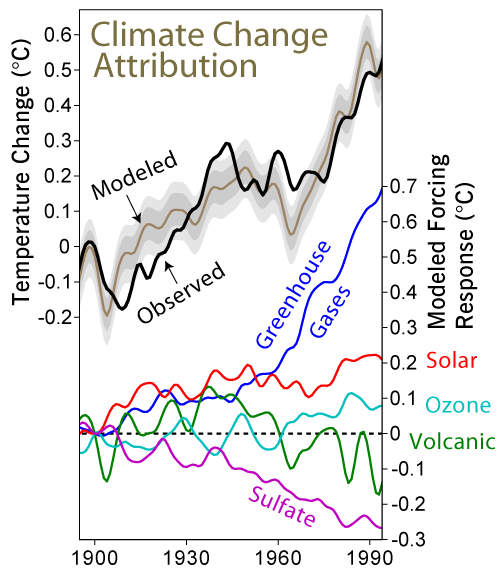 (7) Most of the recent warming is due to clearing up particulates from earlier decades. Unlikely, given that sulphate forcing is increasing, not decreasing. Remember, this is global, not just the sunny US or Western Europe.
(8) CO2 doesn't necessarily warm: ice cores show that T rises *after* CO2 rises. Sigh; again, they need to read RC. Though I think Eric Wolff said it best.
(9) Sea level is rising due to thermal expansion. Yes, thank you, we knew that. Sea level has been rising since the LGM: yes indeed, but not at a constant rate, see e.g. [[Sea level rise]] (that isn't a great page; I put the link there partly in the hope that readers might try to improve it).
(10) Global temperatures are decreasing. Sigh, I suppose it was inevitable they would say that, and it seems a fitting note to end on. See RC.
I didn't even get as far as their solution; if you fight your way on you'll find its just geoengineering by injecting SO2 into the stratosphere; so far so dull. See RC.
[Update: The pdf is gone , so I can't check up, but I've recalled another error from the Freako's eggheads: that stopping the THC will stop the Gulf Stream. that is Wrong; the GS is a wind-driven western boundary current
Uupdate; UCS didn't think much of it either. I notice that they say "The authors claim climate models have a very wide range of future temperature projections (page 168)." which is quite funny since I quote them complaining that all the moels produce the same answers...
Uupdate: Nurture don't like it either -W]
Set your life easier take the personal loans and all you want.
I enjoyed reading your articles. This is truly a great read for me. I have bookmarked it and I am looking forward to reading new articles.
Blu Cigs Coupon Code
What a bunch of arrogant ignorant fools. Global warming is a con. Watch the Great Global Warming Swindle, look up the educated scientists like phycisist and meteorologist Piers. Check out the climaterealist.com website and Nongovernmental International Panel on Climate Change website which are all full of scientists and even ex IPCC members that are full of scientific studies that show there is no evidence of global warming. Cooling is a part of the natural cycle and it is inevitable and is actually due according to the 80 year cycle, don't forget the sun is in a quiet period which is due to get worse and places like the Met office have finally agreed with the likes of Piers that the sun does influence the temperature. The planet has been warmer when there was less CO2 and there is scientific evidence that the last 10 years has cooled which doesn't make sense when considering CO2 levels have increased. Then there is the fact that computer models get it wrong constantly. The only comparison of CO2 and temperature is very close but there is a chronological issue for global warming nuts, and that is it gets warmer and THEN the CO2 levels increase and that is thought to be due to the increase in eco activity when the planet is warmer.
I think that to get the loans from banks you ought to present a good motivation. Nevertheless, once I've received a student loan, just because I wanted to buy a house.
Global cooling concept have no scientific explanations, it is some sort of hypothesis which has no proof. Although global warming is a hot issue within science community. Many people deny this concept as well. But dramatic climate change in the last decade has provided sufficient evidence which can not be ignored. Impacts of climate change are witnessed by the whole world in Pakistan, China, Japan and USA. Climate Change causes are due to a number of factors.
I would like to propose not to wait until you get big sum of cash to order different goods! You can just get the loans or short term loan and feel free
Some specialists say that loans aid a lot of people to live their own way, because they can feel free to buy necessary goods. Furthermore, banks offer financial loan for young and old people.
Are you overloaded with completing philosophy essays paper assignments? You can usually rely on the premium writing companies, which can offer the free essays per good money.
I guess that you need to ease your biography essays performing procedure to be satisfied and the custom research paper service can aid you to get your aim.
Every man in the world should read your incredible theme to accomplish the good quality free essays or even art essay paper.
Not all persons do not have proper academic writing skills.
Have just began blogging and I have to say it is good enough fun but not making any money from itâ¦yet it seems to be really easy, nevertheless people should closely testify your term papers online needs.
Really good information just about this post. People use essays writers and buy custom essay papers and custom written essay about this topic.
Well, thanks for saving me ~$20. That's one book I can cross off my reading list. If they are as sloppy as this on climate, how can we trust them on anthing else?
I gave the chapter a quick read. It is rubbish, as most of these books are. But isn't posting that a copyright violation?
[Copyright: maybe Romm belongs to the Pirate Party? -W]
Nicolas Nierenberg | October 13, 2009 9:08 PM --- Probably not in the USA.
So sad Following logic (Freakonomics) with sloppy illogic.
I was so looking forward to their new book too...
Well, at least my Christmas list to 'Santy' got shorter.
Several of my colleagues are economists. This chapter has a couple of clear fingerprints of economists, in my experience. First, among micro types, one of the primary goals (for much academic research, if not conversations) is to come up with a counterintuitive framing of a finding -akin to what econ types jokingly call "stylized facts."
Second, the department culture at Chicago has a reputation for valuing "smarts" - which means being able to argue about/analyze any topic off the top of one's head, regardless of any background knowledge (that's just clutter, apparently).
Another strange feature of the chapter: like many self-described skeptics, the Freakos (love that) apply weak logic that they would reject aggressively in other domains. E.g., global temp is falling - presumably they wouldn't say "You're wrong about the tide going out; that last wave just washed up the shore toward us, not away."
Disappointing's not the word - upgrade at least to irresponsible...
Well, it's likely time for a complete change in management:
http://www.sciencenews.org/view/generic/id/48065/title/BPA_in_the_womb_…
http://ehp.niehs.nih.gov/docs/2009/0900979/abstract.pdf
What is the current trend in the mean global temperature anomaly?
Global cooling by 0.71 deg C from 1878 to 1911, for 33 years.
Global warming by 0.53 deg C from 1911 to 1944, for 33 years.
Global cooling by 0.48 deg C from 1944 to 1976, for 32 years.
Global warming by 0.67 deg C from 1976 to 1998, for 22 years
http://www.woodfortrees.org/plot/hadcrut3vgl/compress:12/detrend:0.706/…
#7: Why is the data in the plot there detrended?
[Err, which data? And what makes you think it is detrended? -W]
Meanwhile,
CO2 is the highest in 15 millions of years - Science reports:
http://www.eurekalert.org/pub_releases/2009-10/uoc--ltc100809.php
Sorry; I was referring to the data in the link in spangled drongo's second post. If you follow the link, there is a "detrend" option selected.
The SuperFreakonomics article was published in the London Sunday Times last weekend. So wide publicity, then. And the response is woefully inadequate. For instance, the blog post above should deal with each of the important issues clearly (ie to the layperson (or average economist)) and succinctly. But it doesn't. It displays anger and ennui. And then it doesn't, itself, answer to the issues - rather, it says they have been answered, and then points to other less-than-clearly-and-succinctly-expressed posts. The object seems to be to make the layperson work hard to understand why the rejectionist views are incorrect. Bah! Why don't you just get to the point(s). You forget that the object is to win the arguments, not display your anger and scientific erudition. Does the devil always have to have the best tunes?
[I see your point. But the freako people get paid good money for their trash. If anyone wants to pay me to explain their errors in detail, I'd be happy to. In the meantime, ennui is entirely appropriate - as is linking to the answers elsewhere - because this really is the same old trash all over again. It doesn't deserve a detailed rebuttal -W]
David, at first playing whack-a-mole is fun. But when the game never stops, and you want to get back to the rest of your life...
FYI, last night I submitted a comment to Dubner&Levitt's blog giving a link to this post, but it doesn't appear to have survived moderation.
Perhaps I shouldn't have mentioned the "10 errors" part.
[Too much truth is obviously difficult :-) -W]
If they're buying the global cooling argument, then you should challenge them to a bet, William. I'll kick in some money on the side of science.
Not entirely clear to me what the Freakonomics folks think is happening to climate though, so I don't know if there's a margin for a bet.
The link to the chapter pdf isn't working right now. I think republishing an entire chapter is pushing the envelope on copyright, even here in the US, so maybe it's gone.
Not all economists love the Freakos, either. From econo-blogger D-Squared:
The basic problem with the Freakonomics era was that the profession abandoned the study of production, consumption and exchange...the fact that econometricians have invented a huge part of the toolkit of modern statistics doesn't mean that anything you can estimate using an econometrics package is thereby "economics".
We stopped doing economics and started doing awful amateur-hour sociology, basically, because we believed that all the major problems had been solved, that some form of dynamic general equilibrium was all that there was to be said about the economy considered as a system, and that the only interesting things to do were growth theory and finance...
The sociology of academia in the USA also played its part... Because of the unenviable economics of the academic labour market in American universities, graduate students were encouraged to finish their PhDs according to a specific schedule, to write dissertations that were capable of being turned into journal articles in a specific way, and to follow fashion in citation-gathering...
And so we ended up with Freakonomics, the disciplinary equivalent of the battery chicken. The subject matter became more and more cutesy and trivial, methodological corner-cutting in "natural experiments" became the norm, and the idea that there could actually be a subject of macroeconomics became almost quaint.
I found Freakonomics pretty shoddy for such a trumpeted book. Some trivially true observations, a lot of interesting hypotheses that rarely amounted to much more than plausibly-presented just-so stories, and the odd really glaring error. And that's without having expertise in the areas discussed - I'm sure that there were many glaring errors I missed.
My org., the Union of Concerned Scientists reviewed the chapter, too. You're exactly right. It's gets so much of the science wrong: http://www.ucsusa.org/global_warming/science_and_impacts/global_warming….
Apart from the drug dealing article (which was basically rewriting someone else's good work anyway),much of Freaknomics was rubbish, with relatively little economics, and certainly not a lot of basic fact checking.
It was, however, a lazy journalists dream, since it allowed them to rehash bits of the book as 'did you know..' pieces.
Since they made loads of money the first time round, they thought they'd do it again. Only, they had to come up with something even bigger in the contrarian 'your all wrong' stakes - hence the climate change stuff. The lazy articles have already started, so obviously this kind of crap works, sadly. Let the letter writing begin. Its not much, but its the best we can do.
As to point 2), Medawar makes a comparison of weather forecasting and economics in a essay reprinted in "The Strange Case of the Spotted Mice" (I don't have my copy to check, but it's p. 186 according to Google Books)
[Around about http://books.google.com/books?id=C8-PkAfzShoC&lpg=PP1&dq=%22The%20Stran… - thanks - W]
Nailed by Romm, quoted with emphasis supplied by Tobis:
http://initforthegold.blogspot.com/2009/10/romm-vs-freakshow-ii.html
If you want to sell a book in the US, based around the idea of Freakonomics, then a simple dollar proposition is to attack AGW rather than to affirm it. Every Fox/Murdoch/ journo can play the role of advertiser for the authors by endlessly quoting from their dog's breakfast of a chapter.
It rather reminds me of the philosophical notion of bulldust - proponents of bulldust don't care whether they are right or wrong, just that the bulldust achieves their aim. Endless plugs on Fox media is my guess as to their aim, in the SuperFreaker case.
#8 Spangled Drongo
Oh look, you're reproducing the infamous "it looks like a W, therefore there's an oscillation!" drivel from our favourite Deltoid troll, Girma Orssengo. For the unfamiliar, this is taken from a (literally) Moby Dick sized comment thread on Deltoid, where Girma drew a *straight line* from the 1850s to the present day, asserted there was a straight linear trend over that time (because... he'd drawn one!), then *removed* that trend and claimed everything else was natural oscillation, of unknown cause, but possibly the moon, or oceans, or Milankovitch, or something.
Who's more foolish, the fool, or the fool who follows him?
(Unless of course you arrived at this staggering ineptitude independently in which case, my sincere apologies - there's obviously something in the water.)
Freakonomics claim that your rumors of their climate realism ("denial") are exaggerated:
http://freakonomics.blogs.nytimes.com/2009/10/17/the-rumors-of-our-glob…
[Thanks Lubos. I note they promise a rebuttal at some point; that will be interesting to see. I've been told by several people that they've been deleted references here and to Romm from their comment threads. I don't think I've called them denialists - just hopelessly ignorant. I do hope they are going to respond to the errors found, not to some strawmen -W]
Krugman appears to have started a thorough exposition of L+D's fallacious climate economics, focusing here on their misrepresentation of Weitzman. Interestingly the latter's paper was the key to persuading K. to raise the alarm.
Regarding your point #2, questioning the assertion that economic models are better than climate models: It is my understanding, as a reasonably educated nonspecialist, that projections of future climate change are dependent upon projections of future economic activity. Therefore, if the economic model is bad, then the climate model is going to have problems.
On the other hand, it also is true that future economic activity is going to be influenced by climate. Therefore, the validity of the economic model is going to depend upon the validity of the climate model.
This makes it difficult to say that one is better than the other, because the are interdependent: if one is bad, then the other is going to have problems, too.
[That would depend what you mean by "models". Were you to mean "models, including all input data" than clearly both are interdependent if you want them both to be good. In which case the Freako's point fails. If you mean, how good are the models, as models, assuming 100% good input data, then I maintain my point. Also the climate models integrate the economic forcing (CO2 emissions, mostly) and so the answer in say 2050 is tolerant of some variation of the inputs. Incidentally, having read what the Freako's *claim* their chapter is about, the most striking point is that this matter is irrelevant - so why did they bring it up? -W]
"It doesn't deserve a detailed rebuttal" -William M. Connolley
"...at first playing whack-a-mole is fun. But when the game never stops, and you want to get back to the rest of your life..." Ian
Both comments miss the point. If you really want to stop this AGW nonsense (which 'never stops') you have to labour your points, and do it again and again. To say 'I'm fed up' or 'I've got more important things to do' will not get the job done. If it's really too much work - then take the time to prepare a (one/two page) template with some simple charts for AGW dummies and other dummies like me, which you can use again and again with minor tweaks, as required by circumstances. But displays of righteous anger accompanied by references to 'difficult' (for dummies) papers and posts will never achieve what you want to achieve, as has been amply demonstrated, again and again. So... how much do you really care? Enough to put in the extra work? Or not? I think the anti-antivaccination people are doing a better communications job than you anti-AGW people. OK - your science is more difficult, but you really need to try harder.
@27 David
Please see this excellent resource:
http://www.skepticalscience.com/argument.php
My experience of using this in a comment thread is that it has precisely no effect, more's the pity. Still, have to keep trying.
> you have to labour your points
Seriously, try this. The result? You will be labelled as shrill, elitist, arrogant, dismissive, closed-minded, emotional and/or a religious zealot - all of which will be taken as evidence that there is something to this anti-AGW stuff after all. If it was nonsense, you wouldn't try so hard to deny it would you?
Sorry to labour this - but here is a post from Joe Romm(?)which, while wasting a might too much space in shrill righteous indignation, does at least do a better communications job for the side of the angels:
http://climateprogress.org/2009/10/12/superfreakonomics-errors-levitt-c…
And its follow-up:
http://climateprogress.org/2009/10/14/superfreakonomics-errors-nathan-m…
The whole of Chapter 5 has been scanned into here if anyone finds this useful :-
http://www.docstoc.com/docs/13213779/Superfreakonomics
@28Dave
Thanks Dave - an excellent resource from which to cut and paste as required. That's exactly the kind of thing that's needed. And more of it. As for being labeled shrill, etc, etc - that very largely depends on the language and style used. The fact is, quite a lot of anti-AGW blogs are very shrill, elitist, arrogant, not to say angry etc, in their style, and sorely lacking in direct meaningful and persuasive content - and that does weaken the case by arousing suspicions of religious-type zealotry, or the need to win research grants. But I don't think hammering away dispassionately suffers from this weakness. You'll never convince the AGW nutters and those with their own amoral or immoral axe to grind - who will always throw that kind of mud - but there are a lot of reasonable people out there who are otherwise pretty open-minded, but still inclined to believe in the possibility of a 'conspiracy' of research grants... (which, let's face it...)
I've read the chapter (it was posted as a PDF on climateprogress.org) and I think it's misleading and incredibly disappointing. Details on my blog at http://www.standupeconomist.com/blog/economics/climate-change-in-superf…
I'd like to see the L&N authors provide an estimate of the increase in acid precipitation due to the deliberate injection of 1-2 Mt. Pinatubos of sulfates into the atmosphere every year and an analysis of long-term effects this increase would have on marine, freshwater and terrestrial habitats and productivity. My hunch is that the "cure" would be far worse the "disease" given the very well documented effects of acid rain from unregulated coal burning in the mid 20th century.
This says it all:
"If anyone wants to pay me to explain their errors in detail, I'd be happy to. In the meantime, ennui is entirely appropriate."
You're not going to change people's minds with that attitude. Maybe you're point isn't to change minds, but people are linking to this as if it provides a good argument? (I got the link from the Freakonomics blog.)
IMHO, you should just chill out. They are just trying to entertain people. They probably don't expect to change people's views on the cap and trade bill--I suspect they both support it.
[Errm, you've complaining about my ennui but advising me to chill out. Can you spell "irony"? -W]
If anything they may have helped put global warming back in the news more and driven a lot of people to your blog and others to get more informed. Unfortunately, the anger, disrepect and lack of clarity aren't helping people get educated!
[OK then - which bits aren't clear? I thought it all was, but then I've seen this before -W]
I do get the feeling that GW is almost like a religion now. It's like most of the world has decided to accept it as 100% fact and not listen to any arguments or even doubts any more. If I even broach the topic with my friends, it's like I'm blaspheming and I find myself in an argument against four people who never give me a chance to give any input.
But largely, most people think "how could you even doubt it?". This is not scientific. Science would tell you even if it's a fairly solid theory, doubt it, test it, look for holes. Prudence says that if we are indeed causing a negative effect with severe consequences, we should take steps to stop it. But that doesn't mean that the theory is objectively right. It means it's better to err on the side of caution.
And the last problem is that there have yet to be any practical means by which to change the situation. In fact, the cleanest source of power that doesn't rely on any lucky facts of geography is nuclear power, which the same people who now so zealously believe global warming is 100% fact demonized nuclear power as 100% dangerous and harmful. Which, being a physicist, I know it's not nearly as bad as most people think.
Basically it comes down to environmentalist types, people who decide their scientific views with their hearts and not their minds, who are easily swayed to one side such that they never consider the other, have placed themselves in a neat little box. Then again, such people wouldn't believe me when I say things like biofuels, electric cars, and solar panels aren't the solution. They're good ideas, but they aren't at a level to be implemented yet.
Bit of an ad hom there, isn't it Andrew? Objectively, you are not coming off as a scientist, but rather as a member of the group you chastise. If you want to know how you can keep your head while those about you aren't, maybe you should, ahem, engage the literature. It's hard to take you seriously when you ask people to listen to someone (you) who appears to be speaking outside of your discipline, while unencumbered by the fairly broad, deep, and stable literature field. By the way, if you can solve the nuke fuel related terrorism issue, you probably can draw more people to your fission-plants-are-safe point of view.
"Basically it comes down to environmentalist types, people who decide their scientific views with their hearts and not their minds, who are easily swayed to one side such that they never consider the other, have placed themselves in a neat little box."
I notice your very helpful chart cuts off in the 90s. Is that because for the last 8 or 10 years warming is not in evidence and the head of the IPCC has said that despite the overwhelming forcing of CO2 something has over forced it? i.e. CO2 absolutely drives climate except when it does not.
And of course solar activity has very little to do with climate. It is just a coincidence that low solar activity is happening during a cooling period. Again.
And please the models are really very good. They didn't predict the last 10 years of no warming but they will be spot on in 100 years. Especially if we keep revising them when the predictions they make fail to materialize.
What we need to do is to get as much plant food out of the atmosphere as we can. If we can keep it at 280 ppm +/- 10 ppm all will be well. Unless some durn fools plant too many plants. Then we will either have to go after them or authorize carbon burning.
By way of analogy, the L&N "solution" is akin to defending the continued spraying of DDT by suggesting we genetically engineer bald eagles to be resistant to organochlorine pesticides while letting all the other birds and fish killed by them to continue dying. Third graders have a more wholistic, non-compartmentalized ability of critical analysis than these folks. But, then again, third graders aren't trying to sell a book based on a hook regardless of its veracity or real-life consequences.
M. Simon: did you even read Wm. Connolley's paragraph #10 and the attached link?
"(10) Global temperatures are decreasing. Sigh, I suppose it was inevitable they would say that, and it seems a fitting note to end on. See RC."
You might want to read it and then read the referenced link. It fully answers your query.
William,
I have not read their chapter, but from all the commentaries, they clearly have lots of things wrong. However, I think that you and your coauthors in the BAM piece are a bit off in the way you characterize things in the 1970s, commenting as an economist who worked with Reid Bryson back then and has kept track of the lit since (yes, I know he was on the losing side).
So, if one looks at your paper more closely what one finds is that there was a clear debate in the early 70s with everyone knowing what the data was, if fuzzily, and what were the big forcers, if not exactly how strong each was. Up until 1975, the cumulative number of "warming" articles did not exceed the "coolers plus neutrals." In that year they did so for the first time. Their advantage accelerated after that, with no "cooling" articles being published after 1977. But, while it is ridiculous to say there was a "global cooling consensus," it is also misleading to characterize the situation by your "only 12% of articles between 1965 and 1979 were pro-cooling," with the more general swipe that it was just the media and a few oddballs who worried about global cooling in the 1970s, especially the early 1970s. After all, we did have global cooling for three decades or so up until the mid-1970s.
[The tag-line for our paper is "There was no scientific consensus in the 1970s that the Earth was headed into an imminent ice age. Indeed, the possibility of anthropogenic warming dominated the peer-reviewed literature even then.", and that is correct. The trouble is that there is no "approved version" that we are trying to counter. "Everyone believed in global cooling in the 70's" is the common claim, and we've debunked that. You could restrict yourself to 1975 (clearly we couldn't, becasue there is stuff past then that is of interest) but then "Up until 1975, the cumulative number of "warming" articles did not exceed the "coolers plus neutrals." is also rather misleading. For *all* periods the number of warming articles is greatest.
one finds is that there was a clear debate in the early 70s with everyone knowing what the data was, if fuzzily, and what were the big forcers, if not exactly how strong each was. - Yes, I entirely agree -W]
"After all, we did have global cooling for three decades or so up until the mid-1970s."
With the salient point being that the exact same research and analytical methodologies used to detect and explain this cooling period are those being used to detect and explain the post 1970s warming. This why the L&N "global cooling vs. global warming" strawman is a strawman. It is not coincidental that the 1940s-1970s cooling period stopped very soon after nations began requiring stringent controls on S02 aerosol and particulate emissions from industry and power plants. This marked reduction in industrial aerosols in the 1970s and 1980s allowed the underlying signal of increased CO2 to be no longer dampened and masked, which if nothing else confirms the veracity of the overall global warming climate models and the entire 1900-present time series. You could also throw in the dramatic increase in tropical deforestation in the 1980s and onward as a separate forcing toward increased ambient CO2 because of the large-scale removal of the natural carbon sinks that were absorbing a lot of the CO2 produced by industrial/fossil fuel emissions during the 1940s-1970s period.
"Unless some durn fools plant too many plants. Then we will either have to go after them or authorize carbon burning."
You are unaware that in the long term, plants are carbon-neutral? Most of the carbon removed during plant growth is released as plants decay or are eaten. In the short term, new plant growth can be a carbon sink, but once the system matures, (such as in a mature forest,) it no longer removes substantially more carbon from the atmosphere than it puts in.
It's not as if we have problems releasing carbon through burning, either. Wildfires do it all the time. Should we perceive some fanciful need to add more carbon to the atmosphere, I somehow don't see us having great difficulty doing that.
This is a truly great blog, thank you! I'm following your feed now. But you really need to CO with the A's because it makes it really hard for FT visitors to understand what you are saying sometimes!
I doubt it'll make any difference and I doubt anyone will bother to read it but, for the record, my response to this post, amongst others, can be found here:
http://goingonabearhunt.blogspot.com/2009/10/superfreakonomics-witch-hu…
It's not about whether global warming is true or not (it is), it's about whether the blogging community have got it wrong this time.
It's a pity so many people failed to understand, or in many cases even read, this chapter, because it raises a very important issue worthy of further debate.
[Never mind that what was written in the book was (for the most part) factually accurate) - this suggests to me that you haven't read the chapter, or my criticisms, very carefully (BTW your politeness here rather contrasts with your tone on your blog where you call this this misconceived piece.
Your parsing of the global cooling issue is wrong. The Freaks make a number of errors in regard to the consensus in the 70's. I notice that you delicately skip over that issue.
Which of my 1-11 do you actually disagree with? -W]
Ellie says:
It may be a "pity", but who is responsible for that?
The idea that the rest of us are somehow supposed to overlook how miserably the SuperFreaks botched the facts (and even direct quotes from scientists!) on global warming AND to overlook the way they "framed" their arguments ("global cooling", etc) is just ridiculous.
These guys are certainly astute enough to have gotten things right. As Ray Pierrehumbert indicated, they simply did not make the minimal effort to do so.
Why should i even waste my time wading through stuff that was clearly produced more for its "sensational" (and book sales) value (global cooling!) than for its scientific accuracy on the (outside?) chance that I might find something that is accurate, to say nothing of something of value that others have missed?
PS If by "worthy of further debate" you refer to geoengineering", that has been already debated plenty by scientists who are far more knowledgeable than either of the Superfreaks.
We are in a cooling period, (again)...
[Cut. You want http://www.realclimate.org/index.php/archives/2009/10/a-warming-pause/ -W]
My kids think that SAVE THE PLANET means we have to save it from being dead. STOP SCARING MY KIDS will ya! It's been 23 years of crying wolf and this looks like another WMD scam called Y2kyoto.
Al Gore is the Bernie Madoff of climate change.
History will curse you global doomers for taking civilization back thousands of years to when we thought humans were the centre of the universe.
You should probably remove item #5 at this point. While I don't think the recent CRU leak is exactly a smoking gun, it provides the evidence you say doesn't exist in your 5th point.
[I must have missed that bit. Where? -W]
And I suppose that people see GW folks as religionistas because of their vitriolic style, ad hominem attacks, and unwillingness to question the status quo in light of possible evidence, when said evidence goes against previously held beliefs. It is a primary characteristic of religion, and is starting to become one of GW.
[Hmm, no, that doesn't look like a reasonable characterisation to me, either of religion or of GW folks, insofar as either can be seen as a whole -W]
You guys are such haters! take things out of context why don't you. Trying to backup what you think is wrong because your using somebody elses knowledge doesn't prove anything. Tt's another theory, that's it. It's also very interesting.
Now, this is one helluva article you got up with!!.. Love it!!..
Cars and houses are quite expensive and not everybody can buy it. But, loan are invented to help people in such kind of hard situations.
I took my first loan when I was 25 and that supported my relatives very much. However, I need the short term loan again.