

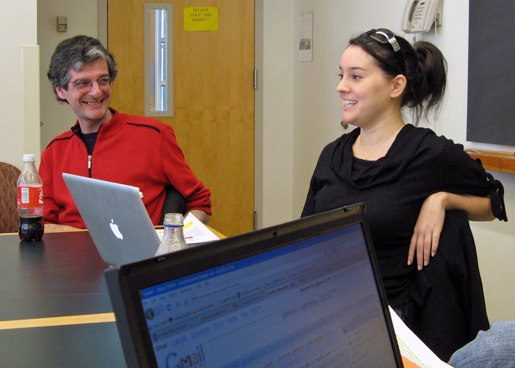
I had the happy pleasure of visiting on Friday with Sheril Kirshenbaum and Bora Zivkovic for a panel discussion in a course at Duke University's Institute for Genome Sciences and Policy.
 ="" p="">
Directed by Dr Misha Angrist, PubPol 196S "Science in the Media" is described in the course catalog as follows:
Those who write about science, health and related policy matters for a general audience face a formidable challenge: to make complex, nuanced ideas understandable to the nonscientist in a limited amount of space and in ways that are engaging and entertaining, even if the topic is far outside the reader's frame of reference. This is even more difficult in a time when acute financial and political crises tend to dominate the ever-shrinking print journalism universe. What, if anything, can writers do to get people to care about science? What does good science writing look like and what can we hope to get from it as readers and as citizens? We will examine different modes of science writing, different outlets for publication, and the peculiar editorial demands each places on the writer. We will consider multiple narrative approaches and various traps into which science writers may fall. Our first goal is to read broadly and deeply with particular attention to science stories as told by the best practitioners in the field. Our second goal is to write: about what we've read, about scientists we've talked to and the science they do, and about the meaning of it all to a public that is simultaneously bombarded by, fascinated with and alienated from science.
(We featured Misha Angrist here last November when the local press covered his participation in George Church's Personal Genome Project.)
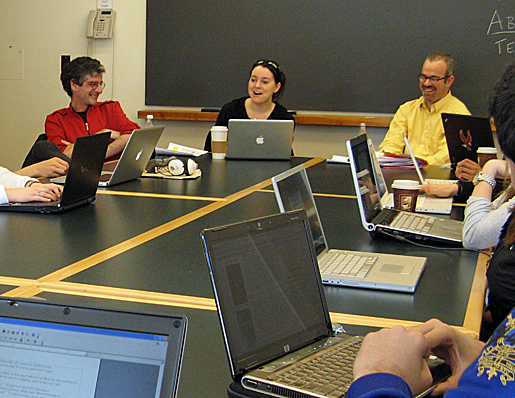
About a dozen students, many on their way to graduate school asked us questions ranging from how Bora got started blogging and developed such a comprehensive handle on the science blogosphere to how Sheril uses her scientific training to communicate policy and write books. Bora tells a moving story of how he left a warring Yugoslavia and translated his equestrian expertise into a career in research and, now, science communication.
Other areas of focus were how one develops a voice and reputation in the blogosphere, with or without a pseudonym (including how a pseudonym might have helped Sheril when an overzealous reader showed up at her building). The discussion also touched on whether practicing scientists have an obligation for public outreach about their work, perhaps via blogs, especially given the accountability expected with NIH stimulus grant funds. We were even fortunate to have Isis (On Becoming a Domestic and Laboratory Goddess) join us online to discuss how important it is to be voice and role model for others "managing to do bench science when you're too pregnant to approach the bench." The most interesting question I received from the awesome students we met was about how personal do I think is appropriate on a science blog. The questioner had read my post eulogizing my Dad and there had been notable discomfort among the class when they learned that despite all the care I put into my science posts, I am best-known for liveblogging my vasectomy.
I hold that I am a blogger who writes mostly about science - I'm still not sure what is a "proper science blogger." One could still see that even my personal posts have scientific content: my post about my Dad talks about his influence in how I became a biologist and the realities of living with substance dependence; my vasectomy post was to get men to sack up and stop depending on their female partners for pharmacological or surgical contraception and provide a forum for men to talk candidly about the procedure.
In the context of the class and in answering Angrist's course question of, "what, if anything, can writers do to get people to care about science?," I feel that close personal experiences engage the reader in learning about science or expanding their worldview about scientific topics.
But even without intentional science content in our personal posts, I submit that we as scientists, and our trainees, can benefit from readers seeing us as just like "real people" with fears, sadness, anxieties, triumphs, deaths, flooded basements, births, worrying about balancing families and work, managing breast pumping and lectures, and everything else that everyone else does.
Many thanks again to Misha for inviting us and to the Duke students for engaging us.
[See this Q&A with Misha Angrist in last week's Duke Chronicle on genomics and privacy]
I think an aspect of blogging science is that it makes it accessible to the layperson, which is what I am. We can interact and ask questions if there is something we do not understand regarding a topic. We can expand on a topic if it is one that we have knowledge in, thereby adding others who are reading a particular thread.
I also think that having science blogs may help with encouraging people to go into the sciences if they discover through reading blogs that ordinary people have the same interests and have made it their work. Kinda a case of "Oh hey, I think I want to do this sort of discipline too!" then off to uni to learn.
I have been reading the scienceblogs for a little over a year. I started out with PZ's and now have ten which I read daily. I discovered them by either seeing them suggested or looking in blogrolls. If I like the writing style and the topics I continue reading, hence the current daily ten.
I have been lurking your blog for about four or five months. I enjoy the topic of pharmacology due to a grandfather who was a pharmacist who owned his own pharmacy, a sister with a PhD in organic chem who is in research for a major pharma, and a niece who is currently a freshman on her way to a degree in pharmacology.
Anyway, enough rambling. I enjoy your blog with its mix of hard science and everyday realities.
Thank you!
More personally-oriented, less science-specific blogs are incredibly important in that they demonstrate that successful scientists can be (relatively) normal people, affected by the same major issues as most everyone else. I hate the misconception of the general population that you have to be a superstar to be a scientist, and I like the feeling of doing something to combat that misconception.
It was a pleasure to share Friday's panel with such wonderful and talented colleagues!
Thank you for including me in your discussion! I had such a blast!!!!
What Candid said. I think it's important for students who may be considering grad school and an academic career to realize that there are a lot of pitfalls, obstacles and assholes to overcome but that these aren't that different from any other profession. I also think it's valuable for students to see that their professors and mentors are (mostly) regular people who lead semi-normal lives and who have interests outside of science.
Sounds like it was really interesting...
i agree with candid and pit. i had no clue what to expect in grad school, beyond "hard work and sacrifice" and whatnot.
also, it's nice to be able to convey myself as a regular human being (with plenty of faults, struggles and life lessons to learn!) first and science as what i chose to pursue for a career.
Abel: As you know, I'm as non-sciencey as one could get but because of this unique experience I've had since tip-toeing into the blogosphere, and because it was started by Physioprof who has all these science blog friends, I've personally been introduced to things I never dreamed I'd be reading about. And I mean that. Now I grant you, much what I do come across is way over my head, but as I jump around from blog to blog I find, surprisingly, a hell of a lot of it isn't. Especially in the areas of substance abuse, etc. And the primary reason it isn't all Greek on those rare occasions when I "get it" (to go to one of the points of your post) is because so many of the bloggers connected to you do, I find, communicate on a personal level... they write not only well but in language that's relatable. And that's huge.
I have found (again, as a doofus laymen) that I'm lured first to a site by the person and the persona, in other words by how that person comes across and how he or she writes (which is that personal touch you talk about), and if they've managed from time to time to be entertaining while splitting the atom, to not bowl me over with lab-speak, I find myself going back to those sites and lo and behold and in spite of myself I've learned something. And this from a guy who not only avoided taking science classes back in the day, but who sprinted passed the doorways to where it was taught!
All that said, I'm not ready to go out, my friend, and buy myself a chemistry set but I hope you get the idea of what I'm saying here. About you writing from time to time not only on a personal level but about personal things. It's a good thing, Abel. And the result is that, because of the internet and its far-reaching possibilities, you guys who blog have not only managed to humanize yourselves and your profession, you've snatched science from the stars and brought it to earth. You've not only created a terrific avenue to communicate and educate each other, but a super highway to educate a non-science audience. And thank you for it!
Jesus... it just hit me. I could've saved a lot of time and said all of the above in this one simple sentence... "What you guys have done is made science cool!"
Cool! Jealous!
Thank you all so much for your feedback and comments, but I especially want to thank Rowan and scribbler for commenting. While I really enjoy the readership of fellow science bloggers, the whole reason I started this was to inform folks like my family or those I'd meet in bars who might have an interest in science and medicine but not be in the fields themselves.
Rowan's point about the blog helping others think about careers is also really important to me. While kids understand what a doctor or nurse is, or a pharmacist like Rowan's grandfather, it's important that our blogs let other know about non-clinical health and research careers.
For CE, leigh, and PiT, I agree that it's really valuable for mid-career folks like me to let others know that, yes, we have stress and insecurities, now and previously in our training. You're not alone and you're not crazy for feeling as you do during your training. I was shocked by the comments of relief and appreciation when I discussed my feelings about my dissertation defense on my anniversary back in November. I had no idea that discussing these things would be of value to anyone.
And scribb, don't apologize for writing such a lengthy comment - you're a writer! Plus, I really appreciate your sentiments. Glad I could be of value in your understanding of the crazy stuff we do.
And, of course, many thanks to Sheril and Isis for being part of the discussion. And Rebecca, we're the ones who are jealous of you!