
Readers who are regulars at Effect Measure or Deltoid will be familiar with the opinions of attorney and author Michael Fumento. Fumento considers himself an avian flu "skeptic," and recently issued a "challenge" (the title, "My avian flu challenge to the leftist bird-brained squawkers", might give you some clue as to its scientific value) to bloggers, in response to one blogger's comment that "... there was a "50%/50%" chance of [an influenza] pandemic in the next year":
I took advantage of Mr. Paramedic's oversight to bet him 10-1, with him picking the dollar amount, that there would be no such pandemic in the next 365 days. Odds of 2-1 would be even, so this is an offer you'd think he'd snap up. So far no reply. Now I'm extending the challenge to all bloggers who've ignored my flawless track record on disease scares dating back 20 years and who have said in no uncertain terms that I've been grossly irresponsible and a total idiot on the subject of pandemic flu.
...Okay guys, put your bucks where your blogs are! Ten to one odds for each of you; each gets to pick the amount in question. I say the year 2008 will roll around and there will be plenty of terrible problems in the world, but pandemic avian flu won't be among them.
 Revere, Mike, Tim, and Revere especially have already ripped much of Fumento's argument apart, so I'm not going to focus on that.* Rather, what people like Fumento do is almost a form of quote-mining. In Fumento's case, he takes the worst case scenario that influenza virologists and epidemiologists have noted--that is, a highly deadly pandemic occurring at any moment--and suggesting that's the consensus opinion, and that anyone who voices any concern about pandemic influenza is a "chicken little."
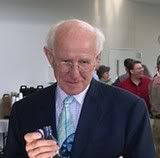
One target of this ire has been virologist Robert Webster of St. Jude's (photo to the left). He recently visited us here in Iowa, and his message was much more tempered than what's been reported in the media. More after the jump.
First, the title of Webster's talk asked whether H5N1 would acheive pandemic status. His answer, despite assertions by people like Fumento, is the same as the vast majority of those who've studied the virus: we just don't know. Indeed, he emphasized just how remarkably little we know in general about the pathogenesis and transmissibility of influenza viruses--and it's the latter that really will be key when it comes to a pandemic strain. He also cautioned that we really need to control interpandemic influenza as well, which is another common refrain. Because we just don't know where the next pandemic strain will come from, it's prudent to do whatever we can to reduce all types of influenza infections, not only exotic ones like H5N1.
Webster also reminded the audience (as I noted here) that, while H5N1 is the "bird flu" that's receiving the lion's share of media (and scientific!) attention right now, other serotypes of avian influenza have circulated recently, including H7N7 and H9N2. During the H7N7 outbreak in the Netherlands, 30 million chickens were destroyed, and there were over 300 human cases of conjunctivitis. There also was evidence of human to human spread, and one death from the outbreak. Additionally, there was serological evidence of H7N7 infection in pigs, which have long been a concern as a potential "mixing vessel" between avian and human-type influenza viruses. The take-home message: H5N1 ain't all that has the potential to become a nasty pandemic strain, and we need to keep our eyes peeled.
However, H5N1 is, of course, the interest of the moment, as it continues to re-appear in Europe, Asia, and Africa. Webster mentioned the live poultry markets, which he feels are a potential breeding ground for pandemic influenza viruses. To combat this, he said that Taiwan is actually planning to shut down their markets in 2008, and Hong Kong is buying back vendors' licenses. Similarly, he reported that China is not re-opening markets in Shanghai and Beijing. It will be interesting to see if this has any effect on disease outbreaks or viral spread.
The discussion moved from the topic of domestic birds, then, to the role of migratory birds in the maintenance and spread of the virus. As far as entry into the U.S., Webster thought that it would be more likely to enter via smuggling rather than carriage in wild birds. However, he also noted that the situation in wild birds is, well, scary. (My characterization, not his). In some experiments with H5N1, they've noted that, even if the virus is pathogenic initially for ducks, variants are quickly selected with lower pathogenicity. These variants are fairly stable in the environment, and can be shed by the ducks for an extended period of time. Additionally, they are still virulent in domestic fowl (including chickens) and in humans. Additionally, H5N1 is shed not only from the intestinal tract in ducks (where influenza viruses are typically carried in waterfowl), but also in the respiratory tract.
Therefore, the ecology of this virus potentially presents a perfect storm in some areas of the world. In Thailand and Vietnam, for example, they use domestic ducks to graze in rice paddies. These ducks are often transported into the country, which is itself a way to potentially introduce H5N1 into new areas. Webster also noted another cultural phenomenon related to ducks, which is the consumption of dishes containing duck blood (apparently, these are good for hangovers!), particularly in Laos and Vietnam. This has previously been identified as a risk factor for contraction of H5N1, but it's difficult to convince people to give up cultural practices.
What about the vaccine? Webster noted the ongoing ecologic experiment in Vietnam, where they vaccinated all poultry for H5N1. This reduced cases for awhile, but currently have experienced new cases in poultry, with worries about new human cases as well (thus far unconfirmed, to my knowledge). However, problems with the vaccination strategy they used in Vietnam were that 1) it wasn't standardized; much of it was "home brew" vaccination, where local areas or even farmers made their own, and 2) that the vaccines typically didn't work well in geese or ducks. Still, their limited success despite these drawbacks show that, if vaccination is done properly, it does have the potential to stem a pandemic.
Webster wrapped up detailing some experiments showing that recombination of H5N1 with the human H3N2 strain led to only limited replication and transmission in the ferret model of disease. However, different results may be obtained by using different strains, or mixing and matching different genes from the viruses. We just don't know what the "optimal" combination would be for a human pandemic, and all the permutations realistically can't be tested. At least so far, however, it seems that human-to-human transmission isn't easy for H5N1, but Webster said, "God help us if it does--we're going to have a mess." He noted many things that I've also highlighted previously; that, if a pandemic were to happen, hospitals would be pushed beyond surge capacity, the young could be hit hardest if the "cytokine storm" the current strains of virus produces would persist; and that we simply don't have the facilities or abilities to produce a lot of vaccine, quickly, in the event of a pandemic. But nevertheless, contrary to how he's been portrayed in the media as a "scaremonger," Webster simply urged against complacency, and noted that he himself has several months' of food and water stored for an emergency (though apparently, it took a bit to convince his wife to take him seriously!)
All in all, a very entertaining, practical, and prudent talk--for a "chicken little."
*The problem is, of course, that biology just doesn't work this way. It's not a lottery where one puts in a certain number of balls, which sit unchanged until someone draws. It's not even a game where all of the players can be largely defined by statistics and injuries. The probability of an influenza pandemic is affected not only by the accumulation of changes in circulating influenza viruses--it's also a property of changing human behaviors that can make a pandemic eiither more or less likely to occur.
Tara: Nice post. I heard Webster about 6 months ago say the same things. In the meantime he published a summary of the H5N1 stuff with Govorkova in the New England Journal of Medicine (free access for this article I think) which is a marvel of concision and worth the read no matter how much you know about H5N1 but even better if you don't know that much. I commend it to your readers. Here is the link: http://content.nejm.org/cgi/content/full/355/21/2174
My post on it here (apologies for link whoring).
Thanks, Tara. A thoughtful and informative post.
If and when a pandemic occurs, it will be the foresight of Webster and "leftist bird-brained squawkers" like him that get all of us through it.
How is prepping for a flu pandemic "leftist?" That is completely nutters. The only connection that I can even see is that the current funding priorities are for bioterrorism, when a flu pandemic could be far more serious than an outbreak of nearly any biological agent.
Wonderful post, Tara!
Thanks.
This really is a terrific post. Go figure that a straight-down-the-middle-dissection of junk science won't get a lot comments but it can bring out lurkers like me.
Nicely done!
wonderful post. I have to add that Fumento was fired from one of the blogs (winds of change) that he bloviates at. Of course, I was one of the targets, but the issue was not me, it was his fact-challenged assessment of Flu Wiki. Far, far more important than anything Fumento says is everything Webster says.
Thanks again for the post.
Excellent post, Tara. Of course, you always have really good posts :-)
Tara,
Well said. I must admit that when I first ran across Fumento's strident blather, I was ALMOST irritated enough to attempt to set him straight-- an exercise doomed from conception, no doubt. My ire quickly subsided to amusement, however, and I got on to more important tasks; there was laundry to do.
With two decades of medical practice in my back pocket, I am still intrigued by the statistics the so-called experts attach to the probabilities of human health (eg, "the lifelong risk of acquiring this-or-that condition is such-and-such.") It's only fitting that the amateurs toss around some numbers, too.
One thing remains certain, though (and this applies as much to our friend H5N1 as it does to, say, malignant melanoma): No matter what the odds may be, if "it" happens to YOU, it's a 100% certainty...
Hi Tara,
Slightly OT. Do you think that a country can, or does, own a virus? The Indonesian government are currently complaining about the development of an H5N1 vaccine by an Australian company (contracted to the Australian Govt) that used an Indonesian strain of the virus. The strain, incidentally, was obtained from the WHO.
The nub of the matter seems to be Intellectual Property rights and $$, as Indonesia is currently working with a US company (Baxter?) to develop a similar vaccine.
Mind you, the Indonesian Govt could be opening themselves up for some serious litigation if "their virus" jumps the fence and bites a neighbour.
Cheers.
that was strange, how Webster suddenly switched to
a "no one knows" - strategy last year just after giving
his estimates multiple times openly in public before.
Maybe they told him to stop this.
Maybe he suddenly lost his knowledge.
No one knows.
So, no one knows, whether Webster is any more competent
to give a panflu-prediction than Fumento.
...and Dem, Webster says ... nothing.
(no one knows)
So , how can this be more important than ...
anything , (including Fumento) ?
Time for a logic - check.
You're conflating several different things here. No one knows if H5N1 will become a pandemic strain. I've not seen Webster contradict this, though he may have voiced his own opinion on whether it would or not. The estimates, however, refer to potential numbers (cases, deaths, etc.) IF H5N1 or *any* influenza strain became pandemic. These numbers are based on models from prior epidemics, with the 1918 scenario being essentially "worst case" (the numbers that usually make tne news write-ups, because they're the splashiest). Surely you can see the difference?
no one can be 100% certain at this moment, whether there will be a(nother)
pandemic or not. (although Osterholm says 100% and some say:"not if but when")
Of course. No clairvoyance.
But that's not what Webster says. He implies, that it's principally impossible for anyone to
give a reasonable probability estimate of a pandemic happening (within some timeframe
- say 5 years).
That's not what he implied earlier. It doesn't make sense either.
These common estimates, "if" a (H5N1)-pandemic is assumed, how bad it would be,
and then referring to 1918,1957,1968 are pretty useless, because H5N1 is quite different.
1918 is not the worst possible case according to many expert statements.
I think most would agree "not if but when." Influenza pandemics have reappeared over and over in human history; I see no reason for there not to be another one at some point. 5 years, 10 years, more? That's less certain.
I think perhaps you're confusing Webster's comments with the ones from Fumento's post above. Webster didn't lay odds at all.
Well, okay, I suppose it can theoretically get worse than the morbidity and mortality from 1918, but once you get to that much death and social disruption, "worse" starts to get a bit meaningless. But, point taken--I suppose the theoretical "worst case scenario" would be more a la The Stand than Spanish flu. And granted, H5N1 is different, but we have to start somewhere as far as estimates and extrapolation. 1918, 57, and 68 are what we have to go on at the moment as far as pandemic influenza.
Tara C. Smith wrote:
>
>> no one can be 100% certain at this
>> moment, whether there will be a(nother) pandemic or not. (although
>> Osterholm says 100% and some say:"not if but when")
> I think most
> would agree "not if but when." Influenza pandemics have reappeared
> over and over in human history; I see no reason for there not
> to be another one at some point. 5 years, 10 years, more?
> That's less certain.
human history changed dramatically the last century.
Great advances with vaccines were made in the last years. Also genetics,
nanotech. Universal flu-vaccine is possible in 10 years.
Mankind could die by metor, nuclear war,.. before a pandemic
gets a chance. Nothing is 100%.
In this case not even 90% IMO.
>> But that's not what Webster says. He implies,
>> that it's principally impossible for anyone to give a reasonable
>> probability estimate of a pandemic happening (within some timeframe
>> - say 5 years). That's not what he implied earlier. It doesn't
>> make sense either.
> I think perhaps you're confusing Webster's
> comments with the ones from Fumento's post above.
> Webster didn't lay odds at all.
hmm... Could it be that you had missed it ? For me the most important event
last year. You have a blog-entry, one page long about Webster, links back
to his statements from 2005 but missed this one :
http://abcnews.go.com/WNT/AvianFlu/story?id=1724801
There are "about even odds at this time for the virus to learn how to
transmit human to human," ..."Society just can't accept the idea that 50%
of the population could die.And I think we have to face that possibility"
How could it be ? revere also posted here and tries to avoid -
he had a blog entry back in 2006 about it , instead links to
Webster's nejm-article.
My thread about chances of a pandemic was deleted from Fluwiki,
my probability posts can't be found with effectmeasure search , what's
going on , conspiracy ? probability deletion ? taboo creation ?
>>These common estimates, "if" a (H5N1)-pandemic
>>is assumed, how bad it would be, and then referring to 1918,1957,
>>1968 are pretty useless, because H5N1 is quite different. 1918
>>is not the worst possible case according to many expert statements.
>
>Well, okay, I suppose it can theoretically get worse than the
>morbidity and mortality from 1918, but once you get to that much
>death and social disruption, "worse" starts to get a bit meaningless.
> But, point taken--I suppose the theoretical "worst case scenario"
> would be more a la The Stand than Spanish flu. And granted, H5N1
>is different, but we have to start somewhere as far as estimates
>and extrapolation. 1918, 57, and 68 are what we have to go on
>at the moment as far as pandemic influenza.
but >60% mortality actually with H5N1, endemic in birds,
H5 not seen before.
1. I was not "fired" from Winds of Change, I told them I quit over their policy of insisting that I respond to any and all comments on my postings, including one that indicated I was gay because I used the word "blow." Meanwhile I was providing free work product to a website that judging from its advertising makes a tidy sum.
2. Since my 1987 article "AIDS: Are Heterosexuals at Risk," I have been taking on alarmists like Robert Webster and in each and every case I have been right and they have been wrong. And, as a rule, once they have been proved wrong they simply disappear back into the woodwork and nobody holds them accountable. This is regardless of how high their position or how extreme their warnings, such as HHS Secretary Donna Shalala's 1993 insistence that every man, woman, and child in America is at risk for AIDS. This pattern of gross irresponsibility, attacks on me for MY alleged gross irresponsibility, and no discredit to the alarmist will be repeated with Webster.
MichaelFumento,
seems that for you this is just one possible
disaster-threat in a chain of several and you
just apply your experience-statistics to it.
But this time it's different. It's not just a few experts who are warning, but the majority of them.
Including WHO,CDC.
your:
"the odds of H5N1 becoming pandemic in the next ten year to be a tiny fraction of 1 percent"
is not supported by any experts AFAIK.
The most moderate expert that I'm aware of is Palese
but even he seems to consider it much more likely than you.
1. It's a matter of record that I QUIT the Winds of Change blog because they were insisting that I respond to every single comment, including those that implied I was gay because I used the word "blow." I had better things to do, thank you and Winds of Change, while making good advertising money, pays its writers nothing. Since I hadn't been hired, I couldn't very well be fired.
2. Second, in such a long blog it's remarkable that there was no mention that, as I have repeatedly noted in blogs, Webster stated in the New England Journal of Medicine last year that it is alarming that human cases of H5N1 contracted from birds are continuing to increase. Yet if you follow the WHO reports, human cases this year have continuously lagged those of last year. Insofar as the plurality of human H5N1 cases come at the beginning of the year, it appears likely that for the first time in four years there will actually be a decrease in human cases from the year before. If it was so alarming when we were seeing MORE cases, how should we interpret it when we're seeing less?
See if you have the ability to look up the WHO URL to see for yourself. Maybe I should bet you 10 to one that you don't!
Oh man I remember you, youre the guy that mocked Dr. Garth Nicolson when he found Dr. Shyh Ching Lo's mycoplasma incognitus in the blood of Gulf war vets!
Every animal that Dr. Lo injected with this microbe died, this doesnt happen in HIV hepatits C etc. He did not find in healthy controls. The animals that died only had a weak antibody response when near death, so you need to use the PCR to find this microbe, not antibody testing. Here is a summary of Lo's work.
http://www.aegis.com/pubs/atn/1990/ATN09501.html
Dr. Garth Nicolson has written a riveting book where he had confidential sources who told him it was part of the bioweapons program. Darn Good book.
http://www.projectdaylily.com/
You should apologize for trashing him and saying that all the Gulf war vets symptoms were just psychological, they had Lo's mycoplasma incognitus in their blood, abnormal brain scans, and many other symptoms that couldnt be explained by stress.
The estimates, however, refer to potential numbers (cases, deaths, etc.) IF H5N1 or *any* influenza strain became pandemic. These numbers are based on models from prior epidemics, with the 1918 scenario being essentially "worst case" (the numbers that usually make tne news write-ups, because they're the splashiest