

"There is a single light of science, and to brighten it anywhere is to brighten it everywhere." -Isaac Asimov
One of the most spectacular and successful ideas of the 20th Century was Einstein's General Relativity, or the idea that matter and energy determines the curvature of spacetime, and the curvature of spacetime in turn determines how gravitation works.

Image credit: Hyper-Mathematics - Uzayzaman / Spacetime.
From the orbits of planets to the bending of starlight, General Relativity governs all gravitational phenomena in the Universe, and accurately describes every observation we've ever made.
And the more concentrated energy is -- in any form -- in a given region of spacetime, the more severe the curvature that results. This means that if we can probe systems that are more extreme than we find in our own Solar System, we can potentially observe some aspects of General Relativity that are only theoretical predictions at this time.
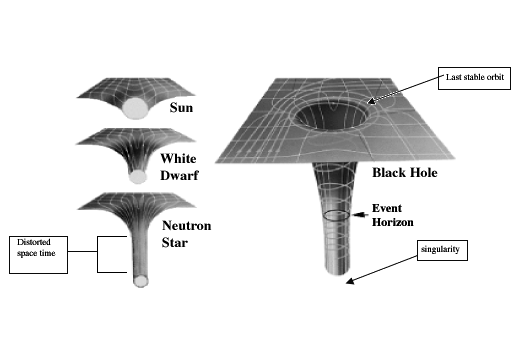
Image credit: NASA.
While our Sun curves spacetime significantly enough to do things like bend starlight and cause a time-delay in communication signals, there are examples in the Universe that allow us to have a lot more fun with General Relativity.

Image credit: ESA and NASA.
In particular, white dwarfs -- like Sirius B, illustrated above -- condense a Sun's worth of mass into a volume of only the Earth, creating spacetime that's curved 100 times more severely than at our Sun's photosphere. One of the most extreme things that happens in our Universe is that we find multiple white dwarfs orbiting one another, creating a binary white dwarf system. (Binaries are very common; although our Sun isn't a binary system, our closest neighboring star is!)
According to General Relativity, these binary orbits are inherently unstable, and will eventually spiral in towards one another, coalescing, and eventually triggering a Type Ia supernova!
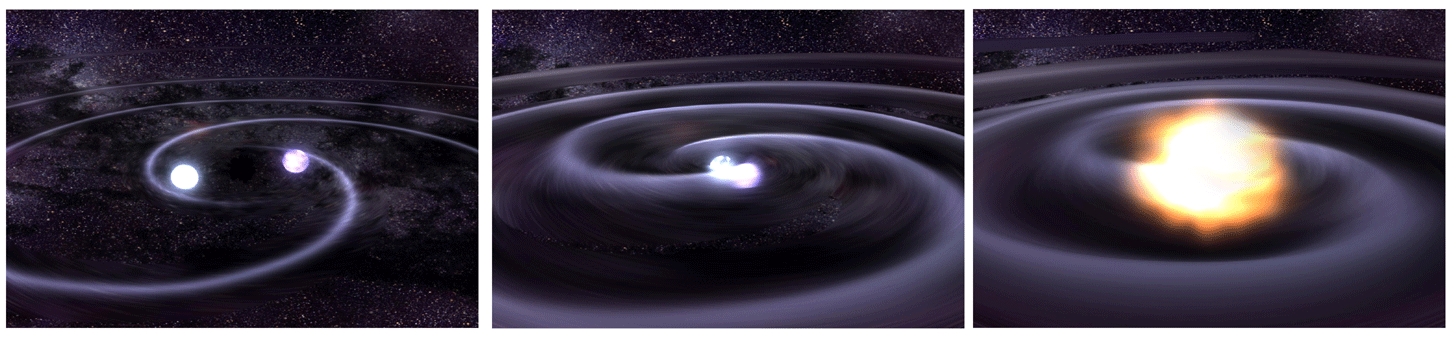
Image credit: NASA / Dana Berry, Sky Works Digital.
But objects that fall deeper into a gravitational potential well must somehow lose all that gravitational potential energy; where does it all go?
According to General Relativity, it gets radiated away, but not in the conventional form of radiation. Not in the form of known particles like photons and neutrinos; instead, this is a special type of radiation: gravitational radiation or gravitational waves.

Image credit: NASA.
Rippling through spacetime at the speed of light, these gravitational waves should be emitted each time a pair of masses orbits one another or each time a rotating object changes its shape. White dwarfs provide an increased curvature to spacetime compared to our Sun, but the most severely curved spacetime comes from neutron stars (which are a further factor of 1000 smaller than white dwarfs) and, in the most extreme case, black holes.

Image credit: J.M. Weisberg, D.J. Nice, and J.H. Taylor.
All that's missing to complete the picture is a direct detection of this gravitational radiation. It's challenging, because a gravitational wave, when it passes through an object, only distorts its shape in this weird way, as the animation below shows.

Image credit: Markus Pössel of Einstein Online.
It appears to make a normal-shaped object first squished and fat, then normal again, then thin and stretched, then normal again, etc. Because all of spacetime is undergoing this, the object itself may have extraordinary difficulty noticing it, but there's no problem with seeing it for an outside observer.

Image credit: Auriga from the INFN in Italy.
On the other hand, this is happening in three-dimensional space, not in an idealized 2-D case, and they're coming from a source that is (probably) elliptical, rather than circular, in nature. So we have to take those things into account when we're looking for gravitational waves in reality.

Image credit: Markus Pössel of Einstein Online.
But the biggest problem with detecting them is that these gravitational waves are maddeningly weak. The amount of stretching/compressing that occurs in one direction relative to another is so small that, for even the Nobel-prizewinning binary pulsar, the number would be just 10-26, meaning that a 1-meter object would stretch/compress by 10-26 meters as a gravitational wave passed through.
So we fight this from two different angles: we look for sources that are even more powerful than the inspiraling neutron stars we talked about earlier, and we try to build detectors that are sensitive to the tiniest change in distance possible. The detector setup is known as an interferometer.
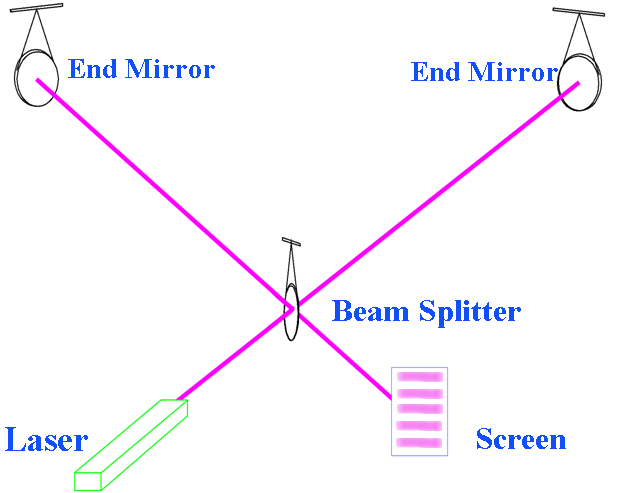
Image credit: LIGO/LSC, retrieved from albert.phys.uwm.edu.
Shine a monochromatic laser through a beam splitter, and send the two light beams off at 90 degrees to one another. This ensures that if a gravitational wave passes through, one "arm" will contract while the other expands, and vice versa. If the shift is sufficiently large, the interference pattern that shows up on the screen will shift in a predictable fashion, as dictated by General Relativity!
In practice, we have a few stations around the world that use this concept with two additions:
- The entire apparatus is incredibly insulated from vibrations, motions, temperature variations, etc., here on Earth, and
- They bounce the light back-and-forth along mirrors many times to artificially increase the path length.

Image credit: Ricky Geautreaux, Aero-Data Inc., Baton Rouge, LA.
This is what the LIGO collaboration/experiment, or Laser Interferometer Gravitational-Wave Observatory, is all about.
The difficulty is that it's only sensitive to signals stronger than about 10-20, which is a very big number in this field, and it's only sensitive to very fast frequencies, or gravitational wave signals that repeat hundreds of times per second. The only astrophysical sources even capable in theory of being detected by LIGO are neutron star-neutron star mergers (not inspirals), neutron star-black hole mergers, black hole-black hole mergers, or a very fortuitous Type II (core-collapse) supernova.

Image credit: Amber Stuver of Living LIGO.
Unfortunately, this does not include the most common black hole mergers in the Universe: the ones occurring at the galactic center. They're so supermassive (and hence, their event horizons are so large) that they simply cannot be detected by the frequencies LIGO is sensitive to; the wavelength of the gravitational radiation will be too long for LIGO's "arms".
What makes this even more challenging is how close these (very rare) objects need to be to us in order to even have a shot at their gravitational waves. You see, the further away you are, the smaller the signal becomes. As always, we could get lucky.

Image credit: Dr. Christopher Burrows, ESA / STScI and NASA; Hubble Heritage team.
In 1987, the light from a Type II supernova that went off in the Large Magellanic Cloud reached Earth for the first time. It wasn't quite within our Milky Way, but it was close: just 168,000 light years (about 51 kpc) away. If LIGO was fully operational at the time, depending on the correct model for gravitational waves from Type II supernovae, it could have been detected.
Maybe.

Image credit: Harald Dimmelmeier, José A. Font, Ewald Müller, and Markus Rampp.
You have to get your amplitude up, at the proper frequency, into the detectable range. And it's difficult to know whether that's going to happen or not. After all, there are uncertainties here, and difficulties in modeling how something as complex as a supernova occurs!

Image credit: Davis Dulin of NC State, using an MHD simulation with genASiS.
Although supernovae are copious throughout the Universe, finding one within the 10 kpc (about 30,000 light years) normally used in simulations is an extremely rare occurrence, having happened maybe 9 times in recorded history, and only 2 of which were type II.
So rather than wait for the Universe to come to us, we can do something about it, and expand our sensitivity, which is exactly what LIGO's working on doing right now.

Image credit: H. Dimmelmeier, J. A. Font, & E. Müller (2002).
Expanding our search by upgrading to advanced LIGO should allow us to detect objects that are more than an order-of-magnitude farther away, while close by, we should be able to detect lower-amplitude objects.
One illustration of how the search expands from LIGO-in-its-current-form to the anticipated (2014) advanced LIGO is shown below, courtesy of David Shoemaker.
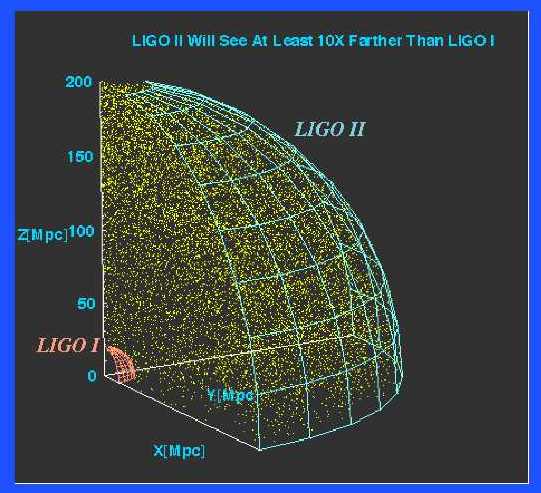
Image credit: David Shoemaker for the Advanced LIGO (LIGO II) Collaboration.
This may sound promising, but remember that our galaxy has had only 2 type II supernovae in the past 2000+ years, while the rate of binary mergers of collapsed objects is unknown but possibly far lower. Expanding our search range by a factor of between 10-to-maybe-50 (optimistically) could, conceivably, give us a few detections per year, but we could also see zero, and that wouldn't be surprising either. (Right, Clara, Sean, Nick?)
The fact of the matter is that LIGO isn't the ideal tool for the job of finding gravitational waves: LISA is, but we didn't fund it. Famous astrophysicist Kip Thorne may be predicting that LIGO will find gravitational waves by 2017, and this may happen, but it's unnecessarily optimistic. Advanced LIGO should come online in 2014, and assuming it reaches design sensitivity immediately (it took the first LIGO many years to get there), the event rates are on the high end of estimates, and the optimistic gravitational wave models are accurate, we'll definitely see multiple sources by 2017. Also, Kip Thorne will probably win a Nobel Prize; he'll be 77 in 2017.
But if even one of those assumptions is flawed, we have every reason to believe that gravitational waves still exist, and that Advanced LIGO won't see them. It's a spectacular chance for gravitational waves, but if we don't see them, it doesn't mean that relativity is wrong; it means we need to build a better tool for the job. I'm hoping this works as ideally planned, that it's working perfectly in 2014, and that we enter a new era of gravitational-wave astronomy. But if this isn't our entry, I'm not going to be surprised either, and neither should you.
The science is amazing enough without the sensationalism.
Hi Ethan,
great article as usual. A question tough. What would be the scientific benefit of discovering gravitational waves? I mean, would it shed some new light in GR? Or is it just for "kicks". Looking at NSF's site
"Cost: LIGO is the largest single enterprise undertaken by NSF, with capital investments of nearly $300 million and operating costs of more than $30 million/year." And I found some sheets for advanced LIGO which go as far as $600 million (tough am not sure they are accurate). Am just wondering if cost/value is there, especially given the chance it might very well do nothing. This isn't about feeding africa, but think there could be much better astro projects for that ammount of money?
What I don't understand about these gravitational wave detectors which use light intereference: shouldn't the wavelength of the light get stretched/compressed by the gravitational wave, too? Whoch would lead to a cancellation of the effect, so we wouldn't see any interference at all?
The light that goes one way travels a different gravitational path than one that travels the other way.
Think of the aether that would have shown up as interference patterns in the Michelson-Morely experiment.
I just want to say thanks, for one of the tidiest explanations of gravitational waves I've ever read! :)
"A question tough. What would be the scientific benefit of discovering gravitational waves? I mean, would it shed some new light in GR?"
It will prove that gravity is propogated at the speed of light.
Why the speed of light? That speed falls out of Maxwell's Equations which don't address gravity at all. Is it simply that they can't go any faster? That's not very satisfying.
Light is affected by a gravitational field, Rob.
A light-like line travels the shortest path between two points which for a non-euclidian geometry is not a straight line.
Therefore you get a different line travelled. Which means a different length of line.
Oops. Pressed enter early.
Now what if some mass moves. Since it produces a gravitational field, the gravitational field will change. If that change propogates faster than light, you'll know that that mass moved.
Information travelling faster than the speed of light?
A bit of a problem re: causality.
Because that change could be affecting the same photon several times.
@ Ethan -- The merger of the two objects in a binary neutron star (BNS) system occurs at a gravitational wave frequency of ~1500Hz, which is far above the most sensitive band of the instrument. This means that the majority of the power from a BNS signal will come from the inspiral, spread out over the last half hour of its life.
When the interferometers are at design sensitivity, they should be able to detect BNS systems out to a few hundred Megaparsecs. Making the first detection is not an easy task and the universe could be unkind, but these instruments are definitely the right tools for the job.
@Wow:
"The light that goes one way travels a different gravitational path than one that travels the other way."
This does not answer Bjoern's question (and also mine).
There's no difference between stretching lengths of LIGO-arms and stretching of LASER-wavelengths.
To my opinion both should generate no effect...
@Ethan:
Could you perhaps explain this very special point explicitly?
Thanks a lot.
Best regards.
"To my opinion both should generate no effect…"
OK, lets think here. Why do you think they are doing this if they know there isn't going to be an effect?
It got me for a while too..
Think of this.
The "straight line" between here and a galaxy that is being gravtationally lensed is straight through that galaxy, right? But the line taken by light is a detour AROUND that galaxy or mass in the middle.
So the physical straight line isn't the light straight line.
Therefore they travel different distances.
This from the wiki may help:
"When a gravitational wave passes through the interferometer, the space-time in the local area is altered. Depending on the source of the wave and its polarization, this results in an effective change in length of one or both of the cavities."
Note the "depending on the source... one or both of the cavities".
@ Wow
Am unclear on some aspects of gravity and what GR gives as opposed to purely Newtonian concept. And it deals with speed. Did some research (not all of which I fully understand). So if you could bare with me and try to explain if you can.
Namely, there seem to be a difference between gravitational waves and gravity as a force. According to GR gravity is curvature of spacetime caused by mass/energy, and wave is a wave. That's ok. And everyone seem to agree that gravitational waves should travel at the speed of light. That's ok too.
Now the part which I have difficulty with. In Newtonian term, gravity as a force is instant. I can't seem to find what GR says on the subject or if it covers it at all. If gravity as a force (or as curvature) is indeed limited to "c", does that mean if i.e. we remove the Sun from the solar system, it would take a certain amount to time for planets to "notice" that. In case of earth 8 minutes or so?
This seems a bit bizzare. That they would still orbit like they do now, even without the sun being there, untill the information (traveling at the speed of light) that the gravity source isn't there anymore, reaches them?
I also found this reference: "anyone with a computer and orbit computation or numerical integration software can verify the consequences of introducing a delay into gravitational interactions. The effect on computed orbits is usually disastrous because conservation of angular momentum is destroyed."
And this: "“If the Sun attracts Jupiter towards its present position S, and Jupiter attracts the Sun towards its present position J, the two forces are in the same line and balance. But if the Sun attracts Jupiter toward its previous position S’, and Jupiter attracts the Sun towards its previous position J’, when the force of attraction started out to cross the gulf, then the two forces give a couple. This couple will tend to increase the angular momentum of the system, and, acting cumulatively, will soon cause an appreciable change of period, disagreeing with observations if the speed is at all comparable with that of light.” (Eddington, 1920, p. 94)"
I hope you understand what my question/dillema is. And really hope you or someone with sound physics background can shed some more light to this. This isn't so much a question about gravity waves as it is about gravity as a force or curvature. Is it instant? Or is it somehow a finite number yet many orders of magnitude above "c"? If spacetime can in fact "move" faster than "c" as in expansion, and gravity is somehow a fundamental property of spacetime, then it too might not be limited to "c". I don't know :) Hope someone can help me understand
Thanx!
@Wow:
I'll try it differently, using the ART:
1. Varying gravity alters the actual speed of the light within the LIGO-arms, differently per arm.
2. Varying gravity does not stretch or shrink the LIGO-arms themselves.
Is that correct?
Best regard.
@Sinisa Lazarek:
With GR the coordinate system has been changed in such a way that it seems, as if gravity would be "instant", no aberration --- as long as you do not change masses abruptly --- you may only accelerate them, which produces gravitational waves...
If you use gravity-runtime you have to do this in usual 3D space coordinates --- then you have aberration and you will get the same effects as with GR, but more difficult to calculate...
Best regards.
@ SCHWAR_A
I agree that all of our experiments and observations show that it acts as if it is instant. What I don't understand is how can that be physicaly. What is instant? Every force needs to propagate in some sense of the word. That propagation can't be instant. I mean wouldn't that violate causality in some sense?
Problem is you ought to be using "Event" for this.
"That propagation can’t be instant. I mean wouldn’t that violate causality in some sense?"
Yes, it would.
It would also mean that gravity cannot be mediated by gravitons, since they can't go faster than light.
"2. Varying gravity does not stretch or shrink the LIGO-arms themselves."
That is not correct. The stretch is different, but exists for both. Otherwise you'd not need an L shaped interferometer.
Light shifts frequency up when going down a gravitational potential, shifts down when going up.
The etalon in the arms of LIGO will select for the shift one way but not the other.
Therefore if each arm sees a different gradient of gravitational wave, it will select or deselect differentially.
And the recombination of that light will no longer completely cancel out, even if it ends up shifted PRECISELY back to the frequency it had.
It's a little odd when you think about it, but you do get to see the effect can work.
@Sinisa Lazarek:
"how can that be physically"
It is mathematically and thus in physics correct.
If you change your GR space-time coordinate system into "your physical" 3D space you get back your expected propagation time, and also aberration...
I have done such transformation some time ago (in german) and calculated a binary mass system in usual classical 3D space with propagation and thus with aberration of gravity, and I even got the acceleration of the masses as in GR --- more exactly, the exact gravitational redshift formula...
Best regard.
@Wow:
" The stretch is different"
Could you explain how the LIGO-arms' materia is affected by the gravitational wave?
Best regards.
http://www.scribd.com/doc/58496226/Detecting-Fractal-Dimensions-via-Pri…
Same way as any other material is affected by a gravity well.
@Bjoern, SCHWARZ_A: The point, which I don't think Wow is explaining clearly, is that the stretching is not isotropic: one direction is being stretched while the perpendicular direction is being compressed. (The leading term in the far-field expansion of gravitational radiation is the quadrupole term, which is part of why the waves are so weak.) Thus, if the polarization of the wave is favorable, LIGO will measure an effect. However, if we have the bad luck of an otherwise detectable wave linearly polarized at a 45 degree angle to the arms, LIGO will see nothing.
The Michaelson-Morley experiment had a similar issue, which the experimenters addressed by making their apparatus rotatable. They established that there was no effect for any orientation of their apparatus. But they were doing a lab experiment, so they had that luxury. Astrophysicist often have to wait for something to happen in order to test their theories, particularly when violent events (e.g., SNae or black hole mergers) are involved.
"The point, which I don’t think Wow is explaining clearly, is that the stretching is not isotropic"
It's a bit of a problem finding an explanation for something you thought was kind of obvious, especially if you're not entirely sure of the right words to use.
Ta.
@ Wow
"Problem is you ought to be using “Event” for this."
Not sure I understand to what you are referring. Use "event" for what? And what do you mean by "event"? Am not a physicist, so some phrases I might not be familiar with.
What I did find with confidence is that however we arrange it, light and gravity do not propagate in the same way. There is no abberation or anything similar.
@ SCHWAR
"If you change your GR space-time coordinate system into “your physical” 3D space you get back your expected propagation time, and also aberration…"
well, this is what I don't understand. We do not have any physical aberration in gravity. If there was, we would see orbits decay. Correct?
Bjoern (and Schwar_A and others),
Of course, we cannot know for sure whether there will be a fringe-shift due to a passing gravitational wave, as we've never yet successfully tested it. However, this is not a question of whether the wavelength of light stretches or not as a passing gravitational wave stretches space (it does), but a question of whether, over time, you build up a phase shift.
And the way it works is pretty straightforward: when the incoming gravitational wave encounters the interferometer arm, the light leaving the beam splitter left it unstretched, but then the path length the light travels changes, becoming longer, the original length, shorter, the original length, etc.
But we are using light as a clock, not really as a ruler, and the phase shift due to the lengthening/shortening of the interferometer arm is real, and therefore so is the shifting interference pattern.
There is a paper (published 1997) I can point you to, if it helps explain things better: http://gw.aei.mpg.de/images/Saulson_1997AmJPhys_65_501.pdf
Good explanation Ethan, it helps. But so many questions still.
Kaluza-Klein and others (e.g. Weyl, string theory) have somewhat successfully combined GR and EM. The spin = 2 of graviton pops out of string theory; does the speed of gravity = c pop out of the mathematics of any of these theories or is it always inserted by hand?
Is there any other way of finding a graviton other than by finding a cosmic event's gravitational wave? Are there any desktop quantum experiments or particle accelerator experiments that might detect a graviton?
Gravitons are not part of the standard model of elementary particles; so in the various extensions to the standard model what other things are hypothesized (e.g. extra dimensions, extra particles) besides gravitons?
Are LISA and the other gravitational waves experiments capable of detecting (indirectly) any other things hypothesized by extensions to the standard model. Specifically, might LIGO or eLISA find evidence of extra dimensions without evidence of gravitational waves? Or are LIGO and eLISA single purpose experiments?
Any thoughts will be appreciated. Yes, yes, I don't understand and my questions are probably naive. Thanks for any education.
"“Problem is you ought to be using “Event” for this.”
Not sure I understand to what you are referring. Use “event” for what? "
Here's a clue. It was *immediately* after your post:
"I agree that all of our experiments and observations show that it acts as if it is instant. What I don’t understand is how can that be physicaly. What is instant? Every force needs to propagate in some sense of the word"
Now, what do you think "event" would be better used in?
"Are there any desktop quantum experiments or particle accelerator experiments that might detect a graviton?"
Only if you can think of a way to spot the quantisation of such an event.
Given the difficulty of finding the value of "e" when it relies on the electromagnetic force which is (IIRC) 10^19 times bigger, I think you'll see the problem right there...
"What I did find with confidence is that however we arrange it, light and gravity do not propagate in the same way."
Well, yes.
One is the force carrier of electromagnetism and the other the force of gravity.
Since they're different effects, they won't propogate the same way.
What, precisely, do you think this reveals?
@ Wow
still don't understand the "Event" reference but ok :) Not an englishman so it might be grammar related.
as for this: " light and gravity do not propagate in the same way.”
Well, yes.
One is the force carrier of electromagnetism and the other the force of gravity."
Ok, I'll refrase... the EM field and gravitational field. But please, let's not discuss semantics. I'm interested in the inner workings of gravity as described by GR. Especially SCHWAR's sentence (because this is also what I came across): " as long as you do not change masses abruptly"
But as a thought experiment, let's say we change it abruplty. What would happen? Would the space instantly become uncurved everywhere? If so, how can that be? (my original question). Thanks in advance.
@Sinisa Lazarek:
...see here...
Best regards.
"still don’t understand the “Event” reference "
OK, try here:
http://www.phy.syr.edu/courses/modules/LIGHTCONE/events.html
Not sure what the native language version would be for a non-English speaker, mind.
But "instantly in some sense" defines a light-like path from one event to the observer of that event, or the light like path between two events.
"Instantly in some sense" means "not instantly". I.e. at the speed of light. I.e. you could not have seen it happen any earlier.
The problem is you have used a term you already have had to make not merely wooly but furry: "instantly".
Talk of events in spacetime. If you can't put your scenario accurately, you cannot get an accurate answer. At best, you'll get answered by 100 more questions, more likely, the right answer to the wrong question.
"But as a thought experiment, let’s say we change it abruplty. What would happen?"
The information about that change cannot under standard causality propogate faster than the speed of light.
The sun is 8 light minutes away. What we see is 8 minutes old. And the same would be the same of gravity.
Spinning masses "see" the other mass slightly behind where it "really" is, since it sees an event that is slightly older than "now" when it occurs on that other body. And vice versa.
This means that from the POV of the center of mass of the binary system, they don't actually orbit each other as a simple non-GR-accounted binary system would.
Just like we could see with Mercury and our sun.
And that means that we see a variation between the gravity information passed on, getting higher or lower at the frequency of the rotating system.
A wave in the gravitational field.
Gravitational waves.
Thanx for the link Wow and Schwar. Will read and go over them and will keep you posted. Am sure I'll more questions :)
As for "event", I know what it means in everyday talk, of course. Didn't know what it means as a technical term in relativity. Now I will :)
Thanx again for pointing me to materials.
one way to get better chance to detect gravity waves would be to go out and blow up stars with intelligent thermostellar devices, as in the movie "Dark Star." this isn't without problems though. for instance, one of the bombs may get stuck on the release mechanism and threaten to blow up you starship, rather than the sun. then you need to talk it down....
http://www.youtube.com/watch?v=qjGRySVyTDk
I think I think, therefore maybe I am...
SCHWAR_A 10:06 am
Very nice link. The things I didn't even know that I didn't know. And much of the explanation surrounding the mathematics is understandable. So in conclusion:
"Indeed, it can be rigorously proven that no gravitational influence in general relativity can travel faster than the speed of light... what do experiments say about the speed of gravity? The answer, unfortunately, is that so far they say fairly little... Within the framework of general relativity, though, observations do give an answer. The Einstein field equations contain a single parameter cg, which describes both the speed of gravitational waves and the “speed of gravity” occurring in the expression for aberration and in the velocity-dependent terms in the interaction.. and the success of the theory in explaining the orbital decay of binary pulsars implies that cg = c at the 1% level or better"
Such excellent work.
Re: The Speed of gravity, it is equal to the speed of light and here is how we know that; the post I wrote even got reddited a few months ago.
Re: Matt's comments about LIGO being the correct tool for NS-NS, NS-BH and BH-BH mergers, yes, that is correct. The uncertainties on the amplitudes of the gravitational radiation are small compared to the design sensitivity of LIGO + predictions of GR, and that LIGO is the proper tool for detecting these solar-mass-level mergers. However, the major issues are getting to design sensitivity (being on the Earth is a major hassle) as well as the rate at which these final-stage mergers occur. For example, if it's less than once per million years per Milky Way-sized galaxy, LIGO (probably) won't see a single one by 2017. For what it's worth, of all known binary NS-NS systems, the one closest to death is the double pulsar PSR J0737-3039, which is still 86 Myr away. If these mergers exist copiously, design-sensitivity advanced LIGO should see them, but I am merely hopeful, and not willing to bet the farm on it.
I was really bummed when I heard NASA was backing out of LISA, and the ESA was "re-evaluating" it as a consequence. Not quite cancelled, but it' ain't gonna fly anytime soon...
And aside from hopefully enabling a direct verification (or contradiction) of this prediction of GR, LISA would open up an entirely new field: gravitational astronomy.
But noooo...
Ok, not an expert on this...but this is where my knowledge stands:
- gravity is a force, but the force is caused my the curving of space-time.
- if there is a sudden change in the curvature, there is a wave like effect, called gravity waves (think of a horizontal fabric being stretched downward from the middle and then let go. it will oscillate before coming to rest)
- these waves travel outward at the speed of light. thus the earth will keep revolving around the sun till the info reaches the earth...
- around a moving object, light will not necessarily travel faster or slower, but the time taken will change due to the path length changing by Lorenz contraction...
-
All fine, Lil, except for the last one.
Light will travel at the same speed. But, since it has further to go than a straight line, it will take longer than the linear distance between the start and end points would imply.
Your fabric analogy is subject to a proportionally exagerated effect from the gravity surrounding it at our point of observation. You shake that fabric, waves... yes, but they are caused by our own local gravity, much stronger than would be encountered if spread out over the solar system, no? The fabric is also a 2D model, for that matter. Many of these ideas are illustrated with 2D mindsets, but space is 3D. What do 3D waves look like? Do they really behave like the threads in a woven fabric?
Oh hey! It looks like LISA is still alive, now dubbed New Gravitational wave Observatory or NGO: http://sci.esa.int/science-e/www/object/index.cfm?fobjectid=50141
Theyr'e still giving roughly the same frequency range as LISA. I wonder what they sacrificed to cut down on costs. The first thing I notice is that it isn't 3 equal vessels, but a mothership and two daughterships that talk only to the mother. So instead of a triangle, it's a V. Not sure what that implies for sensitivity. Here's hoping we still get our gravitational observatory!
What are the adjustments to Kepler's Laws when orbiting near a black hole?
None, Bernard. It doesn't matter if the gravity is produced by a star or a black hole or any other mass of the same size.
The changes you get near a black hole are the same (though potentially far greater magnitude) are similar to those mercury gets because it is close to our sun.
" What do 3D waves look like? "
You need a 4D piece of paper to illustrate that.
"Do they really behave like the threads in a woven fabric?"
There's also longitudinal waves. They are "normal" waves (i.e. 2D) but don't behave like threads in a woven fabric.
BBC is reporting today evidence for gravitational waves has been observed! I was reading Ethan's post just yesterday and wanted to share:
http://www.bbc.co.uk/news/science-environment-19408363
Leave it to press to mess everything with fancy titles. Gravitational waves weren't spotted! Orbital decays were. But that's not really news, since even the article says that it has been observed before. What is cool with this binary is that the period is really small.. only 13 minutes and thus is great for observation and mapping. But not, they haven't observed any waves.
Orbital decay in free space hasn't been seen before. A geostationary satellite doesn't undergo orbital decay. It needs thrusters because the rotating masses of the rest of the solar system mess up the simple orbital we want to keep it geostationary, but it doesn't decay.
These stars are much further apart.
If there are gravitaional waves, they will be taking energy out of the system (rather like the obscure mechanism that is causing the moon to fly away from us at some cm per year, the energy coming from the rotation of the earth) and therefore, despite the absence of any dense atmosphere to run in to, the system will decay.
@ Wow
"Orbital decay in free space hasn’t been seen before"
from the above BBC article: "In principle, any two massive objects orbiting one another can emit gravitational waves, slowly losing the momentum of their orbits into the waves.
The effect is to slightly change the size of the orbits, and the time it takes to complete them. A measurement of a minuscule change in the orbits of rapidly rotating neutron stars called pulsars garnered the 1993 Nobel Prize in physics."
http://www.nobelprize.org/nobel_prizes/physics/laureates/1993/speedread…
Yup. That's exactly what I said.
If there were NO gravitational waves, then what would happen?
That's not what I commented on.
You said that it hasn't been seen before. But it has. My general comment on the whole article Mathew posted is that it isn't news. The same obsevration (altough not of the same binary) even got a nobel prize 20 years ago. Not news.
"That’s not what I commented on. "
That;s what you looked like you were commenting on.
You claimed that they hadn't seen gravitational waves because they've seen orbital decay and they've seen it before.
This looks a lot like "gravitational waves are not proved by orbital decay!".
Except that the effect of gravitational waves is to produce orbital decay in a system where there is no other dissipation of energy.
Orbital decay in free space requires Gravity waves.
What it looks like here is that they've proven the link by more than just proposed causality, but by correlation with the expected effect. And this required a stronger source of orbital decay.
"That;s what you looked like you were commenting on."
I wasn't commenting on the existance of grav. waves. I was commenting on inappropriate title of the article.
"You claimed that they hadn’t seen gravitational waves"
well, they haven't. Nor do the astronomers claim they did. It's an indirect observation. Their paper is about orbital decay. Caused by g. waves, yes.. but not direct observation, to which the media hint with their title.
"This looks a lot like “gravitational waves are not proved by orbital decay!”."
No it doesn't. At least, it was never my intention to say anything along those lines. I just don't like when the title of a news article says one thing and the rest of the text says something else. No issue with gravitational waves. The appropriate title could have been i.e. "Orbital decay study confirms g.waves" .. not "G. waves spotted!" Because when you use word "spotted" or "seen" .. it alludes to direct observation. This was not the case here. This doesn't mean that the work of astronomers is any less significant. Like I said before, my comment was on the title of the article on BBC.
"I wasn’t commenting on the existance of grav. waves. I was commenting on inappropriate title of the article."
Well, a better one could be made, but it's rather like the announcement of the Higgs Boson. They'd seen the effects much earlier, but they hadn't proven them, so they held it in abeyance.
This one is just a bit longer between the two events.
I don't understand, what "time-delay in communication signals", caused by what?
Caused by a finite speed of light. Combined with Special Relativity, it means that when something happened and when you get to find out about it are separated in time.
As an electrical engineer, several effects in signal propogation come to mind while reading this post.
The first is group delay, where the phase velocity of a signal through a channel or medium is a function of its fourier frequency components. This usually has a dispersive effect that spreads electrical and optical pulses out, though it doesn't affect a steady state sinusoid with only one fourier component. It can also lead to ringing and overshoot on square waveforms.
The second is non-linearity, where a pulse or waveform can be reshaped due to non-linear effects. For example saturation of dialectrics, magnetics and electronics that lead to "clipping" of the signal peaks.
Non-linear transmission lines combine group delay and non-linearity, so that the phase velocity of a signal is designed to be a function of amplitude in order to sharpen up the leading edge of a pulse. Imagine the face of a wave steepening as it approaches the shore.
The last effect is attenuation, where energy is lost due to resistive losses or coupling out of the system. Usually this is a function of frequency as well. I would think that dust (and dark matter?) would cause some very small attenuation as some of the gravity field is converted into the kinetic motion of the particles. I would expect this to look similiar to a lowpass filter, though the loss might be negligable.
There seems to be an implicit assumption with gravity that space-time is a linear non-resistive medium with a constant phase velocity of c. Is there strong reason to believe that a sharp gravity pulse would not experience disperrsive effects and smooth out? Does space time curve in a linear fashion, or do non-linear terms start to appear when you really stretch it (i.e. a super massive black hole) in such a way that the peaks of a sinusoidal wave might be clipped? Is space time lossless, or does some of the energy of stretching and relaxing space time change into a differant form (coupling to higer dimensions or heating the fabric, whatever that might mean, as one crazy notion)? Does gravity propogate all fourier components at the same velocity, no matter how quickly your supernova blows up or how fast your stars are orbiting each other?
These conjectured effects would likely make it more difficult to detect the gravity waves as the signal smears out and attenuates. On the other hand, observation or non-observation of these effects would give further insight into space time.
Can anyone comment on this?
I suspect the answer, as it was for early GR calculations, that nonlinear spacetime in GR would be far too hard to calculate with the maths and computing power we have to hand today.
Regarding the change in precession of the Hulse-Taylor binary, how much energy was converted to gravitational radiation over how much time?