

"The cosmos is all that is or ever was or ever will be. Our feeblest contemplations of the Cosmos stir us—there is a tingling in the spine, a catch in the voice, a faint sensation, as if a distant memory, or falling from a height. We know we are approaching the greatest of mysteries." -Carl Sagan
If you looked out at the planets in the Solar System orbiting our Sun, you'd expect that if you know where they are right now and how quickly they're moving, you can figure out exactly where they're going to be at any time-and-date arbitrarily far into the future. That's the great power that comes with understanding the laws of nature that underlie any physical system: in this case, the laws of gravity that governs the motion of planets in our Solar System.

Image credit: Chaisson, Eric; McMillan, Steve, ASTRONOMY, 2004.
And if the planet you were observing wasn't where it appeared to be, you'd assume that one of two things were amiss.
- Either there's extra mass somewhere in the Solar System that's throwing off the motion of the planet you're looking at, due to the effects of its gravity, or
- Your understanding of the laws of gravity are incomplete, and need to be upgraded or modified in some way.
Believe it or not, this has actually happened twice before in our own discovery of the Solar System.

Image credit: original source Michael Richmond; modifications by me.
For some sixty years after its discovery, Uranus posed a great mystery. Kepler's and Newton's laws were well-known, and yet Uranus (green, above) was observed to move more quickly than its predicted orbital speed, then to move at the predicted speed, and then to move too slowly. The laws of gravity could have been wrong, in principle, but a large, unseen mass (dark blue, above) even farther out could have been affecting its orbit. The discovery of Neptune in the mid-19th Century was the extra mass that was missing from our picture, and explained the anomalies in Uranus' orbit.

Image credit: French Wikipedia user Dhenry.
On the other hand, Mercury's orbit was observed to precess, or to have the elliptical path it traced out rotate in space with respect to Earth. Some of this precession was predicted, both from the difference between a calendar year and an orbital (sidereal) year here on Earth and from the presence of the other known masses in the Solar System. But there was some extra precession beyond what was predicted. There could have been an extra planet interior to the orbit of Mercury; that could have explained it.
But what turned out to be the case was that Newton's law of gravity wasn't the entire story, and needed to be replaced with Einstein's theory of general relativity. It was only when Einstein's theory made additional (non-Newtonian) predictions that were then confirmed, such as the bending of starlight by gravitational mass, that our theory of gravity was upgraded.

Image credit: Hyper-Mathematics - Uzayzaman / Spacetime.
Well, since that time, there have been additional challenges to how gravitation works in our Universe, albeit on much larger scales than our Solar System.
From the 1930s to the 1970s, galaxy clusters and individual galaxies had their speeds measured very precisely for the first time. This meant that the speeds of individual galaxies in clusters could be measured relative to the center-of-mass of the cluster itself, and the rotational speeds of spiral galaxies could be measured relative to the center of the galaxy itself. In both cases, it was found that the motions did not line up with the predictions of general relativity in a Universe where matter was made up primarily of protons, neutrons, and electrons.
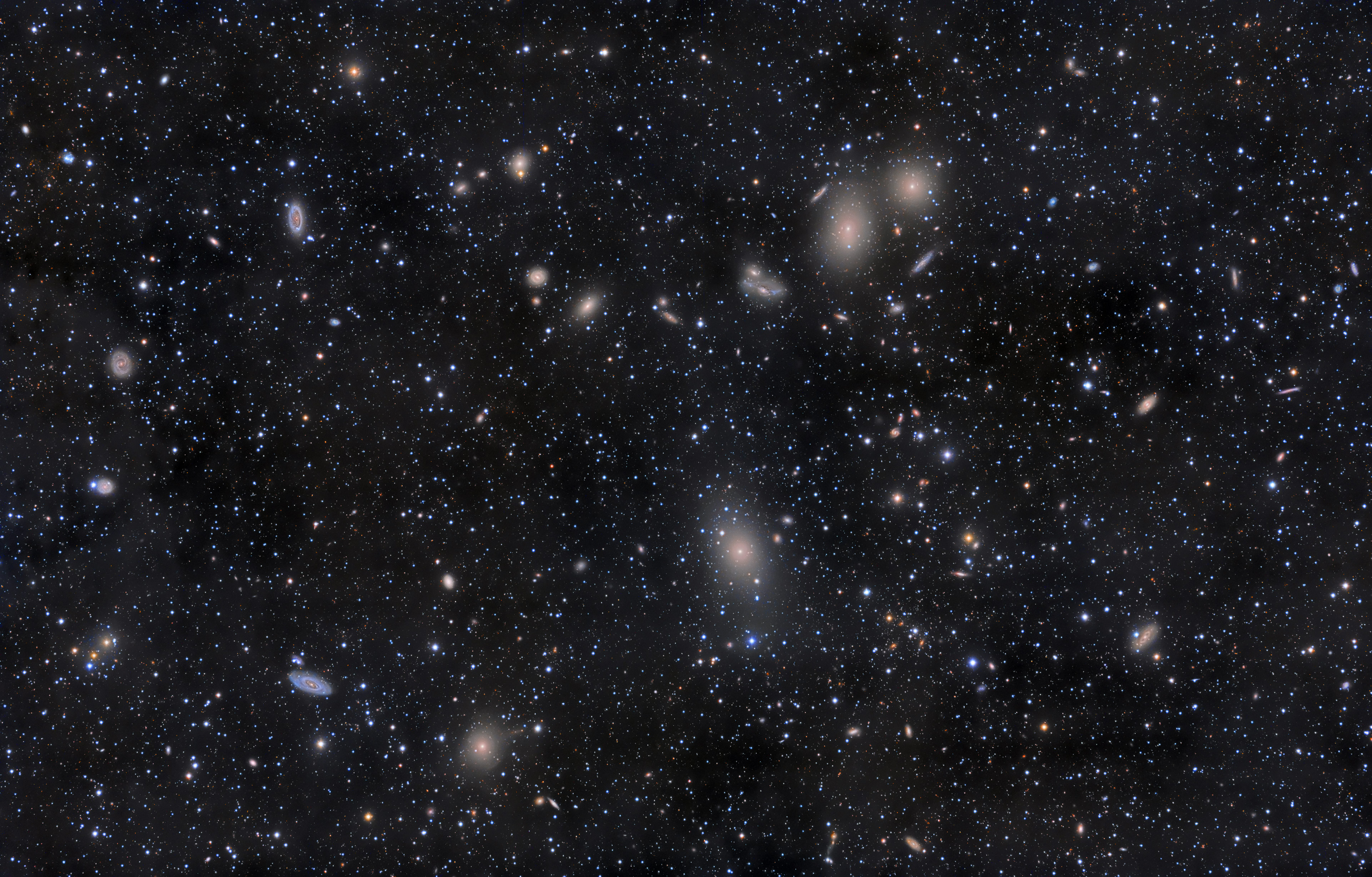
Image credit: Rogelio Bernal Andreo of http://blog.deepskycolors.com/about.html.
Again, in principle, there are two reasonable possible resolutions to this conundrum.
- Either there is some unseen mass/matter out there, or
- The laws of gravity need to be modified/enhanced once again.
The leading candidate for the first scenario is the addition of some type of dark matter to the Universe, while the second scenario requires MOND, MOG, the relativistic TeVeS, or some similar type of modification. I've written about these possibilities many, many, many, many times before, but there's one very simple test that you can apply to tell which of these two possibilities are consistent with our actual Universe. A test that -- spoiler -- the advocates of #2 are terrified of bringing up in their own papers.

Image credit: Mark Subbarao, Dinoj Surendran, and Randy Landsberg for the SDSS team.
You look at the Universe on the largest scales. Not on the scale of stars, nor at individual galaxies, not even at clusters or supercluster of galaxies, but at the entirety of the visible Universe. Those scales, the largest possible scales.
Because on those scales, there's no denying that gravitational forces dominate, and the other forces are all but insignificant. If you can accurately measure how the Universe clusters on the largest scales, you can compare the predictions of a general relativity + dark matter-dominated Universe with what you observe, as well as a no-dark-matter + modified gravity Universe, and see what you get. Below is the prediction of the standard ΛCDM cosmological model (GR + dark matter).
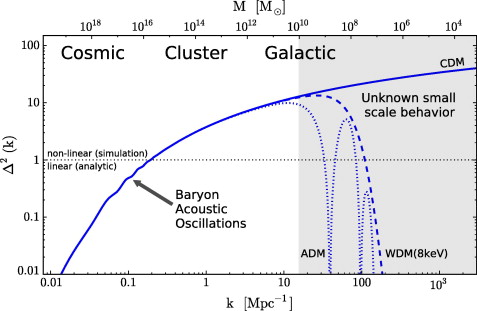
Image credit: Michael Kuhlen, Mark Vogelsberger, and Raul Angulo.
In particular, it's the largest scales -- all the way on the left -- that are the best and most robust test of these two scenarios. While many other variables enter into play (and the uncertainty rises) the farther to the right you're willing to go, the largest scales are the simplest and most straightforward test of which of these possibilities is correct. Why's that?
On these scales, simulations are not required, and the way the largest-scale structures in the entire Universe are distributed/correlated (which is what the Power Spectrum measures) is known, exactly. So what do we see when we look out at the Universe on these largest scales, and compare with the predictions of these different scenarios?
Courtesy of Scott Dodelson, I present to you the one graph that incontrovertibly settles the matter, at least for the time being.

Image credit: Scott Dodelson, from http://arxiv.org/abs/1112.1320.
Those red points (with error bars, as shown) are the observations -- the data -- from our own Universe. (Courtesy of the Sloan Digital Sky Survey.) The black line is the prediction of our standard ΛCDM cosmology, with normal matter, dark matter (in six times the amount of normal matter), dark energy, and general relativity as the law governing it. Note the small wiggles in it and how well -- how amazingly well -- the predictions match up to the data.
Now look at the blue curves: these are models with no dark matter. The dotted blue curve is what you'd get in a no-dark-matter Universe that abided by general relativity. The "wiggles" you get are far too large in amplitude, and the spectrum fails to rise on progressively smaller scales as required by our Universe. The solid blue curve is what TeVeS -- the relativistic version of MOND -- predicts. It can raise the overall amplitude of the Universe's power to an appropriate level at a few select points, but the spectrum is all wrong. Ruinously wrong. It's not even close to viable.
And until those in favor of modifying gravity can successfully predict the large-scale structure of the Universe the way that a Universe full of dark matter does, it's not worth paying any mind to as a serious competitor. You cannot ignore physical cosmology in your attempts to decipher the cosmos, and the predictions of large-scale structure are some of the most basic and important predictions that come out of physical cosmology. And that's why the Universe needs dark matter -- and not MOND, MOG, TeVeS, or any other dark-matter-free alternative -- in one all-important graph!
Could you interpret the vertical scale on those last two graphs for me? Yes it's a power spectrum, but I'm trying to imagine just what those wide, periodic swings in amplitude would look like, concretely, for the distribution of matter in the universe.
Just so there’s no misunderstanding or incorrect conclusion jumping, it is clear to me that the Invisible Dark Matter theory has progressed well beyond the stage where it can be convincingly refuted.
The most important thing that remains is to identify the DM particle (or particle family) involved and to ascertain all of its properties.
In your link to your post of 1 March 2011, the first ’many’ and the one with the MOND FAIL motivational poster, you stated:
This idea of Modified Newtonian Dynamics is known as MOND, and it works very well for explaining the rotation curves of individual galaxies. In fact, arguably, this is something MOND does even better than dark matter!'
If the Dark Matter concentrated in galactic halos possesses one or more special properties that enables a fudge factor like MOND to appear to work well, what property or properties could Invisible DM possess (apparently not also possessed by Baryonic Matter) that could deceive the observer into concluding that MOND, in this single restricted instance, act as if it can provide a more plausible explanation for galactic rotational speeds?
.
You are fighting a straw man, the bullying on the MOND phenomenology here is just completely ridiculous... Please read the relevant litterature, such as http://arxiv.org/abs/0807.1200 or http://arxiv.org/abs/1301.0623 . Here is a copy-paste, for your information (and education): "the main motivation for studying alternatives to LambdaCDM based on the MOND phenomenology is not necessarily to get rid of any form of dark matter, but rather to explain why the observed gravitational field in galaxies is apparently mimicking a universal force law generated by the baryons alone. At a fundamental level, covariant theories of modified gravity often have to include new fields to reproduce this effective force law, so that dark matter is actually replaced in many of these theories by ‘dark fields’ (with an energy density nevertheless subdominant to the baryonic one), or even by what could really be called ‘dark matter’ (with an energy density outweighing the baryonic one) exhibiting a kind of new fundamental interaction with baryons: this makes the confrontation between MOND and dark matter much less clear than often believed, since the former implies a more complex structure of the dark matter sector than the currently assumed CDM, but does not necessarily imply the absence of a dark sector."
@AlanL: finding the properties of the dark sector that can produce the MOND phenomenology on galaxy scales, while not contradicting the evidence for massive dark matter on large scales, is precisely what most researchers working on MOND-inspired covariant theories of the dark sector are after (see links hereabove, with the idea of "dipolar dark matter" as a good example). They dont deserve the bullying that this website constantly and coherently makes a living from...
Addressing cosmological issues with covariant theories based on MOND: http://arxiv.org/abs/1006.3809 or http://arxiv.org/abs/1210.4106 Far from getting a definitive answer, but making a few predictions (quite clear ones in the second case). In short, research in action!
(and by "periodic" swings I know they're not recurring in time, but recurring across different scales of the universe--and looking at the scale it seems they're not periodic with the same period)
So it looks like stuff is extremely clustered at some scale, spread out more evenly at a larger scale, then extremely clustered again at a still larger scale, etc. But I still find it hard to imagine what this would be like.
I think Alan L. is right on. As soon as the theory of DM can explain why MOND should appear to work on galactic scales, then MOND will be speedily tossed in the dustbin of history. Until then, there is still a big unanswered question: where is the apparent MOND-ian regularity coming from?
Ethan,
The figures showing the motion of Uranus were created by me, for a course I was teaching on computational physics. You can see the original versions at
http://spiff.rit.edu/classes/phys317/lectures/intro/intro.html
Alan L.:
That's a very interesting question. One potential hypothesis to keep in mind though is that the answer isn't a special property of DM, but rather a slight difference in the dynamics, as in the density and distribution of DM around galaxies, than was calculated/simulated. If we ever acquire the ability to more easily and precisely measure the location of DM then the mystery might simply vanish.
However any hypothetical property of a DM particle that someone can come up with that would explain the difference would also be intensely interesting and hopefully worth looking for.
Michael,
Thank you! That's amazing, and I've been hoping to track down the original sources of those images. What did you use to create them, and would it be easy/free to recreate it?
Ben,
I agree that everyone studying cosmology should learn about MOND and what it can successfully do, as well as what it can't do. To present it as a viable cosmological alternative to dark matter is at best a contrarian position, one that has (IMO) no place in the public sphere. It is deservedly marginalized for its failings on large scales, and until there is hope of addressing them, it deserves to remain as a footnote, useful only as a curiosity for galactic dynamics.
Research? Fine. Presented to the public as a legitimate, viable cosmological alternative? Be prepared to endure my continued "bullying" on the MOND phenomenology. (Thank you for the praise of calling it coherent!)
@Ethan:
Wasn't MOND created based on the Tully-Fisher relation to fulfill exactly its 4th-power law?
But this relation is based on intrinsic luminosity, not on measured baryonic mass.
Measured velocity dispersion leads to rotation speed, speed leads to total mass (incl. DM) and this total mass is assumed to be proportional to luminosity - I cannot see why the last step is possible: Could you please explain this 'mystery' (what it is at least to me), maybe in an extra article, if of general interest?
Thanks a lot in advance!
Ethan, you do not seem to have read the scientific references linked to in the above message, and you seem very keen on not letting the public sphere know about what is going on in the research sphere. That is at best a strange way of presenting research to the public... Now, no one has ever said that MOND "per se" was a viable cosmological alternative, it is not even a theory. But the point is that there are existing theories based on the MOND phenomenology which might be viable alternatives, such as the dipolar medium theories or the bimetric MOND theories linked to above (in the case of the dipolar medium, the matter power spectrum is fully reproduced at the linear level, so this is a falsification of your whole blog post since this is a MOND-based theory, and there are even predictable signatures on the CMB). In parallel with the numerous groups of people who are trying to solve the problems of LCDM by slighty tweaking LCDM, the other interesting thing currently going on in the research sphere is the actual search by others for new viable theories explaining the MOND galactic phenomenology while not getting in conflict with the cosmological constraints (e.g., ideas based on entropic gravity). Obviously, these theories are not viable alternatives yet, since these theories are still in the making. Perhaps they will fail, it's too early to say. And indeed, all this is not easy, and believe me, solving the problems of LCDM within LCDM is not going to be easy either, IMO a dead end, but the future will judge. But this is what research is: it's not as easy as writing a blog.
Attention: LDF [layman dumbness follows]
Are there theories of why cold dark matter does not condense into compact bodies like stars and planets the way baryonic matter does?
More LDF: Why is there angular momentum in the universe? It is not clear to me why a uniformly expanding universe would have any. If it's conserved it must have been there in the beginning.
Ethan
I'm glad you raised this discussion again.
Not because I support MOND. I don't.
But because of this:
Mathematicians Offer Unified Theory of Dark Matter, Dark Energy, Altering Einstein Field Equations http://www.sciencedaily.com/releases/2012/09/120906092059.htm
The main idea of this new theory seems to be:
1) Einstein's GR implicitly assumed conservation of energy and momentum for normal matter before he derived his equations; this is an error.
2)The equations of GR should be derived with the assumption of conservation of energy and momentum for all matter (i.e. baryon matter and energy as well as dark matter and energy).
3) When this is done, a different set of equations results; and out of this, voila dark energy and dark matter are unified. i.e. not two different hypothetical things, just one theoretical hypothetical thing.
GRAVITATIONAL FIELD EQUATIONS AND THEORY OF DARK MATTER AND DARK ENERGY. by TIAN MA AND SHOUHONG WANG, Jul 2012
http://arxiv.org/pdf/1206.5078v2.pdf
This seems like an interesting idea BUT...... all three of their arXiv papers Jul 2012, Oct 2012, Dec 2012 are totally unreadable by a layman. (occasionally a readable sentence but never a full paragraph).
And as a layman, I wonder:
1) So what? Is there an advantage in 1 dark thing versus 2 dark things? i.e. will this new theory help in any way in finding a direct observable or a new observable? I don't think so.
2) The authors pound away at their totally un-understandable conclusions so hard that even as a layman I feel "The lady doth protest too much."
3) Mathematicians telling that their logic is solid; is very different than astrophysicists saying something encouraging about this research.
That said, I am still curious:
So has anyone in the astrophysics community critiques this new work? (i.e. Is this another form of MOND or something else? Is this an old idea dressed up? Or is this a new idea with no clothes yet? )
By the way my personal bias is this new theory adds nothing but a transformation to a more difficult set of GR equations to solve but no new physical insight. And we are just going to have to wait for some kind of:
1) direct observations of dark matter and dark energy
2) quantum gravity field theory
So this is one of the things I've been wondering about.
Any professional thoughts, feedback on this theory (or my thoughts). I defer to your expert insights and opinions?
Thanks.
Ok i have tried asking this elsewhere but no one has responded. As Dark Matter DM was thought up before dark energy expansion was discovered could DM just be a mathematical construct?. My reasoning is if space expands uniformly but gravities inverse square law is true then as a galaxy expands matter further out from the centre of gravity would have to constantly re-iteratively fall back down the gravitational wells making it look like it is spinning faster than it should on large scales. This i think would give the observed effects of DM without the need for its existence whilst being more noticeable on larger scales than the small ones.
Or is this effect all ready taken into account in current models and does not explain it all? I am just and interested amateur but i have never seen this point referred to. It just seems logical to me that if space expands then two or more objects orbiting each other would have an energy change to compensate.
Ben,
Of the two papers you link to, one (the DDM paper) is a dark matter paper that seeks to reproduce some of the aspects of MOND, while the other (Milgrom's bimetric paper) invents another metric with another field that is designed to produce a dark-matter-mimicking effect.
I have nothing against dark matter incorporating aspects of MOND to attempt to reproduce small-scale dynamics; on the contrary, I think that is a smart approach, and one I have advocated in the past, right here on this very blog! What I resent are claims akin to "dark matter is not necessary for cosmology in XXXX-MOND-inspired-model," as is often claimed by Kroupa, McGaugh, Zhao, and many of the other authors in the papers you cite. In fact, if this thing that you said were true:
then I likely wouldn't write some of the things I do. But it isn't true, and it hasn't been true for about 3 decades now. Again, for emphasis, you cannot simply poke at the small-scale problems of ΛCDM and ignore its large-scale successes -- i.e., all of physical cosmology -- when talking to the public of the Universe. But the MOND-camp plays their disingenuous tune to the press offices frequently, and it undermines the public's understanding of cosmology.
If you have a problem with the way I blog, you are now very well-informed as to my motives. Your options are to try to change my mind (good luck with that), to change the culture of half-truths when speaking to the press that's prevalent among the MOND-people, or to get your own blog.
Ethan:
I appreciate the way you blog, and think "you seem very keen on not letting the public sphere know about what is going on in the research sphere" is grossly unfair. You do let people know what's going on, but also provide context, which is critically important and keeps at bay misconceptions that would otherwise be easy to reach. So, thanks.
Alex:
Dark Energy is very weak on the scale of galaxies, and even clusters, so (qualitatively, imo) seems like an unlikely explanation for the galaxy rotation curve anomaly.
I think if we had an Observatory on the dark side of the moon many questions could be answered. I hope nobody takes this as spam. It is a sincere attempt to push science forward. I just started a petition on the White House petitions site, We the
People. Will you sign it? http://wh.gov/ENaF This is very relevant to this discussion. Thank you very much.
http://www.bbc.co.uk/news/science-environment-21043381
Hmm, very nice.
Why is the far side of the moon an interesting place for an observatory? Seems like it'd be inconvenient having the observatory on the sun-facing side of the moon for half the month. What if something interesting e.g. a comet impacting Jupiter happened during that time?
"What if something interesting e.g. a comet impacting Jupiter happened during that time?"
Then we wouldn't be able to see it with that telescope.
However, if we put one on the earth, what if it happened when Jupiter was below the horizon there?
Same thing.
Dark side of the moon is not affected by the earth's reflections, which is both much bigger and much more reflective than the moon, and every astronomer knows how bloody hindering awkward the full moon is for looking at stuff. The earth is 10x worse.
"If it’s conserved it must have been there in the beginning."
So, if it were there in the beginning, so what?
Expansion says nothing about rotation, you can have both.
Thanks CB for the the reply it just seemed to me that if Dark Energy(DE) had the same inverse square law as gravity but in the opposite direction it might explain why the galaxy rotation curve anomaly graph looks linear with distance as one inverse square law added to another with one, with one axis in the opposite direction would I think look like the B curve of a typical spiral galaxy but only if as you say DE was strong enough, I knew it was weak but did wonder if 50,000 light years of DE expansion effects might add up to a noticeable effect for stars that far away from the centre of our galaxy. Mind you thinking on it a bit more the idea could be much more heretical than just getting rid of DM as a mathematical construct due to not taking DE into account. You might end up going back to a continuous creation infinite universe with the CMB just being the light of an infinite number of stars red shifted down to that level by the averaged effects of Matter opposing DE. So I am glad its so low I wouldn't want to be lynched by rampaging physicists for being a smart Alec ;)
PS CB The far side of the moon is good for radio astronomy as it blocks out the interference on a lot of the spectrum from earth mind you I think the poles might be good for IR astronomy as you could rotate away from the sun and use cold craters as heat sinks to make the IR kit function better as NEO's show up better in IR anyway.
"But the MOND-camp plays their disingenuous tune to the press offices frequently, and it undermines the public’s understanding of cosmology."
There are disingenuous tunes in all scientific camps. (e.g. due to need for funding, prestige, righteous belief that one is correct, my area of research is better than yours, etc..)
Here's the thing. There are many publics.
1) the funding public
2) the scientifically informed public
3) the life is a political horserace public
4) the my religion is literally correct public
etc...
And in my opinion, scientists should never underestimate the desire and need of any of these publics to understand science. Even a creationist public wants and needs to understand the science of evolution (to be sure to discredit it); but a strange thing might also happen they might get hooked on science.
Now on the issue of MOND. In my mind, theoretical science is a bargain. I mean the cost of 10 or even 1000 theretical physicists or astrophysicists might be cheaper than the next biggest and baddest space telescope or superaccellerator.
And we as the funding public need to understand that a high level of funding for theorists is very pragmagtic; because some bizarre hypothesis (extradimensions, DM, some extension beyond the standard model of particle physics, some extension beyond the standard model of cosmology, some quantum gravity or extra dimension gravity or something) will predict a new phenomenon or postdic a phenomenon.
I as a layman, have not ruled out a great many possible explanatiobns of the "dark matter observations". I emphasize the phrase "DARK MATTER OBSERVATIONS" because that's what we have "OBSERVATIONS" not an "EXPLANATION".
And the possible explanations that I don't rule out include everything from Fred Cooperstocks General Relativity to some kind of new non-standard model particle to extradimensions to quantum gravity to....
And when we achieve an excepted explanation, I'm not confident that the answer will be a new particle.
So my way of thinking of the possibilities is something like this. Take the sum of all the possible theories (by professional scientists) to explain the "dark matter observations". That is the set of possible solutions so far and from which an accepted solution might develop.
Then take the sum of all observation and experiment that is testing these various hypothesies explaning dark matter. Associate these with the above hypotheses; this then gives the probabilities sense that a particular hypothesis is correct.
NOW, the problem for the "dark matter observations", is all of the experiments and observations so far to find an explanation of the "dark matter observation" have failed. It's like having a horserace, in which we have never seen the horses run.
So in my mind, "Dark matter believers" calling "MOND believers" disingenuous is itself disingenuous. Because NO we can not explain the "Dark Matter Observations" and any of the hypothesises might hold a key idea to a new and excepted theory that explains the "dark matter observations"
So please scientist, speak your convictions in public. Give the public, benefit of the doubt that they need and can be an important part of the dialogue. Yes even about dark matter.
And yes, science is not a popularity or political contest; but a well educated and subtlely informed public is important on many scientific issues.
These Freudian slips just keep slipping out.
"However, if we put one on the earth, what if it happened when Jupiter was below the horizon there? Same thing."
It's not the same because the duration of occlusion is ~30 times longer. An event that lasts longer than half a day can be seen by an earth telescope. An event that lasts longer than an hour can be seen by Hubble. An event that lasts 10 days could be missed entirely by a moon telescope.
Earthshine is relevant only if the other option is building an observatory on the earth-facing side of the moon. Which, granted, would be dumb.
Lagrange points 4/5 are a better choice for the same advantages without the disadvantages. Earth orbit works too.
The only reason to build a moon-based telescope is if you're planning on manufacturing it there. Which would be freaking fantastic; we could in theory build scopes of enourmous size. I would love for this to happen. I just don't think you can justify the long chain of development that would need to take place before such a project could even begin with just the idea of a far side telescope. We'd need to be devoted to the ideas of a moon base etc on their own.
Alex:
Dark Energy expansion appears to be constant at every point in space, which means its net effect is linear with respect to the distance between two points, not inverse-square. So (cosmologically) nearby things are not expanding away from us noticeably at all, and gravity vastly dominates, while at extreme distances Dark Energy dominates so much that objects are receding away from us faster than light and are lost to us forever.
It is a non-scientific attitude to be a CDM-only advocate or a MOND-only fan, since, at this time, we only know that both theories are effective theories which are valid in specific domains. Therefore, as a scientists one should be able and open to discuss both from equal distance.
1. LCDM is successfully describing CMB spectra with the additional hypothesis of dark energy. Its difficulties for galactic and smaller scales require substantial refinements which are heavily discussed but not yet found convincingly. In this light, LCDM is incomplete. It is in its present form valid in a restricted window of length scales only.
2. MOND is very successful on galactic and smaller scales for rotation supported systems but cannot describe clusters of galaxies in a satisfying manner and is far from explaining the large scale structure or CMB spectra. This strongly suggests that MOND is an effective theory. As such it can be applied in a restricted window of length scales only. Moreover, a_0 shows large fluctuations in all relevant investigations, unfortunately often hidden in log-log plots, so it is not cogent to claim a new constant of nature.
Both "theories" are equally disruptive for the basics of our currently accepted theories: LCDM needs ad-hoc particles outside the scheme of the standard model but we have so far no clear signal of their existence. MOND changes the laws of gravitation in an ad-hoc manner, and its additionally required external field effect (EFE) violates the equivalence principle.
On the one hand, a future complete form of LCDM will need to add a fascinating interplay of baryons, DM, supernovae and other elements in order to be successful on the galactic scale. Obviously, this theory will be more complex than the present one.
On the other hand, the yet unknown theory which might lead to an effective formulation as MOND must be derived from basic principles otherwise it will not be accepted as a fundamental theory. Therefore, one would expect that the new theory, if it can be found, is more economic or less complex than MOND with all its ad-hoc elements.
@OKThen
"It’s like having a horserace, in which we have never seen the horses run. It’s like having a horserace, in which we have never seen the horses run. "
More like a horserace which has started, and one horse has already lapped all the others. It still has a long way to go to the finish line, but some of the other horses don't appear that they could ever reach it without hitching themselves to the lead horse as it passes by. And, uh, a new horse could enter the race at any time and take the lead.
"So in my mind, “Dark matter believers” calling “MOND believers” disingenuous is itself disingenuous."
When someone says MOND does away with the need for Dark Matter, that it is an alternative to the DM hypothesis in its entirety, that's disingenuous. The converse is not true, because while MOND does better at some things, DM can still explain them fairly well. MOND fails utterly at explaining many things DM explains.
[asks plaintively]: could someone suggest what a no-dark-matter universe would look like whose matter distribution followed the oscillating curve shown in Ethan's last graph, as a function of scale?
As Ethan has previously said, "We have very few examples of high-speed galaxy cluster collisions in the Universe, with Abell 520 and the Bullet Cluster being the two best measured ones, and yet they appear ... to be inconsistent with one another!... if it turns out that this is as young a collision as the Bullet Cluster, there are no hiding galaxies, and the current picture of dark matter cannot explain what these galaxy clusters are doing, we may be learning an awful lot more than we bargained for awfully soon... What’s the solution to the mystery? I’ve made my wager; what’s yours?"
Yes we all know Ethan's horse is the "dark matter horse".
We just do not know what or who the "dark matter horse" is.
It's not the only horse that we don't know.
Here's a paper Quantum Gravity and Dark Matter arXiv:1105.2916. It's interesting hypothesis goes something like this. "While cold dark matter works spectacularly well at the cluster and cosmic scales, it had been found to be somewhat wanting at the galactic scale... With only a single parameter MOND can explain easily and rather successfully the observed flat galactic rotation curves and the observed Tully-Fisher relation. But there are problems with MOND at the cluster and cosmological scales.... But the true picture should be found in quantum gravity, the analog of QCD in this comparison. Furthermore, the Milgrom scaling can perhaps be viewed as an analog of the Bjorken scaling and quantum gravity corrections to the Unruh formula as the analog of the logarithmic corrections to the Bjorken scaling as provided by asymptotic freedom in QCD."
So the above paper suggests that Dark Matter explains some observations better, MOND explains others observations better, but a quantum gravity will explain both of these observations best. But of course quantum gravity is not yet a horse that is in the race. We don't have equations.
The "dark matter hypothesis" fits to some observations; but we have no particles, or properties of a hypothesized particle, and we have a weaker Tully Fisher explanation than MOND.
MOND has equations, needs no particle; but gives weak cosmic explanations.
And quantum gravity is just an idea without even equations, except those like Quantum Gravity In De Sitter Space,
Edward Witten, 2001. And other quantum gravity ideas, not ready for prime time. Yes yes, the quantum gravity horse is not ready to race yet.
So let's bet on the phantom dark matter particles hypothesized to be associated with the "dark matter observations". Yes such phantom particles are the leading hypothesis. But without better observations or a better quantum gravity; well the horserace simply can't be held.
Maybe the horserace will be held within 10 or 20 years. These things are hard to tell.
But I feel more confident that a theory of quantum gravity will be achieved. I am not so confident that a "dark matter particle" will ever be found. I do feel confident that the "dark matter observations" will be explained.
Yes, it's a who you gonna believe situation.
So who you gonna believe:
--- the bullet cluster or Abell 520?
--- the fit to cosmic observations or the fit to the baryonic Tully-Fisher relation?
--- that quantum gravity will not make a significant difference in the calculations at galactic and cosmic level or will make all the difference?
Yes, in my mind the most important horse missing from the discussion of the "dark matter observations" is quantum gravity. Yep, I wager one cup of coffee on quantum gravity.
CB I may not have been clear using the inverse square law both ways even with DE being linear here is my thought experiment with extreme examples for clarity a simplified version of the galaxy could be a black hole BH in the middle as a high gravity source. going outwards we have star A orbiting it at a distance of a 1000 light years then star B orbiting at 2000 if DE magically doubled all of space in a linear fashion without immediately changing their orbital speeds star A would be at 2000 LY out and Star B would be 4000 LY out right? But as they are now not moving at the correct speed for their new orbits. Star A would need to correct for a 1000 LY change and star B would need to correct for 2000LY which would not be linear because the change would be caused by the inverse square law of gravity from the black hole correcting them at different rates even tho the expansion was linear. As you say it could be that DE is too small an effect to explain away DM in the way i have suggested but i have never seen this idea explored and dismissed for that reason. And as DM's effects were calculated before DE was discovered i did wonder if this simple idea might explain away the need for DM but leave its observed effects especially as they would be more noticeable on large scales than small ones the way DM seems to be.
Using the words "weak" and "weaker" without expounding on the vastly different scales of "weakness" (one means a somewhat worse fit, the other means not even remotely workable) is disingenuous.
"Who you gonna believe" is of course a red herring. You must believe all the evidence. However I find evidence against a hypothesis less compelling when it may only be an artifact of insufficient understanding of the dynamics in the specific case in question -- the Pioneer Anomaly being an instructive example. Abell 520 may be able to be explained by DM if we learn more about the cluster. Behavior like that seen in the Bullet Cluster categorically cannot be explained by DM-free MOND. Once again the situation is not symetric.
As far as how I bet, I bet on the front-runner, whatever that is at the current point in time. The horse race has been going on since 1930. Yes it has. And the current front-runner by a large distance, by virtue of the currently available evidence, is Dark Matter. Yes it is.
If and when Quantum Gravity enters the race and by weight of predictive power takes the lead, then and only then will I change my bet.
You of course are free to go with the promising but untested hypothesis. I see no reason to jump the gun unless you're actually working on developing that hypothesis, but that's me. However even if you choose to do so, even if you are the one doing the work and trying to make the better hypothesis, this has no effect on the current state of of reality and our knowledge thereof.
CB
Very thoughtful answer.
Thank you.
But CB, your answer doesn't seem sufficient; because scientist bet with their careers. What theories they work on and what instruments they build and how they use them.
Now let me argue against myself for a bit.
A theorist has argued that data from the Fermi Space telescope provides, "a so-called 'smoking gun' signal of dark matter annihilation."
Very nice. Seriously, excellent work.
Bergson continues, "The nice fact which distinguishes this situation from other similar situations with dark matter candidates is that there are no viable astrophysical alternatives." Very nice, a "dark matter candidate" can't get better than this.
And explaining the "dark matter observations" is one of the most important challenges of particle physics and astrophysics today. I'm sure I could find a quote.
And as Ethan and CB point out the Dark Matter hypothesis, not MOND, and not Quantum Gravity are the leading horse.
Then why is Dr Finkbeiner so cautious about redirecting the Fermi space telescope. On the one hand, maybe the most important discovery in the last 100 years of astronomy on the other hand nothing.
Which way will he wager? "Dr Finkbeiner wants to be careful that the bid to chase the dark matter mystery isn't at the cost of less speculative science. "You know, it's a half-billion dollar mission and the data's used by hundreds of people... I try to be as sceptical as possible, especially about the things I want to be true - so I'm hesitant to be the guy who says 'hey let's drop everything and go look at this', and then have it turn out to be nothing."
Yes, I'm waiting for either Bergstrom's theory to be demolished or for the Fermi space telescope to be redirected.
Let see how these scientists decide to spend their careers and their research dollars. Now that is a wager.
And if we search the news, regarding "dark matter observations"; i find quite a few scientist spending their creative careers on MOND or GR or Quantum Gravity or other non "dark matter hypotheses".
So yes, CB, my wager is personal and irrelevant to the astrophysics determination of an explanation for the "dark matter observations". And personally, I will be ecstatic if e.g. Fermi space telescope finds strong evidence that explains dark matter.
But whether the Fermi space telescope redirects itself is a telling decision about how strong a candidate the "dark matter hypothesis" is.
So I ask, will the professional astronomers at the Fermi space telescope redirect (or not) their space telescope to get better data this excellent "dark matter "smoking gun"" or NOT?
http://www.bbc.co.uk/news/science-environment-21043381
My wager was easy, cup of coffee.
The Fermi space telescope astrophysicists' wager is their careers. That's a wager to watch. Who do they believe?
"If and when Quantum Gravity enters the race and by weight of predictive power takes the lead, then and only then will I change my bet."
I find this the most pressing need for science to determine wrt gravity/DM/DE.
It may be that some form of it will consequentially come out with both DM and DE as byproducts. Which would be great for these theories.
It may be that it will be enough of a difference to place one or other out of range and some other method of explaining discrepancies are needed.
At the moment, though, I take DM as "we observe more movement than the mass we see allows under our understanding" and similarly for DE. But like centrifugal force, it is just a genuinely applicable fiddle to the observations to make it fit.
Centrifugal force doesn't "exist", but it IS necessary to make this force "visible" to turn what we assumed was an inertial frame into a genuinely usable inertial frame of reference.
"Lagrange points 4/5 are a better choice for the same advantages without the disadvantages. Earth orbit works too."
They're bloody expensive, though.
"But CB, your answer doesn’t seem sufficient; because scientist bet with their careers. What theories they work on and what instruments they build and how they use them."
It's sufficient for me, because I'm not a theorist, nor the director of an observatory. I'm an engineer, a consumer of science. Of course DM has no bearing on my work, but the point is I have no reason to "bet" on anything but the current state of the art and wait for further information to change the situation, so that's what I do.
At the same time, I cheer any theorist who believes they can come up with a better hypothesis than the current front-runner and puts forth the effort to come up with one. This is absolutely essential for furthering science. But the nature of their bet is completely different than mine or yours, and absolutely cannot be hung entirely on the idea that they will eventually be proven right. Because most of them cannot be. If DM or QG are the right answer, then everyone who spent their careers working on MOND "wasted" their time.
Or did they? How is coming up with a plausible explanation, working out it's implications, comparing them to reality, and in doing so ruling out that hypothesis a waste of time? It's the essence of science, and most scientific results are affirming the null hypothesis.
it's simply not tenable to have every theorist "bet" based on whatever arguments you might make in favor of one or the other and choose to only study that theory. We'd end up with only a few theories being studied, and thus might miss a better one than any of what has already been mentioned.
Now for the observatory directory, the trade-off is completely different. The decision of whether or not to make specific observations with Fermi really has nothing to do with whether alternative theories are more plausible or not; it's about whether a specific already-existing observation will be confirmed or not. Also they have to take into account the needs of everyone else who wants to use the telescope who aren't investigating anything related to the DM mystery at all. The danger of a null result isn't really "oh noes, DM is wrong, we should have bet on MOND" but rather "oh noes, we told all these other people to shove off for a while, but we never actually saw anything."
Note that this could still be the case even if all other observations which appear to point to DM turn out to have pointed us in the right direction, and DM turns out to be the right answer.
Let the theoretical and observational astronomers make their "bets" based on their specific situations. There's more going on for them than just what the current state of knowledge is, and shouldn't affect how I view that state or how it is presented.
" If DM or QG are the right answer, then everyone who spent their careers working on MOND “wasted” their time. "
Not necessarily.
In trying to find out how MOND could work, the scientists may find new and novel ways of teasing out more reliable data from what is available.
Or discover something new.
Penicillin being a well known example of someone finding something useful whilst "wasting their time". Same with smallpox and vaccines.
Yes, thus quotes around "wasted". Because it isn't.
"I have no reason to “bet” on anything but the current state of the art and wait for further information to change the situation, so that’s what I do."
Well that's your way of learning. Which is fine.
My way of learning also includes studying what is known, i.e. answers. But I also focus on what is not known, i.e. questions.
I focus on what I call my learning questions, which sometimes develop into my learning hypotheses. And my learning hypotheses guide my learning; just as a scientists working hypotheses guide their research.
And it is OK for me to simultaneously hold two contradictory learning hypotheses. Because I don't know yet; and the scientist may not know yet.
Inevitably my learning hypotheses will lead me to scientists accepted theories or scientists working hypotheses. And I don't argue with scientific theories within their domain of relevance, i.e. within that domain supported by observation and experiment.
Which brings me back to the "dark matter observations".
The "dark matter observations" are solid observations; but in my mind, the "dark matter observations" are outside of the domain of relevance of any accepted theory.
So in my mind it is scientifically dishonest to tell the public that the "Universe needs dark matter". Maybe astrophysicists just need a working theory of quantum gravity.
Just as after the Michelson-Morley's experiment and Einstein's special relativity; the "Universe no longer needed the aether."
We know that there are excellent observations which we call "dark matter observations."
But we don't know if those observations require
-- a new kind of particle e.g. beyond the standard model of elementary particles or
-- a new theory of gravity e.g. a quantum gravity
So in my mind the only scientifically honest thing to tell the public is
-- we have dark matter observations which are solid
-- we do not have a solid explanation
-- we have working hypotheses that are guiding research (i.e theory, observation and experiment)
-- finding an accepted scientific explanation to the "dark matter observations" is one of the most important outstanding problems of physics and astrophysics. (i.e. one of the most important unanswered questions)
If you can't find it; it might not be there.
"Well that’s your way of learning. Which is fine."
I'm sorry, when did betting become the same thing as learning?
I learn based on what questions aren't answered, i.e. ignorance. I bet based on conditional probability, i.e. knowledge. In learning more the knowledge I gain may impact the conditional probability. However informing my conditional probability with ignorance is foolish.
Are you really tying the two together -- you're interested in learning about Quantum Gravity, therefore you're betting it's true? That's like assuming you have the same risk of cancer as a person with a family history of cancer, just because you've become interested in the family history but have yet to find out if cancer actually runs in the family or not.
"So in my mind the only scientifically honest thing to tell the public is"
a list that I agree with, but does not include discussions of the actual possible explanations and their relative merits. Failing to educate the public because of a false equivalence between degrees of "solidity", and the fallacy that not knowing with 100% certainty what the answer is means that essentially we know nothing.
However it is perfectly possible to honestly tell the public about these theories, and doing so will demonstrate that while we don't know the answer, we do have a current best answer that is actually pretty solid. It does a fantastic job of explaining observations from multiple lines of evidence that other possibilities so far have zero success at, and its observational problems are in regimes where differences between observations and the parameters assumed for simulations are going to cause problems on their own.
"If you can’t find it; it might not be there." is true, but as applied in your case to justify not talking about the answer at all just reinforces the bad logic of "the Standard Model is nonsense because we haven't yet found the Higgs Boson/Tau neutrino/weak force bosons" (depending on time period). Those things were hard to find. We fully expect DM, if it exists, to be hard to find. It's kinda in the name. "We haven't found it yet" is why we cannot say that we know the answer for sure, but until we've actually ruled out all potential spaces it's not actually that profound of an argument against the hypothesis.
"We might have a new best hypothesis in the future" is also not a reason to not inform the public of the current best hypothesis now.
This is a very good post which I rec'd through National Geographic. I shared this article on my blog, giving YOU, the writer and National Geo due credit and printed as is. You Ethan, are a rude nasty man with an amazing ability to write and obviously intelligent. It is a pity when you do not recognize a compliment. I often share postings from Nat Geo, WITH credit and usually receive a THANK YOU. YOU can kiss MY ASS and stay the hell off my blog.
A. Flame,
Your blog -- which I was quite upset about -- is located here, with my post at this url: http://naesnest.me/2013/01/21/the-universe-and-dark-matter/
As you can see, there is no mention of me (Ethan Siegel), this blog (Starts With A Bang), National Geographic (the company that hosts all the Scienceblogs blogs), or any way to direct traffic back to the original post. (Which is here.)
What you have done -- even if it was done innocently via the use of wordpress's reblog feature -- is what I call thievery.
You stole my words and passed them off as your own, and gave neither credit nor traffic to me. I don't care a whit for whether you think I should consider that a compliment or not; I consider it thievery and I consider you a thief. I am furnishing a copy of this to you via email, and I am reporting your blog to wordpress for infringement. If you were to add credit and the appropriate linkbacks, this would be a different story, but it isn't. You can fix it and then we can talk, or not.
Ethan
You are correct to be upset.
Yes, yes, yes.
You think things through very well and come up with very interesting solutions that are effective, e.g. your comment policy. Good luck. I hope you get satisfaction in this matter.
So I will be interested in how you resolve this thievery issue.
My only thought is this.
A. Flame is a bully.
The only way to deal with a bully is to stand up to them.
Because bullies are basically cowards.
Bring out whatever it takes to either get full credit and linkbacks or the post taken down.
National geographic lawyers, I would think would have an interest in protecting the material on their blogs.
It is A. Flame who is the rude nasty person and bully.
Actually, as far as I can tell. the blog you redirect us to seems to have only 1 post, yours Ethan.
So I expect your words will also be deleted soon.
At which time I would delete YOUR link to the thieves web page. AS A MATTER OF FACT I RECOMMEND DELETING THAT LINK NOW! No need to feed the thief. Your link may be the thief's best source of traffic.
So anyone thinking of going there to check it out; BE WARNED, it is a waste of time and as Ethan says, "thievery".
Dear Sir,
Your post was deleted from my blog immediately. After the way you contacted me and before I even replied to you. I no longer wish to have your words on my blog. If you do not wish to have any of your posts re-blogged-perhaps you should make certain to post to sites without this feature. I did not and would not steal your words. You had no right to approach me in such a rude manner. I would have graciously removed your post from my blog along with a printed apology. However, you took it upon yourself to approach me rudely and accuse me of plagiarism. As for my blog being small or insignificant to you, I do currently have over 1000 readers. This is in less than a years time. I also post to about 8 other large sites, each of those have around 1000 or so readers as well. Therefore, you were receiving the benefit of reaching yet a broader audience. I always take time to make certain all authors receive credit.
OKThen, I have not bothered to look at the link Ethan posted. However, I can assure you....I am an Author myself. I happen to be fighting cancer. The chemo leaves me sick and sometimes unable to write. However, I try keep a very active blog. The days I am too ill to write, I will often share guests post. In fact, as an author, I know how much work is involved in being recognized and published. Therefore, I am in the process of creating a domain specifically for guest writers. It is my plan to post their writings and for those newly published, to advertise their books free of charge.
OKThen..no, me a bully? No..I am the first to admit I am frail, weak and a giant chicken. Ethan is the one who posted a nasty comment on my blog. He approached me First and rudely. I simply responded in anger. (I point out again...I deleted this article immediately, so to be accused of still having it up...is either an outright lie or Ethan needs to check my blog.
This matter is closed as far as I am concerned. You may have noticed, I am not leaving an apology. I am no longer the one who needs to give out an apology.
"Your post was deleted from my blog immediately."
Your right.
But this does rather remove your assertion that you were doing a good deed and are offended that you aren't allowed to post someone else's work on your website because it is supposed to be all about free speech.
Mind you, Ethan, it isn't theft.
Barnpot here may be committing fraud (by pretending to have done what you did), but he stole nothing.
If he'd tried to sue YOU for "copying" "his" work, that would be a lot closer. Attempted theft of your copyright. And if winning, theft of your copyright.
"You may have noticed, I am not leaving an apology. I am no longer the one who needs to give out an apology."
Neither does Ethan have to apologise.
Nor OKThen.
Copyright infringement isn't theft, but it is outright douche-baggery for an alleged author to do it.. I'm not an author, and I know that if you want to reproduce a work in its entirety on your blog you need to ask the author FIRST. Post an excerpt and a link if you don't want to do that.
Don't disagree.
Just said it wasn't theft unless someone tried to take the copyright for themselves illegally.
As to the "need to ask FIRST", that's not really necessary.
Copyrights don't cover several activities that require copying.
The "use" to which firey was putting them to does not, it seem, come under any of those.
"Don’t disagree."
As expected, since I was agreeing with you.
"The “use” to which firey was putting them to does not, it seem, come under any of those."
Right, it doesn't appear to fall under any non-infringing copying behaviors or fair use defenses, thus they needed to get permission.
When the blog invites you to share a post with Google+, WP, Stumble Upon, Digg and a few others I do not recall....that is giving permissions to reblog to those sites! That is the sole function of those buttons. I have done nothing wrong. I certainly did not deserve to be jumped on by Ethan. I would have graciously removed and offered a public apology.
OKThen...does not owe me anything, nor did I ask anything from him. I was simply pointed out that I responded rudely to Ethan because he came onto my site making false accusations. There was absolutely no reason for him to be .rude.
For those unfamiliar with reblog: this feature is placed by the website owner. It is an invitation to please share this article-which is exactly what I did. It was through WP, and all author credits are included. Obviously this feature is not going to permit one to "steal" anothers work. Ethan's post has several invitations to the viewer to please share this work through WP, Google + and several other Invitations which Ethan does have included at the bottom of his post.. When the permission is there, aka "an open invitation" , there is no need to ask. Take the invitation down if you do not wish to have your work shared. It was not my intent to step on toes, or infringe on your rights. You should have approached me decently. I have done nothing wrong on my part. Take you "reblog" buttons down or post elsewhere where these buttons are not used. I am certain this will happen to you again, unless you change that format. I would appreciate not being abused on this site. You do realize, I can report this as abuse if it continues. My rude response to you was in reply to your rude comment you left on my blog. That is what started this problem. I suggest no more bad mouthing me or my blog. I too can report to WP. As I used WP's invitation to reblog your article---I have done nothing wrong. However, if bad mouthing me continues on this site, and should cause me to lost any subscribers...etc.....I am the one who has a case against you. I am only hoping it does not have to go this far. Simply refrain from discussing this any further and no action will be made. Also be aware, if you decide to waste WP's time by reporting this mess out, I will hand over all of the public defamation of my character going on here. I am the one who did nothing wrong, except to reply in anger after you verbally attacked me on my blog. You are the one in the wrong for the continue harrassment. Especially, since the piece was removed as soon as I recieved your complaint. It was not necessary to openly make false accusations. I hope I will not be forced to report this.
"Right, it doesn’t appear to fall under any non-infringing copying behaviors or fair use defenses, thus they needed to get permission"
The point being this fact was completely missing.
You had an absolute there.
Copyrights cover certain uses.
Not all.
And we're already f*ed up enough by the content cartels insisting all sorts of crap because people bought into their Big Lie.
You know, stuff like "Software is licensed, not sold".
A. Flame
Just a couple points.
1) I do see the reblog buttons at the bottom of Ethan's post. I don't really know how they work. But your explanation makes sense.
2) Did go to your site and saw the Ethan's post and did look for for some attribution to Ethan. I found none. But I did find at the bottom a reference to National Geographic (which is not at the bottom of Ethan's post)
3) so I assume you did as you say and the name "Ethan Siegel" being above the post simply was not included.
4) What I can't remember (because I didn't check it out) was whether the links within Ethan's post were retained in your posting on your blog. If they were then attribution and link to Ethan was given indirectly because Ethan's posts always have links such as "As I have explained in one of my previous post link"
5) So if those links are always included in a reblog; then that is good and if not then then that reblog service should be approached and asked how to make sure those links are included.
Ethan
I assume that if you include your name "Ethan Siegel" after the title of each post then when someone uses these reblog functions; correct attribution will be automatic. As well you need to understand if or NOT reblogging carries over links in general and in this case.
AFlame
Defamation and libel laws do not apply to a person's psuedonym only to their real name. So there's that.
Which is besides the point. Let's not even talk about that; let's rather de-escalate this discussion.
Let me start.
A. Flame as far as I can tell (based on your explanation); you have inadvertantly upset Ethan and then I got involved. And knowing how open and sensible Ethan, and not understanding things like how reblogging works or even what it is. Well I reached a hasty conclusion.
So I aplogize A. Flame.
Thank you for coming back to this site with you explanation.
And now I understand how in this Comedy of Errors, how you have been offended.
Sorry.
Be healthy and chalk this up to a technical misunderstanding on how reblogging works, is suppose to work, or doesn't work.
Best regards,
OKThen
Ethan
Let's move on.
I've looked around some. I still do not see a theory that explains the observed VS predicted of galactic rotation or universe expansion. There is math that fits, kind of like how string theory math fits some things. What I'm not seeing is the understanding of why some of the math fits. I don't understand how it is that space-time warping from gravity densities has been proposed since early 1900s and proven with confirmed tests but the application of such has not been utilized. I believe it boils down to this: It's easier to do the math than it is to imagine the effects of space-time. So here is the answer. It's as easy as falling off a log if you see it. And like every other good physics equation it's short and it fits. The answer: Time is not constant throughout the universe. You can not see time. It is not visible. It is not dark or light.
Time in a dense gravity well moves slower. Time in areas of weak gravity moves faster. Now apply that to areas where we know there is density such as a black hole. (In the center of rotation) and change that speed of time as you approach the edge of rotation where there is less mass density. What you end up with is an explanation for the observed galactic rotation and edge of the universe expansion. Time has infinite dimensions.
I wonder how much of a role time has in atomic processes. Highly localized Sub atomic space-time distortion generated by relativistic speeds of particles in atomic orbit. Oh oh, I see a link between macro physics and micro (string). Good luck understanding.
Dark Matter holding atoms together forming matter from energy
There are a number of theories on how the universe was created and how we came to exist, though this theory does not give the answer as to how it all began it does give a theory as to what dark matter is and how it affects the universe.
Dark matter IS the fabric of space:
I have tried to think of ways to explain this to be comprehendible for the average person out there:
At some point in time pure energy is injected into the universe, science refers to this as The Big Bang, to give readers an easy understanding of what happens I will use condensing of gases to give you a batter image of what Dark matter is and what it is does to energy to form matter as time goes on, energy is condensed by dark matter, this crushes protons and neutrons together, as they are forced together, electrons form a field around the nucleus of the atom, atoms combine to form matter, imagine gases being condensed to form a liquid, this same type of process taking place to form matter from energy as dark matter condenses it .
Energy does not belong with dark matter, this is like forcing water into a steal block that is sealed in a chamber with no room for anything, impossible to accomplish yet energy has found a way to enter into dark matter which created us and all matter throughout the universe and from my calculation it is still going on every day more energy is injected/forced into dark matter/space.
Realizations:
Dark matter remains constant not increasing or decreasing in mass while energy continues to be injected into the universe which creates gravity waves, this is actually a wave created as dark matter and energy are squeezed together in the universe, this increases the condensing process reducing the size of atoms, I know some of you are thinking this could be measured but not as you may think due to everything being relative, as atoms are reduced in size all matter is also reduced/condensed, so let’s say the earth is reduced in size by this process as atoms are squeezed smaller and smaller your measuring equipment also becomes the same size, you would not notice it because (everything) has changed in size, the earth, moon and sun all reduce in size along with your ruler so everything is relative making measuring this only possible by the distance between stellar bodies.
Measuring the process:
Measure the atom being squeezed is only noticed as dark matter/space increases distances between stellar bodies, you will also notice the distance between the moon, earth and sun and other stellar bodies become further from one another and can be measured today.
I would also like to have some research done on dinosaurs as I am wondering if the large sizes of mammals millions of years ago may have something to do with this process , just seems like it could be an interesting thing to research if my theory ends up holding up to the scientific community.
The future of the universe:
1.I theorize Energy will continue to fill the universe condensing the atoms until it reaches a critical point wherein another big bang will occur, this would increase the amount of dark matter by tearing the fabric of space/dark matter and doubling the space at the same time inflation of matter/atoms would occur allowing more energy to fill the new universe and these cycles continue over and over.
RST5851
RST5851,
All great, but unfortunately, your "theory" doesn't stand up to some simple observation. For instance, factoring out the well-known effect of tidal friction, the distance between the earth and moon is not increasing. That is, it is increasing, but we know exactly why it is doing so and any increase in this distance due to your idea would have to be in excess of the observed increase rate. No observed excess increase, therefore your idea is false.
Further, why would atoms decrease in size while distances between celestial bodies increase. You do realize, right, that atoms are comprised mostly of empty space, ie. in your conception dark matter. If the increase in the amount of space caused celestial distances to increase, then it should cause atomic distances to increase as well. Also, in principle anyway, measurement of atomic shrinkage certainly is possible. Light would be unaffected by this shrinkage. Simply measure the time it takes a photon to traverse an atom. Then c times this time would be the size of the atom.
Further, your speculations regarding mammal size, probably unbekinownst to you, actually refute your idea as well. Blue whales are enormously larger than any mammal that existed 65 milliion years ago during the time of the dinosaurs. The dinos were reptiles, not mammals, and using them as a baseline, reptilian size has been on a distinct downward trend since they went extinct. Even if we allow comparison of the dinos with the largest currently living mammals, the trend is toward smaller size, not larger. The average diplodocus was much bigger than a blue whale, for instance.
In short: it conflicts with known observations, therefore it's false.
In the standard form of Einstein's field equations, replace the -1/2 by -1/2 + dark-matter-compensation-constant. An easy scaling argument shows that this idea is approximately equivalent to non-relativistic MOND. The alleged Fernández-Rañada-Milgrom effect states that the -1/2 in the standard form of Einstein’s field equations should be replaced by -1/2 + sqrt((60±10)/4) * 10^-5 . Combining the ideas of Fernández-Rañada and MIlgrom leads to a unique theory.
Where is the Dark Matter, or can we build models with something non-existing? Same with Dark Energy, galaxies are expanding but not accelerating, that is an illusion due to the additional space-time fabric expansion. Are we getting used to say non-senses like the big-bang matter comes from nothing?? Relativist MOND looks reasonable for now.
Please check this document:
http://arxiv.org/pdf/1112.3960v2.pdf
Fred,
How can you read that document and think relativistic MOND looks reasonable, when they conclude (all the way at the end of Section 9):
In the standard form of Einstein’s field equations, replace the -1/2 by -1/2 + dark-matter-compensation-constant. An easy scaling argument shows that this idea is approximately equivalent to non-relativistic MOND. The alleged Fernández-Rañada-Milgrom effect states that the -1/2 in the standard form of Einstein’s field equations should be replaced by -1/2 + sqrt((60±10)/4) * 10^-5 . Combining the ideas of Fernández-Rañada and MIlgrom leads to a unique theory.
Interesting but when talking about Einstein Field equation, youre talking about GR, isn't it ?
I have an idea, tell me if it's wrong or true ?
Since MOND phenomenology appears to be true only in weak gravitation fields, wouldn't it be the key concept to understand what is quantum gravity ?
I'll try to be more clear : since Dark Matter is essentially supposed to be weakly interacting massive particles and that no detection has ever been made in the experimental context of the usual grawity fields like we have around us, wouldn't be easy to suppose that this MOND theory comes from the quantum vacuum, ie that Massive particles are popping out from the vacuum due to the inexistence of any gravitational field ?
Sorry, but all I hear is you saying "Look, I made my model fit this one line and they didn't, so I WIN NYAH". This is an immature way to approach science.
That's the beauty of Dark Matter though. There IS no data. You can just put it wherever you please in the universe to make everything add up and say problem solved. It's like making an earth-centric universe with epicycles. You can do it and make the math work every time, but that doesn't mean you actually understood it.
MOND doesn't work yet but the idea is worth pursuing. If we can explain our entire observed universe with nothing but the physical matter that IS there and a set of rules, I would say that is a superior solution to assuming the presence of something unobservable.
Why would you try to stomp out another avenue of research like this? The worst possible outcome of their work is that they PROVE themselves wrong and we all learn something from it.
Very good blog.
How about a classically Rotating Wave for a fermion? It rotates (spins) on an axis in line with its forward motion. Per EM laws it corkscrews through 3D space with a longer path hence dilated time of one rotation. Per EM laws the wave fronts must incline thus exhibiting length contraction. The orbital and spin angular momentum exhibit QM. Furthermore, any second incidental wave will be affected by the first spinning wave. The "binding energy" that caused the first wave to rotate in one spot will act in a tug o war with the second. The first spinning wave will slow down and the second wave will bend. I'm pretty sure that is the real explanation for "gravity". That is at the micro view.
At the macro view, swarms of fermions are thus impartng their bindng energy on others. So, everythng is slowing down and in effect expanding away from each other. So by conservation, the binding energy has always been there.
The simplest action/reaction I can think of is a collision of two particles or waves. Chances are taking the limit to infinitesmal, that the collision will never be bang on. Thus asymmetry is inherent. Thus I think spin is just as fundamental as straight forward translational motion.
Bill Christie
604 603 6462
"That’s the beauty of Dark Matter though. There IS no data."
Wrong.
Clumps of such stuff causes lensing, and the variation of "MOND" needed to explain the rotation curves of different galaxies would require far more fitting than any Dark Matter theory does, and for no reason.
Just because you don't know why Dark Matter works doesn't mean you can make up a reason why it's false.
Bill, your post was complete wordsalad.
No one on the Physics Forum or Stackoverflow Exchange can answer this question. Perhaps someone here can. The Bullet Cluster is supposed to be a 'Slam Dunk' proof of ΛCDM because the gravity lensing follows the stellar matter and not the cluster gas. Why is this significant. If, say, only 10% of the matter were in this superheated gas, then you would expect the lensing to follow the larger part of the mass. Where is the 'Slam Dunk' proof that 90% of the bullet cluster is made of gas?