

"It took less than an hour to make the atoms, a few hundred million years to make the stars and planets, but five billion years to make man!" -George Gamow
Earlier today, a video (from last month) was released where one of the members of the US House of Representative -- a member who sits on the House Committee for Science, Space and Technology -- proudly proclaimed the following:
"All that stuff I was taught about evolution, embryology, the big bang theory; all of that is lies straight from the pit of hell." -Paul Broun
Well, if the Big Bang is a lie from the pit of hell, then the Universe itself is lying to us, and I'm a liar repeating those lies that it tells us about itself. Here's why.

Image credit: Babak Tafreshi (TWAN).
This is the night sky, our window into the deepest recesses of space itself. The points of light visible in this skyscape are stars and planets, but buried among them are faint, fuzzy structures whose structures were only revealed with the invention of the telescope.
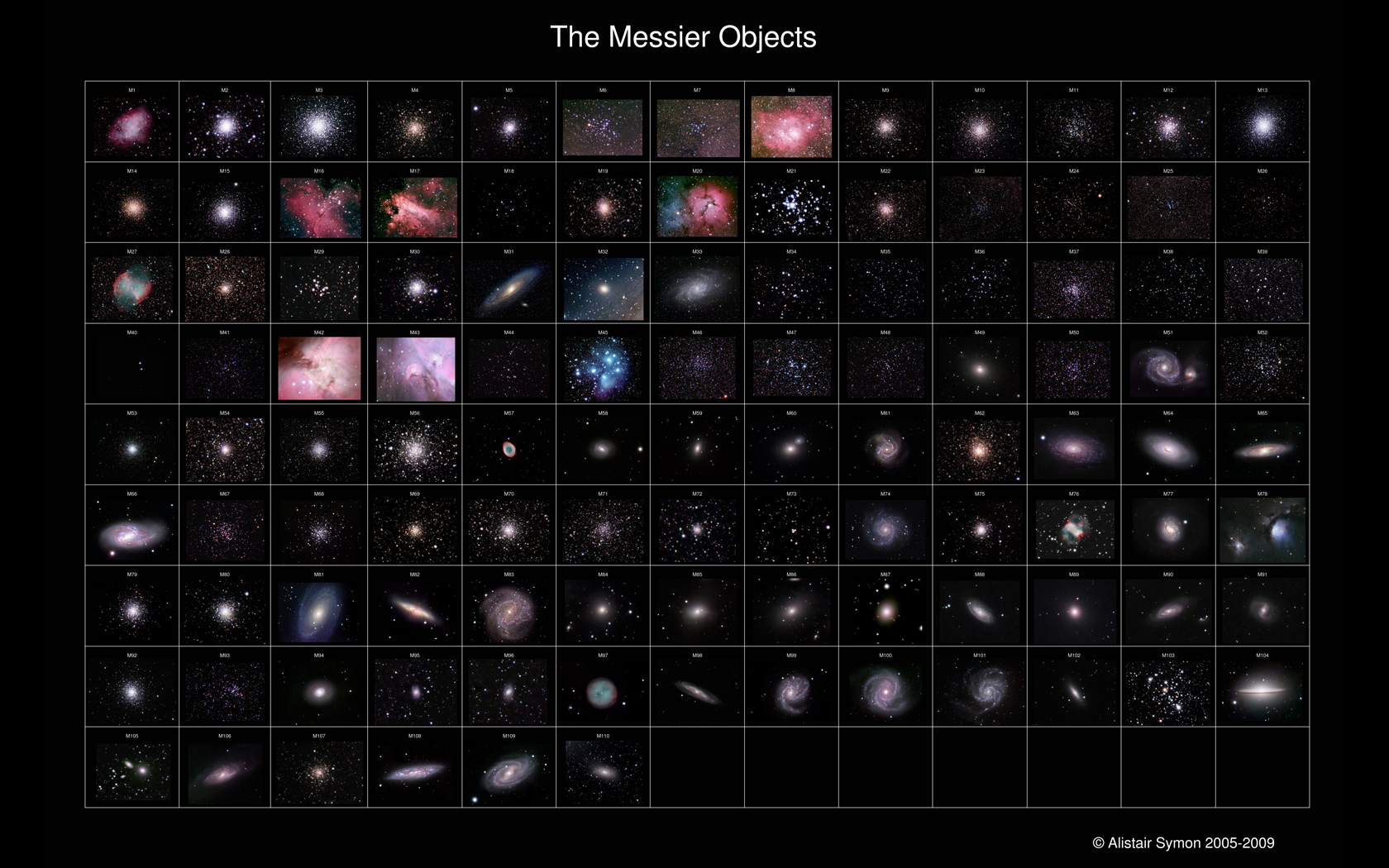
Image credit: The Messier Objects by Alistair Symon, from 2005-2009.
Originally marked as this-is-not-a-comet, these nebulous structures were found to consist of a variety of star clusters, stellar corpses and remnants, and new star-forming regions. But there was another type of nebula among them, the spiral nebulae, with a distinctive structure and a very peculiar property.
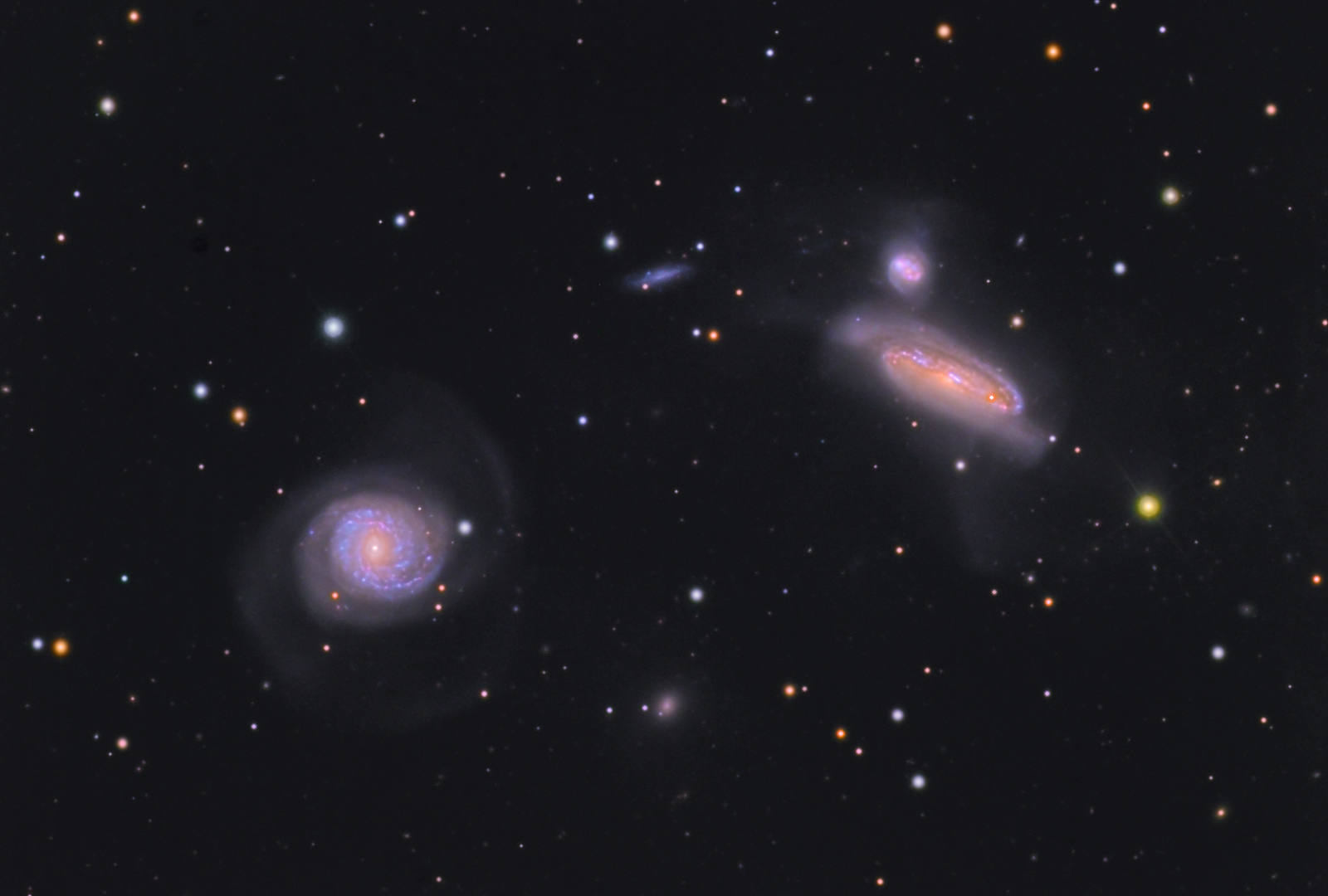
Galaxy Group NGC 7771, by Kent Biggs of http://www.kentbiggs.com/index.htm.
These spiral nebulae may come in a variety of orientations and sizes, but they're practically all moving very fast, and the ones that are moving fast are all moving very fast away from us. What am I talking about?
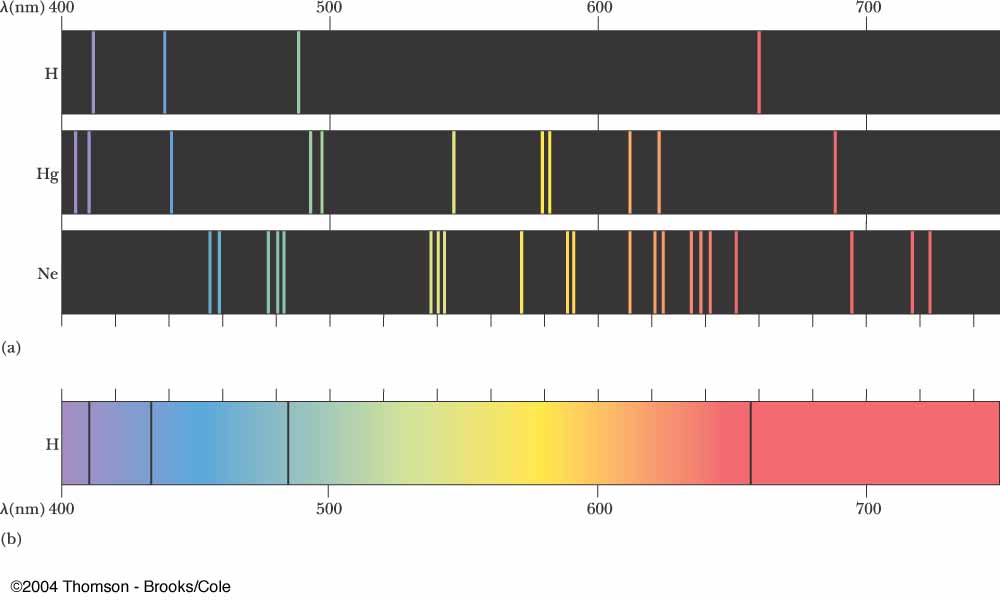
Image credit: Thomson, Brooks / Cole.
Every atom in the Universe absorbs and emits light at very specific frequencies: frequencies determined by the quantum mechanical laws of physics. Every atom of hydrogen in the Universe absorbs light at identical frequencies to one another, ensuring that when we see a pattern of spectral absorption lines, we can identify what atoms are present, and in what amounts.
But if those atoms are moving either towards us or away from us, or if the space between those atoms and ourselves is either contracting or expanding, those spectral lines will be shifted. Well, when we look out at those spirals in the sky, this is what we find.
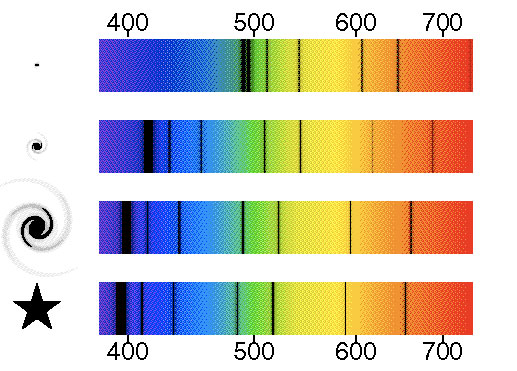
Image credit: webexhibits.org/causesofcolor.
The smaller and fainter one of these spiral nebulae appears, the faster it appears to be moving away from us! By making a variety of measurements, including those of individual stars present in these nebulae, we can not only determine their distances from us (placing them far outside of our own galaxy), but measure the relationship between their distance from us and their apparent motion away from us.

Images credit: Hubble's original paper (left) and W. Freedman et al. for the HST Key Project (right).
Although this was first done by Hubble back in the 1920s, modern measurements are far superior and extend billions of light years away from us.
So these spirals were not objects within our own galaxy at all, but rather "island Universes" unto themselves, or galaxies in their own rights. But if these spiral nebulae are galaxies, and these galaxies move away from us in proportion to their distance from us, then what does that tell us about our Universe?
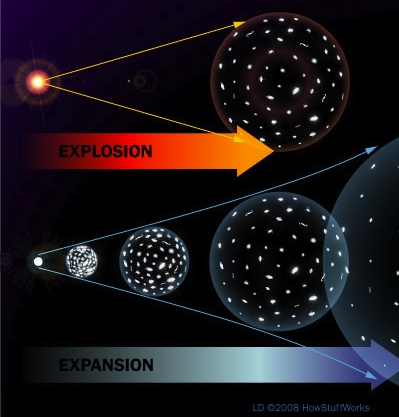
Image credit: copyright 2008 from HowStuffWorks.
It means that either the Universe had some type of explosion in the past, hurtling everything away from us, who just so happens to lie at the center of this cosmic explosion, or that the Universe itself is expanding.
Only the latter explanation is consistent with General Relativity, our experimentally verified best theory of gravity. (There are other alternative explanations for this one observation, such as tired light, Hoyle's steady state theory, and Alfven's plasma cosmology. Hang on and bear with me!) The idea that the Universe is expanding carries with it a number of staggering implications, first realized by George Gamow.
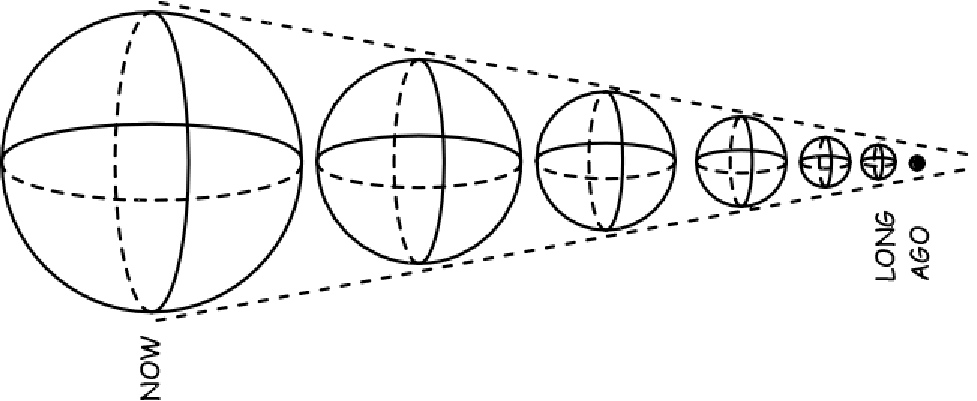
If the Universe is expanding with great spaces between the galaxies today, then in the distant past, things must have been closer together. Furthermore, because of how gravity works, it means if we look increasingly farther back in time, all the particles of light (photons) in the Universe should have had a shorter wavelength, which means they had a higher energy!
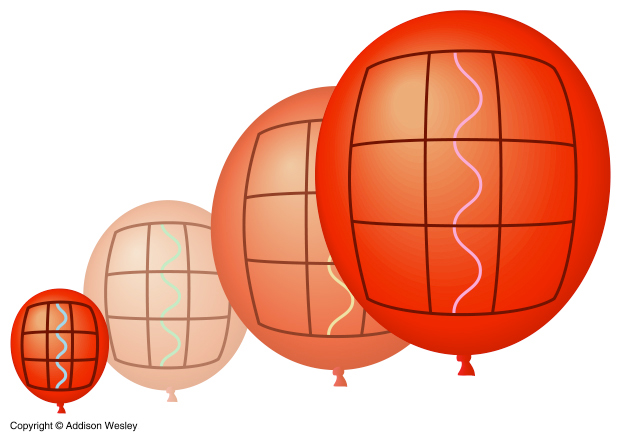
Image credit: Addison Wesley.
Well, if this picture of an expanding Universe that was denser in the past is true, then it must have been hotter in the past as well. At some point, in fact, it must have been so hot that the atoms themselves would have been blasted apart by the photons present. And at some point even earlier, before that, it would've been so hot that even atomic nuclei couldn't have formed; the photons would have blasted everything apart into individual protons and neutrons!
So the Big Bang model -- simply by stating the Universe obeys General Relativity and is expanding today -- makes some very big predictions. Among them is the prediction that, based on the fact that it was very hot and dense in the past and has been expanding and cooling ever since, we should form the lightest elements in the Universe out of protons and neutrons when the Universe is only a few minutes old!
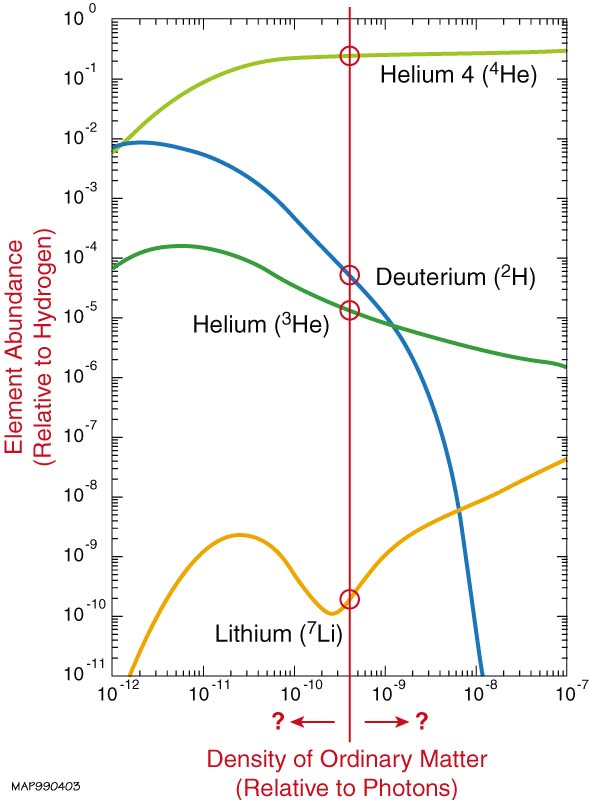
Image credit: WMAP science team.
This includes deuterium, helium-3, helium-4, and lithium, in very specific proportions to one another, dependent only on the number of photons in the Universe.
This also means that, when the Universe finally cools enough to form neutral atoms, those photons left over from the Big Bang should still be there, omnidirectionally, in our Universe today. The only difference between then and now is that, because the Universe has been expanding and cooling, this radiation is not only no longer visible to our eyes, it isn't even infrared anymore! It ought to have redshifted all the way into the microwave portion of the spectrum.
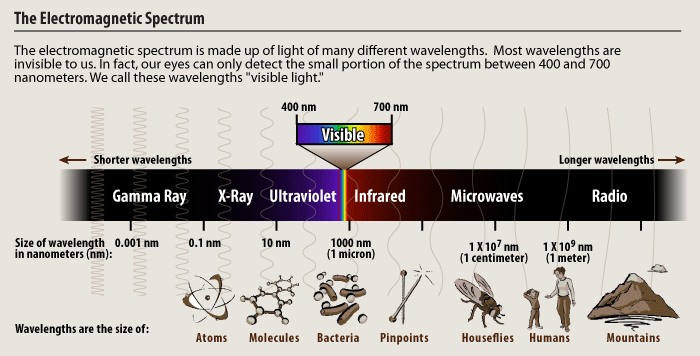
Image credit: James Webb Space Telescope team, via http://webbtelescope.org/.
And what's more than that, it ought to have a very particular spectral distribution, known as a blackbody spectrum. Well, this microwave-wavelength radiation was discovered back in the 1960s everywhere in the sky, and its wavelength was determined to an incredible precision to be blackbody in the 1990s by the COBE satellite.
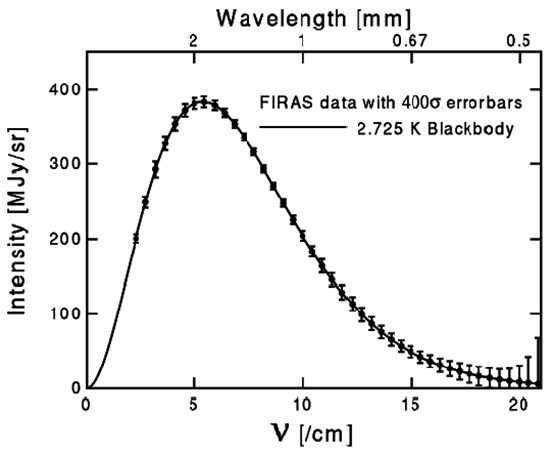
Image credit: COBE / FIRAS science team.
And finally, it was only last year that the first absolutely pristine galaxies -- made out of atoms that had never formed stars before -- were found in the Universe. But this gas was indeed verified to have the right elemental abundances of hydrogen and helium, with no trace of any heavy elements that shouldn't be there!

Image credit: Michele Fumagalli, John M. O'Meara, and J. Xavier Prochaska, via arxiv.org.
And with those three cornerstones in place -- the expanding Universe from the recession of distant galaxies, the abundances of the light elements, and the cosmic background of microwave radiation -- the Big Bang has been verified in a way that no alternative has. None of the other options proposed can give us these three things together: not the tired light model, not the steady-state model, not a plasma cosmology, nothing.
The Big Bang is the only model ever proposed that is consistent with these three pieces of data.
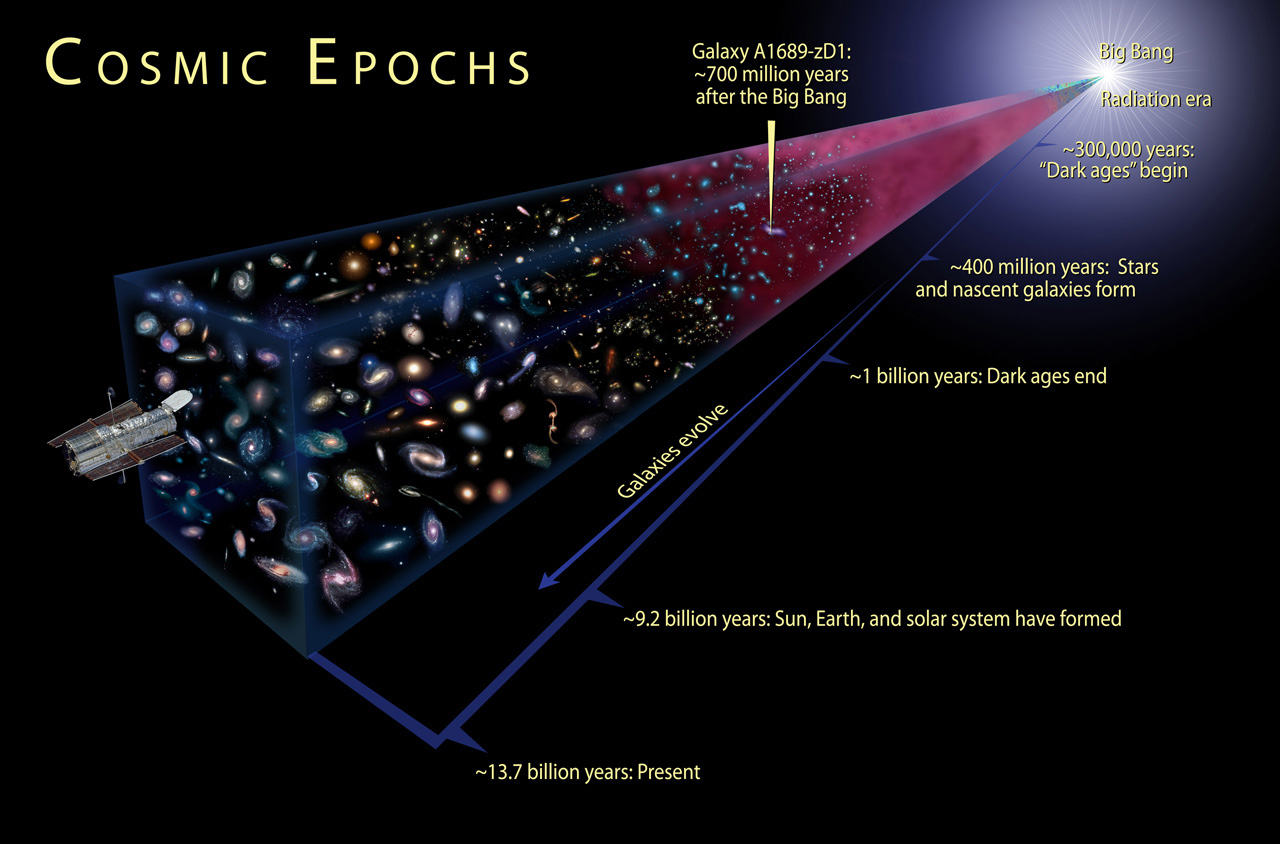
Image credit: NASA, ESA and A. Felid (STScI).
Of course, the Big Bang also gives us structure formation that matches galaxies and clusters in the Universe. Furthermore, it can actually be consistent with dark matter, dark energy and inflation, and every astronomical observation ever made and physical experiment ever performed. It's not only the best theory out there for the physical Universe, it's objectively, scientifically, an incredibly successful theory.
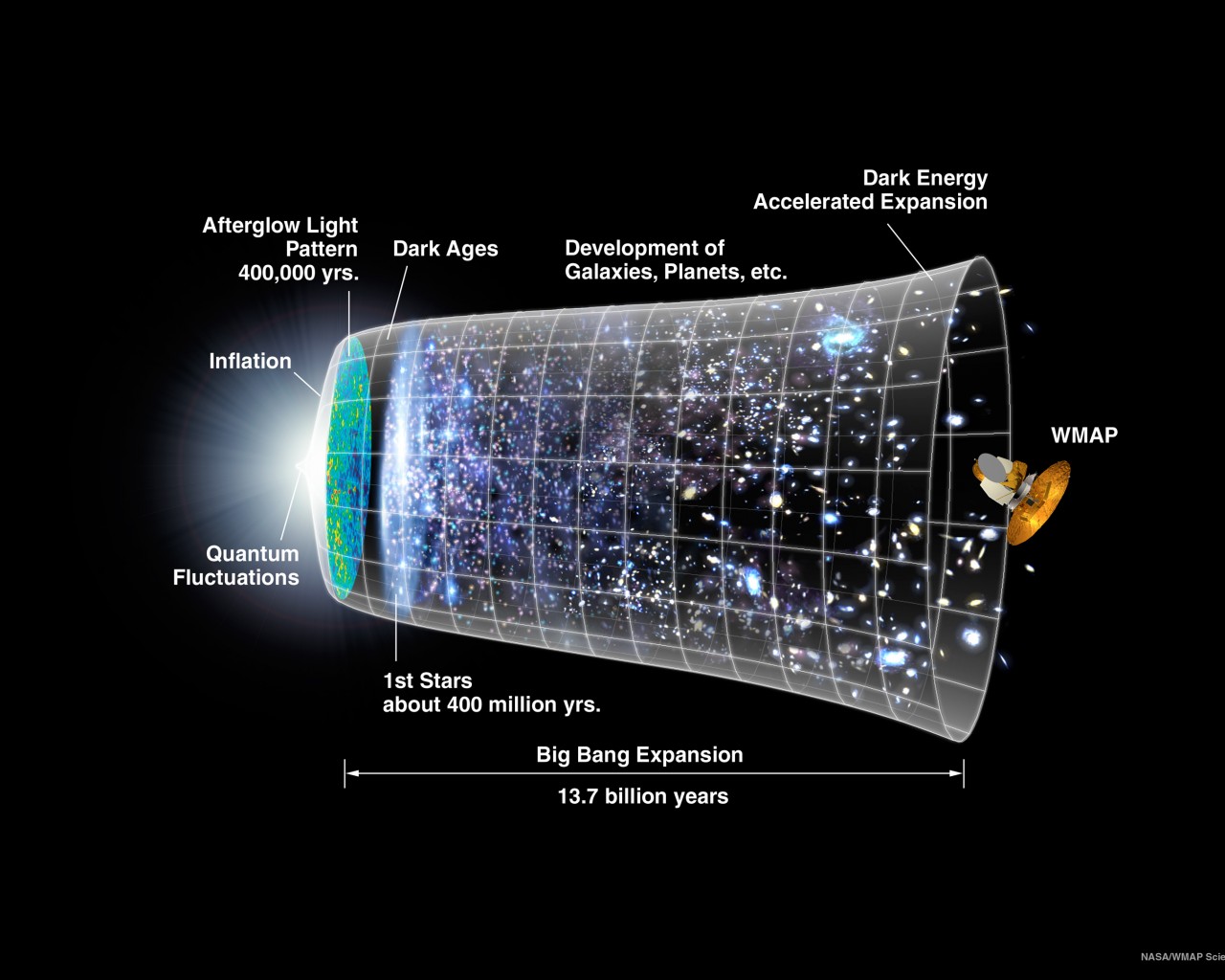
Image credit: NASA / WMAP science team.
If it's a lie, then the Universe itself is lying to us, and we'd be absolute fools not to repeat that lie. But Broun was right about one thing: considering the entire Universe was once so hot it had no neutral atoms, no atomic nuclei, and was entirely a furnace of ionized plasma, it did all come from the pit of hell!
At least, that's one way of looking at it. Some of us, though, have a slightly more poetic name for the miraculous story of the origin of everything in our entire observable Universe.
We call it the Big Bang.
So, who else here has a certain T-shirt with that CMB graph on the back?
HELL Yeah, Ethan! I'm a recent convert from the particular anti-science mindset the politician in question is advocating. I have to say, you've written the perfect guide to the Big Bang for anyone and everyone! This article makes me want to just "shout it from the rooftops" that we UNDERSTAND the universe we live in!
Thanks for being my moment of zen today. Understanding the universe around me is such a transcendent experience.
Not I randy, but I know what you are talking about. It is a nice shirt.
I also like how the name "Big Bang" was coined by a detractor of the theory trying to make it sound ridiculous, severely underestimating how much people -- including (especially) scientists -- love explosions.
Broun has capped teeth. Isn´t vanity something his bible is very claer about?
I am shocked to find out that people like Paul Broun, who know nothing about these scientific fields, have strong opinions about it.
Shocked, I tell you.
It is like if someone who knows nothing about science would go out, take one image of the night sky, and prove that the universe is static. Or expanding.
Or it is like if someone who knows nothing about science would go out, take one image of an glacier, and prove that the climate is cooling. Or warming.
Yes, I can only repeat that I am truly shocked that people who don't care about the details have strong opinions about the broad picture.
Sure Paul Broun is a snake who gathers up the people that didn't went to college and want to kick back at those who they think are smarter than them, and visa versa. It's nothing new, he's a good sales guy playing into a market. But that doesn't make Big Bang absolutely correct, yes there is 100% Red Shift and there are galaxies a billion of light-years away from us, but it is a patchwork theory and using a fool like Paul Broun is easy to make your own theory look all shiny and gold.
This will most likely get me kicked into the dungeon, but tell me how can Expanding Space stretch a Photon physically out? When that balloon stretches out, you are applying pressure from the inside, but Space as no inside; and if you see a proton as a point particle on the stretched balloon, the proton itself isn't stretched one single bit. Similarly a Photon is a point particle, so how could Space ever be stretching it out? Yes one could suggest that the space through witch it travels is moving further away, but that still does not 'stretch' the photon. Yes a sound-wave can Red Shit when you're moving away, but here you have a physical medium (air) through which the vibrations, and there is supposedly none for light particles (photons). For space to be stretching a Photon, it needs to have grip on that photon, and how could that be, when a photon moves like a snake from one side of the Universe to the other. You can only have grip on a photon when there is an Aether, just like in General Relativity where the gravity of the Sun affects the Aether and causes Blue Shift.
Does anybody knows what effect the total mass of our Milky Way has on the light coming from distant Galaxies; and what effects, the ever expanding heat that is generated by our Milky Way, has on the incoming light from far away places, and what about the Us affecting the Dark Matter that surrounds us …? It is far more likely that this is where you need to look to explain the Red Shift that we observe. I might also be just lying though, that's what we all naturally do:
http://www.livescience.com/772-lie.html
It even worse when these people who disbelieve in anything science told us in the last centuries sit on the House Committee for Science, Space and Technology ...
Just don't understand what's a religious crackpot doing in a committee for science, space and technology??? If it was a committee for i.e. freedom of religion or anything like, that I could understand. But this is just ridiculus.
Greetings my fellow apes, having proudly emerged from the pit of hell. Best creation story ever told (and the only one backed up by science ;-).
OK, I've been wanting to ask for a while and this is as good a time as any.
There are a couple of things about the Universe that are sort of interesting :-) .... like it's kind of big, as you went into a while back. Or that it emerged from the big bang out of, literally, nothing.
So my two questions are ... is there any reason to believe, or to rule out that the big bang happened only once.
The second is a rather difficult question (for me anyway). As I understand it, the radius of curvature of the universe seems indistinguishable from infinite. Is there any reason to believe/suspect that it isn't in fact infinite ? What would be the cosmological implications if it did in fact turn out to be infinitely large. Is there such a thing as the "center" in that case ? (Does the question make any kind of sense ?). If not, it would be a bummer for those who want to believe that there is a center, and that it is located on or near to Planet Earth. ;-).
SL, it'll be back-scratching. You're forgetting how much EXTRA money a politician gets for being on a committee.
So if you throw someone a seat on one, they'll help you bring home some bacon.
The remarkable thing about Broun is, he's a physician.
A clear, excellent explanation of the Big Bang and the strong evidences that support it., thanks Ethan.
Regarding the observation of the Universe (stars, galaxies, etc.) , I was wondering about one thing for a while. I will try to be as clear as possible...We can often hear about the observation of distant stars and planets with some properties (e.g., size, composition, etc.), but when we observe a distant star, how do we filter the light that comes from it from the light that comes from all over the place (I suppose there's a lot of light that comes into the telescope). That is, how do we point the telescope to observe just a single star that is millions of light years away.
Does it make sense to ask something like this? Thanks!
Filip,
You might want to check this Wiki page to get the answers to your questions: http://en.wikipedia.org/wiki/Hubble_Ultra-Deep_Field
Thanks Chelle. I'll take a look.
What a damned liar Broun is.
He is trash talking the most rewarding sustained effort this world has seen, sustained by the best and brightest individuals we have.
And what has he to offer as alternative? A goat herding manual,* with among the worst moral one can think of (genocide, death punishment, mutilation, torture, slavery, misogyny) suggested as modern moral!
* it isn't that of course. Best I can see from the sparse historic sources is that the religion, a typical greek synchretic pagan religion with earliest texts in greek, surfaces after the hellenic conquest. (The dated Dead Sea scrolls.) Likely an adoption of "superior" culture of the conquers by the conquered, which diverse cult in later centuries split into the jewish et cetera cults.
It is, if anything, a conquest manual for both sides, how to live with winning and losing.
Religious 'wing-nuts' on Science, Space, and Technology Committees are no accident; the agenda is clear. Just as with climate science, if you get enough idiotic counter-noise of pseudoscience or fundamentalism of religion, the argument is diluted in a non-productive fight over basic principles. I know colleagues in medicine of Broun's stripe. They are not rational about this issue nor respectful of the march of science and reason since the organization of civilized society. Physicians should stand for principles of science and reason in the intersection of faith and belief. There is middle ground that does not require drastic religious rejection.
Quick inspection of the video, Broun's backdrop is a trophy wall of slaughtered deer. The Lord certainly 'doth take away.'
Your summary of science is good and reminds me of "Brief History of Time' from Hawkins. Thanks for speaking out.
Broun doesn't like general relativity, but I bet he doesn't refuse to use a GPS. He doesn't like the CMB predictions made by thermodynamics, but I bet there's a refrigerator in his house. He probably doesn't like the ancient age dates determined by measuring radioisotope decay, but I bet he votes to support our nuclear arsenal.
A fool. Sadly, a powerful one.
Thank you for smacking that knot head down!
@Wow
I know.. My question was mostly rhetorical. It's a corrupt and dirty business... the politics.
Someone put him there, and of course they all have some agenda for it. Sucks really, when some corrupt religious crackpot gets to decide who gets funding for what.
So what came before the big bang and what comes at the end when the universe contracts? How can there have been nothing? My kids want to know and I have no good answers other than it's a mystery.
Lori,
There are theories about all of the questions that you ask, but they are just that: theories. Telling your kids that there are things that no one knows yet is important, as they need to understand that not all questions have easy (or even any) answers. The next step is to look them in the eye and tell them that if they really want to know, perhaps they can be the one who discovers the answer.
Maybe, if they get encouragement from you and from their teachers, they will be. That's the legacy that you pass on to all future generations.
"So what came before the big bang"
What's north of the North pole? Where does the cold go when you stop the draught?
What is the difference between a ducks legs?
Some questions don't have answers. Some of them because the question is ill posed.
Before the big bang, there was no time, but since "before" means "at a time before", how can you ask about a time before a time started?
When someone asked the brightest minds "Are the planets going to stay in their orbits?" the answer was "Maybe".
There was no better answer.
But the answer led to something a lot more useful: Chaos Theory.
And that led to the ability to find what questions CAN be answered.
And they turned out to be more important than anything else.
Well, actually I think Milton would beg to differ on which term is more poetic.
What always bothers me about the biblical literalists is that there is no statement in the bible about where the authors' evidence for Adam and Eve, and even for their lineage, came from. We don't have a direct statement from God to Moses, or anyone else, saying, "here's exactly what happened." Instead we have a primitive author writing down something that he says happened several thousand years before. As we modern historians know, it's tough to be very exact about something that happened long ago, but yet this oral history is supposed to trump the scientific evidence. Faith is one thing, but the faith we're being asked for is faith in the primitive authors, and not faith in god.
@Hephaestus (and hence @Lori): I wouldn't generally even call those theories yet. They're more hypotheses, unless and until we find some possible way to test them.
And I thought I might explain my first comment, for those who don't make the connection, that graph is on the back of the well-known "Science: It works" XKCD T-shirt.
Paul von Broun:
http://www.ammoland.com/2012/06/22/congressman-paul-broun-defending-our…
PS he is not a dr. he is only an md
so putting dr. in front of his name is presumptuous
@chelle
" It’s nothing new, he’s a good sales guy playing into a market."
Yep, he´s playing "the knitters vote", the old ladies who likes this kinda talk. And if he wins those he has another round won.
on a sidenote:
https://fbcdn-sphotos-g-a.akamaihd.net/hphotos-ak-ash3/580423_477768475…
But don´t worry. NASA trained Jedi´s already:
http://static.neatorama.com/images/2012-09/astronauts-desert-survival-t…
What a damned liar Broun is.
One of the remarkable ironies about so many Biblical literalists is their casual attitude toward Exodus 20:16: "Thou shalt not bear false witness against thy neighbor." Which is hardly an obscure point of theology, since it's one of the Ten Commandments. It's also one of the handful of Biblical commandments that is actually implemented in law: perjury is a crime, and libel and slander are grounds for civil lawsuits. There are reasons unrelated to fear of $DEITY why lying about matters of importance is a Bad Idea.
Either we are created in 7 days / are only 6,000 years old, or came out of nothingness 14 billion years ago from the womb of' Providence' and 'The Big Bang.' The two positions are incompatible, one has to give way to other.
The reason our life is devoid of the richness of renaissance men is that the days are past when our present schools could give time and attention to a child to learn knowledge. History is the first step of learning for any child; history teaches man to learn from the mistakes of the past. That knowledge will lead him/her to Geography and finally to familiarity of classics and our globe. Once he/she knows our earth well, some unanswered queries will lead him to know our solar system where our 'blue pearl' sits as a third planet around the sun in quite a silent part of our galaxy.
Once we discover our triviality in the system of the Universe, the road to self-discovery is laid bare. The idea of a 14 billion-year-old Universe raises an enquiry and questions the entire logic and philosophy of Abrahamic scriptures. Faith tells us a story that is the greatest myth of all times. If that is the litmus test of trust that Gingrich imposes "How can you have judgment if you have no faith? How can I trust you with power if you don’t pray?” then USA/mankind has a big problem.
It is this dichotomy and basic error of understanding of our age that is rarely addressed. Majority of the Faithful across the lines of Abrahamic scriptures refuse to believe science of creation that evolved through a carbon-based life from the throes of dead stars. From the womb of death we are formed, to quote Rumi who inspires me a lot:
I died as a mineral and became a plant,
I died as a plant and rose to animal,
I died as an animal and I was Man.
Why should I fear?
When was I less by dying?
Rumi
When a star dies we form! Yes, every carbon atom in our body is the primordial 'star dust.'
Though the 'faithful' have broken the hearts of atoms, discovered particles that travel faster than light very near to the Vatican at CERN, they undertake journeys to study distant galaxies but the eternal sin and guilt of reconciliation with the scriptures that acquaint us with an allegorical tale of creation still remains a collective burden on mankind's conscience.
Congressman 'Paul Brown' you are the result of 4 billion years of evolutionary success. Fc-king act like it.
@United States Congressman Paul Brown, M.D. from the 10th Congressional District of Georgia has formed a theory as to why scientists and teachers collect facts about the universe and then teach them to new generations. Here it is: "God's word is true... all that stuff I was taught about the evolution, embryology, the big bang theory... all that is lies straight from The Pit of Hell. And its lies to try and keep me and all the folks that were taught that from understanding that they need a saviour."
Yes, absolutely 'we' f-c-ers don't act our age, we are actually 14.3 billion years old, every atom in our body originates from 'The Big Bang.' Once we discover our triviality in the system of the Universe, the road to self-discovery is laid bare. The idea of a 14.3 billion-year-old Universe raises an enquiry and questions the entire logic and philosophy of Abrahamic scriptures. Faith tells us a story that is the greatest myth of all times. If that is the litmus test of trust that even Gingrich imposed "How can you have judgment if you have no faith? How can I trust you with power if you don’t pray?” then USA/mankind has a big problem. It is this dichotomy and basic error of understanding of our age that is rarely addressed. Majority of the Faithful across the lines of Abrahamic scriptures refuse to believe science of creation that evolved through a carbon-based life from the throes of dead stars.
Our 'star dust' that our body is composed off is even 10.3 billion years older from the time when planet earth came into existence 4 billion years ago. We are product of 14.3 billion years of evolution. At some point 14.3 billions of years ago all the matter in the Universe occupied a space no larger than the following full stop. In an explosive burst, this point, or 'singularity', expanded at an astonishing rate like a fireball at temperatures of billions of degrees, creating space as it rapidly spread.
Within the first second gravity and all the other forces were formed. Within minutes the Universe was billions upon billions of miles across and most of the matter that will ever exist was created. Either we are created in 7 days / are only 6,000 years old, or came out of nothingness 14 billion years ago from the womb of' Providence' and 'The Big Bang.' The two positions are incompatible, one has to give way to other.
The reason our life is devoid of the richness of renaissance men is that the days are past when our present schools could give time and attention to a child to learn knowledge. History is the first step of learning for any child; history teaches man to learn from the mistakes of the past. That knowledge will lead him/her to Geography and finally to familiarity of classics and our globe. Once he/she knows our earth well, some unanswered queries will lead him to know our solar system where our 'blue pearl' sits as a third planet around the sun in quite a silent part of our galaxy. When a star dies we form! Yes, every carbon atom in our body is the primordial 'star dust.' 'After life' as 'Star Dust' will continue. Each and every bison and atom in our body without being 'sentient' configuration as us will live until perpetuity as universe collapses on its own self.
From the womb of death we are formed, to quote Rumi who inspires me a lot:
I died as a mineral and became a plant,
I died as a plant and rose to animal,
I died as an animal and I was Man.
Why should I fear?
When was I less by dying?
Rumi
Trillions upon trillion atoms that constitute our body will not disappear as death ensues, they will be around in a different configuration. One day the hydrogen in our body was burning in the core of a star, the other day after the explosion it became heavier compound like carbon that formed the basis of hydro carbon life.
After out death,' ashes to ashes,' 70% of us is water and water will revert to water, rest of 'us' will disappear in natures trillion upon trillion upon trillion of tones of materials and star dust, what we will leave behind is what our 'present conscious status' will help us to formulate.
That is how we will live forever. The more nonsense we utter lesser we will be known; the higher intelligent content we deliver we will be a known speck, we need to become a known tiny speck for our future generations.
We humans are not 'radioactive material' we are composed of slow elements after nearly all the energy to make us sentient has been extracted and exhausted in becoming a 4.8 billion old quiet earth and then nature extracts remaining vitality by awarding our brain 100 trillion synapses, as living itself is a high powered exercise our low lying elements for hydrocarbon life is ok, whereas burning in the cores requires 'packed energy' to create nurseries of future earths, like that of H and He , once we lose our 'sentient status' we might one day return to the cores of stars to turn into a higher energy particles.
Though the 'faithful' have broken the hearts of atoms, discovered particles that travel faster than light very near to the Vatican at CERN, they undertake journeys to study distant galaxies but the eternal sin and guilt of reconciliation with the scriptures that acquaint us with an allegorical tale of creation still remains a collective burden on mankind's conscience.
In his own time, with his own devices and methods, Ptolemy was probably as confident in his conclusions as many today are in the big bang conclusion: that this so-called best conclusion is the correct conclusion.
If matter is whizzing away from one origin at such humongous speeds, explain colliding galaxies.
Explain too how this humongous amount of matter assembled in an origin so small.
It seems to me inevitable that a human mind so thoroughly schooled in xianity's out-of-nothing fantasy, even if that mind's possessor did study mathematics, would conjure up something so much like that out-of-nothing fantasy. Would that mind be capable of anything else?
The God of scriptures is Jealous- I like the God of singularity
by Iqbal Latif on Sun Oct 30, 2011 03:15 AM PDT
God of science is big-hearted and demands free enquiry. The God of scriptures is Jealous! I like the God of singularity! But what we believe in light of God's Ten Commandments is utter profanity and sacrilege! God of science is big-hearted and demands free enquiry. The God of scriptures is Jealous ''for I, the LORD your God, am a jealous God, punishing the children for the sin of the fathers to the third and fourth generations of those who hate me, but showing love to a thousand generations of those who love me and keeps my commandments.''
In science, greats have remained great whilst their thinking was destroyed by the new greats. Aristotle believed in geocentrism but Aristotle remains the major source of philosophy in the modern world though some of his findings are found to lacking truth. This is the greatness of science; it is based on reason and logic.
Reason and science leads to freedom of mind from dogma and acquirement of rationalism. The belief in the theory of Big Bang, theory of evolution, germ theory of disease, theory of gravity, theory of relativity, theory of atomic structures and theory of chromosomal inheritance requires no Holy Scriptures but scientific proof and rigorous test of these truths. Science progresses with each funeral whereas religion continues to present the same story of creation with a lot more contradictions. There is no region of the world where you can see mindless predominant following of Aristotle, Newton, or Einstein. Yet, those regions where science helped to develop tools of progress are regions where theories of sciences and philosophy are well treasured. Where Newton is respected, logic and rationalism has survived and progressed by leaps and bounds, toleration in those regions is admirably better. Regions, where pre-dominant thinking and learning of scriptures is considered as divine progress, stand still, and with poverty of mind that dominates the landscape material hazards make the life of inhabitants miserable.''
There is no final word in our world: Newton proved Aristotle wrong but the greatness of Aristotle stays in the mind of man and is part of cultural folklore. I will enigmatically point out to a strange dichotomy that I have written about a lot, i.e. the Prophets. The next prophet never discarded the principles of the old rather rehashed them and redefined the geography and incidences with his own juxtaposition. Incoherence of the Holy Scriptures in events and personalities is at sharp contrast to rejection of ideas with reason and logic. Sciences progress with the death of an idea and a funeral takes off a new. The holy scriptures in succession tend to wean authority from the previous and tend to support the incoherence of the myths, though supportive of fables, but defining them for their own geography. The stories of Torah, Bible and Quran are not supportive of each other rather contradict each other, Newton negation of Aristotle made Aristotle even the greatest of beings.
What consumes my mind is the void and slow pace of human history and phase of discovery from 500 BC to 1600/1800 AD and the huge exponential growth from 1600 to 2011. I am obsessed with discoveries that led to the causes and origins of that massive exponential increase in rate of growth of our knowledge spectrum. Ideas should be rewarded, not persecuted. The idea-man should be loved, not condemned. When Galileo was condemned and arrested, the emphasis of science moved from Italy to Northern Europe. When in 1200 AD Ghazali arrested free will over philosophical dialogue of Averroes and introduced the concept of predestination as the favourite strain of Allah’s ideology, Middle East descended into a chaos which it has not recovered so far. History takes time but grinds very fine and destroys those who deny the flow of knowledge.
Wow, how quickly this discussion turned into extreme bigotry in the name of science. Both sides of the political debate parade science when it's on their side, then quickly ignore/deny when it's against them.
Ethan, please, more science, less bigotry.
The spiral nebulae are also lies from the pit of hell. Satan put them there to fool people into thinking the universe is expanding! :-)
Wow. I am amazed at the smallness of the minds collected here. Y'all need to learn how to think big. You get all excited over comments made by some guy who is obviously a baby Christian and has not yet learned enough to know what he is talking about. But your reaction is silly. In the Bible (Genesis 1, if you care to look it up) it says that God created Adam and Eve in a single day. If you had met them at the end of the day you would have seen young adults. "No way," you would say, "that these people are one day old!" Now expand your mind to encompass the whole universe. The Bible says God created it in five days. At the end of those five days you would look at the universe and say, "No way this universe is less than 14 billion years old!" Yes. God can do that. He is big enough.
@Lori
These people will have you believe that the universe is all that there is because they can't stand the idea that there is something bigger. Tell your kids that before the Big Bang there was God and after the universe comes to an end there will always be God. There is nothing empty and hopeless in that.
This may make the part of his condemnation of embryology unusual, but remember that as a physician his formal training and knowledge about evolution and cosmology would be little (evolution) and none (cosmology). It is the fact that he he willing to lie and say that there are numerous scientists and a great deal of data that contradict the ideas are the important points here.
It is amazing how congressman Broun can rely on all of the inventions that have arisen due to science and technology, such as nuclear power, jet aircraft, satellite applications, and even medicine for Pete's sake, but deny the reality of science when it comes to evolution and cosmology. Really scary that he is on congressional committee for science, space and technology.
Technolgy.
technology.
Beautifully written and illustrated article. Thanks!
"Representative Paul C. Broun, Jr... received his Medical Doctor degree from the Medical College of Georgia in Augusta. An internship at Good Samaritan Hospital in Portland, Oregon and a residency at University Hospital in Birmingham, Alabama followed." from his web page
The influenza evolves very quickly, whereas the measles virus evolves very slowly. Thus immunization against measles lasts a lifetime; but immunization against influenza must be done annually. How does an M.D,, like Paul Broun explain the need for vaccines without explaining evolution? Or is Paul Brown against immunizing children? Probably.
Paul Broun says, "You see, there are a lot of scientific data that I’ve found out as a scientist that actually show that this is really a young Earth. I don’t believe that the earth’s but about 9,000 years old. I believe it was created in six days as we know them. That’s what the Bible says." Are you getting the picture yet?
"Kind of scary, don’t you think, that we have legislators like Broun who have little respect for science serving on the House Committee on Science, Space, and Technology?" What do you think?
Why exactly did his republican peers in congress select him to serve on the House Committee on Science, Space, and Technology?
http://en.wikipedia.org/wiki/The_Republican_War_on_Science
Oh, do you think Rep. Paul Broun is part of the republican war on science?
@ChristFollower: Oh, the "appearance of age" argument? *yawn* How novel...
That this makes your god a deceiver doesn't bother you...? Tell me: did Adam and Even have navels? Did they have scars (which most if not all adults have from injuries which they got as childs)?
@Tom Sarbeck:
Err, no. Ptolemy never claimed that his model corresponds to reality, he only intended to "save the appearances". (and there are internal contradictions in the Ptolemaic system)
No one claimed that it does. It's not matter that's "whizzing away from one origin", it's space itself that's expanding.
Expansion happens on large scales (think of galaxy clusters and super clusters, not individual galaxies). Locally, on smaller scales, the gravity of galaxies dominates, so that they are drawn to each other. (That's explained in lots of popular-level astronomy texts even, so you really have no excuse for not knowing this and pretending that that's a problem for the Big Bang theory.)
No one says that it did. Please, learn a bit about what the theory actually says before erecting more straw men!
If you think that the Big Bang model follows from christian thinking, then why do so many fundamental christians oppose it...?
@chelle:
Err, did you notice that Ethan mentioned other pieces of evidence beside the redshift...? (and there are several more beside the ones Ethan mentioned)
Why do you think so? Do you belong to the people who consider Dark Matter and Dark Energy to be "patches" in the theory? Well, there is also the point of view that they are natural parts of the theory and should have been included in it right from the start...
It doesn't. The electromagnetic waves are stretched, the photons themselves remain point particles.
Well, yes - that's one of the points where the balloon analogy breaks down. BFD.
One needs no "grip" on an electromagnetic wave in order to stretch it. That's a very mechanistic point of view.
Huh??? General Relativity says nothing about an Aether!
Yes, one can estimate that using the Schwarzschild metric. I don't have the exact number at hand, but I've seen it - and it is completly negligible compared to the observed redshifts.
Huh? What heat? Do you mean the electromagnetic radiation emitted by the stars, or what? Why on Earth should that have an effect on the incoming light? Do you propose completely new laws of electromagnetism???
Sorry, I don't understand at all what this is supposed to mean.
@Bjoern,
Everybody knows, because relatively new data has been popping up and the theory has been skewed plenty of times to keep it fit: http://youtu.be/IcxptIJS7kQ
--
The question remains the same, how can you stretch out electromagnetic waves? It's not necessarily a 'mechanistic' point of view, but a physical one; at the end of the day a photon is still a thing, not a ghost.
--
It doesn't says so in the book, but Einstein himself saw it as a 'New' Aether:
--
Why wouldn't electromagnetic radiation have an effect on the incoming light, like I said before, a photon is not a ghost. I don't think there should be complete new laws of electromagnetism, only that there might be a situation whereby the interaction of light with the 'New' Aether, might cause a small but not negligible change within that Aether, whereby photons could be physically stretched, just like Gravity does.
--
…
You say that the Red Shift generated by the mass of the Milky Way is 'negligible' but have they also included Dark Matter which can bend light. And how much Dark Matter is our Milky Way attracting/subtracting from space around us, or is it constant?
"The question remains the same, how can you stretch out electromagnetic waves?"
Well one way is by making it go up a gravitational field. And gravity stretches space, remember.
"Why wouldn’t electromagnetic radiation have an effect on the incoming light"
Because they don't interact. You need an electric charge to interact with light. Light is neutral. No interaction.
"but have they also included Dark Matter which can bend light"
How can you believe that Dark Matter bends light (what? does it grab both ends of the photon and twist it?) but not that expansion of space bends light (by asking does it grab both ends and pull?)?
@Chelle
there is a place for your aether theory and all you think world is and isn't. It's not this post.
You can post it here:
scienceblogs.com/startswithabang/2012/09/23/weekend-diversion-you-are-responsible-for-what-you-say/
@Bjoern,
I forgot to respond to this one:
Yes, those "absolutely pristine galaxies", that's like finding a clear diamond and waving with it, as if it is was some relic from a time before ours, when elves, dwarfs and hobbits roamed the old pure worlds. Its an interesting gem to have been discovered, to attribute it to the beginnings of time, might be a bit presumptuous.
Totally off-topic: Google search has celebrated N Bohr's 127th birthday today (7 Oct)
I guess Niels is in the pit of hell celebrating
"that’s like finding a clear diamond"
No it isn't. It's finding galaxies without any nucleosynthesized elements.
Its like finding water with H2O in it.
I think you misunderstand some things about Almagest. Ptolemy most certainly did intend to describe reality and, for that matter, it was perfectly predictive to observation until Galileo's telescope.
It's worth noting that the distinction between the "truth" of a phenomenon and a rigorous, abstracted, fully descriptive presentation of observations is the hallmark of modern science and so, to the degree to which your assertion were true, if it were, is the degree to which Ptolemy was more scientific in the modern sense, not less. Indeed, Galileo and Newton in describing gravity made precisely this fundamental advance that marked the birth of modern science — they did away with teleology and related underlying hypothesized mechanisms and simply described gravity mathematically, without attempting to explain "how it works". That's modern science.
And, no, Ptolemy's astronomy was not internally inconsistent. What you are alluding to with the "saving the appearances" quote is the equant. The supposition of the equant no more made the model internally inconsistent than a normalization term elsewhere. Indeed, per the previous paragraph, the equant is only problematic if one is determined to imagine some specific mechanical impetus for the described motion (even then, one can imagine various possibilities).
Ptolemaic astronomy is popularly criticized as being essentially unscientific and in my opinion this is very mistaken. It can rightly be described as being prescientific in that while having a strong empirical basis (necessarily so, as describing the movements of the heavenly bodies was of great practical concern because of astrology), it nevertheless existed strongly in the context of a mystical, teleological Aristotelian cosmology. An argument can be made that the geometry of heliocentrism is simpler and more elegant and, importantly, that this was known to Ptolemy and thus heliocentrism should have been preferred because of parsimony. However, parsimony is not the ultimate deciding factor in science (if so, then the theist cosmology discussed here might be preferable) but, rather, correspondence with other, related observations and known facts is important. As such, Ptolemy and those before, including the classic Greeks, were well aware of heliocentrism's elegance but rejected it on the basis of two very reasonable objections: that the Earth doesn't feel as it is in motion; and, more convincingly, the lack of observed parallax of the "fixed stars" would indicate an incomprehensible (to them) distance. Fully modern and defensible science is littered with elegant but rejected theories that are built upon a uncomfortable hypothesis — and often they're later resurrected and accepted. As heliocentrism was.
Anyway, I am in general agreement with the spirit of your criticism of Tom Sarbeck — there is a vast difference between ptolemaic astronomy and contemporary cosmology. Ptolemaic astronomy can largely be thought to exist within a single book. Contemporary cosmology, and the evidence for the Big Bang, is vast in comparison. Arguments that take the form "well, people believed X in the past and so Y, which we believe now, is just as likely to be wrong" are facile and generally ignorant. On the other hand, arguments that take the form "well, what people believed in the past, such as X, was just ignorant nonsense and, in contrast, Y, which we believe now, is almost certainly true and qualitatively superior as an example of knowledge" are also facile and generally ignorant.
"And, no, Ptolemy’s astronomy was not internally inconsistent."
Hang on, it IS internally inconsistent as a THEORY. I.e. it doesn't explain a damn thing. It just tries to plonk things down that fit.
It's no more scientific than curve fitting a polynomial to a set of observations.
It has no predictive ability and no proscriptive value.
It's just-so stories for philosophers.
"However, parsimony is not the ultimate deciding factor in science "
However, that's no need to multiply your factors just for the giggles.
Each factor you add in adds yet something else you need to explain and another thing that can go "wrong" with your theory.
@Chelle
I agree with Sinisa Lazarek; Your continued discussion of your aether theory does not belong on this post or any Start with a Bang post except the following post (i.e. the comments policy web page).
scienceblogs.com/startswithabang/2012/09/23/weekend-diversion-you-are-responsible-for-what-you-say/
Please reread this Start with a Bangs comment policy web page and confine your personal speculations (which you have already amply expressed and which others have already amply answered) to the above Starts with a Bang comments web page.
@Wow,
"It has no predictive ability and no proscriptive value."
It was perfectly predictive for all possible observations until Galileo's telescope.
And, anyway, "internally inconsistent" doesn't mean what you think it means if you think that something as a theory has to "really explain something" to be "internally consistent". I can't quite get my head around why you would use "internally inconsistent" to mean something that has nothing to do with internal consistency.
But as to your "really explain things" argument, I urge you to consider Newton and gravity. Are you arguing that Newton wasn't doing science? That his theory of gravity wasn't science, but "just-so stories for philosophers"? The whole point of the distinction between modern science and pre-scientific natural philosophy is precisely that modern science attempts to primarily mathematize observations into a predictive abstraction and *not* to "really explain things".
Newton had no explanation for what gravity is or how it affects matter the way that it does in the sense that you are insisting is necessary (i.e., some mechanical explanation of causation). He simply described it mathematically with precision and elegance. That is what Ptolemy did, too, with regard to the motions in the heavens. Ptolemaic astronomy was predictive in the way you insist (within the context of the observational limits of its time) and what it lacked that you decry is exactly what Copernican heliocentrism also lacked, as well as Newton's gravitation. That is, a causal mechanism, something that satisfies the intuitive need to understand how it "really works".
You are appealing to a kind of naive intuitive realism, that a "true" scientific theory must describe a natural phenomenon in such a way that it satisfies one's mechanical intuition about causation — that it's not merely a mathematical conceit, an abstraction without any direct correspondence to physical reality. But the history of progress in physics is exactly one of consecutive adopting of theories which were initially criticized as being no more than mathematical conceits which don't truly correspond to anything real. This is best exemplified with QM, of course; and QM demonstrates just how wrongheaded, how counterproductive, how anti-scientific one's insistence on an intuitive, mechanical comprehension is as the litmus test for the truth of a theory.
I don't dispute that at the core of science, as an institution, as a worldview, is a kind of naive realism that assumes that empiricism is the path approaching Truth, How Things Really Are. And, in fact, I'm entirely in agreement with science in this sensibility and what science has done and is doing. Even so, there is a powerful tension between this desire for Truth and the rigorous empiricism of science because, in fact, historically within the history of science and in the history of pre-scientific natural philosophy, the urge to center investigation around a presumed (and intuitive) comprehension of the nature of reality has time and again led to more bad science that was proven wrong than it's led to good science that was proven right.
When you insist that Ptolemaic astronomy was a mathematical conceit while Copernican astronomy was real science you are precisely, astonishingly missing the point — which is to say, you're obviously appealing to your contemporary idealistic comprehension of local astronomy, a kind of naive realism. You're not, as you're claiming, evaluating these theories on the basis of their empirical correctness of their times, because they're both correct on that basis. You're appealing to "truth"; and while that's psychologically at the root of why we do science, thinking in those terms is not scientific.
@Sinisa & OKThen,
My post here is very much 'on-topic' you have the idiot Paul Broun selling some snake oil, to a bunch of even bigger idiots. But on the other side of the spectrum you have an other sales guy, and this one is pretty smart and to sell his stuff he starts by using the comments made by the dumbass, to move on and sell an amazing story about the expansion of space. The interesting part is that the general public of course doesn't want to have anything to do with the stupid guy, so they simply buy the product from the smart guy, without being too critical.
btw 'OK', Aether is not my special pet theory, it is like Einstein said the substance that makes GR work. Yes on paper it is pure Space that's curved, but in reality there is something filling up that Space, and giving it its properties. If you want to (keep on) expand(ing) Space you also need to stretch out that substance, so Big Bang no longer makes any sense at all, just like making Eva out of Adam his rib. So if this topic is about liars than my comments are very much on point.
Also remember that Einstein was not too critical for those Big Bangers such as the Sitter because they measured for him that light was bend by the Sun and thus proving GR, its a bit of politics. Giving them hell would have been a little unthankful from him, so he was easy on them, although perhaps you may remember this quote from him:
--
Wow,
Its like finding water with H2O in it.
Wow, what a revelation!
"My post here is very much ‘on-topic’"
Nope, you are demonstrating that you have mabsolutely no interest in listening to any answers given or in showing how your BS is better.
You've been asked and then told several times before, get your sorry ass over to:
http://scienceblogs.com/startswithabang/2012/09/23/weekend-diversion-yo…
because you're not listening to anyone and cluttering up this thread with yet more useless and repeated crap.
"“It has no predictive ability and no proscriptive value.”
It was perfectly predictive for all possible observations until Galileo’s telescope."
Only for the stars and outer planets.
It sucked big time for Venus (phases that can only happen if they are an inferior planet, spinning around the light source closer than we do).
Oh, and ptolemy's circles were not a theory. They were curve fitting exercises.
And note: the positions of the planets WERE NOT accurate, they were inaccurate and each inaccuracy added up over time. After 150 years, the disagreement between the "prediction" of Ptolemy's system and the actual visible system were noted.
Nobody ever managed to find a version of the circles that worked even for viible astronomy.
@ Chelle
you've been warned. As far as expansion goes, don't know if you realize but 2011 Nobel prize in physics was awarded precisely that thing. So it's not one guy, it the current understanding of the whole astrophysical community. You may not like it, you may disagree with it personally, but this blog is not a place to advertise those things. As far as I know, you have your own blog, so post it there.
@Sinisa,
There is nothing wrong with giving someone a prize for measuring the fact that Red Shift is accelerating, that's a damn fine observation. But to attribute it to the Expansion of the Universe, well that might still be a bit too presumptuous.
chelle, you've been told to move this crap over to the other thread by Ethan before.
I guess you don't want to do as the BLOG OWNER HIMSELF wishes if it means you can spam bollocks at everyone?
Sending ALL your stuff to /dev/null is still a possibility if you refuse.
Chelle, one more time. Anything you feel you want to share with the world regarding why you feel today's mainstream cosmology is wrong, you can do here:
http://scienceblogs.com/startswithabang/2012/09/23/weekend-diversion-yo…
If you can't do that, and continue to pollute other topics on this blog with your pseudo-science, I will ask for you to be removed.
Wow & Sinisa,
It looks more like you guys are spamming this thread with telling me that I have to move; there are now already 4 posts with a link to that "responsible for what you say" page. I'm here responding to Bjoern's comments, let me debate with him instead of you guys posing threats and heckling up my conversation with him. Leave the moderation over to Ethan.
In reference to Paul Broun bringing up a story from the Biebel, this is starting to look like an other one from that crazy book:
Look I'm no saint, and Ethan is not an emperor; but guys are sure a bunch drama queens.
I just don't understand why Republicans don't disown morons like this one. I'm not here to debate the whole Dem vs. Repub political situation, but (and I'm guessing I'll get criticized for this) there are some good political points made by Repubs. However, I have no idea why they insist on being associated with anti-science BS like this.
How can anyone take conservative ideas seriously when there are wackadoodles like this out there? Why, for instance, is it necessary to trash all of modern science if one believes that some responsibility and accountability in government spending would be a good thing? It doesn't seem to me that the two are related at all, so why must fiscal conservatives be associated with this nonsense?
BTW, I realize that, historically, conservative politicians have been no better than liberal ones in terms of responsible government spending. It's just that conservatives tend to the be ones who preach that we should spend more responsibly. I am wondering why one must believe that evolution and the big bang come from the pit of hell to believe that we should question whether proposed government expenditures are really necessary.
@Tom Sarbeck,
Yes, you are right. In his own time, Ptolomey was probably convinced he was right. For a contemporary of Ptolomey to say that his ideas were "lies from the pit of hell" would have been just as over the top, though, as saying similar about evolution and big bang theory today. Sure, Ptolomey was wrong, but nobody really knew that until there was a better explanation for the motions of the planets.
Similarly, nobody is claiming that there could not be a better explanation for the evidence than the Big Bang theory. However, before you criticize this theory, you must have a better idea if you want your criticisms to be taken seriously. It's not enough to say "the big bang theory is wrong" (any other accepted theory would fit here too). You must say "the big bang is wrong, and this alternate theory fits observations better."
This is not a bad thing; this is how science works.
Chelle, if you think your comments belong here, show us some science. It seems to me that your hypothesis on the redshift could be experimentally tested. The milky way does not radiate light and heat uniformly in all direction, so redshift would surely vary depending how the source galaxy aligned with ours. Care to postulate what variation we should expect?
@Keith M Ellis,
Sure, Ptolemaic astronomy was predictive. It was predictive in the same way that a linear model is predictive when you have only two data points. Ptolomaic astronomy just kept adding curves to account for each new observation. It's similar to using polynomial curves to fit a set of data. Mathematics tells us that if we have N data points, a polynomial curve of order N-1 will fit the data perfectly.
That's pretty much the equivalent of what Ptolomey did. It worked for reproducing known observation. In fact, it probably agreed more closely with observation than did the early heliocentric models, especially the pre-Kepler ones that used circular orbits. That doesn't give it real predictive power, however, as more and more epicycles needed to be added to account for new observations. Heliocentric theories worked better because of parsimony and real predictive power.
ChristFollower,
Just so we are clear, you expect me to believe the following:
1. There is an omnipotent, omniscient God who loves mankind and is infinitely good.
2. This omnipotent, omniscient God actually created the entire universe in a span of literally 144 hours (six standard days).
3. This omnibeneovlent God is actually misleading us by making his creation appear as though it's over 14 billion years old.
Why would God mislead us like that? To what purpose? I thought lying was a sin, and God cannot commit sin. What am I missing here?
Admit it, there's really no SCIENTIFIC justification for the creation story of the Bible. If you want to believe whatever it is you believe out of faith, fine, but don't bring it here. This is a science blog. If you have scientific backing for your belief, then by all means present it.
Sean T,
"I just don’t understand why Republicans don’t disown morons like this one."
It's because he's part of their family, you can always tolerate a little more from your own kind.
--
DavidL,
"Care to postulate what variation we should expect?"
Well word on the street is that Dark Matter surrounds our Milky Way in the form of a halo. So it would be hard to tell what clear variation to expect, if it would be one of the things that plays a part in causing the Red Shift. An interesting image for making guesses may be that one picture with those fingers; where in the upper half they all clearly point in our direction, while in the lower half it is less pronounced as Wow suggested once: http://www.sdss.org/includes/sideimages/sdss_pie2.html
But I have to admit, for now, that this is where my discourse reaches its limits, as I am making relatively wild guesses and betting on multiple horses.
@ Chelle
" I’m here responding to Bjoern’s comments, let me debate with him instead of you guys posing threats and heckling up my conversation with him. Leave the moderation over to Ethan."
my comment to you was for your post from October 7, 1:31 pm. In there you once again write about aether and etc etc..
I'm not threatening or heckling you. I warned you politely to stop with aether thing here. As to why I did that, let me remind you of the very thing Ethan asked all of us to do:
" .... That is what I need you, my readers, to do: if you catch someone doing this, warn them to either cut it out or take it here, and if you warn them, and they violate this policy, I will contact them personally, and — if necessary — ban them."
I haven't disrupted your debate with Bjoern, but when you moved to (intentionally or not) again to the topic of "cosmology got it wrong", I posted what I posted. And will continue to do so. Sorry that you find this offensive.
Ethan
Please issue Chelle a warning or ban him from this blog.
Chelle's first warning from you was on Ethan's Sept 10 , 2012 post in which Chelle posted 89 comments. Each comment by iteself perhaps looks reasonable or niavely curious; but Chelle's pattern is of deliberate disruption.
Chelle
If this was the first time that you were discussing the merits of your interpretation of the aether theory; then your questions would be fine.
No one is heckling up your conversation with Bjoern. It is you who is heckling this blog.
Your intentions are dishonest. You persistently argue against some established theory , regardless how established. You argue to disrupt, not to learn; you argue to fill this blog with non science.
So if you want to argue forever the your same personal points of view; then do it on the page that Ethan has provided or elsewhere.
We have heard your point of view already too often. Stop clogging this blog with your personal speculations.
We all have speculative working hypotheses. For example, Ethan has favored the axion hypothesis to explain dark matter. But Ethan does not push his favored hypothesis down anyone's throat. Ethan respects his readers who are hear to learn established science not personal specualtions. Nor do I or Wow or others fill Ethan's blog with our personal hypotheses. That is not the purpose of this blog.
Sinisa,
"let me remind you ... if you catch someone doing this, warn them ..."
Ok, that's fair, I was wrong about the moderation thing.
Dark matter? As in something with mass but which does not interact with electromagnetic radiation? Spot the problem here? Not so much multiple horses Chelle. You are putting your money on the dung beetles still preoccupied with gathering up the shit left at the start line.
And clearly you have forgotten that the image you linked to is false colour, and redshift is the parameter assumed to be equivalent to distance from us.
"... something with mass but which does not interact with electromagnetic radiation?"
That is what Einstein's New Aether in GR is about, that gravity (mass) interacts with light by bending spaces or in other word the medium through which the 'electromagnetic radiation' moves.
chelle,
The comments policy is quite clear about derailing/hijacking threads. I warned you myself earlier on another thread that, when you are told to take it to the appropriate thread, you take it there.
It is not up to me to tell you each and every time; anyone may do so. In this case, you are free to make your statements about the aether or questioning the Big Bang model over there.
You may not hijack this thread any further, and are to make your comments on your own topic in the appropriate place.
You know the drill, and this is the second thread you have been explicitly warned on by me; please respect this blog and all those who comment on it. If you violate the policy a third time you will not be warned.
"For example, Ethan has favored the axion hypothesis to explain dark matter."
I'm a little more partial to some modification to f=ma and the regularity of spacetime. The metric is usually assumed to be very smoothly varying, but I wonder what it looks like at the scale of quantum interactions. We already know there's something odd there.
And along with such oddities as:
1) The electric charge may be higher than the unit given in the books, the actual charge being hidden by the sea of virtual particles around it.
2) The Lamb shift, always a favourite of mine to demonstrate how "quantum actually is true!" (with the proviso that in this case "true" means "accurate representation of the results of looking at reality and the results of the model", even if the model isn't what it is "really" doing. If it acts like it's doing that, what, really, is the difference?)
3) Casmir effect.
All three show that the quantum effects DO show up on the macro scale if you look hard enough in the right places.
Maybe Dark Matter is just the result of the wobbling of the spacetime caused by virtual particles. Maybe the virtual particles are "enough there" to modify the masses.
Though I suspect any such change would be scores of orders of magnitude too small to explain the discrepancy. I may be missing something, so I still hope, but this would be rather groundbreaking.
I guess the reason why the fundies think science is satanic is because according to their god, the god tells them PRECISELY what's going on. No errors, no miscommunication, and the seeder of doubt (especially the doubt of the truth of god) is given to the token bad guy, Satan.
Therefore doubt in the answer to these idiots gets handed to the realm of satan's vaccilation.
See also the Shrub era "diss" of "he's flip-flopping", where changing your mind is seen as a WEAKNESS fer crying out loud.
"there are some good political points made by Repubs."
Undoubtedly.
However, such are shouted down and those espousing it either ostracised, voted out or re-educated (see McCain for the latter).
I think the problem was that after Shrub, the republicans didn't conceive that they might lose power and they've been obsessing over stopping anything happening in case it makes their opponents look good.
There are a lot of Rep voters cheesed off with their party and their defection is the only thing keeping Obama in the running: he's losing his base. If it weren't for that, the Republicans would explosively haemorrhage votes and decide that chasing the rabid vote not worth it and regain their voters.
@Wow
"... I wonder what it looks like at the scale of quantum interactions. We already know there’s something odd there."
share your sentiment. Am currently reading a very good paper on the status of quantum gravity. And the possibility of fluctuations of the metric are discussed at some length. The trouble is that if they are there, the sizes must be well below what we'll be able to probe experimentaly for a long long time... i.e. plank length.
My personal gut feeling is that the mathematical model with which relativity is described is incomplete. Not because of singularities and such. But as a tool in general. The idea of relativity is correct (as far as we can see), but even Einstein struggled for 10 years to find the math that can describe it. My feeling is that some "new" math has to be discovered in order to allow for quantum probing of gravity. I have no clue what that might be, since even the math used to currently describe the working of GR and metric are well beyond my math comprehension (Riemann curvatures, Lie deriviatives etc...). But a clean fresh perspective might be due.
@Keith M. Ellis:
Well, I read somewhere (sorry, no reference available - that was a long time ago, but IIRC it was a quite reliable source, a popular science journal) that for describing different phenomena for the same planet, Ptolemy had to use different values for describing the orbit...
@chelle:
What has adapting a theory to include new data to do with a "patchwork theory"?
Electromagnetic waves "live" in space, they are "carried" by space (both words are not really the right description - the only right description is in the language of math, I'm sorry). So if space expands, electromagnetic waves expand with it by necessity.
And in the very same quote you provide, he points out that this is not an Aether in the sense in which the word was used before the theories of relavitiy! ("...though in a more sublimated form.") So for you simply saying Aether, as if you meant the original concept, is equivocation.
Err, because electromagnetic waves don't interact with each other...? Ever heard of the superposition principle...? (only in _very_ special circumstances, they do)
Make up your mind. Do you suggest an interaction of the heat (i. e. electromagnetic radiation) of the galaxiy with incoming light? That would contradiction electromagnetism. Or do you suggest an interaction of the "New Aether" (Einstein essentially meant space or spacetime itself) with the light? That's essentially General Relativity, leading to the usual Big Bang theory, with the usual explanation of redshift due to the expansion of space.
Since the amount of Dark Matter in our galaxy isn't that much greater than the amount of normal matter (only around a factor of five), including that Dark Matter doesn't change a negligible quantity into a relevant one.
It is essentially constant.
You really haven't understands Ethan's argument there at all, apparently... try reading it again. (and if this article is not enough, try reading up on "primordial nucleosynthesis" a bit more!)
Additionally, there is the CMBR. And, as I mentioned: there are several more pieces of evidence which Ethan hasn't even mentioned... Try reading this:
http://www.talkorigins.org/faqs/astronomy/bigbang.html
Well, a lot like frontier statistical analysis, SL, a big problem for those who are out of it for ages now is that you lose the knack for knowing WHAT SPECIFIC mechanism you need to use to get useful results out.
Look at the mess that McIntyre made when he applied exploratory factor analysis as if he were applying principal component analysis.
@chelle:
Very "interesting" way of thinking...
That people "buy" Ethan's story because Ethan actually works on this topic and knows what he is talking about has not ever occured to you...?
And you know this how...? And your evidence for this assertion is where...?
So you claim that Einstein secretly thought that the Big Bang theory is wrong, but never stated this actually, due to political reasons...? Wow. You really have a strange view of science.
OUCH! The Nobel Prize was _not_ given "for measuring the fact that Red Shift is accelerating", and the measurements were not attributed "to the Expansion of the Universe". You really have not the faintest clue what you are talking about!!
I see that any further discussion with you is pointless. You are ignorant (that's not bad in itself), and you are totally unwilling to accept that you are ignorant and to actually learn a bit about the things you critize. Instead, you are totally full of yourself. (and _that_ is the bad thing here) Try reading up the Dunning-Kruger effect...
Almost there. Now the only thing left to realize for you is that you are making _totally_ wild guesses _all the time_ ...
Bjoerm, can you take it over to the other thread for this.
Chelle isn't allowed to respond on here to issues on her aether theory.
As far as I understand (as an amateur), the big issue is also with the metric as is mathematicaly described now. All the forces contribute to it in GR, as any energy is equivalent with mass, so they in a way give some property to it, yet it's the metric that in turn puts limits to them, since it regulates spece/time. So in a way it goes back on itself to infinity. Put on top of that all the weird and bizarre things of quantum and totaly different way of doing things... and how in the world do you calculate something like that??!? :)
@Bjoern,
The after-party continues over here:
http://scienceblogs.com/startswithabang/2012/09/23/weekend-diversion-yo…
Hello, there are some things I don't understand about the expansion of space.
Is it an omnidirectional acceleration, like a negative pressure, happening all the time at any point of space, to which particles like photons or matter somehow resist (in the centripetal direction), loosing energy in the process?
@chelle: As I said - I'm not interested in any further discussion with you, since you are obviously not only ignorant, but also not willing to do something against that ignorance.
@Pronoein:
Yes.
No. First, photons loosing energy has nothing to do with a "resistance" to the expansion; second, there is no centripetal direction, since there is no center...
@Bjoern: thank you for clearing the first part of my inquiry.
I thought that since this acceleration is omnidirectional at any point and provokes an expansion, then it is centrifugal at any point. Is it wrong?
And since it's an action applied to something, there should be a reaction if the reverse direction, hence centripetal. Is it wrong too?
Also, where does the lost energy go?
@Pronoein
the expansion of space is not that simple if you go into detail. It's the metric of GR that is expanding.. in a way yes, it reflects also on space, but also on time. And it affects all the forces of nature that we know of. Not in everyday observable effect, but in principal. Expansion is what causes the redshift. Now acceleration of that expansion is caused by something that in all actuality no one really knows what it is or why it's happening, and that is called Dark Energy. So in a way those are two different things.
The photons don't loose energy directly, since the metric expands, this has a direct effect of streching the wavelength of light traveling across huge intergalactic distances. Which causes the redshift. But even on that scale the streching is not huge. If you convert that to sizes we are use to and living in, the effect would be something like many tens of orders of magnitude below plank scale.
So there is no lost energy really.
@Sinisa: your answer opens more questions than it closes!
You shift the effects of expansion from space to GR metric as if it were a sufficient explanation, but that's still obscure to me. Do you mean that the definition and measure of distance and time themselves are changed by the expansion? Can you elaborate on that?
"it reflects also on space, but also on time": in this case, how do you distinguish expansion from a plain slowdown of c? (or of any movement, in fact)
"Expansion causes the redshift": but do we know how?
"there is no lost energy really.": it looks like you're saying "the photon is the same as before, only at a bigger scale". Is it correct?
Anyway, taking in mind that E = hc/L, L being the wavelength which got bigger, are you saying the E remains the same?
"the effect would be something like many tens of orders of magnitude below plank scale.": interesting, I thought nothing determined could happen below planck scale.
@Pronoein
"your answer opens more questions than it closes!"
that's the beauty of science at least to my mind. :)
"You shift the effects of expansion from space to GR metric as if it were a sufficient explanation"
I don't shift it. It's in the math of GR. Even Einstein couldn't accept that it came from the formula for GR. Einstein saw it and couldn't really believe it. He thought that the Universe ought to be static. That's why he introduced the "lambda" - cosmological constant in the first place. As a sort of counterweight so that it would model a static universe.
But the problem with grasping this is how it's portrayed in mainstream science shows and lectures.... you know.. the baloon, the streching rubber band etc... The "space" physicist think of in this case is not what you and I think of. Space they talk about is a mathematical construct (one of many) that are used to describe very complicated maths they use to render GR. The fact that our "reality" seems to play along with all this is even more fascinating to me. You see... we don't really understand why it is so in real world. The Universe seems to be follow what our math tells us.
"Do you mean that the definition and measure of distance and time themselves are changed by the expansion?"
No. Why would the definition change? Or am I not understanding you. You can't separate space and time. This is what's so tricky and different between Newton and GR. In Newton's view space and time were only our "fabrications".. tools we used to cope with physics. In GR spacetime almost has a a life on it's own. To be extremely precise... it's the scale factor which is a function of time and is inserted into the metric is what gets bigger over time. You see, these are all mathematical concepts. But they fit the observation. It's not like an explosion type of thing... universe is not expanding into something. Spacetime is sort of expanding onto itself. It's not the air in our rooms that gets bigger. It's not a Newtonian type of physics.. where everything is "normal". And it's very hard to grasp in our heads because everything we see and know doesn't work that way.. it works like Newton describes. But Universe seems to work in GR. And it's even more complicated than this. When you go into what makes a metric, and different tensors.. Basically.. all the forces of nature (electromagnetism, weak and strong forces etc..) all get plugged into this metric.. they define it. And in return, metric tells them how to behave. It's a loop. It's weird, I agree.
"in this case, how do you distinguish expansion from a plain slowdown of c?"
"c" can't slow down. "c" is constant in GR. At least when looking localy. It's the only "constant" thing in the Universe, if you will. Space and time bend and twist, expand and contract in order for "c" to always remain the same.
"or of any movement"
well.. movement is a change of spatial position over time. expansion is not that. Expansion of spacetime metric is not movement.
"Anyway, taking in mind that E = hc/L, L being the wavelength which got bigger, are you saying the E remains the same?"
This is a very hard question for me to answer since I'm not a physicist by profession. I don't understand the fine points of math in GR. You have comoving velocities, you have proper velocities, also proper time, etc etc.. Not all observers see the same or measure the same. From photons perspective nothing changes and nothing happens. From our perspective.. if you use only E=hc/L, yes it looses energy. But that would then imply that the conservation of energy is broken. But from what I read about GR and that particular question, no it's not violated. Someone more math educated here can give you a more detailed explanation on hows and why of that.
"“the effect would be something like many tens of orders of magnitude below plank scale.”: interesting, I thought nothing determined could happen below planck scale.
To us yes, but not for the Universe. This particular point can be easily calculated. The expansion of spacetime is roughly 74km/s for 3 million light years. If you do the math in reverse.. you get something like 2.3x10^-18 meters for 1 meter of spacetime. With LHC we are able to probe, I think, something like 10^-11 meters. Go to quantum scales and the expansion goes below plank scale. But as minute as it is.. it's there. But that doesn't mean we are getting stretched apart. Any force which is stronger that this (and all of them are on our scale of existence) overrule the expansion.. that's why we are still here, and that's why any observable effect gets noticed only on superlarge scales.
By the way, there are excellent articles on wiki and all over internet about GR, metric, tensors and expansion. They are great references if you want to know more. But definately, the more you read.. the more questions you'll have ;)
By the way, if I got something of the above wrong. Ethan, Wow, CB and the rest of physicists here.. please correct me. I enjoy these discussions greatly, since every time I get to learn something new.
Thank you for your answers Sinisa. To be honest, there are still many contradictions in my head.
For example, just following the consequences of describing expansion as an omnidirectional negative pressure:
1. Then any binding force is of opposed sign.
2. Then any bound system thus loses energy due to expansion.
ANY bound system in the universe, all the time! Does that include fundamental particles ? They kind of vibrate and fluctuate, yet are bound around a coordinate...
The loss may be at subplanck scale locally, thus undetectable, but it adds up to something detectable at large scales.
Is that a recognized consequence of expansion or did I get it wrong?
I think you're right in so far as the ANALOGY of pressure being used gives that impression.
HOWEVER, the analogy is not the thing it analogieses.
If I tell you a concussion is like an explosion behind the eyes, it DOESN'T mean that there's an actual literal explosion behind the eyes, but that the visual receptors register random strong signals and interprets this as a bright random explosion of light.
The expansion is the expansion.
It is like negative pressure. When using certain bulk attribute models, the maths acts exactly like it is a negative pressure (in General relativity, pressure is energy, which curves space as well, so negative energy is like negative pressure in that equation).
It doesn't mean it IS negative pressure.
" just following the consequences of describing expansion as an omnidirectional negative pressure"
I'm not sure you can do that strickly speaking. Since it's not a force but a fundamental property of spacetime. It would be (to my mind) be like trying to say does a spin of a particle bestows a small angular momentum to all of us.. if so why are we all not spinning. Spin is not a force.. it's a propery. Just like that the expansion is not a force, it's a property.
But in reality how could you have a perfectly bound system, and how would you be able to account for all energy parameters in it? There isn't even an exact solution to Einstein field equations. There is for some individual cases, but in those some of the parameters are given value zero. It's all an approximation. Sometimes a very precise one, but still an approximation.
But from classical (newtonian) perspective, I guess you could look at it and say that yes, every bound system "resists" expansion.
As for what happens with fundamental particles when GR is in question. No one really knows. We don't have a working theory of quantum gravity. We don't have the math that works for something like this, yet. So neither I nor anyone else can confidently answer that.
As for the question from last night (redshift and energy).. perhaps this can help
http://arxiv.org/ftp/physics/papers/0407/0407077.pdf
Criticizing the big bang guess requires me to posit a better guess?
Not so if I'm criticizing the certainty with which many folk posit the big bang guess.
We here know what Heisenberg's uncertainty did to the physics of his time. We probably know what Godel's incompleteness did to the mathematics of his time.
Who here knows what deconstruction did, and is doing, to the language of our own time? Welcome to a new uncertainty.
"Who here knows what deconstruction did, and is doing, to the language of our own time? Welcome to a new uncertainty."
Whose deconstruction?
Maybe Derrida's. Maybe that of the person who defined deconstruction as "close reading".
"Criticizing the big bang guess requires me to posit a better guess?"
Yup.
Unless you propose merely nihilism, which by definition leads nowhere (and actively nowhere, rather than just not moving).
@Bjoern:
"...electromagnetic waves don’t interact with each other…(only in _very_ special circumstances, they do)"
That's interesting to me: Could you please give me a hint for further studies?
Best regards.
@WOW: are you saying that I shouldn't reason at all with words or concepts?
@Sinisa: thank you for the paper. It says that redshifted photons do loses energy in the normal Doppler effect, with is kinetically transferred to the receding, emitting source like a recoil. For the cosmological redshifts, it posits a "cosmological recoil" too to explain the apparent loss of energy. It doesn't look like a good paper by the way.
"@WOW: are you saying that I shouldn’t reason at all with words or concepts?"
No.
Are you saying you have no words or concepts?
Pronoein,
"are you saying that I shouldn’t reason at all with words or concepts?"
This link might help:
http://en.wikipedia.org/wiki/Metric_expansion_of_space
I was assuming that pronoein was using the name Tom Sarbeck otherwise his query makes no sense.
There does seem to be a bit of sockpuppetry going on on that account since he upbraids himself on the next post.
The way I think about the expanding metric is that the coordinate system is expanding. Not the space between my TV and sofa. That way it's not some force stretching it, but the property of the coordinate system. Just like it can twist or bend or be whatever shape. All those are properties of it.
The best analogy I could come up with is 3D modelling. In example you have a certain 3D object. Whatever... a sphere, a torus, a chair.. doesn't matter. And now you increase the polygon count on it. It's not like you are making it bigger in 3D space, instead you are increasing the number of polygons used to make it. If you want to get poetic you could say the Universe is refining it's resolution when looking from outside :D Everything remains the same but in one instance there are i.e. 4 polygons between point A and B, and in some later instance there are 5 or 8 or 10 polygons between them. The "size" of the object remains the same.. but in all honesty, when talking about the Universe, size is really not worth talking about.
So that's how I picture expanding metric. Why is Universe like that is a different question all together.
p.s. In this way I can understand what the proper and co-moving distances are, and also why it's a function of time. Hence the z-shift when talking about cosmological time.
Can't understand the math, but can visualize this.
Or using a zoom lens. You're not making the space bigger, you're just using more of the film recording area to record the bits of the object.
It's a bit like the occasional confusion when noobs ask about a photo of the moon "What magnification is it?".
Well, seeing as the moon is a thousand km in radius and that photo fits in your hand, it's magnified one millionth times.
What they really want is how magnified it is compared to the view their eyes see of the moon.
And that depends on how far you hold the photo away from your eye and how big the print is.
Gah!
So it's generally figured for those who ask that sort of question without knowing what they're asking, to give the magnification as if holding the photo so the entire page subtends an angle of 40 degrees, which is about the field of view you can concentrate on.
@Sinisa: interesting point of view about the expansion. It's like space volume doesn't change at all, only its coordinate density, though it gives properties to space as if it was a thing, not void, which deepens the questions.
But the question whether expansion acts like a force remains the same: imagine having a tension between two distant objects, will the expansion exerts a opposed force on it?
@Wow, when you say "The expansion is the expansion.[..] It is like negative pressure, [...] it doesn't mean it is", you're invalidating any reasoning. You're negating the possibility to infer anything from what is said. Is it what you wanted?
I came here in the hope to find educated people willing to share constructive thoughts about the current conundrums of science. Do you disagree with that?
The rest of your answers about me are disruptive, accusative and condescending. You are lowering the debate in such a way that I simply can't communicate with you on that level. If you have nothing constructive to say, I`ll have to ignore you from now on.
"You’re negating the possibility to infer anything from what is said. Is it what you wanted?"
No I am not?
(OK, seriously, what was the question mark for?)
Here is what I DID say:
the analogy is not the thing it analogieses.
"I came here in the hope to find educated people willing to share constructive thoughts about the current conundrums of science. Do you disagree with that?"
We don't have enough data to be able to agree or disagree with your statement that you "came here in the hope to find educated people ...". Disagreement with your statement about why you came here will be based on personal preference more than any hard data.
What you have done so far is ask a question and follow up before it is answered with a statement that doesn't follow on from the query.
You are, at best, confused.
Take a few minutes and take one question you wish to have explained. And make it pertinent to this thread.
Take as much text as you think is necessary to explain about that question
1) What do you hope answering the question will achieve for you.
2) How this has been explained to you before.
3) Where in that explanation have you had the sticking point problem.
and then answers will at least be feasible and we will know when it has been achieved.
Gish galloping means that nobody knows why you're here, when you will finish asking questions, nor when your question has been answered.
And not being on topic means that other people cannot find the thing they are looking for in a thread of this topic.
" imagine having a tension between two distant objects, will the expansion exerts a opposed force on it?"
I think we need to distinguish between the expansion of Universe caused by intrinsic velocities of galaxies, an inertial speed if you will.. probably the leftover of primordial inflation period. And the expansion caused by the "growth" of metric. Like I said before, I do not think that the expansion of metric can be treated as a force. But that's my view. If someone can offer evidence that it is a force, I will gladly ponder it. There are however very important things that need to be explained if you treat it as a force. What is the force carrier? How does it interact with other forces? What are it's parameters etc etc.. If you go that way you basically have to introduce a whole new force to the physics world, with all the formula and theory that follows it. That would be more along the way of Dark Energy. That is much closer to negative pressure than just metric expansion is.
From the perspective of the anti-science folks, sending someone to a different thread because they disagree with the article doesn't seem too clever. If all you care about is preaching to the choir then that's fine but It can give the wrong impression to the other folks. I don't see the problem with just ignoring someone if you find them irritating, no need to threaten them with expulsion.
Chris
Ethan has set a very high standard of openness and respect for all commentors on his blog.
But this blog is Ethan's classroom; and no teacher can tolerate anyone continually and systematically disrupt the learning of honest students.
Read Ethan's Sept 10 post and all comments including the 89 disruptive antiscience comments by Chelle.
Then read Ethan's Sept 23 post/new comment policy and all comments.
And finally read Ethan's Oct 5, 2012 post (this post) and all comments.
My conclusion as a regular reader and commentor on Ethan's blog is that Ethan is very fair in tolerating diverse views, including antiscience views. But he can't tolerate deliberate systematic abuse of his good will.
Chris,
Don't worry. Some of those who were considered to be anti-science turn out to be 'science' leaving those who opposed them, to be seen as 'anti-science'. The course of science is like the flow of a river, it takes many crazy turns.
btw Ethan is generous enough to have given me a lot of freedom, and he has created an area for us all, to allow free speech.
"sending someone to a different thread because they disagree with the article doesn’t seem too clever"
Well, given this isn't happeneing, making that statement isn't too clever, Chris.
And you can only consider chelle innocent of a need to be quarantined on the subject of the aether if you have never read chelle's posting history, so making this snide accusation is pretty unwise even if it were untrue.
And you have demonstrated why in my opinion Ethan is being far too lenient with distruptive trolls. They ought to, once found to be antisocial with no redeeming features, banned because they will play and be given play for the martyrom card. By other, less obvious trolls, some who agree with the mad rhetoric of the banned troll (see WUWT's cries of persecution wherever they find a fellow denier kicked out for disruption from a blog) and a few who consider free speech to be the SOLE AND ONLY requirement (as long as they are telling someone else to allow free speech, not having to put up with it themselves).
@ Pronoein
a little follow-up from yesterday.
Remember that the metric expansion is an intrinsic property of spacetime (as far as math goes). Just like.. mm.. density is a property.
Now it could very well turn out, that in some future time we discover what is the cause of that property. But it is currently fundamental in GR.
As far as deeper questions. Many of your questions rely on other questions i.e. is spacetime discrete at small enough scales. Maybe. Maybe not. And so on. Maybe quantum gravity will help with that. Maybe it wont.
@Prononein:
Huh? Are you sure you know what the words you use mean?
"omnidirectional" means "in all directions at once".
"centrifugal" means "away from a center", i. e. at each point in one certain direction.
This two words contradict each other!
@Sinisa Lazarek:
Energy conservation is indeed violated in General Relativity:
http://math.ucr.edu/home/baez/physics/Relativity/GR/energy_gr.html
http://blogs.discovermagazine.com/cosmicvariance/2010/02/22/energy-is-n…
@Sinisa Lazarek:
The argument in the paper makes little sense to me. The crucial part is apparently the calculation on page 5. The argument is a bit convoluted, but as far as I understand it, he simply shows that the energy loss of the photon is made up by an energy gain of the source. But since energy can obviously not be transferred from the photon to the source once the photon has left the source, it doesn't help at all that the total energy of photon and source stays constant... This makes the problem of energy conservation even worse: now you have to explain not only how the photon loses energy, but also how the source gains energy at the same time!
And additionally to the redshift, one also has the fact that the total energy of the universe increases with time, since the density of Dark Energy stays constant, but the volume increases...
@Tom Sarbeck:
No. Who said so? But critizing the Big Bang requires you to understand it - and to understand the differences between the words "guess", "hypothesis" and "theory"...
@SCHWAR_A: http://en.wikipedia.org/wiki/Nonlinear_optics
Chelle and Chris
Discussion of the Comment Policy does not belong on this page.
I will post my response to Chelle on Ethan's comment policy page
http://scienceblogs.com/startswithabang/2012/09/23/weekend-diversion-yo…
Follow me there to further discuss Comment Policy.
"This two words contradict each other!"
They may claim this is because they're not native english speakers.
And the use of fractured english may be because
1) they aren't a native speaker (in which case it is unfair to EVERYONE to ask these questions here in a foreign language, go to a science blog in your native tongue)
2) They're trying to hide behind "I'm a not english speaking person" fake or real language problem so that they can never be accused of trolling
3) just undereducated and displaying D-K
possibly several other options you can consider for yourself.
Either go to your native language speaking venue and ask there or stop and formulate your queries PRECISELY so that the english speakers here can understand you.
Your post is very good. Content is also nice. keep posting.
@ Wow
"1) they aren’t a native speaker (in which case it is unfair to EVERYONE to ask these questions here in a foreign language, go to a science blog in your native tongue)"
I know to whom you are referring, but still this is uncalled for. Many of us here are not from English speaking countries. And the above sentence sounded a bit harsh even for you.
SL, I disagree strongly.
It is not fair on the people trying to answer and not fair to the person trying to ask.
Someone to whom english is a difficult language to express yourself, you get errors like this one Bjoern pointed out:
> “omnidirectional” means “in all directions at once”.
> “centrifugal” means “away from a center”, i. e. at each point in one certain direction.
> This two words contradict each other!
Not because of trolling but that the english idiom is obscure. It also sets up evidence that these are being deliberately being conflated which in the case of a non-native speaker is not a fair aspersion. In the case of this being deliberate, it's not fair on the people trying to understand the question. And when someone answers, if their understanding of the language the answer comes in is as badly understood as to conflate the two statements as per above, the answer will not be understood, and that is a waste of the time and effort someone put into trying to both understand the question AND answer it.
Rather than wrestle with both a foreign tongue AND the sometimes counter-sensible explanations of cosmology, why not wrestle on just one?
It is uncalled for to demand that they ask here. Nobody is served by it.
And Pronoein has been asked several times to stop, think clearly and get the language right. If he cannot get it right in a foreign language, then he is better served finding a native speaker site.
Other non-native english speakers may have fractured english, and even native english speakers do too. But they don't attempt to see an explanation as wrong because of the language barrier.
Either because their facility with the language is good enough, or they're starting off with "I am being educated here, I'll assume that if it's unclear, I may have misunderstood a word, so I'll check that word out".
They would gain more benefit from a native language forum for their questions and answers still.
@Wow: Well, I'm not a native English speaker myself - but nevertheless, I wouldn't say that all people for whom English is not the first language should not be allowed to ask questions here...
This may be where you're getting your problems from:
"I wouldn’t say that all people for whom English is not the first language should not be allowed to ask questions here"
Haven't said that at all.
I have not said that someone should not be allowed to ask questions.
Here's a hypothetical.
Lets say all I posted a question here in Welsh.
No bugger understands it.
Would I be better off asking the question in English?
Oh yes indeed.
Does it mean I'm not allowed?
Nope.
The difference being that posting here in Welsh would not be productive.
What if I only understood Welsh? Should I be reading an English language blog?
No.
Does this mean I shouldn't be allowed to read it?
No.
If I'm tired and my boss says "You should go home", is he asking me to go home or demanding that I leave work?
Both you and SL are interpreting it as "YOU MUST LEAVE NOW!".
@Wow: Well, at least the first part of that:
certainly sounds like "you must leave now".
"certainly sounds like “you must leave now”."
Nope, it sounds more like "you have to take time to be clearer in a foreign language".
Are you saying that fluency has no effect on accuracy of communication?
Which do you think is better for someone:
1) Struggle with a foreign language so that they can post here
2) Find a native language speaker who is knowledgeable and ask them in their native language
?
Well, I doubt that there are good blogs on cosmology in many languages...
Bjoern,
Don't you get it, all he wanted to do was bully 'Pronoein' away, that's how 'Wow' is, and now he's twisting and turning trying to talk his way out of it. Tthere's a pattern that always shows up when he's cornered.
The first time I passed by this blog, and made some comments I was just like everybody else, asking questions and suddenly 'Wow' starts trowing insults and insinuations at me, ... and the rest is history.
If there is one person on this blog who Ethan should have addressed already a long time ago than it is 'Wow'.
@chelle: I agree that Wow sometimes isn't very polite - but no, what he did above was in no way "bullying". And if you think that "Ethan should have addressed his behaviour already a long time ago", then you are apparently unable to understand Ethan's commenting policy...
@Bjoern,
I'm not saying that 'Wow' hasn't got any good sides an knows a lot, but a bully he surely can be, and has been plenty of times. Not to mention how he has accused others of being sock-puppets of mine etc. etc. There is some obsessive behavior going on with him.
If Ethan doesn't want to address anyone who insults others, and makes false accusations and insinuations, and wants to leave it 'a free for all' than that I can understand it, I have bitten back a couple of time myself, but that's the type of setting you get when you don't do a lot of moderation. So sure I do get Ethan's policy, but I simply have a different opinion about that.
Wow and Bjoern and others
This discussion belongs on the Comment Page not here.
Let's try to keep on topic on Ethan's post.
Please follow me to Ethan’s comment policy page
http://scienceblogs.com/startswithabang/2012/09/23/weekend-diversion-yo…
Follow me there to further discuss Wow's comment.
Thank you.
"Well, I doubt that there are good blogs on cosmology in many languages…"
They exist. If someone is having trouble with the English, and explain where they come from, someone may know of a blog that doesn't give them the handicap of understanding via a translated language.
@Bjoern
« “omnidirectional” means “in all directions at once”.
“centrifugal” means “away from a center”, i. e. at each point in one certain direction. »
Expansion is omnidirectional in the sense of "all possible axes", but as for its sign, it goes outwardly, not inwardly.
"away from a center" is not a direction, it's an information about the sign of the directions. All the directions pass to and from a center.
« This makes the problem of energy conservation even worse: now you have to explain not only how the photon loses energy, but also how the source gains energy at the same time! »
The paper says 2 different things: for the normal Doppler effect, there is a recoil effect (transfer of energy) at the moment of the emission only.
For the cosmological Doppler effect, they suppose that there is some constant analogous recoil effect, with a constant transfer of energy to the unknown source of expansion.
"but as for its sign, it goes outwardly, not inwardly."
Wrong.
There is no centre, therefore there is no "in".
From Sol it goes "out in all directions" including Proxima Centauri.
But from Proxima Centauri, it goes "out in all directions" including Sol.
Whereas if there WERE a cetre, one of those two or both would be wrong.
" there is a recoil effect (transfer of energy) at the moment of the emission only."
Has NOTHING to do with the Doppler effect.
@Wow: oh, I see why we didn't understand each other.
I'm not talking about a center in the universe, there is no such thing as far as I know.
It's an intrinsic property, as Siniza said, which means that every point of spacetime is feeling the expansion. What is the shape of the expansion tensorial vector?
It's a spheric expansion, since the distance increases homogeneously whatever the angular direction.
Thus, every point of spacetime is at the center of an expansion which goes outward, like a negative pressure.
As for a recoil effect linked to the doppler effect, that's not what I am saying, that's what's the *paper* is saying. I don't subscribe to this paper.
If the paper really IS saying that, then discard it, it's talking rubbish, but it is more likely that you have misinterpreted it when translating it internally to your native language.
As to your opener "I’m not talking about a center in the universe..", I don't have the faintest clue what you're talking about now because your discourse there has nothing to do with the statement "but as for its sign, it goes outwardly, not inwardly" and my return volley "There is no centre, therefore there is no “in”.". At best you're saying you were originally incorrect and that you have changed your position.
Wow,
"... but it is more likely that you have misinterpreted it when translating it internally to your native language."
Is this normal behavior for a German like you to be so disrespectful towards other languages, I don't think so. You are a type of nasty bully that can be found everywhere, cut it out.
http://en.wikipedia.org/wiki/Bullying
And return to you:
http://en.wikipedia.org/wiki/Passive%E2%80%93aggressive_behavior
you narcissist.
Cut it out.
What and why.
Or are you just trying to bait me so you can whine to Ethan to get be banned?
You know, passive aggressive that is actually just bullying.
In either case, not really pertinent to this thread, so we can take it back to the shouters' corner thread where you last posted a pervy picture as some proof of the existence of aether.
Wow,
Stop bullying me as well, and if you have a problem with a woman's breast showing in an image than say so where it is due. It's this bullying here in this topic towards 'Pronoein' that I was addressing. Others didn't like your tone about this subject as well, so I'll paste it again here until you cut it out.
--
“… but it is more likely that you have misinterpreted it when translating it internally to your native language.”
Is this normal behavior for a German like you to be so disrespectful towards other languages, I don’t think so. You are a type of nasty bully that can be found everywhere, cut it out.
http://en.wikipedia.org/wiki/Bullying
Nope, not bullying, chelle. Though you are trying hard to blame me for it.
Chelle
Everyone moved this discussion to the Comment Page after my above suggestion.
"OKThen
Let's move to this discussion to the comment page
October 10, 10:39 am
Wow and Bjoern and others
This discussion belongs on the Comment Page not here.
Let’s try to keep on topic on Ethan’s post." etc.
Chelle keep on topic her and keep this discussion on the comment page!!
Chelle, the particles don't expand. The space around the particles expands.
George Wald told Harvard graduates in the late sixties: "there is life all over this universe, but the only life in this solar system is on earth. And in the entire universe, we are the only men." I would just add this: some men are much more ignorant than others. Thank you, Ethan, for pointing out the reasons that local school boards should be trying very hard to convince their communities to pay to hire the best teachers they can find.
Wow, Science can explain anything from the universe to a complex nervous system and how it infuences our actions and thoughts..
Remarkable put up, definitely regret not going on the USO style dinner. Keep up the good do the job!
"..., the big bang theory; ... is lies straight from the pit of hell."
Paul Broun is wrong; the big bang theory is an assertion by people who do not require empirical support for their assertions.
Like the churchmen who refused to look at the sky through Galileo's telescope, these people refuse to look at the evidence for electricity in space.
So, first Mark Davies and now an "electric universe" True Believaroonie?
Nothing proves you're right like comparing yourself to Galileo.
Bunny, you're trying too hard.
"Like the churchmen" refers to the Bangers.
So now the question becomes, is Tom really so stupid he missed the point of the post made by Naked Bunny with a Whip?
Better invective than that has failed, dean.
So you really are that stupid. Thanks for the verification.
Is there anything in particular that spurred you to try your hand at necromancy some four years after your last comment?
Necromancy works, Narad.
BICEP2's failure reminded me that Bangers are still looking for some evidence.
I learned the fate of Higgs One and wondered if there would be a Higgs Two.
Who better to ask than the deceased Higgs One?
I found its remains and they told me there's a Higgs Two scheduled for 2030.
By then the Bang will have met its maker, the Right Reverend Georges LeMaitre. He did his best to provide support for Genesis.
Narad, get out the black crepe paper; there's another funeral.
LIGO has followed BICEP2 to the graveyard of failed attempts to support the Bang.
Tom, you've claimed BICEP2 failed before, yet it was explained to you that your belief in what it showed was horribly wrong.
Apparently you don't listen too good.
"...yet it was explained to you that your belief in what it showed was horribly wrong."
Wow, a search here reveals:
1) no belief of mine in what BICEP2 showed, nor
2) any such explanation.
Where did you find them?
Um, the LIGO detection has nothing to do with primordial gravitational waves.
Ok, Narad, but I balk at the untestable claim that space is expanding, the trampoline-like pictorial metaphor for gravity, and everything the Bangers assert without evidence.