
Advertisment
Home

Main navigation

  • Life Sciences
  • Physical Sciences
  • Environment
  • Social Sciences
  • Education
  • Policy
  • Medicine
  • Brain & Behavior
  • Technology
  • Free Thought
  1. grrlscientist
  2. Fledermaus Hologramm

Fledermaus Hologramm

  • email
  • facebook
  • linkedin
  • X
  • reddit
  • print
Profile picture for user grrlscientist
By grrlscientist on April 20, 2010.

tags: Fledermaus Hologramm, Senckenberg Naturmuseum, museums, Frankfurt am Main, Germany, travel, fossils, paleontology, image of the day, photography
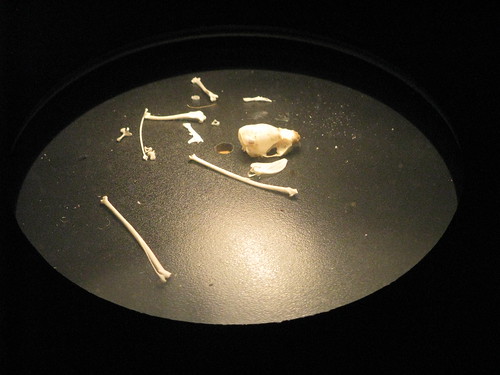
Fledermaus Hologramm.

Senckenberg Naturmuseum, Frankfurt am Main, Germany.

Image: GrrlScientist, 13 April 2010 [larger view]

Tags
Animalia
Frankfurt through my eye
image of the day
my pictures
Nature
Photography
Fledermaus Hologramm
Frankfurt am Main
germany
Museums
paleontology
Senckenberg Naturmuseum
skeleton
travel
Frankfurt through my eye
image of the day
my pictures
Nature
Photography

More like this

Advertisment

Donate

ScienceBlogs is where scientists communicate directly with the public. We are part of Science 2.0, a science education nonprofit operating under Section 501(c)(3) of the Internal Revenue Code. Please make a tax-deductible donation if you value independent science communication, collaboration, participation, and open access.

You can also shop using Amazon Smile and though you pay nothing more we get a tiny something.


Science 2.0

  • Blood Pressure Medication Adherence May Not Be Cost, It May Be Annoyance At Defensive Medicine
  • On January 5th, Don't Get Divorced Because Of Hallmark Movies
  • Anxiety For Christmas: How To Cope
  • The Enceladus Idea In The Search For Life Out There
  • Does Stress Make Holidate Sex More Likely?

Science Codex

More by this author

Big News: This Blog Has Migrated to a New Home
September 1, 2010
As one of the initial recruits to Scienceblogs, my years and effort invested into Scienceblogs have been worthwhile. Since I relocated my original blog, Living the Scientific Life, to Scienceblogs in early January 2006, it received more than 6 million visits and nearly 30,000 comments, it helped…
ScienceBlogs = ZombieBlogs
July 20, 2010
Unless you've been living under a rock, or you are the CEO of Seed Media Group (SMG), you are well aware that Bora Zivkovic left ScienceBlogs 24 hours ago. Shockingly, despite this important loss, Adam Bly, CEO of SMG, has not communicated with any of us who remain at ScienceBlogs about this loss…
Mystery Bird: Magnificent Frigatebird, Fregata magnificens
July 20, 2010
tags: Magnificent Frigatebird, Man O'War, Fregata magnificens, birds, mystery bird, bird ID quiz [Mystery bird] Magnificent Frigatebird, sometimes known as the Man O'War, Fregata magnificens, photographed at Quintana Neotropical Bird Sanctuary, Brazoria County, Texas. [I will identify this bird…
Scientia Pro Publica (Science for the People) #35 is Published!
July 20, 2010
Nam et ipsa scientia potestas est (And thus knowledge itself is power) -- Sir Francis Bacon. The most recent edition of Scientia Pro Publica (Science for the People) -- "Scientia Pro Publica 35" -- was just published at the buttcrack of dawn today by John at Kind of Curious. To share yours,…
The Secret Powers of Time
July 20, 2010
tags: The Secret Powers of Time, time, hedonism, future orientation, education, personality type, popular psychology, society, culture, lucifer effect, teenage pregnancy, Philip Zimbardo, Royal Society of Art, RSA, streaming video In this video animation, Professor Philip Zimbardo conveys how our…

More reads

Birds Come First - oh no they don't!
In the previous article we looked at the Birds Come First, or BCF, hypothesis. It goes without saying that BCF has not won acceptance in the community, nor - in fact - is it even familiar to the majority of archosaur workers. Here, we take a critical view of BCF: does it stand up, or does it fail? To begin with, let me note that the underlying premise of BCF is fundamentally problematical: the…
Whirligig at the surface
Whirligig beetles inhabit the interface between air and water. The series below depicts Dineutes sublineatus, a large species common in the mountain streams of Arizona. Whirligigs are named for their habit of swimming in frenetic loops along the water's surface, a behavior that makes them difficult to photograph in the field. To get these shots, forgive me, I cheated. I set up a 10 gallon…
Throwback Thursday: How do black holes get so big, so fast? (Synopsis)
“It is by going down into the abyss that we recover the treasures of life. Where you stumble, there lies your treasure.” -Joseph Campbell When we look at the centers of galaxies, it's no surprise that there are large black holes there, millions or even billions of times the mass of the Sun. Image credit: Chandra X-ray Observatory (blue), Hubble Space Telescope (green), Spitzer Space Telescope (…

© 2006-2025 Science 2.0. All rights reserved. Privacy statement. ScienceBlogs is a registered trademark of Science 2.0, a science media nonprofit operating under Section 501(c)(3) of the Internal Revenue Code. Contributions are fully tax-deductible.