

You can run your car engine at high RPMs without much lasting issue but the atmosphere is a lot trickier. It may seem that temporary overshoots of warming targets are okay but getting back down below 2 degrees Celcius won't undo the effects that occur in permafrost and oceans, according to a new paper using Earth System Climate Model to compare 42 pairs of climate scenarios and estimate what might occur.
In each model pair, one scenario temporarily exceeded its warming pathway before returning to it, while the other stayed below the threshold.
Overshoot was measured using “degree-years” which combined how much global temperatures exceed a target and how long they remained above it. The scholars found that degree-years were a strong predictor of lasting changes in several climate variables but some variables were found to be much more susceptible to warming than others.
For example, permafrost experienced almost no recovery of its lost carbon when higher temperatures returned to their baseline levels. Also persisting after overshoot were changes to sea-level rise, ocean warming and ocean oxygen levels.
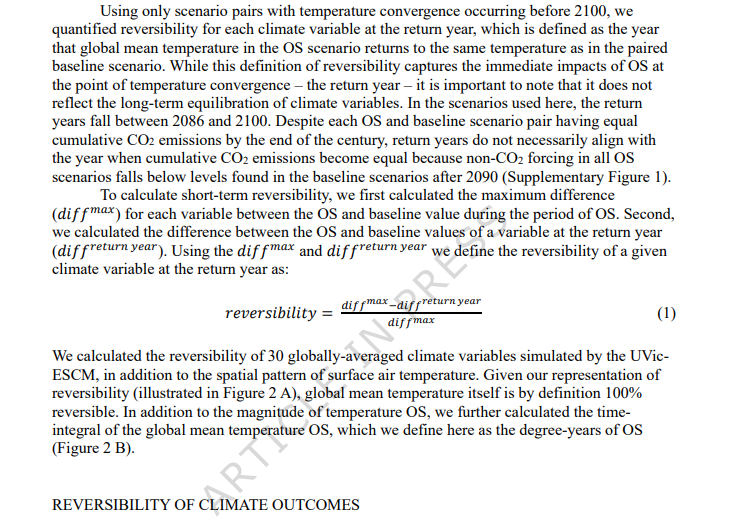
The authors say that the peak level of warming alone does not tell the whole story and policy makers also need to factor in the length of time spent above a target to consider how much lasting change will remain. Therefore, climate goals should not be viewed simply as a temperature level that might get worse before it gets better - like if we eventually adopt green energy that works, such as nuclear - and things will be fine after temperature thresholds are exceeded and settle back. How long we stay at those temperatures matters and factoring in the accumulated effects of overshoot is necessary to better assess climate risks and adaptation measures.
Citation: Dickau, M., Zickfeld, K. & Matthews, H.D. Irreversible climate changes driven by degree-years of temperature overshoot. Commun Earth Environ (2026). DOI: 10.1038/s43247-026-03761-z